
Riding Mower vs. Zero-Turn Mower: The Ultimate Buying Guide for Your Lawn
In today’s expansive consumer market, where an overwhelming array of options from both large retail chains and online platforms is readily available, the process of selecting the ideal lawn mower for your property can feel more daunting than ever. While this abundance of choice undeniably benefits consumers by offering diverse features and price points, it can also lead to considerable confusion. A significant area of uncertainty for many homeowners centers around discerning the fundamental differences between traditional riding mowers and their increasingly popular, agile counterparts, zero-turn lawn mowers.
Traditional riding mowers are celebrated for their ergonomic comfort and straightforward operation, making them an excellent choice for individuals managing larger yards or those who prefer a more classic, familiar approach to lawn maintenance. They typically offer a stable and comfortable ride, akin to driving a small tractor. Conversely, zero-turn mowers are distinguished by their exceptional maneuverability and unparalleled precision. This design allows operators to trim grass with remarkable efficiency, particularly when navigating around complex obstacles, tight corners, and intricate landscaping features. A thorough understanding of the core distinctions between these two powerful categories of lawn mowers is absolutely essential for making an informed decision that perfectly aligns with your specific lawn care needs, property characteristics, and personal preferences.
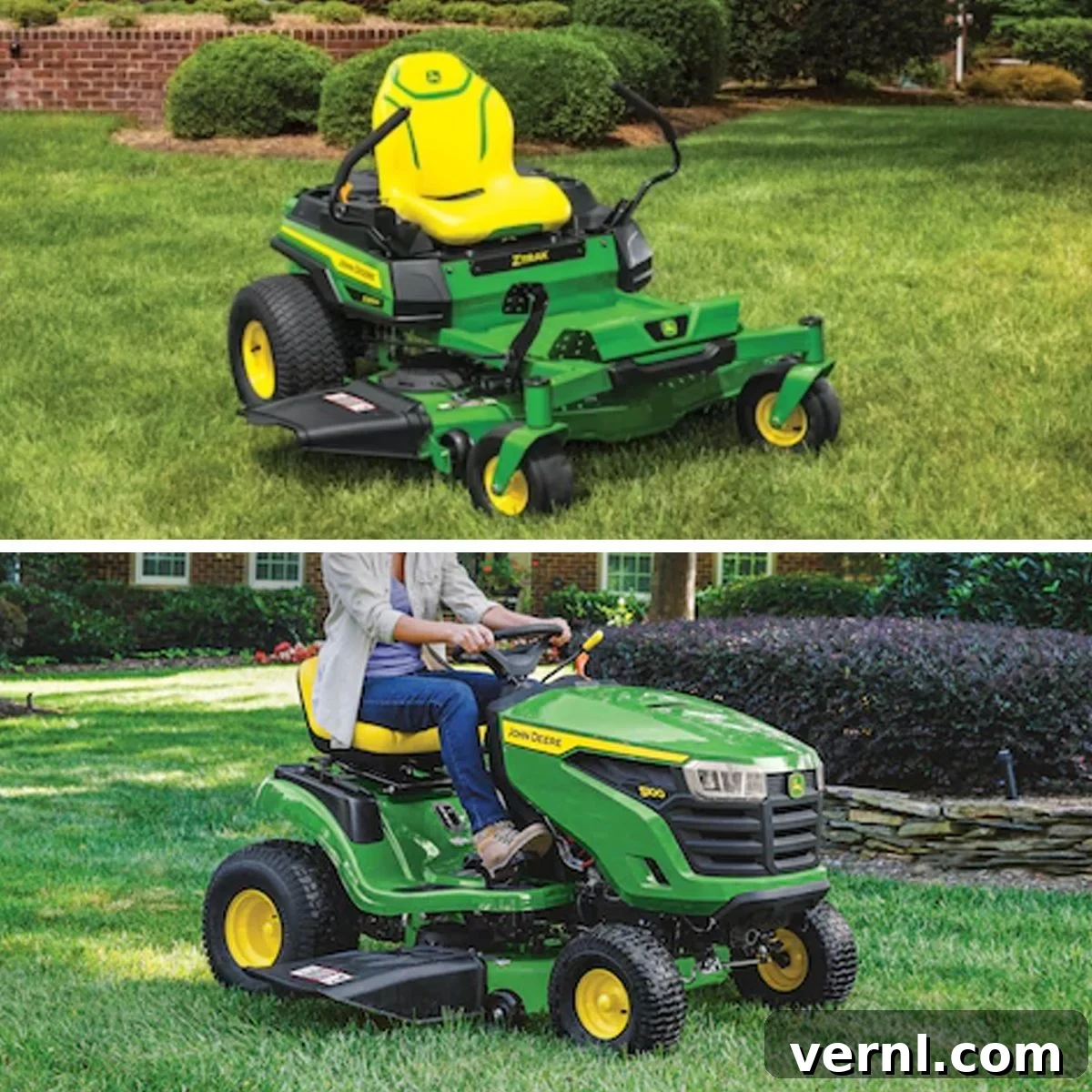
To provide a clear, practical, and comprehensive side-by-side comparison illustrating these crucial differences, we will reference two representative models from the esteemed manufacturer, John Deere: the classic John Deere S100 riding lawn tractor and the innovative zero-turn John Deere Z330M. While the precise specifications and features of lawn mowers naturally vary across different brands and models, these two examples serve as excellent benchmarks for highlighting the key attributes, operational characteristics, and performance capabilities unique to each mower type in our detailed analysis.
Distinguishing Features: Traditional Riding Mower vs. Zero-Turn Mower
The core differences that define and separate traditional riding mowers from zero-turn riding mowers primarily revolve around two critical mechanical aspects: their turn radius and their distinct steering control mechanisms. Grasping these fundamental distinctions is key to understanding how each mower operates and performs on various lawn types and terrains.
The Revolutionary Turn Radius
The concept of the “turn radius” is the most fundamental and defining characteristic of zero-turn mowers, giving them their name and their reputation for superior agility. A traditional riding mower operates with a steering system similar to that of a conventional rear-wheel-drive car or tractor. The rear wheels provide the propulsion, moving the mower forward, while the front wheels are responsible for steering, dictating the direction of travel. This design inherently requires a wide, sweeping arc to execute a turn. To maneuver around obstacles or make sharp turns, the operator typically needs to perform multiple forward and reverse movements, often leaving behind unsightly strips of uncut grass that require additional passes or manual trimming.
In stark contrast, a zero-turn riding mower (ZTR) boasts an innovative drive system that allows its independent rear drive wheels to rotate in opposite directions simultaneously. This groundbreaking engineering enables the mower to pivot instantaneously on its own axis, effectively turning “on a dime” without any forward or backward motion. This true “zero” turning radius eliminates the necessity for wide, arcing turns, dramatically reducing the amount of backing up, repositioning, and three-point turns commonly associated with traditional mowers. The direct result is unparalleled precision, significant time savings, and a consistently cleaner, more professional cut, particularly in landscapes with numerous obstacles or intricate designs.
Steering Mechanisms: Lap Bars vs. Traditional Steering Wheel
Another pivotal differentiator lies in the method of steering control. The vast majority of zero-turn riding mowers feature a distinctive steering system comprised of two individual lap bars, rather than the familiar steering wheel found in traditional vehicles. Each lap bar independently controls the speed and direction of one of the rear drive wheels. To move forward, the operator pushes both bars forward simultaneously. Pulling both bars back engages reverse. The true magic of zero-turn maneuvering occurs when the bars are operated independently: pushing one bar forward while simultaneously pulling the other back causes the mower to pivot precisely in place. This allows for incredibly tight turns and highly accurate navigation around any landscape feature.
While the lap bar system offers exceptional precision and responsiveness, it typically involves a brief learning curve for new users to master. However, once proficient, operators find it to be an intuitive and highly efficient control method. It is worth noting, though, that not all zero-turn mowers exclusively employ lap bars. Some modern zero-turn models, such as certain configurations of the Cub Cadet ZTS series, come equipped with a more conventional steering wheel. These “steering wheel zero-turns” still deliver the characteristic pinpoint turning and superior maneuverability of a zero-turn machine, offering a familiar control experience for users who prefer the comfort and tradition of a steering wheel without sacrificing the benefits of a zero-turn radius.
Advantages of Traditional Riding Mowers: Accessibility and Enduring Value
While zero-turn mowers impress with their agility and speed, traditional riding mowers offer a compelling set of advantages that continue to make them a popular and practical choice for many homeowners. These benefits often center on their affordability, comfort, and straightforward design, appealing especially to those seeking a reliable, economical, and versatile lawn care solution.
Exceptional Affordability and Broader Budget Accessibility
One of the most compelling advantages of a traditional riding mower is its significantly lower initial price point. On average, a traditional riding mower can cost anywhere from 30% to 50% less than a zero-turn mower of comparable engine power and cutting deck size. For example, using our John Deere models, the S100 traditional riding mower is approximately 38% more affordable than the Z330M zero-turn model, translating to a substantial saving of roughly $1,500. This considerable price difference makes traditional riding mowers far more accessible across a wider spectrum of budgets, allowing more homeowners to invest in a quality riding mower without an exorbitant upfront financial commitment. For many, this initial cost-saving is a decisive factor, making efficient lawn care achievable within their financial comfort zone.
Simpler Maintenance and Readily Available Parts for DIY Enthusiasts
Thanks to their longer market presence and generally simpler mechanical designs, traditional riding mowers are often easier and less expensive to maintain and repair. Replacement parts for these models are typically more widely available and can be sourced from a greater variety of retailers, including local hardware stores, dedicated power equipment shops, and extensive online marketplaces. Furthermore, for homeowners who enjoy do-it-yourself projects, the steering and drivetrain systems of traditional riding mowers are generally less complex and more familiar to work on. This familiarity empowers many owners to comfortably perform routine maintenance tasks, diagnose minor issues, and even undertake more significant repairs themselves, leading to considerable savings on labor costs and minimizing equipment downtime. The widespread knowledge base and less intricate construction contribute to a lower overall cost of ownership throughout the machine’s lifespan.
Enhanced Stability and Comfort on Varied Terrain
Traditional riding mowers frequently offer superior stability and comfort, particularly when operating on uneven terrain, gentle slopes, or across varied ground conditions. Their design, which often includes a lower center of gravity and a wider wheelbase, contributes to a more secure and planted feel during operation. Many models also incorporate more robust suspension systems that effectively absorb shocks and vibrations, resulting in a smoother and more comfortable ride for the operator, especially during extended mowing sessions. This comfort factor is highly valued by individuals who spend considerable time tending to larger properties or those who prefer a less physically demanding mowing experience.
Greater Versatility with a Wide Range of Attachments
Another significant, yet often underestimated, advantage of traditional riding mowers (often referred to as lawn tractors) is their superior versatility with attachments. Many models are specifically designed to easily accommodate a diverse array of accessories, effectively transforming them into multi-purpose machines beyond just cutting grass. These attachments can include utility carts for hauling materials, dethatchers for improving lawn health, aerators, spreaders, snow plows, and even small tillers. This multi-functionality makes a traditional riding mower a more comprehensive investment for overall property management, enabling users to tackle various yard work tasks throughout the year with a single piece of equipment. Their typically robust towing capacity is particularly beneficial for managing larger properties that frequently require hauling or pulling.
Advantages of Zero-Turn Mowers: Speed, Precision, and Professional Finish
While traditional riding mowers offer compelling benefits, zero-turn mowers truly excel in maximizing efficiency, dramatically reducing mowing time, and consistently delivering a remarkably precise, professional-grade finish. For those with expansive, complex properties or a strong desire for peak productivity and an immaculate lawn, zero-turn mowers present an undeniable and highly attractive appeal.
Unmatched Precision for a Flawless, Professional-Grade Finish
The defining “zero-turn” capability directly translates into unrivaled precision during every mowing pass. Unlike traditional mowers that necessitate multiple maneuvers, repeated backing up, and repositioning to navigate around standalone obstacles such as trees, intricate flowerbeds, garden statues, playground equipment, or structural features, a zero-turn mower can pivot effortlessly and precisely around these elements. This means you can cut significantly closer to obstacles without missing patches of grass, virtually eliminating the need for time-consuming follow-up trimming with a string trimmer. The cumulative result is a much cleaner, more uniform, and beautifully manicured appearance for your lawn, characterized by crisp edges and a truly professional finish that homeowners and landscapers alike consistently strive for. This precision not only saves valuable time but also dramatically enhances the overall aesthetic appeal and curb appeal of your landscape.
Exceptional Speed and Significant Time-Saving Performance
Beyond their precision, zero-turn radius mowers are demonstrably faster than traditional riding mowers across almost every operational metric. This enhanced speed is a direct consequence of several synergistic factors. Firstly, their advanced and highly responsive steering system completely eliminates the considerable time wasted on complex, multi-point turns and repetitive maneuvering. Secondly, zero-turn mowers typically feature significantly wider cutting decks, commonly ranging from 48 to 60 inches or even larger, compared to the more standard 42 to 46 inches found on most traditional riding mowers. A wider deck covers substantially more ground with each pass, thereby drastically reducing the total number of passes required to cut an entire lawn. Thirdly, zero-turn mowers often boast higher maximum operating speeds. For example, while the John Deere S100 might top out at around 5.5 miles per hour, the John Deere Z330M can achieve impressive speeds of seven miles per hour or more. Cumulatively, these factors can reduce total mowing time by up to 50% for large properties, translating into immense time savings and allowing you to reclaim your weekends for other activities.
Boosted Productivity for Large and Intricate Properties
The powerful combination of pinpoint precision and exceptional speed makes zero-turn mowers extraordinarily productive, making them an indispensable tool, especially for large properties (typically one acre or more) and those characterized by numerous intricate landscape features. For homeowners or professional landscapers who need to cover expansive areas with utmost efficiency, a zero-turn mower represents an invaluable asset. Less time spent executing turns, fewer passes required to cover the same area, and higher operational speeds all contribute to significantly more ground being covered in considerably less time. This increased productivity can also indirectly lead to greater fuel efficiency, as the engine runs for a shorter duration to complete the same task. For anyone seeking to maximize their time, achieve a superior cut, and handle challenging or extensive lawns with ease, a zero-turn mower is undoubtedly a compelling and rewarding investment.
Zero-Turn vs. Traditional Riding Mower: Essential Buying Considerations
The decision-making process between a traditional riding mower and a zero-turn mower requires a thoughtful evaluation of several critical factors that are unique to your property, budget, and personal preferences. Carefully considering these key points will empower you to make an informed choice, ensuring you select a lawn mower that will effectively meet your specific lawn care needs and provide reliable performance for many years to come.
Budget and Initial Investment
Your allocated budget is almost always the initial and most significant determinant in your mower selection. If your financial ceiling is less than $3,000, you will find it extremely difficult, if not entirely impossible, to purchase a new zero-turn mower within that price range. Quality zero-turn mowers typically start well above this threshold and can quickly ascend to much higher price points depending on advanced features, engine size, and cutting deck specifications. In contrast, traditional riding mowers offer a far broader array of options within a more accessible price bracket, with many excellent and capable models available between $1,200 and $2,800. While some high-end traditional models can certainly exceed $3,000, the entry point for traditional riding mowers is considerably lower, making them a more viable and practical option for budget-conscious buyers seeking an efficient lawn care solution.
Yard Size and Acreage to be Maintained
The size of your yard is a pivotal factor that directly influences which mower type will be most efficient and cost-effective. For properties approximately an acre or less, a traditional riding mower such as the John Deere S100 is often perfectly adequate, offering sufficient power and cutting deck size to manage the task efficiently without an overinvestment. However, if you are maintaining a particularly large yard, ranging from one acre up to three or four acres, the superior speed, wider cutting deck, and exceptional maneuverability of a ZTR mower like the John Deere Z330M will make a dramatic difference in the overall time you spend mowing and the frequency of refueling stops. For expansive properties, the inherent efficiency gains of a zero-turn mower transition from a convenience to an indispensable necessity, transforming a multi-hour chore into a much quicker and more manageable task.
Yard Complexity and Landscape Features
The complexity of your yard’s landscape significantly impacts which mower type will deliver optimal performance. Properties that feature numerous permanent obstacles—such as mature trees, intricate flowerbeds, decorative garden statues, children’s play equipment, or winding pathways—will greatly benefit from the unparalleled agility and precision offered by a zero-turn mower. Its exceptional ability to navigate tight spaces and pivot effortlessly around these features minimizes missed patches and drastically reduces the need for subsequent secondary trimming. However, a crucial practical consideration is to accurately measure the width of the narrowest sections of your property, such as gate openings or constricted passages between structures, and compare these dimensions against the total width of a mower’s cutting deck. Even the most agile zero-turn mower in the world will prove impractical if it is too wide to fit through the necessary access points of your yard.
Terrain Type: Hills, Slopes, and Uneven Ground
The terrain of your yard is another absolutely vital consideration for both safety and performance. While zero-turn mowers excel on relatively flat and gently undulating ground, their operation can become challenging and potentially unsafe on steep hills or significant slopes due to their independent wheel control system and a typically higher center of gravity when executing turns. There is an increased risk of losing traction, sliding uncontrollably, or even tipping over on severe inclines. Traditional riding mowers, with their more stable three-point or four-point steering and generally lower center of gravity, often provide better traction and more predictable control on gentle to moderate slopes. For exceptionally steep or severely uneven terrain, neither a standard riding mower nor a zero-turn might be the safest or most effective option; in such cases, a walk-behind mower or a specialized slope-designed machine may be necessary. Always prioritize safety, and rigorously consult the manufacturer’s recommendations and limitations regarding slope operation for any mower you consider.
Available Storage Space and Mower Dimensions
Do not underestimate the practical importance of your available storage space. Zero-turn mowers, particularly those equipped with wider cutting decks, often require a considerable amount of room for secure storage. Their wide stance and the protruding lap bar controls can make them somewhat bulkier and less compact than most traditional riding mowers. A traditional riding mower with its typically more streamlined profile is often a better fit for a tighter garage space or a standard-sized garden shed. Conversely, a zero-turn mower might necessitate a larger outbuilding, a dedicated, more spacious shed, or a more expansive area to comfortably house it without obstructing other equipment or access.
Operator Experience and Learning Curve
It’s important to consider your own comfort level and prior experience with operating motorized machinery. Traditional riding mowers, with their familiar steering wheel and pedal controls, offer a highly intuitive and easy-to-learn operational experience for most users, closely mimicking the sensation of driving a car. Zero-turn mowers, by contrast, with their dual lap bar controls, present a distinct learning curve. While many individuals quickly adapt to the independent control system, it undeniably requires some initial practice to achieve smooth, precise, and confident movements. If you are entirely new to riding mowers and prefer an immediate sense of familiarity and ease of operation, a traditional riding mower might be a less intimidating and more comfortable entry point. However, for those willing to invest a modest amount of time in mastering the unique controls, the unparalleled precision and efficiency of a zero-turn mower are incredibly rewarding.
Compatibility with Attachments and Multi-Purpose Functionality
Consider whether your mower needs to perform tasks beyond simply cutting grass. If you anticipate utilizing various attachments for other seasonal yard tasks, such as towing a utility cart for hauling soil or debris, spreading fertilizer, dethatching, aerating, or even snow removal during winter months, a traditional riding mower (often specifically designed as a lawn tractor) typically offers far greater versatility and attachment compatibility. Many zero-turn mowers are engineered primarily for high-performance mowing and may have limited or no capacity for heavy-duty towing or the integration of front-mounted implements like snow blades or tillers. It is crucial to verify the available attachment options and their compatibility if multi-purpose functionality is an important requirement for your property maintenance needs.
Who Should Choose a Traditional Riding Mower?
A traditional riding mower often represents the ideal choice for a variety of homeowners, including:
- Homeowners with smaller to medium-sized yards (typically up to 1-1.5 acres) that feature relatively flat terrain or only gentle, manageable slopes.
- Individuals operating on a tighter budget who are seeking an affordable yet effective entry into the world of riding lawn care.
- Those who prioritize a familiar comfort and ease of use, especially if they prefer the intuitive operation provided by a traditional steering wheel.
- DIY enthusiasts who value simpler maintenance procedures and readily available replacement parts, enabling them to perform repairs and upkeep themselves.
- Users who require a versatile machine capable of handling various seasonal yard tasks with a wide array of attachments, such as utility trailers, dethatchers, or snow plows.
- Anyone looking for a stable, dependable, and reliable machine for general lawn maintenance, where extreme precision or blistering speed are not the absolute top priorities.
Who Should Choose a Zero-Turn Mower?
A zero-turn mower is an outstanding investment and often the superior choice for specific types of properties and operators, including:
- Homeowners with large properties (typically 1.5 acres or more) who are keen to significantly reduce their overall mowing time and increase efficiency.
- Individuals whose yards are characterized by numerous obstacles, intricate landscaping, tight corners, and complex features, where pinpoint precision is paramount.
- Those who desire a truly professional-grade finish for their lawn, with crisp edges and minimal need for subsequent trimming work.
- Users who prioritize speed, unparalleled efficiency, and high productivity above all else in their lawn care routine.
- Experienced operators, or those willing to adapt to and master the unique lap bar steering mechanism, in pursuit of superior maneuverability and control.
- Anyone looking for a powerful, exceptionally agile machine specifically engineered for high-performance, precise grass cutting, often to a commercial standard.
Frequently Asked Questions About Lawn Mowers
How Important is Mower Weight When Making a Selection?
Mower weight is indeed a significant consideration when choosing the best lawn mower for your specific needs. Heavier mowers, particularly when used frequently on the same areas, can contribute to undesirable soil compaction over time. This compaction can negatively impact the health of your lawn by reducing crucial aeration, hindering water penetration, and restricting root growth. Furthermore, heavier machines are generally more challenging to maneuver, especially when navigating up hills, across slopes, or around intricate obstacle courses. While increased weight can sometimes be indicative of robust, heavy-duty construction, it often presents a trade-off against agility, ease of handling, and potential long-term impact on your lawn. Lighter models often offer better fuel efficiency and are easier to handle, particularly on softer ground or varied terrain, though consumers should always balance this with engine power and deck durability based on their specific requirements.
What Essential Maintenance Do Lawn Mowers Require Annually?
Regular and meticulous maintenance is absolutely crucial for ensuring the longevity, optimal performance, and safe operation of your lawn mower, whether it’s a traditional riding model or a zero-turn. Annual or seasonal maintenance typically encompasses several key preventative tasks:
- Oil Changes: Regularly replacing the engine oil is paramount for lubricating all moving parts, preventing premature wear, and ensuring engine health.
- Spark Plug Replacement: Installing a fresh spark plug ensures efficient ignition, optimizes fuel combustion, and maintains peak engine performance.
- Blade Sharpening or Replacement: Keeping blades razor-sharp provides a clean, precise cut, which promotes healthier grass growth and prevents tearing that can lead to turf disease. Dull blades also force the engine to work harder, consuming more fuel.
- Air Filter Cleaning or Replacement: A clean air filter is vital for proper engine breathing, preventing harmful dirt, dust, and debris from entering and damaging the engine’s internal components.
- Fuel Stabilization: Adding a high-quality fuel stabilizer, particularly before storing the mower for the off-season (e.g., winter), prevents fuel degradation, which can lead to clogged fuel lines, carburetor issues, and difficult starting.
- Checking Belts and Pulleys: Regularly inspect all drive belts for signs of wear, cracks, fraying, or improper tension, and ensure that all pulleys spin freely and smoothly.
- Tire Pressure Check: Maintaining correct and even tire pressure is essential for achieving an even, consistent cut height and ensuring optimal traction across varying terrain.
- Deck Cleaning: Consistently cleaning the underside of the cutting deck prevents the accumulation of grass clippings, which can cause corrosion, rust, and obstruct the proper operation of the blades.
- Battery Check: For models equipped with an electric start, ensure that battery terminals are clean and free of corrosion, and that the battery holds an adequate charge.
Strictly adhering to the comprehensive maintenance schedule outlined in your mower’s owner’s manual will significantly extend its operational life, ensure consistent performance, and maintain its reliability for many productive seasons.
Can Zero-Turn Mowers Be Used on Hills and Slopes Safely?
While zero-turn mowers are exceptionally efficient on flat or gently sloping terrain, their use on steeper hills and significant slopes requires considerable caution and careful consideration. Most manufacturers explicitly recommend against operating zero-turn mowers on steep slopes, typically those exceeding 10-15 degrees, due to inherent safety risks. The independent wheel control, which grants unparalleled maneuverability on level ground, can actually make it challenging to maintain stable control on inclines, particularly during turns or when encountering uneven patches. On steep grades, there is a significantly higher risk of losing traction, experiencing uncontrollable sliding, or even a dangerous rollover incident. If your property features substantial or numerous hills, a traditional riding mower, with its generally lower center of gravity and more predictable, stable steering system, might present a safer and more manageable option. Always consult your specific mower’s owner’s manual for precise slope limitations and critical safety guidelines, and seriously consider specialized slope-designed mowers if your yard is predominantly hilly or features extreme gradients.
What is the Typical Lifespan of a Riding Lawn Mower?
The operational lifespan of a riding lawn mower, whether it’s a traditional lawn tractor or a zero-turn model, can fluctuate significantly based on several crucial factors. These include the overall quality of its construction, the frequency and intensity of its use, the type of terrain it regularly navigates, and, most critically, the consistency and thoroughness of its maintenance regimen. On average, a well-maintained consumer-grade riding mower can typically last between 500 and 1,000 hours of operation. For the average homeowner, this often translates to a lifespan of approximately 8 to 15 years. Higher-end or robust commercial-grade mowers, which are constructed with more durable components and designed for heavier use, can frequently exceed 1,500 to 2,000 hours, potentially lasting 15 to 20 years or even longer with diligent and proactive care. Consistent adherence to routine maintenance tasks, such as regular oil changes, spark plug replacements, blade sharpening, and proper seasonal storage, is absolutely paramount for maximizing your mower’s operational life and ensuring its reliable performance year after year.
Making the Right Choice: Your Path to a Perfectly Manicured Lawn
Ultimately, the decision between investing in a traditional riding mower or a zero-turn mower comes down to a careful and honest evaluation of your unique circumstances and priorities. There is no universally “better” option; instead, the ideal choice is the mower that most effectively aligns with your property’s specific size and complexity, your available budget, your personal comfort level with the control mechanisms, and your overall expectations for mowing efficiency and the final aesthetic finish. By thoroughly considering all these critical factors and weighing the distinct advantages of each type, you can confidently select a lawn mower that not only meets your practical needs but also transforms your entire lawn care routine into a more enjoyable, less strenuous, and significantly less time-consuming task, leading to a consistently beautiful and meticulously maintained property season after season.