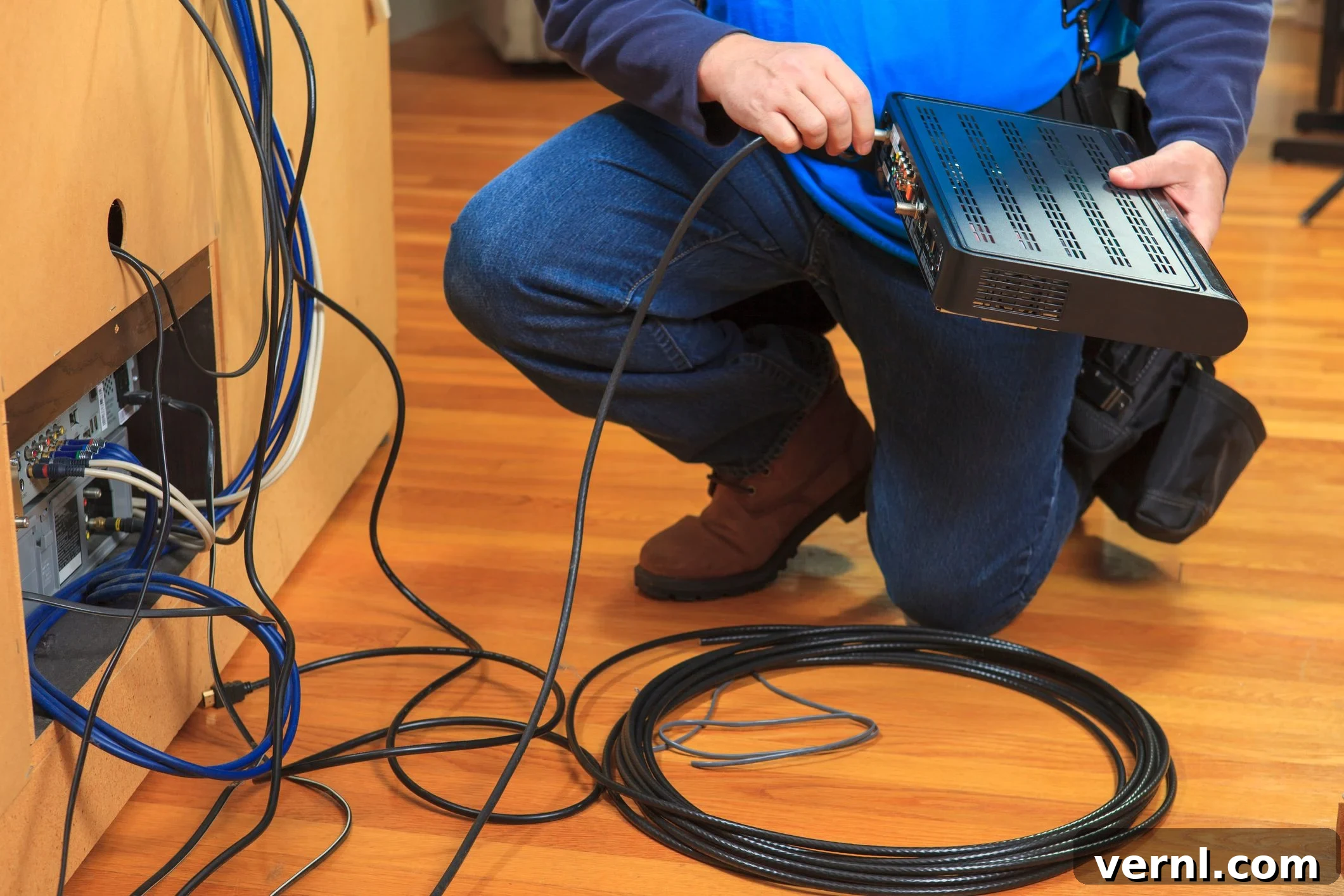
In an age increasingly dominated by seamless streaming and pervasive wireless internet, the traditional wiring architecture of our homes often feels like a relic of a bygone era. Many houses built before the digital revolution feature intricate networks of coaxial cables for legacy cable TV services and various generations of Ethernet lines, frequently exposed across unfinished basement ceilings or embedded within walls. The ongoing “cord-cutting” revolution, spurred by the widespread adoption of streaming platforms and robust Wi-Fi networks, has fundamentally reshaped our home’s connectivity needs. As fewer households rely on traditional cable television, the inclination to declutter by removing these seemingly obsolete cables grows stronger.
For homeowners who have fully embraced the wireless paradigm, rarely interact with a traditional junction box, and enjoy a sufficiently strong WiFi signal to forego direct Ethernet connections, the allure of eliminating those unsightly cords is undeniable. Indeed, you typically can proceed with removing older coaxial cables and various Ethernet wires from your walls and basement. These types of communication cables, unlike electrical wiring, do not carry dangerous electrical currents and are generally safe to disconnect and remove, provided you exercise basic precautions and confirm they are no longer connected to any active service. However, before you commit to a comprehensive removal project, it’s imperative to pause and consider the significant, often overlooked, value and potential future applications these existing wires might offer for your home’s evolving digital landscape.
The Unrivaled Advantages of Wired Connections: Speed, Stability, and Security
While wireless technology continues its rapid advancement, a direct wired connection often remains the ultimate benchmark for unparalleled speed, unwavering reliability, and enhanced security. Before you decide to permanently disconnect your home’s existing Ethernet infrastructure, it’s crucial to understand the profound benefits it can provide to the performance of your connected devices and overall home network health.
Experience Superior Connection Speed and Unmatched Stability
Firstly, even the older generations of Ethernet cables can dramatically boost the speed and stability for any device equipped with an Ethernet port. When compared to even the most robust Wi-Fi connections, a hardwired Ethernet link delivers a noticeably more reliable, inherently more secure, and considerably faster data transfer experience. This performance differential is often substantial, with wired connections sometimes achieving speeds up to twice as fast as their wireless counterparts, particularly in environments prone to network congestion or interference. For demanding applications such as competitive online gaming, buffer-free 4K/8K video streaming, or transferring large data files, Ethernet provides a consistent, low-latency connection that Wi-Fi, despite its convenience, frequently struggles to maintain.
Furthermore, in expansive homes or multi-story residences where Wi-Fi signals can weaken significantly due to distance, architectural barriers, and electromagnetic interference, a wired connection guarantees consistent and robust connectivity across all areas. Strategically extending an Ethernet network throughout your home can effectively eliminate frustrating dead zones and ensure optimal performance for mission-critical devices in every room, making your entire home network more resilient and efficient.
Navigating Ethernet Cable Standards: Essential for Future-Proofing Your Bandwidth
It’s important to acknowledge that not all Ethernet cables deliver the same performance. The age and specific category of your installed Ethernet cabling significantly influence its capabilities and long-term utility. Modern internet services and devices demand increasingly higher bandwidth, and older cable types can easily become a performance bottleneck. Here’s an overview of the most common Ethernet cable categories:
- Cat5: An older standard, typically supporting speeds up to 100 Mbps. While still functional for very basic networking tasks, it is largely considered obsolete for today’s high-speed internet and demanding applications.
- Cat5e (Enhanced): An improved version of Cat5, capable of reliably supporting Gigabit Ethernet (1 Gbps or 1000 Mbps) over standard home network distances. This is a prevalent legacy cable type that can still provide excellent performance for many contemporary users.
- Cat6: Widely regarded as the current standard for new residential and commercial installations, Cat6 cables can support data transfer speeds up to 1 Gigabit per second (Gbps) over its full length (up to 100 meters) and even achieve 10 Gbps over shorter runs (up to 55 meters). This makes Cat6 an ideal choice for modern home networks, especially for connecting bandwidth-hungry devices.
- Cat6a (Augmented): Specifically designed to support 10 Gigabit Ethernet (10 Gbps) over the full 100-meter distance. Cat6a is an excellent future-proofing option for homes anticipating extremely high bandwidth requirements or professional-grade network infrastructure.
- Cat7 and Cat8: These represent newer, cutting-edge standards offering even greater speeds (up to 10 Gbps for Cat7, and 25/40 Gbps for Cat8) along with superior shielding. While powerful, they are often overkill for typical residential use and are more commonly deployed in data centers or highly specialized networking environments.
When connecting a device to a lightning-fast internet connection, it’s paramount to ensure you’re not inadvertently limiting that connection’s potential by using an outdated Cat5 or even an early Cat5e cable. Upgrading to Cat6 or Cat6a wherever feasible can unlock the full performance capabilities of both your internet service and your connected devices, ensuring your network is ready for current and future demands.
Power Over Ethernet (PoE): Streamlining Connectivity and Power Delivery
Secondly, beyond merely facilitating data transfer, your existing Ethernet infrastructure could potentially unlock the benefits of an ingenious technology known as “Power Over Ethernet” (PoE). This innovative solution enables both electrical power and network data communication to be transmitted simultaneously over a single Ethernet cable. While PoE is not a brand-new concept, it is steadily gaining significant traction in mainstream residential applications, expanding beyond its traditional strongholds in commercial and industrial environments.
Understanding How PoE Works and Its Multifold Benefits
PoE fundamentally simplifies device deployment by eliminating the need for separate electrical outlets near network-connected devices. Instead of requiring both an Ethernet cable for data and a separate electrical cable for power, a single PoE-enabled Ethernet cable efficiently handles both. This significantly reduces cable clutter, streamlines installation processes, and offers far greater flexibility in device placement, particularly for devices that need to be mounted in ceilings, walls, or outdoor locations where traditional power outlets are scarce or inconvenient to access.
The key advantages of integrating PoE into your home network include:
- Reduced Cabling Complexity: A single cable manages both power and data, minimizing installation effort, material costs, and visual clutter.
- Enhanced Placement Flexibility: Devices can be strategically installed wherever network connectivity is optimal, without being tethered to the proximity of a power outlet.
- Improved Safety: PoE power is typically low voltage and automatically negotiated by devices, significantly reducing the risks associated with traditional AC power wiring.
- Centralized Power Management: Power for all PoE devices can be efficiently managed from a central PoE switch or injector, enabling easy remote reboots, power cycling, or scheduled power on/off.
- Potential Cost Savings: Fewer electrical outlets and reduced electrical wiring requirements can lead to notable cost reductions during initial construction or renovation projects.
Practical Applications of PoE in the Smart Home
PoE holds immense potential for the modern smart home, offering a cleaner and more efficient way to power a wide array of contemporary devices, including:
- IP Security Cameras: Simplifies the installation of indoor and outdoor surveillance cameras, often in locations that lack direct access to electrical power.
- VoIP Phones: Commonly used in home offices, VoIP phones can receive both data and power seamlessly through a single Ethernet cable.
- Wireless Access Points (WAPs): Allows for optimal, ceiling-mounted placement of WAPs for superior Wi-Fi coverage without the need for nearby power sockets.
- Smart Home Devices: Emerging smart lighting systems, environmental sensors, and other IoT devices are increasingly leveraging PoE for streamlined, low-voltage installation.
- Video Conferencing Systems: Ensures a reliable power and data connection for dedicated home office setups or media rooms.
Standard Ethernet cables (such as Cat5e or Cat6) are fully capable of transmitting power via PoE, with even older Cat5 cables able to handle up to 100 watts (though typical PoE devices consume significantly less power). To implement PoE, you will need PoE-enabled devices, along with either a dedicated PoE switch or a PoE injector that adds power to a standard Ethernet line. As PoE continues to grow in popularity in commercial settings and educational institutions, its integration into residential environments is steadily increasing, making your existing Ethernet wiring a highly valuable and forward-thinking asset.
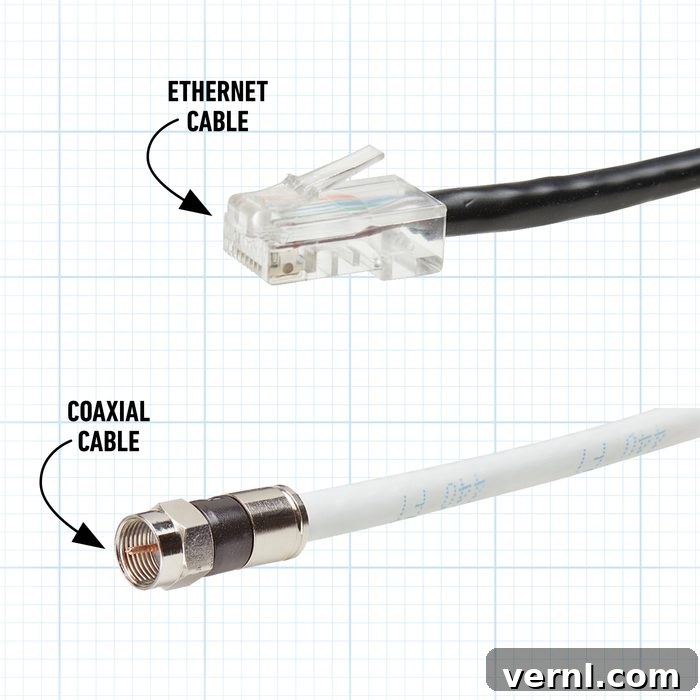
Repurposing Coaxial Cables: The Power of Ethernet Over Coax (MoCA)
Beyond the realm of Ethernet, let’s consider that ubiquitous coaxial cable infrastructure woven throughout your home. While traditionally associated solely with old-school cable TV, these lines possess remarkable untapped potential. They could evolve into an incredibly valuable asset in the future, particularly if you contemplate selling your home, as they represent an existing, robust infrastructure that can be ingeniously repurposed for contemporary networking demands.
Transforming Coax into a High-Speed Network Backbone with MoCA
The key to unlocking this potential lies in a technology known as “Ethernet Over Coax” (EoC) or, more commonly, MoCA (Multimedia over Coaxial Alliance). With the straightforward addition of specialized adapters, you can seamlessly transform your existing coaxial wiring into a high-speed, wired Ethernet network. Coaxial cables are inherently designed to efficiently handle high-bandwidth video signals and are typically well-shielded, rendering them surprisingly effective for carrying high-speed data traffic over significant distances within a residential property.
MoCA technology empowers you to establish a robust and reliable wired network backbone by leveraging the coax lines that are already present in virtually every room of your home. This approach is particularly advantageous for bandwidth-intensive activities such as competitive online gaming, high-definition video conferencing, and connecting smart TVs or dedicated streaming devices that thrive on a stable, low-latency connection. Rather than undertaking disruptive renovations to drill new holes and install fresh Ethernet cables, MoCA adapters enable you to utilize the latent potential of your home’s existing coaxial network.
Tangible Benefits of Ethernet Over Coax (MoCA) for Modern Homeowners
- Leverage Existing Infrastructure: Eliminates the extensive time, financial cost, and disruptive effort involved in installing new Ethernet cables throughout your home.
- High-Speed, Stable Connectivity: Delivers Ethernet-level speeds and exceptional reliability in areas where Wi-Fi signals struggle or running new wiring is impractical or undesirable.
- Non-Interfering Operation: MoCA technology is engineered to operate at frequencies that do not interfere with your existing cable TV, cable modem internet, or over-the-air (OTA) antenna signals on the same coaxial line, provided it is configured correctly.
- Expands Wired Network Reach: An ideal solution for connecting devices in distant rooms, basements, or attics, offering a high-performance alternative to relying solely on Wi-Fi.
- Optimized for Gaming & Streaming: Provides a critical low-latency, high-bandwidth connection essential for competitive online gaming and seamless, buffer-free 4K/8K video streaming.
By simply installing an EoC or MoCA adapter at your main router and near each individual device you wish to connect, you can effortlessly establish a seamless, high-performance wired network segment. This capability represents a significant advantage for homeowners seeking the benefits of a wired connection without the substantial investment and disruption of major renovation. You may not be actively utilizing these coaxial cables for traditional TV services today, but consider yourself remarkably fortunate to have them – many homeowners without such pre-existing infrastructure face considerably greater challenges when attempting to optimize and future-proof their home networks.
Future-Proofing Your Home Network: A Strategic and Insightful Decision
The choice to retain or remove your home’s older wiring infrastructure transcends immediate convenience; it represents a strategic and forward-thinking decision regarding the future resilience and capability of your home’s connectivity. As smart home technologies become increasingly integrated into our daily lives, and our collective reliance on stable, high-speed internet continues its exponential growth, a robust and adaptable network backbone transitions from a mere luxury to an absolute necessity. Your existing Ethernet and coaxial cables, often overlooked, represent a tangible asset that can profoundly enhance your home’s technological capabilities and even bolster its long-term resale value.
Enhancing Resale Value and Adaptability for the Modern Home
Discerning prospective homebuyers are increasingly sophisticated when evaluating a home’s digital infrastructure. A property featuring pre-wired Ethernet, or the readily available potential for MoCA integration, can be a significant and attractive selling point. Such infrastructure signals that the home is already equipped and prepared for the rigorous demands of contemporary digital living. This foundational wiring provides invaluable flexibility, empowering future occupants to effortlessly adapt the network to their specific and evolving needs, whether those involve establishing a high-performance home office, creating a dedicated gaming sanctuary, or implementing a comprehensive smart home automation system.
By judiciously retaining and potentially upgrading these invaluable existing systems, you are making a prudent investment in your home’s future adaptability. This foresight ensures that your property can seamlessly integrate emerging technologies and accommodate ever-increasing bandwidth requirements that are yet to fully materialize. It is a proactive and intelligent step towards cultivating a truly future-proof home environment, capable of meeting the connectivity challenges of tomorrow.
FAQs: Your Essential Questions About Home Wiring and Connectivity Answered
What are the primary benefits of using Ethernet Over Coax (MoCA)?
Ethernet Over Coax (MoCA) offers a multitude of compelling benefits, primarily enabling you to achieve highly desirable Ethernet-level speeds and unwavering stability by intelligently repurposing your home’s existing coaxial cable systems. The most significant advantage is the ability to bypass the extensive labor, considerable time, and substantial cost associated with installing brand new Ethernet cables throughout your entire home. By simply adding a MoCA adapter to your existing coax system, you can instantly create a high-speed wired network backbone. This empowering solution allows you to connect a wide array of devices – including desktop computers, network printers, smart TVs, advanced gaming consoles, and various other smart home devices – with a reliable, low-latency, and remarkably fast connection, fulfilling tasks that traditional coax alone cannot perform.
What speeds can I realistically expect with Ethernet Over Coax (MoCA)?
The speeds you can realistically expect with Ethernet Over Coax can be quite impressive, potentially reaching up to 10 Gigabits per second (Gbps) under optimal conditions. However, the actual performance will be influenced by several critical factors: the age and inherent quality of your existing coaxial cable infrastructure, and the specific MoCA standard implemented. For instance, older MoCA 1.0 standards typically deliver speeds up to 175 Mbps. MoCA 2.0 can reach up to 500 Mbps, while MoCA 2.5 significantly boosts this to 2.5 Gbps. The latest MoCA 3.0 standard is specifically engineered to achieve speeds of up to 10 Gbps. Additionally, the physical distance of the connections and the presence of low-quality or incompatible splitters within your coax system can notably impact overall speed and stability. For the absolute optimal performance, especially when supporting multiple high-bandwidth devices, it is advisable to consider using dedicated MoCA adapters for each device or at strategic, high-demand points across your coax network.
Can MoCA technology interfere with my existing cable TV or internet services?
No, MoCA technology is meticulously designed to operate at specific frequencies that do not create interference with standard cable television signals (CATV) or cable modem internet services. MoCA adapters typically utilize frequencies above 1 GHz, which is well outside the frequency range predominantly used by most cable TV and internet providers. When properly installed and configured with appropriate MoCA-compatible splitters, your existing cable TV and internet services will continue to function entirely normally, allowing MoCA to establish a parallel, high-speed data network seamlessly on the very same coaxial wiring.
How can I accurately identify the different types of Ethernet cables installed in my home?
The most straightforward method to identify the specific category of an Ethernet cable (e.g., Cat5e, Cat6, Cat6a) is to locate the printing directly on the cable’s jacket. This information is typically printed at regular intervals along the length of the cable. Additionally, while not a universal standard, the color of the cable jacket can sometimes provide an indication of its intended purpose or type. If the labels are unreadable, faded, or entirely absent, specialized network testing tools can be employed to determine a cable’s capabilities, or you may consult a qualified network professional for accurate identification.
When should I consider seeking professional assistance for my home network wiring projects?
You should strongly consider seeking professional assistance if you are planning a large-scale cable removal or new installation project, particularly if you are unsure about safely distinguishing communication cables from potentially hazardous electrical wires. Professional help is also advisable for complex PoE setups that demand specialized equipment and precise configuration. Network professionals can ensure the safety of the installation, optimize network performance, properly terminate and test all connections, and ultimately save you from potential headaches, costly mistakes, and ensure long-term reliability.