
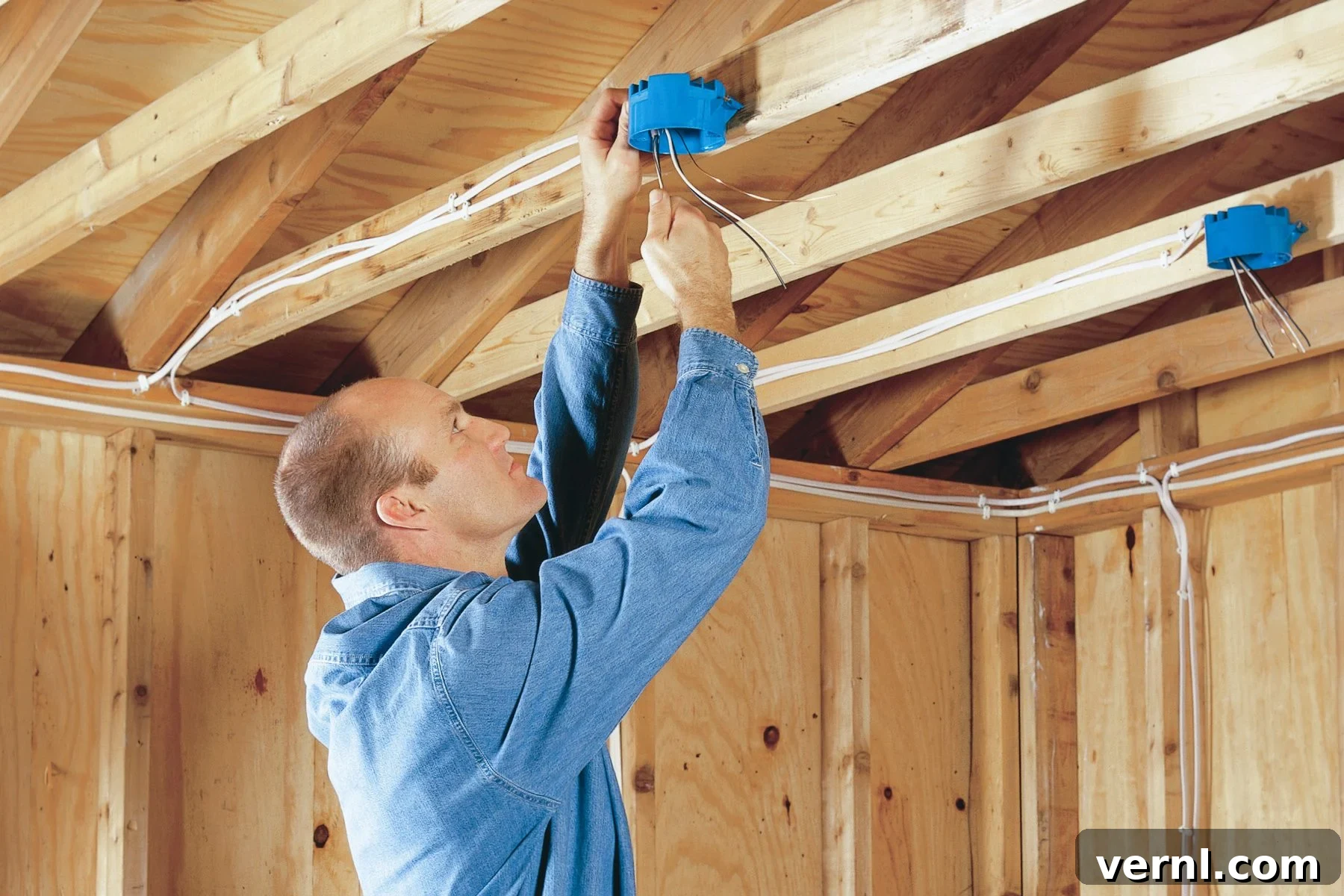
Garage Wiring: A Comprehensive Guide to Electrical Safety and Code Compliance
Is your unfinished garage a workspace or a storage area? Does it have adequate lighting and enough outlets for your tools and gadgets? If you’re relying on extension cords, it might be time for an electrical upgrade. This guide provides essential information on garage wiring, ensuring your space is safe, functional, and compliant with the latest electrical codes.
Garage wiring regulations evolve over time, and local jurisdictions often follow different code cycles. This guide is based on the 2023 National Electrical Code (NEC). It’s crucial to consult your local permitting office for specific requirements in your area. If you’re unsure about any electrical work, consult with a qualified electrician.
Do You Need a Permit to Wire Your Garage?
You may need a permit – check with your city’s electrical inspector to be sure. Permit requirements vary greatly by location. Some areas allow homeowners to do electrical work without a permit up to a certain point, while others require licensed electrical contractors for all installations. Remember that if you need a permit, an inspection will be required upon completion of the work.
Garage Wiring Basics: Staying Up-to-Date
Our electrical needs are constantly changing. As tools, electric vehicle (EV) charging, and other garage accessories become more powerful, garage wiring requirements evolve. Here’s a breakdown of the 2023 NEC basics and helpful wiring tips:
Branch Circuit Requirements
All attached and detached garages with power require at least one 20-amp circuit dedicated to receptacles. In garages with more than one “vehicle bay,” this 20-amp circuit is specifically for receptacles – it can’t supply lighting or anything else. You’re free to add additional circuits as needed, as long as they are 15 amps or higher.
Keep in mind that houses built even a decade ago may have only a 15-amp garage circuit. However, the 20-amp requirement was added in 2017. Tools, EV chargers, and other high-power devices draw a lot of electricity. If everything in your garage is on a 15-amp circuit, you could easily trip the breaker when using power tools or an EV charger.
For EV chargers exceeding 16 amps, a dedicated branch circuit is mandatory. This means the circuit is solely for that specific charger.
Receptacle Requirements
The NEC mandates at least one receptacle for each vehicle bay. These must be on the 20-amp circuit and can’t be mounted higher than 5 1/2 feet above the floor. You can add more receptacles or additional circuits for other uses. Outdoor receptacles may also be included on the garage circuits.
All receptacles inside the garage and outdoors must be protected by ground fault circuit interrupters (GFCIs), which can be either breakers or receptacles. Ensure GFCIs are installed in easily accessible locations. Avoid placing a GFCI receptacle in hard-to-reach areas like the ceiling by your garage door opener or behind a refrigerator. In these cases, use other receptacles or breakers to provide GFCI protection.
Lighting Requirements
The interior of your garage (both attached and detached, with power) must have a lighting outlet controlled by a listed wall switch. This lighting cannot be fed by the 20-amp receptacle circuit unless you have a single-car garage. Additionally, you’ll need a lighting outlet outside any exterior door accessible from ground level.
Consider using three-way switching for interior lights to control them from multiple locations, although it’s not a requirement. The exterior light can be controlled by a switch, remote, or automatic means.
Important: If you combine lights and receptacles on the same circuit and a GFCI trips, you’ll lose both power and lighting until the issue is resolved. For this reason, many electricians run lighting circuits separately from other branch circuits.
Protecting Your Wiring: Safety and Compliance
The NEC mandates that exposed non-metallic sheathed cable (NM-B), often called Romex, be protected from physical damage. Unfinished garages pose a risk to wiring. Here’s how to safeguard your wiring:
- Maintain 1-1/4 inch depth. Keep cables at least 1-1/4 inches from the edge of wood studs, joists, and rafters. Never staple cable directly to the face of framing members, as it could be damaged.
- Use nail plates. If you cannot maintain the 1-1/4 inch depth when drilling through studs, use nail plates. These metal plates protect the cable from nails or screws. When using metal studs with pre-punched holes, use bushings when bringing NM-B cable through.
- Use care with finished walls. If you have concrete block or drywall, consider using conduit or metallic sheathed cable instead of NM-B if the run will be exposed to potential damage from people or tools.
- Support your cables. Secure NM-B cable every 4-1/2 feet and ensure proper support. Running cable horizontally through studs provides support.
- Secure cables at boxes. Secure NM-B cable within 12 inches of boxes, unless it is a single-gang, non-metallic box without integrated clamps and is no larger than 2-1/2 inches by 4 inches. In that case, secure the cable within 8 inches of the box.
Frequently Asked Questions
Does the garage door opener need a dedicated circuit?
No. The 2023 NEC allows the garage door opener to be on the 20-amp circuit, including a ceiling receptacle. You can also add it to any other circuits. If the manufacturer of the opener requires a dedicated circuit, then you should adhere to their listing.