
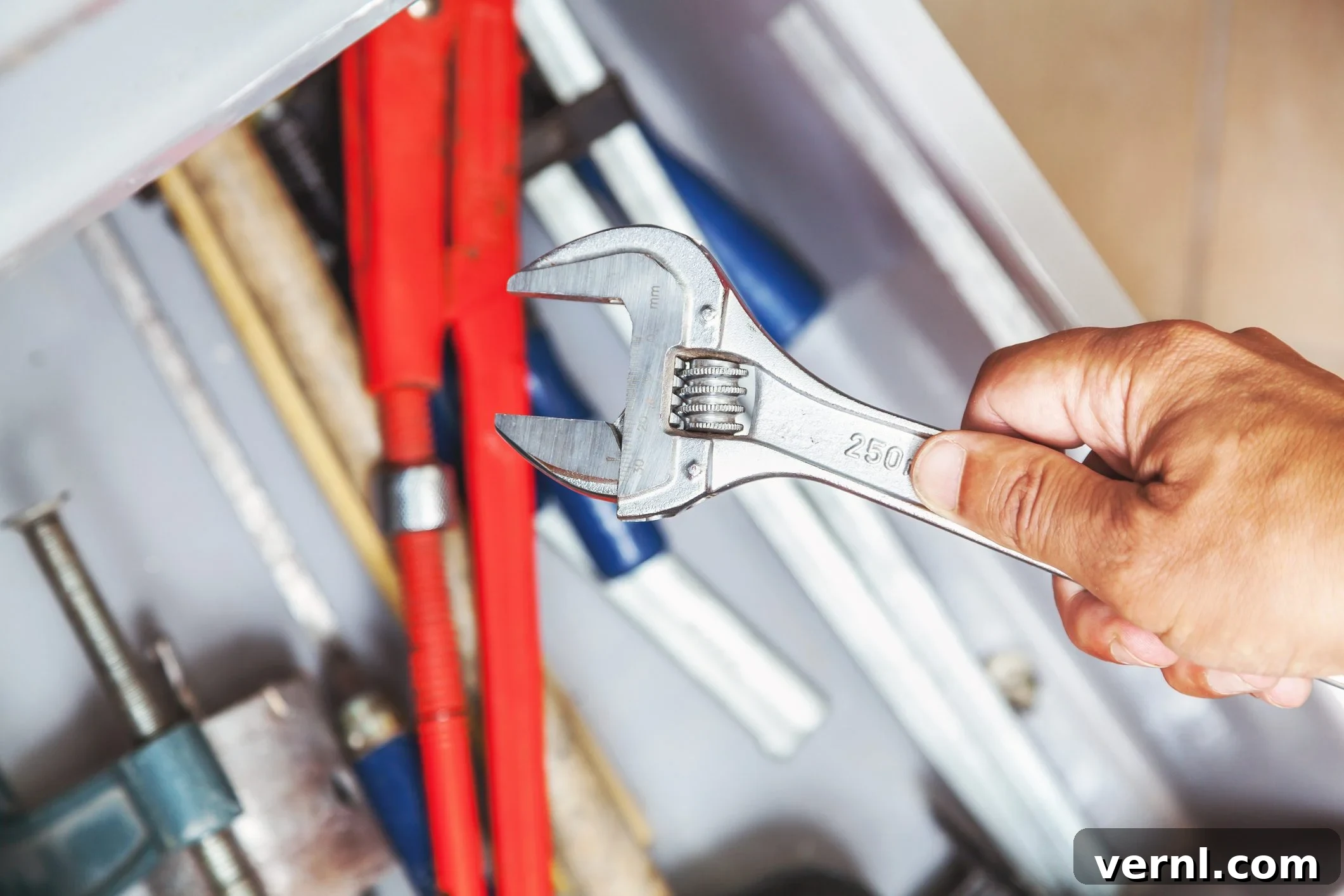
The world of hand tools is rich with history and fascinating nomenclature. Take, for instance, the idiom “throwing a spanner in the works” in England, which means to sabotage a plan. Across the Atlantic, in America, one would “throw a monkey wrench” to achieve the same disruptive effect. This linguistic interchangeability often leads to the misconception that these two tools are identical. While both serve to grip and turn fasteners, their designs, historical origins, and specific applications reveal distinct differences that are crucial for any DIY enthusiast, plumber, or mechanic to understand.
Before the widespread adoption of modern adjustable wrench designs, rudimentary versions of the monkey wrench were already common in the U.S. However, it was the pioneering Swedish inventor, Johan Petter Johansson, who revolutionized the industry. In 1891, Johansson secured patents for both a pipe wrench and an innovative adjustable spanner wrench. His ingenious design, featuring a single movable jaw operated by a worm screw, laid the foundation for most modern tools, including contemporary adjustable wrenches and even the redesigned monkey wrenches available today. This pivotal innovation significantly improved the tool’s strength and reliability.
A key differentiator between early 19th-century monkey wrenches and Johansson’s spanner design lies in their jaw mechanisms. While older monkey wrenches often featured both jaws moving, Johansson’s spanner design introduced a stationary jaw. This fixed jaw provides enhanced stability and strength, making the spanner a more robust and efficient tool for a wider range of tasks. This design principle remains central to the efficacy of adjustable spanner wrenches today.
Today, the market offers a diverse array of adjustable spanner wrenches and specialized pliers, all indispensable for professionals like plumbers and mechanics. While the advent of socket wrenches, which excel at turning fasteners with precision and power, has somewhat reduced the absolute indispensability of a general-purpose adjustable spanner compared to a pipe wrench or a versatile set of adjustable pliers, the spanner retains its unique value. Its slim profile and side-entry capability make it an unparalleled choice when working in confined spaces or when clearance is severely limited, often being the only tool that can effectively tackle the job.
What Exactly Is an Adjustable Spanner Wrench?
An adjustable spanner wrench, often simply called an adjustable wrench, is a versatile hand tool designed to grip and turn square or hexagonal fasteners of various sizes. Its design remarkably resembles an open-end wrench, but with a crucial advantage: adjustability. At its core, an adjustable spanner features two jaws – one fixed and one movable. The movable jaw is connected to a threaded bar with teeth that engage with the grooves of a thumbscrew, commonly referred to as a worm drive. When this thumbscrew is rotated with your thumb, the worm drive mechanism smoothly translates this rotational motion into linear movement of the movable jaw, allowing you to precisely adjust the width between the jaws to fit different fastener sizes.
This operating principle shares similarities with a pipe wrench, particularly in the worm-drive mechanism. However, a significant distinction lies in the orientation of their jaws. A spanner’s jaws extend parallel to its handle, providing a compact and straightforward grip. In contrast, a pipe wrench’s jaws are positioned perpendicular to the handle, optimized for gripping cylindrical objects. Furthermore, because a spanner wrench is never intended for turning pipes, its jaws are smooth. This lack of serrations is a deliberate design choice, allowing for a more accurate and damage-free grip on the flat surfaces of square and hexagonal nuts and bolt heads, preventing marring or rounding of the fastener.
Historically, the term “monkey wrench” encompassed various adjustable designs, including some with smooth jaws. Interestingly, heavyweight boxing champion Jack Johnson received a patent in 1920 for a version of a pipe wrench featuring smooth jaws. This tool, also referred to as a monkey wrench in its time, enjoyed considerable popularity. While Johnson’s specific design is now considered an antique and is no longer manufactured, the broader category of adjustable wrenches continues to evolve. Modern interpretations of the monkey wrench, specifically designed for precision and thin profiles, are still very much available and highly valued in certain applications. We will delve deeper into these variations shortly.
How Does an Adjustable Spanner Wrench Work in Practice?
Using an adjustable spanner wrench is fundamentally similar to using a standard open-end wrench. The process involves slipping the jaws onto a square or hexagonal fastener head and then applying torque to the handle to turn it. The critical difference, and the spanner’s primary advantage, is its adjustability. While an open-end wrench is manufactured to fit only one specific fastener size, an adjustable spanner can be configured to securely grip any fastener within its maximum jaw capacity. This versatility makes it an indispensable general-purpose tool, reducing the need to carry multiple fixed-size wrenches.
The open-ended design of a spanner wrench offers a significant ergonomic benefit, particularly when working in areas with restricted access. Unlike box wrenches or socket wrenches, which require the tool to be maneuvered directly over the fastener and then lowered down—a task that can be nearly impossible when pipes, engine components, or structural elements obstruct the path—a spanner allows you to approach the fastener from the side. This side-entry capability dramatically simplifies tasks in cramped conditions, saving both time and frustration.
Adjusting the jaw width can be done either before fitting the spanner wrench around the fastener or, if necessary, after. However, for optimal grip and ease of use, it’s generally recommended to adjust the jaws to the correct size before placing the tool on the fastener. This ensures a snug fit, which is crucial for preventing slippage and potential damage to the fastener or the tool itself.
Even with its inherent versatility, the conventional adjustable spanner wrench can present challenges in certain niche situations. Its jaws might sometimes be too thick to access an extremely narrow gap, or too short to reach deeply recessed fasteners. Recognizing these limitations, manufacturers have developed specific design variations to address such scenarios, ensuring that there’s an adjustable wrench for almost every challenging situation.
Types of Adjustable Spanner Wrenches
While various adjustable pliers are incredibly useful for tradespeople, such as plumbers and mechanics, it’s important to note that they do not technically qualify as spanners because they lack the defining worm-drive screw mechanism for jaw adjustment. Similarly, tools like pipe wrenches, with jaws perpendicular to the handle, fall into a distinct category. When we talk about true adjustable spanner wrenches, three main types stand out due to their design and intended applications:
- Crescent Wrench: The classic adjustable spanner, often colloquially referred to simply as a “Crescent wrench” due to the brand’s early prominence, is the most common and widely recognized type. These general-purpose wrenches are available in a vast range of sizes, from compact four-inch models perfect for intricate work to robust four-foot giants used in heavy industrial applications. Characterized by jaws that are generally the same thickness as the handle and roughly the same length as the jaw opening when halfway extended, the Crescent wrench is a versatile workhorse. It’s the go-to tool for a myriad of household repairs, automotive tasks, and general assembly work, proving its value by adapting to various bolt and nut sizes with a simple turn of the adjustment screw. Its robust construction makes it suitable for applying significant torque, making it a staple in any well-equipped toolbox.
- Plumber’s Wrench: Specifically engineered for the demanding world of plumbing, this adjustable spanner features distinctive long, slender jaws that are typically narrower than the handle itself. This elongated, thin profile, combined with an extra-wide maximum jaw expanse, allows plumbers to access and turn large plumbing fittings in tight, often awkward, spaces where standard wrenches might fail. Some plumber’s wrenches also incorporate a locking nut to securely tighten the jaws into a fixed position once adjusted, providing extra stability and preventing accidental changes during high-torque applications. These specialized wrenches are indispensable for tasks involving various plumbing fittings, unions, and pipes, offering both reach and an impressive gripping capacity.
- Thin-Jaw Adjustable Wrench (Modern Monkey Wrench): While its ancestor was a bulkier tool, the modern iteration sometimes referred to as a “monkey wrench” in certain contexts (though distinct from the historical one), has evolved significantly. This specialized adjustable spanner closely resembles a Crescent wrench in overall form but distinguishes itself with exceptionally thin, straight, and often precision-ground jaws. These ultra-slim jaws are specifically designed for reaching fasteners in the most confined and intricate spaces, such as inside car engines, behind HVAC components, or within complex machinery. Their precision allows for a secure grip where bulkier wrenches simply cannot fit, making them invaluable for automotive technicians, HVAC specialists, and anyone requiring fine access in tight quarters.
What to Look For When Buying an Adjustable Spanner Wrench
Investing in an adjustable spanner wrench means making a choice between a tool that will serve reliably for years and one that might quickly disappoint. The difference between a high-quality spanner and a budget alternative is often stark and immediately noticeable, particularly in its operational feel and durability. One of the most critical indicators of quality is the amount of “play” or looseness within the gears of the adjustment dial. Inferior wrenches often exhibit excessive play, making precise jaw adjustments difficult and leading to an insecure grip on fasteners, increasing the risk of rounding them off.
When you’re shopping for an adjustable spanner wrench that promises longevity and performance, look for these key characteristics:
- Premium Material Construction: Opt for wrenches made from chromium-vanadium steel. This alloy is significantly stronger and more resistant to rust and corrosion than standard alloy steel, ensuring the tool withstands rigorous use and harsh environments without deforming or degrading over time.
- Ergonomic Handle Grip: A well-designed handle with a rubberized or textured grip is not just about comfort; it’s about safety and control. A non-slip grip reduces hand fatigue during prolonged use and, more importantly, prevents the wrench from slipping, especially when your hands are oily or wet, allowing for more confident and secure torque application.
- Clear and Accurate Width Scale: While not all adjustable wrenches feature a width scale on the jaws, those that do offer a distinct advantage. A clearly marked and easy-to-read scale allows for quick pre-adjustment of the jaws to the approximate fastener size, saving time and ensuring a more precise fit from the outset.
- Smooth Adjustment Dial: The adjustment dial should turn smoothly and effortlessly, without excessive stiffness or looseness. A responsive dial indicates well-machined components and allows for fine, accurate adjustments, which are critical for securing a tight, non-damaging grip on fasteners.
- Appropriate Jaw Capacity: Consider the range of tasks you typically undertake. Ensure the wrench’s maximum jaw capacity is wide enough to accommodate the largest fasteners you anticipate working with. Conversely, if your work involves many small fasteners, a model with a smaller minimum opening might be more suitable.
- Reputable Brand and Warranty: Purchasing from a reputable brand often guarantees better quality control and access to customer support. Many established manufacturers offer warranties that protect against defects, providing peace of mind for your investment.
A good example of a high-performing product meeting these criteria is the Vise Grips adjustable spanner wrench set, which consistently earns high ratings (e.g., 4.8 stars from over 800 reviews on Amazon). This indicates a product that delivers on its promises of durability, ease of use, and overall quality.
Proper Use and Maintenance for Longevity
To maximize the lifespan and effectiveness of your adjustable spanner wrench, proper usage and diligent maintenance are essential. Always ensure the jaws are adjusted snugly onto the fastener, minimizing any play. Apply force in the direction of the fixed jaw, which provides the greatest leverage and reduces the risk of the movable jaw slipping or damaging the fastener. Avoid using adjustable wrenches as hammers or pry bars, as this can easily bend or break the tool.
After each use, especially if the tool has been exposed to dirt, grime, or moisture, wipe it clean with a cloth. Periodically, apply a light coat of machine oil to the worm drive mechanism to ensure smooth operation and prevent rust. Store your adjustable spanner wrench in a dry environment, ideally in a toolbox or on a pegboard, to protect it from corrosion and physical damage. By following these simple guidelines, your adjustable spanner wrench will remain a reliable and indispensable tool in your arsenal for many years to come.
In conclusion, the adjustable spanner wrench, with its rich history and continuous evolution, remains a cornerstone of any comprehensive toolbox. From its distinctive design lineage tracing back to Johan Petter Johansson to its modern variations tailored for specific tasks, understanding this versatile tool empowers users to tackle a wide array of fastening challenges. By recognizing the differences between historical “monkey wrenches” and today’s precision-engineered spanners, and by choosing a quality tool based on material, design, and functionality, you ensure you have the right instrument for any job, whether it’s a quick home repair or a complex professional undertaking.