
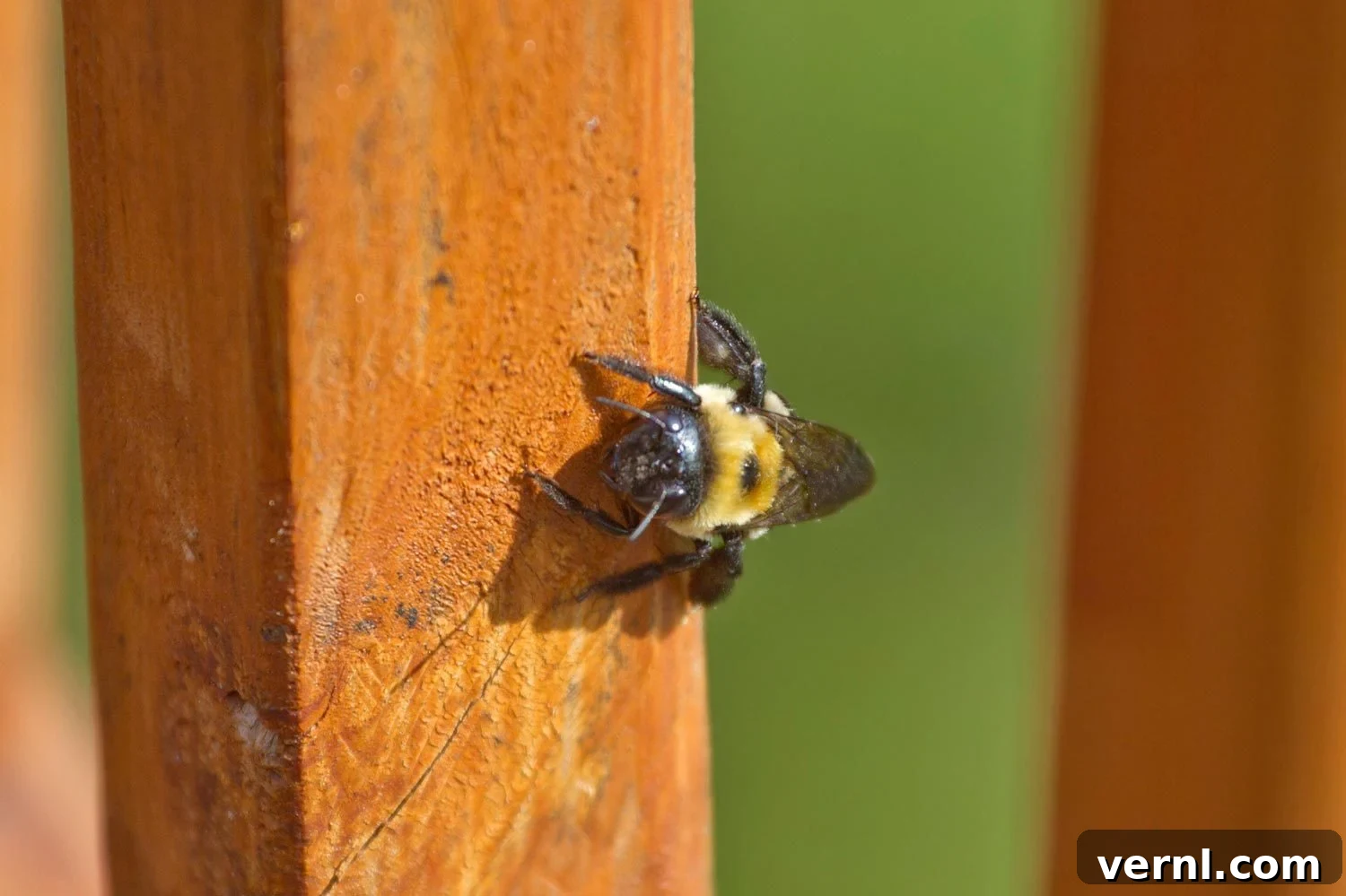
Carpenter bees often evoke mixed feelings among homeowners and nature enthusiasts. On one hand, their peaceful buzzing among garden flowers is a delightful sign of spring and a healthy ecosystem. These robust insects are vital pollinators, contributing significantly to the reproduction of countless plants. On the other hand, this admiration can quickly turn into concern when carpenter bees decide to make our wooden homes, fences, decks, and patios their preferred nesting sites. While they don’t consume wood, their diligent tunneling activities can lead to unsightly damage and, over time, compromise the integrity of wooden structures.
“It’s a common misconception that carpenter bees eat wood. They don’t,” clarifies Emma Grace Crumbley, an entomologist with Mosquito Squad. “Just like many other bee species, carpenter bees primarily forage for pollen and plant nectar. They are, in fact, exceptionally efficient pollinators crucial for a wide array of agricultural and native plants.”
This comprehensive guide aims to demystify carpenter bees, providing an in-depth look at their biology, behavior, and ecological importance. We will also equip you with practical, humane, and effective strategies to manage their presence, ensuring both the protection of your property and the conservation of these fascinating and beneficial insects. Understanding these gentle giants is the first step toward effective and responsible coexistence.
What Exactly Is a Carpenter Bee?
Carpenter bees belong to the genus Xylocopa, a diverse group comprising over 500 species worldwide, making them some of the largest native bees found in the U.S. They are particularly prevalent across the Southern, Southwestern, and Eastern United States. Their name, ‘carpenter bee,’ is quite literal, stemming from their remarkable ability to use their strong mandibles (mouthparts) to chew perfectly round, half-inch diameter nesting holes into various types of wood. These tunnels serve as the exclusive nurseries for their offspring.
“Carpenter bees are frequently affectionately referred to as the ‘gentle giants’ of the native pollinator community,” notes Crumbley. “They stand apart from honey bees in several fundamental ways. For instance, they do not produce honey, nor do they construct the intricate, communal honeycombs associated with traditional beehives. Their nests are distinctly individual, consisting of meticulously excavated tunnels carved directly into wood where each female raises her young, provisioning them with pollen and nectar.”
Solitary Life Cycle and Nesting Habits
A key characteristic of carpenter bees, distinguishing them from highly social insects like honey bees, is their largely solitary nature. While a female might occasionally share an existing nest tunnel with her daughters or other close relatives, they do not form large, hierarchical colonies. Each female carpenter bee typically excavates her own tunnel, which can extend anywhere from several inches to over a foot in length. Within these tunnels, she creates a series of individual cells. Each cell is provisioned with a “bee bread” – a mixture of pollen and nectar – and a single egg is laid on top of it. The entrance to each cell is then sealed off with chewed wood pulp.
The lifecycle of a carpenter bee typically spans approximately one year. Eggs hatch into larvae, which then pupate within their individual cells, feeding on the stored bee bread. New adult bees usually emerge in late summer or early fall. These new adults will then overwinter in the same tunnels where they developed, emerging the following spring to mate and begin the tunneling and egg-laying cycle anew. This preference for unfinished, unpainted, or weathered wood, particularly softer varieties like pine, cypress, and cedar, makes residential wooden structures prime targets for their nesting activities, highlighting the importance of understanding their biology for effective prevention.
How to Identify a Carpenter Bee: Appearance and Key Distinctions
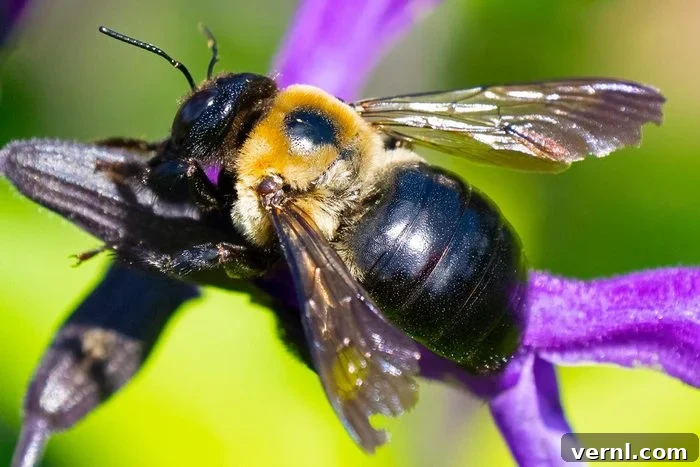
Identifying carpenter bees correctly is crucial, primarily because they are often confused with bumblebees. This distinction is vital for proper management, as bumblebees do not cause structural damage and are generally beneficial insects whose nests should be left undisturbed. While both are large and somewhat fuzzy, there are several reliable features to differentiate them.
The most defining characteristic of a carpenter bee is its abdomen: it is typically smooth, shiny, and almost entirely hairless, predominantly black, though some species may exhibit yellow or white markings on the thorax or head. In stark contrast, bumblebees possess a densely hairy abdomen, often adorned with prominent yellow, white, or orange bands that extend over their entire body. This difference in abdominal hairiness is the most straightforward visual cue. While the Xylocopa genus encompasses a vast array of species with varying appearances, this smooth abdomen remains a consistent and reliable identifier for the larger, wood-boring carpenter bees commonly encountered.
Regional Variations and Smaller Species
Appearance can also vary regionally. For example, in certain Western parts of the United States, such as California’s Central Valley, the male valley carpenter bee (Xylocopa sonorina) stands out with its striking, entirely golden-brown coloration, earning it the affectionate moniker “teddy bear bee.” These males are frequently observed patrolling territories aggressively, despite being harmless. At the other end of the spectrum, there are also very tiny species of carpenter bees, sometimes mistaken for small flies. These smaller species are generally not a concern for homeowners regarding structural damage, as their mandibles are typically not strong enough to chew through solid, hard wood. Instead, they prefer to nest in softer, decaying wood or hollow plant stems.
Do Carpenter Bees Pose a Stinging Threat?
The question of whether carpenter bees sting is a frequent concern for anyone discovering them around their home. The unequivocal answer is yes, female carpenter bees do possess a stinger and are capable of stinging. However, it is vitally important to understand their disposition. Unlike many social bees or wasps that aggressively defend large, communal colonies, female carpenter bees are generally docile and non-aggressive. They will only resort to stinging if they feel directly handled, severely provoked, or if their nest is perceived to be under direct threat. A notable characteristic of their stinger is that it is not barbed, meaning a female carpenter bee can sting multiple times if she feels compelled to defend herself.
Male carpenter bees, on the other hand, are entirely harmless, despite their often intimidating aerial displays. Males are fiercely territorial and will frequently engage in aggressive-looking flights towards perceived intruders, including people. They may buzz loudly and even “dive-bomb” faces in a dramatic fashion. However, this behavior is purely a bluff. Male carpenter bees, by biological design, do not possess stingers. Therefore, while their antics can be unsettling and make one wary, they are literally “all bark and no bite.” Understanding this crucial distinction between male and female carpenter bees can significantly alleviate unnecessary fear and help prevent adverse reactions when encountering these fascinating insects.
For those interested in broader bee management and interaction, insights into how to keep bees away from specific outdoor areas can provide helpful context and strategies.
The Unsung Heroes of Pollination: Carpenter Bees’ Ecological Role
Despite their potential to cause property damage, it is essential to recognize the invaluable ecological contributions of carpenter bees. They are indispensable members of our natural environment, serving as critical pollinators for a vast array of plant species. Indeed, they are instrumental pollinators for numerous native flowers, playing a significant role in maintaining biodiversity and ensuring the reproduction of vital flora in various ecosystems.
“Beyond general pollination, carpenter bees are celebrated as the ‘superheroes’ of buzz pollination, also scientifically known as sonication,” explains Francisco Garcia, entomologist manager at Butterfly Pavilion, a leading nonprofit invertebrate zoo in Westminster, Colorado. “This specialized and highly efficient pollination method involves the bee grasping a flower and vibrating its flight muscles at a precise frequency. These powerful, heavy vibrations effectively shake and release pollen from within the flower’s anthers, a technique that many other insects simply cannot perform.”
This unique buzz pollination is absolutely essential for the successful fertilization of a multitude of our most common and beloved food crops, as well as many ornamental plants. Key examples include a diverse range of nightshade family plants such as tomatoes, eggplants, chilies, and peppers, alongside other economically important crops like blueberries, cranberries, and kiwis. Without the dedicated efforts of carpenter bees and other buzz pollinators, the yields of these crops would be dramatically lower, directly impacting agricultural production and our global food supply. Their importance in agriculture cannot be overstated.
Furthermore, the ecological value of adult carpenter bees and their developing larvae extends beyond their pollination services. They form a crucial link in the food chain, providing a valuable food source for various wildlife species, particularly many types of birds. Woodpeckers, bee-eaters, and shrikes are among the avian predators that rely on carpenter bees for sustenance, highlighting their integral role in supporting the intricate web of life within healthy outdoor environments. This broad ecological contribution underscores the delicate balance that needs to be considered when homeowners decide on management strategies for these fascinating insects.
Effective Strategies: How to Manage and Get Rid of Carpenter Bees
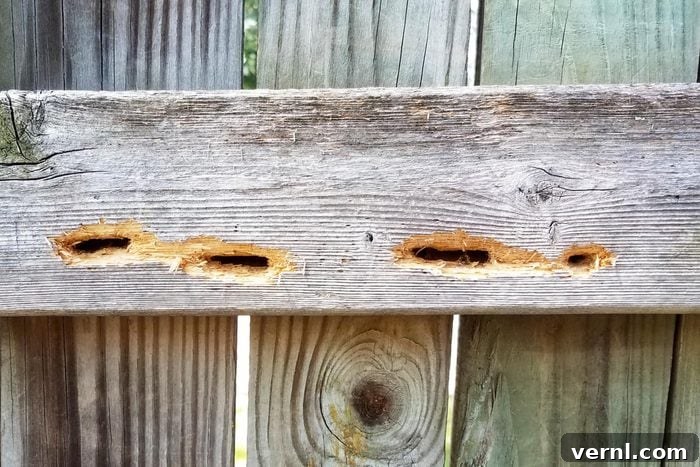
When carpenter bees begin their tunneling activities in your wooden structures, it’s natural to seek effective solutions. However, it’s paramount to approach this issue with careful consideration, acknowledging their significant beneficial role in the environment. Carpenter bees rarely inflict severe structural damage in the short term, and they are broadly regarded as valuable beneficial insects. Therefore, the initial and most critical step is to accurately assess the extent of the problem and genuinely determine if removal is absolutely necessary, or if peaceful and responsible coexistence can be achieved.
“My strong advocacy is always to leave them alone as much as humanly possible, allowing them to continue their vital work of pollinating and enriching your backyard’s biodiversity,” advises Crumbley. “Nevertheless, if the damage they are actively causing progresses to a point where it becomes too severe or widespread to reasonably ignore, any intervention or treatment should be meticulously applied in a manner that absolutely does not threaten, harm, or inadvertently kill other native pollinators or beneficial insects in the process.”
Before implementing any control measures, it is absolutely essential to confirm that you are indeed dealing with carpenter bees and not bumblebees. Bumblebees do not tunnel into wood; they exclusively utilize pre-existing cavities, and their nests, if found, should ideally be left undisturbed. Once you have confidently identified carpenter bees as the cause of the issue, you can then proceed with prioritizing humane, non-toxic, and environmentally responsible solutions.
Comprehensive Preventive Measures to Deter Carpenter Bees
Prevention is undoubtedly the most effective, economical, and least invasive method for managing carpenter bee populations around your property. By making your wooden structures less appealing to them, you can significantly reduce their interest in nesting there. These proactive steps are crucial:
- Finish and Maintain Wood Surfaces: Carpenter bees exhibit a strong preference for bare, unfinished, unpainted, or weathered wood. This includes siding, trim, decks, railings, eaves, and outdoor furniture. Applying high-quality paint, stain, or varnish to all exposed wooden surfaces creates a protective barrier that deters them from chewing into the wood. It is crucial to reapply these finishes regularly, typically every 2-3 years, to maintain their efficacy and protection.
- Seal All Cracks and Depressions: Conduct an annual thorough inspection of all your wooden structures for any existing cracks, crevices, knots, or depressions. These imperfections can serve as inviting starting points for new tunnels or opportunistic entry points for existing bees. Fill these vulnerabilities meticulously with appropriate wood putty, caulk, or epoxy to eliminate any potential access points for the bees.
- Protect Vulnerable Timber Ends: Areas such as the exposed ends of timber beams, fascia boards, roof rafters, and deck joists are particularly susceptible to carpenter bee attacks. Consider physically protecting these rough-cut ends with durable metal flashing, sturdy wire screening, or even aluminum siding. This creates an impenetrable physical barrier, making it impossible for bees to chew into the wood.
- Strategic Wood Choice for New Construction: If you are planning new construction or undertaking significant renovations, consider using hardwoods like oak, walnut, or dense exotic woods, which are generally much less attractive to carpenter bees due to their hardness. Pressure-treated lumber is another excellent option, as the chemicals used in treatment typically repel these insects.
- Implement Regular Property Inspections: Develop a routine of periodically inspecting your property, particularly in early spring (April to June), which is the peak activity period for carpenter bees. Look for tell-tale signs such as small piles of sawdust (known as frass) directly below freshly drilled holes, or audible buzzing sounds coming from within wooden structures. Early detection allows for much easier and more effective intervention before infestations become widespread.
Non-Lethal & Humane Management Options for Active Infestations
If carpenter bees have already established themselves, these humane methods aim to encourage them to relocate without causing them harm, aligning with efforts to help save the bees:
- Fill Unoccupied Holes Strategically: In late fall, after the adult bees have emerged from their tunnels for the season and are no longer actively nesting, carefully fill any unoccupied holes. A highly effective method is to stuff the tunnels with steel wool, which bees cannot chew through, and then seal the opening with wood putty or caulk. This prevents new bees from reusing or expanding old tunnels the following spring, effectively deterring future nesting.
- Strategic Closure of Outbuildings: Keep garages, sheds, workshops, and any other outbuildings that feature exposed wooden elements securely closed during late spring. This period is typically when female carpenter bees are most actively searching for suitable new nesting sites, and restricting access will discourage them from choosing your outbuildings.
- Provide Attractive Alternative Nesting Sites: To draw their attention away from your home, consider strategically placing attractive “bee hotels” or large, untreated logs in a less critical, secluded area of your yard. These alternative habitats can encourage nesting away from your primary structures, promoting coexistence.
- Cultivate Native Flowering Plants: Enhance your garden and landscape with a diverse array of native flowering plants. A rich source of nectar and pollen provides ample food, which can effectively divert their foraging and nesting attention towards natural habitats and away from your wooden structures.
- Utilize DIY Deterrents: Simple household items can sometimes act as effective deterrents. Crumpling newspaper into a brown paper bag and hanging it near existing bore holes can mimic a wasp nest, which carpenter bees instinctively tend to avoid. Another method involves preparing and spraying citrus-based solutions (e.g., lemon, orange, grapefruit essential oils diluted in water) or almond oil near affected areas; these strong scents are often disliked by carpenter bees and can encourage them to leave.
“By thoughtfully focusing on these positive, non-harmful alternatives, you can successfully achieve a harmonious balance between diligently managing carpenter bee concerns and simultaneously cultivating a welcoming, thriving environment for these essential pollinators within your broader landscape,” emphasizes Garcia.
Carpenter Bee Traps: An Effective Non-Toxic Solution
If other non-lethal methods prove insufficient or if you have a persistent problem, a specialized carpenter bee box trap can be an incredibly effective, non-toxic, and humane solution. These traps can be purchased commercially, or you can easily construct one yourself:
- Construct the Basic Box: Begin by creating a small wooden box, typically around 4x4x6 inches in dimension. Drill a single, precisely 1/2-inch diameter hole into one side of the box. This hole should resemble a convincing potential nesting site to attract the bees.
- Integrate a Collection Mechanism: Inside the constructed box, strategically position a funnel that leads directly downwards into a clear glass jar or another suitable collection dish securely attached to the bottom of the box. The ingenious design of this system allows bees to easily enter the perceived nesting site through the drilled hole but prevents them from escaping once they drop into the collection jar.
- Strategic Placement for Maximum Efficacy: Hang or place the completed trap near areas where you observe the highest carpenter bee activity or where existing damage is most prominent. The bees will be naturally drawn to the trap’s design, mistaking it for an ideal nesting location.
- Humane Relocation: Regularly check the collection jar. Once bees are caught, you can carefully unscrew the jar and gently release them into a more suitable, undisturbed natural habitat located far away from your home and other susceptible wooden structures.
When Pesticides Are Considered (Extreme and Last-Resort Cases)
Resorting to pesticides is generally not recommended as a primary solution due to their significant potential to disrupt the delicate natural ecosystem. Pesticides can indiscriminately harm beneficial insects, other vital pollinators, and local bird populations. However, in extreme and rare cases of severe, widespread structural damage where all other methods have been exhausted and failed, a highly targeted pesticide application might be considered. If you do contemplate using pesticides, it is absolutely crucial to proceed with extreme caution and, ideally, under the expert guidance of a licensed pest management professional.
- Optimal Timing is Paramount: If pesticides are deemed necessary, treat existing tunnels and holes in early spring before significant nesting activity commences, or in late fall after the adult bees have naturally departed for the season. Attempting to treat active nests during the peak nesting season is often far less effective and carries a substantially greater risk to both the environment and non-target organisms.
- Targeted and Responsible Application: Only use dusts or aerosols that are specifically labeled for carpenter bee control. Apply these products directly into the visible boreholes using an applicator straw or nozzle. Immediately after application, it is critical to plug the holes with wooden dowels or caulk to prevent bees from re-entering and to trap any bees that may be inside.
- Seek Professional Assistance: For extensive infestations, hard-to-reach areas, or situations where you are unsure about safe application, consulting a licensed pest control professional is highly advisable. They possess the expertise, equipment, and knowledge to ensure safe, effective, and minimally impactful application, thereby minimizing harm to non-target organisms and protecting your property responsibly.
Ultimately, understanding and managing carpenter bees effectively necessitates a balanced approach – one that prioritizes property protection while upholding ecological responsibility. By adopting a combination of proactive preventive measures and humane, targeted control methods, homeowners can successfully coexist with these important pollinators while simultaneously safeguarding the long-term health and integrity of their homes and wooden structures.
Frequently Asked Questions About Carpenter Bees
- Do carpenter bees actually eat wood?
- No, carpenter bees do not consume wood. They bore into wooden structures to excavate tunnels and chambers that serve as nesting sites for laying their eggs. The wood particles (frass) created during this process are expelled from the tunnel opening and often seen in small piles below the holes.
- What specifically attracts carpenter bees to my home?
- Carpenter bees are primarily attracted to unpainted, unstained, or weathered softwoods such as pine, cedar, redwood, and cypress for nesting purposes. Exposed wooden eaves, fascia boards, deck railings, siding, and untreated wooden outdoor furniture are common targets. They are also drawn to gardens rich in nectar and pollen sources.
- When are carpenter bees typically most active?
- Carpenter bees exhibit their highest activity levels in the spring, generally from April to June. During this period, they emerge from hibernation, mate, and begin the crucial process of excavating new tunnels or expanding existing ones for nesting. They can also be observed foraging for nectar and pollen throughout the summer months.
- Can carpenter bee damage be severe?
- While a few isolated tunnels typically do not pose an immediate or serious structural threat, repeated tunneling over several years by multiple generations of bees can indeed weaken wooden structures, particularly if tunnels run extensively parallel to the wood grain. Cosmetic damage, characterized by unsightly holes and staining from frass, is also a very common concern for homeowners.
- How can I easily distinguish between a carpenter bee and a bumblebee?
- The most straightforward and reliable way to differentiate them is by examining their abdomen. Carpenter bees possess a shiny, smooth, and mostly hairless black abdomen. In contrast, bumblebees have a distinctly fuzzy, hairy abdomen, often featuring prominent yellow or white markings that extend over their entire body, including the abdomen.
For more comprehensive and in-depth information on bees, their vital ecological roles, and critical conservation efforts, we highly recommend exploring the extensive resources provided by the Butterfly Pavilion and the Xerces Society.