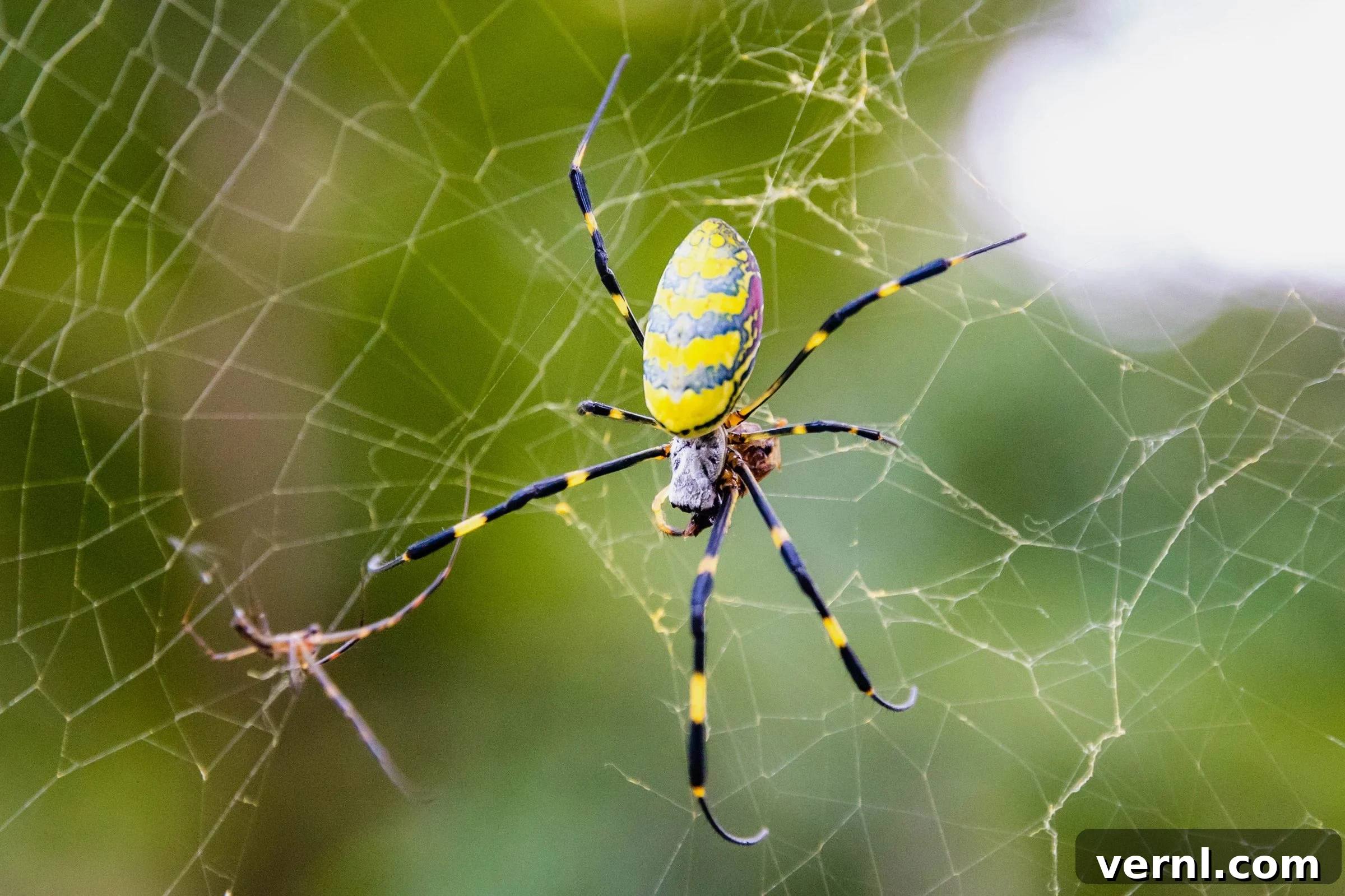
For the past few years, the public’s attention has often been captivated by the likes of spotted lanternflies and cicadas, often dubbed the “bugs of the summer.” However, a new, much larger arachnid is preparing to make its presence known across more regions of the United States: the Joro spider. Reports indicate that the Northeast U.S. is now bracing for a significant increase in sightings of this distinctive, large, and surprisingly mobile spider, originally from East Asia.
Experts have been closely monitoring and warning about the potential widespread arrival of the Joro spider since 2022. Early in 2024, New Jersey Pest Control highlighted that these spiders would be “hard to miss” as they expand their habitat into new states. Renowned for their striking appearance, female Joro spiders boast an impressive leg span of up to 4 inches, often reaching 8 inches when fully grown, and are easily identifiable by their vibrant yellow and grey bodies. While their size might be alarming to some, understanding their nature is key to coexisting with these unique creatures.
What truly sets the giant Joro spiders, sometimes affectionately called “parachuting spiders,” apart from most other arachnids is their remarkable ability to “fly.” This trait, uncommon among spiders, is facilitated by a fascinating dispersal technique known as “ballooning.” During ballooning, these spiders release fine silk threads into the air, which act like tiny parachutes, allowing them to be carried by wind currents over considerable distances. This natural mechanism is a primary factor in their rapid spread across the country, transforming them from localized sightings into a much broader phenomenon.
As we delve deeper, discover all essential information about Joro spiders, from their origins and identification to their behavior, ecological impact, and how to manage their presence around your home.
Understanding Invasive Species: The Joro Spider’s Journey
The Joro spider (Trichonephila clavata) is categorized as an invasive species. An invasive species is defined as an organism that is not native or indigenous to a particular ecosystem and whose introduction causes or is likely to cause economic or environmental harm, or harm to human health. These species can outcompete native organisms for resources, disrupt local food webs, introduce diseases, or alter habitats, fundamentally changing the ecological balance of an area.
Native to several East Asian countries, including Japan, Korea, Taiwan, and China, Joro spiders are believed to have made their way to the United States via international cargo shipments. Specifically, they likely arrived nestled in shipping containers or on personal travel luggage, inadvertently transported across oceans. The first confirmed sighting in the U.S. occurred in northern Georgia around 2010. Since then, they have established strong populations across Georgia, Tennessee, and the Carolinas, with documented sightings extending as far north as Maryland and west into Oklahoma, as extensively studied by institutions like Clemson University. Their adaptability to urban and suburban environments, coupled with their effective ballooning technique, has significantly contributed to their rapid expansion.
The favorable climate in many parts of the U.S., particularly the Southeast, mirrors their native Asian habitats, providing ideal conditions for their survival and reproduction. Furthermore, the absence of natural predators or diseases that control their populations in their native lands has allowed Joro spiders to thrive unchecked. With the transition from spring to summer, a period marked by increased spider activity and reproduction, experts anticipate their continued spread into new states, making awareness and accurate information crucial for residents.
How To Identify Joro Spiders: Distinctive Features
Joro spiders are relatively easy to identify due to their substantial size and unmistakable coloration. Unlike many native spiders, their sheer scale makes them stand out, often catching the eye of passersby.
Female Joro spiders are particularly striking. Their abdomens are adorned with a vivid pattern of yellow and grey, often iridescent blue-green markings, making them one of the most brightly colored spiders in North America. Their long, slender legs are banded with yellow and black, often exhibiting a bluish sheen. Males, in contrast, are much smaller and typically a duller brown, making them far less conspicuous than their female counterparts. This sexual dimorphism is a key identification feature.
Beyond their personal appearance, Joro spiders construct large, intricate orb webs. These webs, often golden in hue, can span several feet across, becoming quite noticeable. They are frequently built in open, elevated spaces, making them easy to spot. Common locations include between power lines, across traffic lights, on poles along busy roads, above gas pumps, and even between trees in backyards. The silk of their webs is notably strong and resilient, designed to capture a wide array of flying insects. In the morning, when speckled with dew, these impressive webs become particularly visible, highlighting the spiders’ industrious nature. While their size might appear intimidating, these spiders generally pose no threat to native species valuable to the environment, as they primarily prey on common insects.
Measuring Up: How Big Are Joro Spiders?
One of the most talked-about characteristics of Joro spiders is their impressive size, which can be quite startling upon first encounter. These “summer visitors” are indeed fairly easy to spot in and around your property due to their notable dimensions.
While the body of an adult female Joro spider typically measures about one inch long, their legs can stretch significantly, giving them an overall diameter of six to eight inches. This expansive leg span makes them comparable in size to an adult human hand, a visual that often contributes to initial surprise and even apprehension. Some individuals have been observed to measure even larger, with an entire length, including legs, reaching up to eight inches. This considerable size is a key differentiator from most native orb-weaving spiders in the U.S., making proper identification simpler. Understanding their true dimensions can help alleviate unfounded fears, as their size is primarily for show and does not correlate with an increased threat level to humans or pets.
The Phenomenon of “Flying” Joro Spiders: Ballooning Explained
The term “flying” associated with Joro spiders often conjures images of spiders with wings, but their method of aerial travel is far more intricate and fascinating. Joro spiders, like many other spider species, utilize a unique dispersal technique called “ballooning.” This process allows them to travel long distances, greatly contributing to their rapid geographical spread.
During ballooning, a spider climbs to a high point, such as a tree branch, fence post, or even a tall weed. It then lifts its abdomen and releases several strands of silk into the air. These silk strands catch the wind, generating enough lift to carry the spider aloft. The spider effectively becomes a tiny, living parachute, allowing it to be transported by air currents for miles. This behavior is particularly common among juvenile spiders, enabling them to find new territories and avoid competition with their siblings. However, adult Joro spiders have also been observed ballooning, which is less common for larger spiders and highlights their exceptional adaptability. This natural phenomenon, driven by environmental factors like wind speed and air pressure, is a testament to the evolutionary ingenuity of these arachnids and explains how they’ve managed to traverse significant distances across the U.S. since their initial introduction.
Are Joro Spiders Dangerous? Dispelling Myths and Understanding Their Nature
The formidable size and “flying” ability of Joro spiders can certainly be unsettling, leading many to question their potential danger. However, despite their intimidating appearance, Joro spiders are generally considered timid creatures and pose minimal threat to humans and pets.
Their venom, while effective for incapacitating their insect prey, is not considered medically significant to humans. A Joro spider bite is often compared to the sting of a bee or a mosquito bite – a mild irritation at most. Due to their small mouthparts (chelicerae), they would struggle to even penetrate human skin effectively, unless they are severely provoked or feel trapped against the skin. Bites are exceedingly rare and occur only in self-defense. Dr. Daniel Kiefer, PhD, an esteemed entomologist and Technical Manager at American Pest, emphasizes, “Spiders often get a bad reputation, but they are actually beneficial to controlling other insects in your yard. Joro spider venom is reserved for their prey, which humans and pets are most certainly not.” This highlights their crucial role as natural pest controllers, preying on a wide variety of insects, including those that might be considered garden pests.
The primary nuisance associated with Joro spiders might actually be their large, conspicuous webs, which people could accidentally walk into! Fortunately, there is no need to worry about Joro spiders “invading” your home. These spiders prefer to build their intricate webs and perform their unique aerial movements outdoors, in open spaces where they can easily catch flying insects. They are not inclined to seek shelter indoors. As Dr. Kiefer explains, “Our technicians use special dewebbing brushes to clear visible webs on the outside of your home, which will be the most effective way to keep them from accidentally getting inside. Flying is dramatic, but, like in Charlotte’s Web, it’s mainly for the Joro spiders to get from one area to another.” This pragmatic advice underscores that outdoor web management is the most effective approach for those who find the webs bothersome. Overall, while impressive in size, Joro spiders are not a threat to agriculture, nor do they pose a significant safety concern for humans or domestic animals.
Ecological Impact and Coexistence with Joro Spiders
As an invasive species, the natural concern arises regarding the Joro spider’s impact on local ecosystems. However, current scientific understanding suggests that their ecological footprint in the U.S. may be relatively benign compared to other invasive species. Studies indicate that Joro spiders primarily feed on common insects, many of which are generalist feeders and not threatened or endangered. This broad diet means they are not specifically targeting crucial native pollinators or other species vital to the ecosystem’s balance. Their presence doesn’t appear to be significantly displacing native spider populations either, possibly because they occupy different ecological niches or are tolerant of human-disturbed environments where native spiders may be less prevalent.
Scientists are continually monitoring their spread and potential long-term effects. The prevailing sentiment among entomologists is one of cautious observation rather than alarm. Many see Joro spiders as another generalist predator that fits into existing food webs without causing catastrophic disruptions. In some ways, their voracious appetite for insects could even be considered beneficial, contributing to natural pest control in areas where they establish populations. Learning to coexist with these visually striking, yet largely harmless, arachnids by understanding their behaviors and minimizing direct interaction appears to be the most sensible approach for now.
Managing Joro Spiders Around Your Property
While Joro spiders are not considered dangerous, their large webs can be a nuisance, especially when built across doorways, walkways, or outdoor living spaces. Managing their presence primarily involves simple, non-toxic methods focused on web removal.
The most effective way to keep Joro spiders from becoming a bother is regular dewebbing around your home’s exterior. Using a long broom, a stick, or a specialized dewebbing brush, you can easily clear away their webs from eaves, porches, garden structures, and other areas where they might be inconvenient. Since these spiders prefer to live outdoors and build new webs frequently, consistent removal will encourage them to relocate to less trafficked areas of your property. For those who find the spiders themselves too large or intimidating to handle, gently sweeping them away with a broom is usually sufficient, as they are not aggressive. If infestations seem particularly dense or persistent in unwanted areas, contacting a professional pest control service that specializes in humane removal can provide a more comprehensive solution. They can offer advice and employ targeted, environmentally friendly methods to manage the spider population without resorting to harsh chemicals. Remember, Joro spiders are outdoor creatures, so sealing cracks and crevices in your home will generally not prevent them from establishing webs outside, but it’s good practice for general pest prevention.
About the Expert
- Dr. Daniel Kiefer, PhD, is an entomologist and technical manager at American Pest, providing valuable insights into insect behavior and pest management solutions.
Sources
- MDPI: “How Urban-Tolerant Are They? Testing Prey–Capture Behavior of Introduced Jorō Spiders (Trichonephila clavata) Next to Busy Roads”
- CBS News: “Joro spiders are an invasive species known for parachuting through the air. Here’s why you shouldn’t fear them.”
- USA Today: “Joro spiders, giant, venomous flying arachnids, are here to stay, pest experts say”
- Clemson University: “Clemson scientist: Study shows Joro spiders ‘here to stay,’ spreading fast”
- National Geographic: “Invasive Species”