As a retired chief electrical inspector and master electrician with 45 years of experience, I’ve had countless “kitchen table meetings” with homeowners and electrical contractors. These discussions often centered on understanding the often-complex rules in the National Electrical Code (NEC) regarding kitchen island and peninsula receptacle outlets.
The sentiment among homeowners varied wildly. Some vehemently opposed any receptacles, viewing them as an eyesore or an unnecessary expense. Others felt there couldn’t be enough, eager for convenience. Navigating these differing opinions often felt like mediating a delicate peace treaty, trying to reconcile practical needs with safety regulations and personal preferences.
The primary goal of the NEC, particularly concerning receptacle placement, has always been to ensure an adequate number of accessible outlets throughout a home. This strategy effectively discourages the use of unsafe extension cords, especially in a busy environment like a kitchen where multiple appliances are frequently used. Decades ago, the code mandated only a minimal number of island and peninsula receptacles. However, as kitchen technology evolved and an explosion of countertop appliances entered our homes, the pendulum swung. Later code cycles introduced more stringent requirements, often mandating additional receptacles to accommodate this new reality.
This “tug-of-war” between minimal requirements, increased demands, and practical application went back and forth for years, leading to much debate and negotiation. Finally, with the advent of the 2023 NEC, we can put many of those arguments to rest. The code has introduced a groundbreaking change: receptacles are now optional on islands and peninsulas. It’s a remarkably simple solution that addresses both safety concerns and homeowner flexibility, leaving many to wonder why it took so long to arrive at this common-sense approach.
The Evolving Landscape of Kitchen Electrical Needs and the 2023 NEC Changes
The National Electrical Code (NEC), published by the National Fire Protection Association (NFPA), serves as the benchmark for safe electrical design, installation, and inspection to protect people and property from electrical hazards. It’s a dynamic document, updated every three years to incorporate advancements in technology, new safety data, and evolving practices. The modifications concerning kitchen island receptacles in the 2023 NEC exemplify this adaptive nature, reflecting a deeper understanding of both household safety and modern kitchen design.
Instead of mandating any receptacles at all, the 2023 NEC now simply states that “if” receptacles are installed to serve an island or peninsula countertop or work surface, only a few basic rules need to be followed. This subtle but significant shift provides unprecedented flexibility for homeowners and designers while still upholding stringent safety standards for any outlets that are chosen for installation.
Future Additions: Planning for Tomorrow’s Kitchen
One of the most practical and forward-thinking aspects of the new 2023 NEC guidelines is the provision for future additions. If a receptacle is not installed to serve the countertop or work surface at the time of initial construction or renovation, the code now requires that provisions be made at the island or peninsula for the future addition of one or more outlets. This intelligent compromise acknowledges that needs can change over time, offering a cost-effective way to adapt without immediate installation.
How is this accomplished? The branch circuit wiring can be extended to the island or peninsula cabinet and safely dead-ended in a junction box. This box should then be covered with a blank cover, which must be clearly marked with a label indicating its purpose, such as “Power for future receptacles.” This simple step ensures that if the homeowner decides to add an outlet later – perhaps for a new appliance or a different use of the space – the underlying electrical infrastructure is already in place, making the subsequent installation much simpler, safer, and less intrusive than running new wiring from scratch.
Distinguishing a Countertop from a Work Surface for Safe Receptacle Placement
A crucial distinction made by the NEC, especially relevant for kitchen islands and peninsulas, is between a “countertop” and a “work surface.” Understanding this difference is vital for selecting and installing the appropriate type of receptacle and ensuring long-term safety, particularly concerning potential liquid spills.
- A work surface is typically intended for dry use, other than food preparation. The risk of spilled liquids impacting receptacles is considered incidental and limited to smaller quantities. A practical example in a kitchen setting could be a built-in desk area, a charging station, or a designated craft zone on an island where food preparation is not the primary activity.
- A countertop, conversely, is typically intended for food preparation and serving. This environment carries a routine risk of spilled liquids, often involving larger quantities that could significantly impact receptacles mounted directly on or recessed in the surface. This definition encompasses all typical food preparation countertops found in a kitchen, including those on islands and peninsulas.
This distinction directly influences the types of receptacle outlet assemblies that are approved for use in each location, with products designed for countertops offering superior protection against moisture intrusion due to the higher likelihood of substantial spills.
Permitted Receptacle Locations: Navigating the Options
If receptacles are installed on a kitchen island or peninsula, the 2023 NEC permits them in one or more of the following strategically defined locations, each designed to balance convenience with paramount safety:
- On or above the countertop or work surface: Receptacles can be installed in these positions, provided they are not located more than 20 inches above the surface. This rule accommodates traditional side-mounted receptacles on the island cabinetry (if within the height limit) or can include installing receptacles on the underside of overhead cabinets that overhang the island or peninsula. This placement often offers easy access and keeps the countertop surface clear.
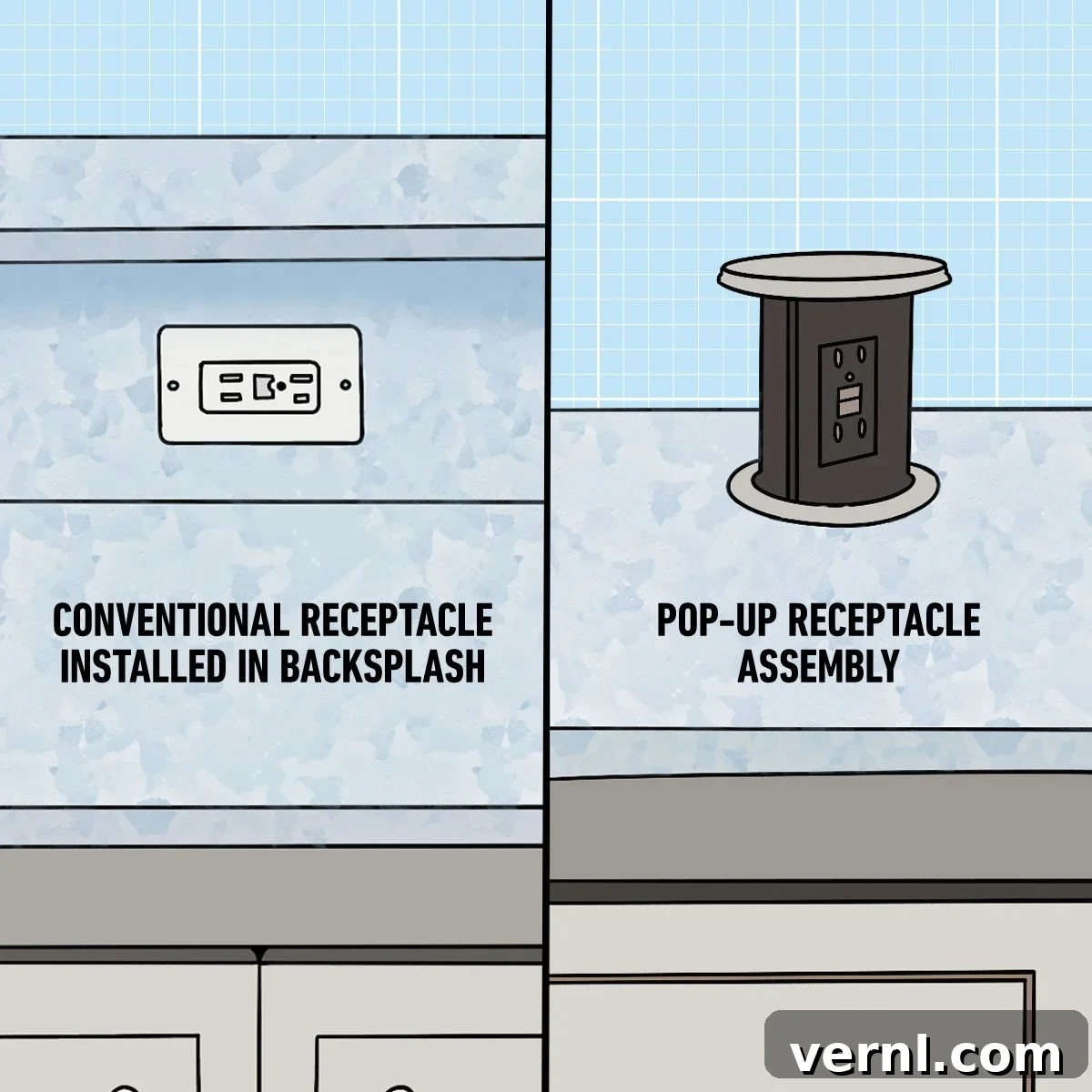
- On or recessed in a countertop: For installations directly integrated into the surface, a receptacle must utilize a receptacle outlet assembly specifically approved for countertop use. These specialized units must be certified by recognized product testing organizations such as Underwriters Laboratories (UL), ETL Intertek (ETL), Canadian Standards Association (CSA), or a similar product testing organization. These assemblies are engineered to mitigate the risk of liquid intrusion and ensure electrical safety in a potentially wet environment.
- On or recessed in a work surface: Similar to countertops, installations in work surfaces must use a receptacle outlet assembly specifically approved for use in a work surface or countertop by a product testing organization. The key difference here lies in the level of liquid protection required.
- Pro Tip: An essential safety consideration is that a receptacle outlet assembly approved for use on or in a countertop can also be used on or in a work surface, as it meets a higher standard of liquid protection. However, a receptacle outlet assembly only approved for use on or in a work surface cannot be installed in a countertop. This is because it may not be designed to prevent the intrusion of larger quantities of spilled liquids, which are more common during food preparation. Always ensure the product’s approval matches or exceeds the requirements for its intended location.
When shopping for receptacle outlet assemblies, particularly for countertops, it is critical to verify that they are explicitly approved for use on or in a countertop. Always check the product marking or the manufacturer’s specifications to confirm this approval. Misuse of an unapproved assembly can pose a significant electrical hazard.
Furthermore, a crucial general rule applies to all surfaces: receptacles are never permitted to be installed in a face-up position on or in any countertop or work surface unless they are specifically approved for that purpose. This stricture is in place to prevent the accumulation of liquids, debris, or foreign objects within the receptacle, which could lead to short circuits, shocks, or fires.
Why Were NEC Kitchen Island Requirements Changed? The Safety Imperative
The periodic updates to the NEC are not arbitrary; they are driven by rigorous research, incident data, and advancements in safety science. The significant changes in the 2023 NEC regarding kitchen island receptacles stem directly from a critical safety mandate, specifically addressing hazards identified by the U.S. Consumer Product Safety Commission (CPSC).
During the revision process for the 2023 NEC, the CPSC provided compelling data compiled over the preceding 20 years. This extensive dataset revealed a disturbing trend: thousands of injuries, including severe burns, and even several tragic deaths, were directly attributed to countertop cooking appliances. These incidents often involved appliances like slow cookers, deep fryers, coffee makers, and electric kettles, all common fixtures on kitchen islands and peninsulas.
CPSC investigations pinpointed the primary mechanism of these injuries. Curious young children, attracted by the appliance or its cord, would often pull on appliance cords that were draped over the edge of countertops. This action frequently caused the appliance to tip over, resulting in spillage of hot liquids or food, leading to severe scalds and burns. Beyond child safety, appliance cords draped over the edge of a countertop are also prone to inadvertent snagging by adults walking past, leading to similar accidents and hazards.
The traditional placement of receptacles on the side of kitchen islands or peninsulas, while providing power, often inadvertently encouraged this dangerous practice of running cords over the edge of the countertop. The 2023 NEC’s shift to making these receptacles optional, and encouraging recessed or properly approved on-surface options, is a direct response to this safety data. The goal is to minimize the opportunity for cords to create a hazard by providing safer, more integrated power solutions or allowing homeowners to omit receptacles if they primarily use portable, battery-operated devices or dedicated wall outlets.
Do I Have To Get Rid of My Kitchen Island Side Receptacles? Non-Retroactivity Explained
For homeowners who currently have side-mounted receptacles on their kitchen islands or peninsulas, a common concern is whether they are now required to remove them. The good news is, generally, no. The National Electrical Code (NEC) is not retroactive. This fundamental principle means that electrical wiring and installations, including those for kitchen islands, that were initially installed to meet the edition of the NEC in effect at the time of that original installation may legally remain in place.
Existing kitchen island and peninsula receptacles, if properly installed according to previous code cycles, can continue to be used without issue from a legal standpoint. However, while you are not legally obligated to remove them, knowing that side-mounted receptacles and the associated draped cords can pose a potential hazard, particularly to young children, this may be an opportune moment to voluntarily improve safety in your kitchen. Upgrading your electrical setup, even if not mandated, contributes significantly to a safer home environment for everyone.
Can I Retrofit My Kitchen Island to Comply With the New Rules and Enhance Safety?
Yes, absolutely. You can certainly update your home’s wiring and electrical installations to align with the current code at any time. Retrofitting your kitchen island or peninsula to eliminate potential hazards, such as appliance cords unsafely draped over the edge of a countertop, is a proactive step toward creating a safer kitchen. This process is often simpler than many homeowners might imagine.
To safely remove a side-mounted receptacle from an outlet box on the side of an island or peninsula, you can follow these step-by-step instructions:
- Turn off the power: Locate the corresponding circuit breaker in your electrical panel and switch it to the “OFF” position. This is a critical first safety step.
- Test to ensure the power is off: Use a non-contact voltage tester or a multimeter to confirm that there is no power at the receptacle before proceeding. Always double-check.
- Remove the receptacle: Carefully unscrew the receptacle from the outlet box and gently pull it forward. Disconnect the wires from the receptacle terminals. Note that sometimes there might be multiple wires if the circuit continues to another outlet.
- Safely terminate the wires: Separately tape up the bare ends of the black (hot) and white (neutral) wires in the box with high-quality electrical tape. Alternatively, and often preferred for a more secure connection, use twist-on wire connectors (wire nuts) over the end of each individual wire. If there is a bare copper or green insulated ground wire, ensure it remains connected to the box if it’s a metal box or safely tucked away if it’s a plastic box.
- Fold the wires neatly back into the box: Ensure all wires are tucked away securely within the outlet box, with no exposed conductors.
- Install a blank cover on the box: Secure a blank faceplate over the outlet box. This safely encloses the wiring and provides a finished appearance.
- Turn the power back on: Return to your electrical panel and flip the circuit breaker back to the “ON” position.
By following these steps, the branch circuit wiring will be safely enclosed in the outlet box, preserving it for future use should you change your mind or for the next owner of the home. This provides flexibility without sacrificing safety.
Alternatively, if you still desire power on your island or peninsula but wish to eliminate the hazards of cords, numerous receptacle outlet assemblies are approved for installation on or recessed in countertops, or on or recessed in overhead cabinets. These modern solutions are specifically designed to meet current safety standards and integrate seamlessly into kitchen design.
Lew Electric Fittings Company and Hubbell Wiring Devices are among the reputable manufacturers offering a wide array of receptacle outlet assemblies specifically approved for countertops, work surfaces, and overhead cabinet locations. Many innovative options are available today, including essential GFCI protection, convenient USB outlets for charging devices, and even integrated wireless phone charging pads, blending functionality with cutting-edge design and unparalleled safety.
Conclusion: A Safer, Smarter Kitchen for Tomorrow
The 2023 NEC’s shift towards making kitchen island and peninsula receptacles optional marks a significant evolution in electrical code. This change, while seemingly simple, reflects a profound commitment to enhancing safety in the heart of our homes, driven by compelling data from the CPSC regarding appliance cord-related injuries. It also grants unprecedented flexibility to homeowners and designers, allowing for kitchens that are not only functional but also aesthetically pleasing and tailored to individual needs.
Gone are the days of rigid mandates that sometimes conflicted with practical safety or design preferences. The new code encourages thoughtful consideration: if you choose to install receptacles, you now have clear guidelines for safe placement and approved assemblies. If not, provisions for future additions ensure your home remains adaptable. Whether you’re planning a new build or considering a retrofit, understanding these updates is crucial for making informed decisions.
Ultimately, the goal is a kitchen where convenience meets paramount safety. By embracing modern, approved receptacle solutions and understanding the rationale behind these code changes, homeowners can create a smarter, safer, and more versatile culinary space for their families. Always remember to consult with a qualified, licensed electrician for any electrical work to ensure compliance with local codes and the highest safety standards.