
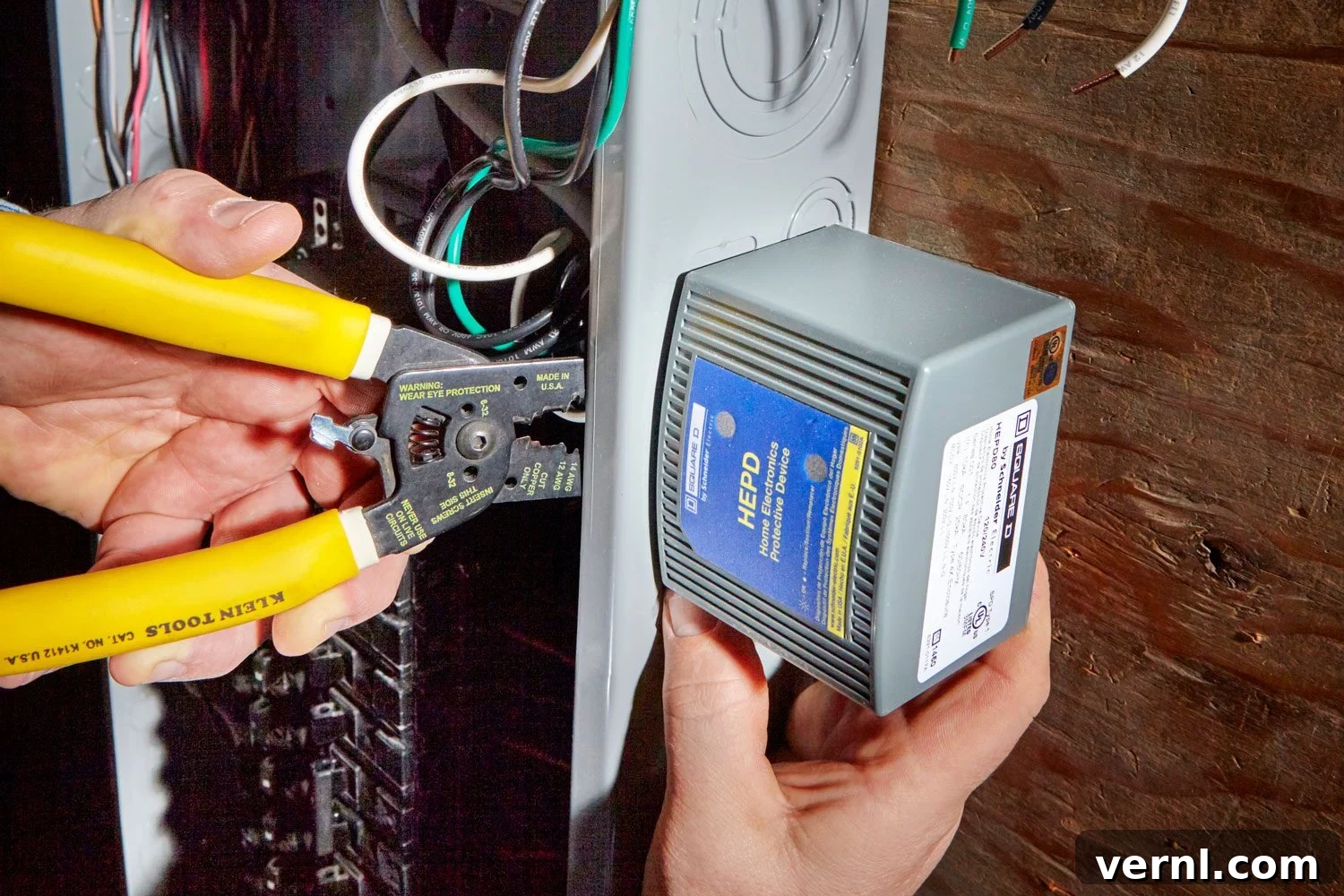
In our increasingly interconnected world, electricity serves as the lifeblood of modern civilization, powering everything from our essential appliances to our intricate smart home systems. Yet, this miraculous force, while indispensable, also harbors the potential for significant disruption and damage if left unchecked. Imagine the catastrophic consequences if the raw, high-voltage currents from a lightning strike or a severe utility grid fluctuation were to directly infiltrate your home’s delicate electronics and valuable appliances. The sheer force of such an electrical surge could instantly transform your sophisticated gadgets into irreparable wreckage, posing not only a financial burden but also potential safety hazards.
Fortunately, this disastrous scenario is largely preventable with the strategic installation of a whole-house surge protector. This critical device acts as your home’s first line of defense against the unpredictable nature of electrical anomalies. However, for many homeowners, the pivotal question often arises: “How much does a whole-house surge protector cost?” The financial investment for the device itself typically ranges from $70 to $700, a figure that doesn’t yet account for professional installation fees.
I can personally attest to the devastating effects a power surge can unleash. Years ago, a powerful lightning strike directly impacted our property, completely obliterating our meticulously installed solar energy system. The inverter was rendered useless, and the control panel for our generator suffered irreversible damage. This experience prompted a crucial question: Could a whole-house surge protector have averted such extensive destruction? To uncover the definitive answer, I sought the expert opinions of two industry veterans: Jay Sanders, a highly respected general contractor based in Baltimore, and Kent Boll, who established his own successful electrical company in 2005 and now serves as the CEO of a multi-trade home-maintenance enterprise headquartered in Minnesota. Their insights shed invaluable light on the efficacy and importance of whole-house surge protection.
What is a Whole-House Surge Protector? Your Home’s Electrical Guardian
At its core, a whole-house surge protector is an advanced electrical safety device meticulously engineered to detect dangerously high electrical voltage spikes and safely divert them away from your home’s main service panel, and subsequently, your sensitive electronics. Jay Sanders eloquently describes its function, stating, “Think of it as a vigilant bouncer for your home’s entire electrical system. It stands guard continuously, poised to block or swiftly redirect any sudden, excessive spikes in electrical current that could otherwise inflict severe harm upon your invaluable appliances and gadgets.”
Kent Boll further emphasizes its indispensable role, particularly in vulnerable regions. “It represents a truly crucial piece of equipment, especially in geographical areas prone to frequent lightning activity or regular power surges from the utility grid. It offers an essential, additional layer of protective safeguarding for all your precious electronics and major appliances, extending their lifespan and ensuring their reliable operation.” Unlike basic plug-in surge strips, which offer localized protection, a whole-house unit provides comprehensive defense at the point where electricity enters your home, shielding every connected circuit and device.
Understanding the Threat: Common Causes of Power Surges
To truly appreciate the value of a whole-house surge protector, it’s vital to understand the diverse origins of power surges. These sudden, intense spikes in voltage can emanate from various sources, both external and internal to your home:
- External Causes:
- Lightning Strikes: The most dramatic and widely recognized cause. Direct or nearby lightning strikes can send hundreds of thousands of volts through power lines into your home.
- Utility Grid Fluctuations: Issues at the local power company, such as grid switching, equipment malfunctions, or even downed power lines, can generate significant surges.
- Nearby Heavy Industrial Equipment: Large machinery in commercial or industrial settings can sometimes create transient surges that affect residential power lines in the vicinity.
- Internal Causes:
- Cycling of Large Appliances: Paradoxically, some of the most common surges originate within your own home. Appliances with large motors, like air conditioners, refrigerators, washing machines, and even vacuum cleaners, can create small, repetitive surges (often called ‘transient surges’) every time their motors switch on or off. While individually small, these frequent surges can cumulatively degrade electronics over time.
- Faulty Wiring: Incorrect or aging electrical wiring within your home can occasionally lead to localized voltage fluctuations that mimic surge conditions.
While lightning strikes are often the focus, it’s the constant, smaller internal surges that quietly erode the lifespan of your electronics. A whole-house surge protector provides protection against both the dramatic and the insidious threats.
Types of Whole-House Surge Protectors: A Layered Defense Strategy
Sanders and Boll collectively identify three distinct categories of surge protectors, each designed to offer specific levels of protection and often utilized in a synergistic, layered approach for maximum safety:
Type 1 Surge Protectors: The First Line of Defense
These robust units are engineered for installation at the absolute entry point of your electrical service, typically positioned between the utility company’s power meter and your home’s main electrical grid connection. Type 1 protectors are specifically designed to withstand and mitigate the most powerful external surges, such as those caused by direct or indirect lightning strikes, or severe malfunctions within the public power lines. They act as the initial barrier, absorbing the brunt of high-energy, catastrophic events before the surge even reaches your electrical panel.
Type 2 Surge Protectors: The Comprehensive Main Panel Solution
This is by far the most prevalent and widely installed type of whole-house surge protector. Type 2 devices are directly wired into your home’s main service panel. Their primary function is to safeguard your entire electrical system not only from external surges that might have bypassed a Type 1 protector but also, crucially, from internal surges. These internal surges are the more common, though often less dramatic, voltage spikes that occur when large appliances within your home, such as air conditioners or well pumps, cycle on and off. Type 2 protectors provide a broad spectrum of protection for most residential applications.
Type 3 Surge Protectors: Supplementary Point-of-Use Protection
In addition to the two primary types, Kent Boll also highlights a third category, which, while not offering whole-house protection independently, plays a vital role in a comprehensive surge mitigation strategy. Type 3 protectors are typically found as individual surge strips, power cords with built-in protection, or specialized wall-mounted outlets. Boll explains, “While they are not technically whole-house protection devices, they are frequently used in conjunction with Type 2 protection devices to establish a layered approach to surge protection. This multi-tiered defense system provides enhanced, localized protection for especially susceptible and valuable electronics, such as high-definition televisions, desktop computers, delicate gaming consoles, and sensitive home theater equipment.” By combining Type 2 with Type 3, you create a robust defense that clamps down on surges at both the main entry point and the device level.
How Does a Whole-House Surge Protector Work? The Science of Safety
Understanding the mechanism behind a whole-house surge protector demystifies its crucial role in home safety. Jay Sanders offers a simplified analogy: “It functions much like a sophisticated filter. When the device detects an excessive amount of voltage flowing into your home’s system, it intelligently channels that surplus electrical energy away from your home’s sensitive circuits, thereby preventing any potential damage to your precious electronics.”
Kent Boll elaborates on this process with greater technical detail:
“The surge protector is designed to continuously monitor the incoming voltage entering your home’s electrical panel. If this voltage level rapidly surpasses a predetermined, safe threshold – typically 120V in the U.S. for residential settings – the device instantly recognizes this anomaly as a power surge. In response, it promptly diverts the excess voltage away from the home’s primary electrical circuits. The most common and effective method for this diversion is by grounding the surplus energy, essentially discharging it harmlessly into the earth. This controlled discharge ensures that the dangerous voltage is neutralized where it poses no risk to your property or occupants. Once the transient overvoltage event has concluded and normal electrical flow is restored, the device automatically resets itself. This entire process occurs instantaneously, often within nanoseconds, ensuring uninterrupted power to your home while providing critical protection.” Many surge protectors utilize Metal Oxide Varistors (MOVs) as their primary component for diverting excess voltage. MOVs act as variable resistors, changing their resistance in response to voltage. Under normal voltage, they have high resistance; during a surge, their resistance drops dramatically, allowing the excess current to flow through them to the ground.
How Much Does a Whole-House Surge Protector Cost? An Essential Investment
The financial outlay for purchasing a whole-house surge protector can vary considerably, generally falling within a range of $70 to $700. According to Jay Sanders, the national average expenditure for the device itself hovers around $300. Beyond the cost of the unit, homeowners must also factor in professional installation expenses. Licensed electricians typically charge between $50 to $100 per hour for their labor, depending on their experience, location, and the complexity of the installation.
Whole-House Surge Protector Cost Breakdown:
- Device Cost: Expect to pay anywhere from $70 for a basic unit to $700 for a high-performance model with advanced features and a higher joule rating (indicating its capacity to absorb energy). Factors influencing this cost include the brand reputation, the device’s joule rating, clamping voltage, warranty coverage, and any additional monitoring features.
- Installation Labor: The installation of a whole-house surge protector is not a lengthy procedure for a qualified professional. It typically takes a licensed electrician approximately two hours to complete the job. Consequently, labor costs for installation usually range between $150 and $200, bringing the total average cost for device and installation to around $450-$500.
In stark contrast, Type 3 surge protectors (individual surge strips or outlet protectors) are significantly less expensive, commonly retailing for $20 to $30. These also require no professional installation, making them an accessible, albeit supplementary, option for protecting specific electronics.
Can You Install a Whole-House Surge Protector Yourself? Why Professional Expertise is Key
The installation of a whole-house surge protector is unequivocally not a do-it-yourself (DIY) project. Jay Sanders strongly advises against it: “This task involves working directly with your home’s main electrical panel, an area that harbors significant electrical hazards and can be extremely dangerous if you lack professional training and expertise. Therefore, it’s a resolute ‘no’ for DIY attempts and an emphatic ‘yes’ for engaging a licensed, certified electrician.”
Kent Boll concurs wholeheartedly, emphasizing several critical reasons why professional installation is paramount: “Only a professional electrician possesses the in-depth familiarity with local building codes, national electrical standards (such as the National Electrical Code – NEC), and proper grounding techniques to ensure that the installation not only meets all stringent regulatory requirements but also functions safely and effectively. Crucially, incorrect installation could inadvertently void your homeowner’s insurance policies or product warranties, leaving you unprotected in the event of future damage.” Beyond safety, an electrician ensures proper wire sizing, correct connection to the panel, and verifies adequate grounding, all essential for the protector’s optimal performance.
The Undeniable Benefits of a Whole-House Surge Protector: Beyond Simple Protection
Investing in a whole-house surge protector yields a multitude of significant advantages that extend far beyond simply safeguarding your electronics:
- Extended Appliance Lifespan and Protection: Modern appliances, particularly those incorporating sophisticated microprocessors and control boards (such as smart refrigerators, washing machines, dishwashers, and HVAC systems), are remarkably sensitive to even small, repeated power surges. These surges can slowly degrade internal components, leading to premature failure. A whole-house surge protector significantly extends the operational life of these expensive investments, protecting them from both sudden, large surges and the cumulative damage of smaller, everyday transients.
- Protection for Your Electronic Devices and Invaluable Data: Laptops, desktop computers, gaming consoles, home theater systems, smart home hubs, and network routers are all incredibly vulnerable to power surges. A sudden surge can cause immediate hardware failure, corrupt operating systems, or force abrupt shutdowns that result in the loss of unsaved work, critical personal documents, or cherished digital memories. A whole-house protector shields these devices, preserving their functionality and your irreplaceable data.
- Crucial Fire Prevention: One of the most severe dangers posed by power surges is the potential for electrical fires. An unchecked surge can cause wires to overheat rapidly, melt insulation, create electrical arcing, and ignite flammable materials within walls or near appliances. By diverting excess current, a whole-house surge protector drastically reduces the risk of such catastrophic events, enhancing the overall safety of your home and its occupants.
- Peace of Mind: Knowing that your entire home is protected from the unpredictable nature of power surges, whether from lightning or internal fluctuations, offers unparalleled peace of mind. This allows you to relax, especially during severe weather events, without constantly worrying about potential damage to your home and belongings.
Are There Rebates or Tax Breaks for Whole-House Surge Protectors?
For homeowners looking to mitigate the upfront cost, it’s worth exploring potential financial incentives. Kent Boll notes, “Depending on your specific geographical location, there can indeed be various state or local incentives available to homeowners.” He further explains, “Some regions may offer these incentives as part of broader initiatives aimed at promoting enhanced energy efficiency or improving electrical safety standards within residential properties. To ascertain whether any such incentives are available in your particular area, the best course of action is to contact your local utility companies, consult state departments of energy, or explore energy conservation and efficiency websites specific to your region.” These programs can sometimes offer rebates, tax credits, or even low-interest loans for the installation of approved home safety and energy-saving devices, including whole-house surge protectors.
When Should You Replace a Whole-House Surge Protector? Maintaining Optimal Protection
Like many critical components, whole-house surge protectors have a finite lifespan and require eventual replacement to maintain their effectiveness. The primary protection components within these devices, typically Metal Oxide Varistors (MOVs), are designed to sacrifice themselves to absorb surge energy. Each surge, whether large or small, causes a degree of degradation to these MOVs. Over time, and after numerous surge events, their ability to shunt excess voltage diminishes.
Online experts and manufacturers generally advise homeowners to consider replacement after a period of two to three years, particularly if you reside in an area with frequent electrical storms or numerous internal surge events. The absolute longest you should typically wait before replacement is five years. Many modern whole-house surge protectors come equipped with indicator lights (often green or red LEDs) that visually signal the device’s operational status. A green light usually indicates proper functioning, while a red light or an extinguished light typically signals that the unit has absorbed its maximum capacity and is no longer providing protection, thus necessitating immediate replacement. Regularly checking these indicator lights is a simple yet crucial maintenance step.
Is a Whole-House Surge Protector Truly Worth the Investment?
When you meticulously compare the relatively modest whole-house surge protector cost against the potentially exorbitant financial burden and immense inconvenience of losing essential household appliances, irreplaceable electronic devices, and valuable data in the aftermath of a devastating power surge, the surge protector emerges as the unequivocally superior choice by a considerable margin. This compelling economic argument becomes even more pronounced if your home is situated in a geographical region characterized by higher-than-average electrical storm activity or a less stable utility grid.
The long-term savings derived from preventing costly repairs or outright replacements of refrigerators, air conditioners, entertainment systems, and computers can easily outweigh the initial investment multiple times over. Beyond the tangible financial benefits, the invaluable peace of mind that accompanies comprehensive electrical protection for your entire home makes a whole-house surge protector an intelligent, responsible, and ultimately indispensable investment for any modern homeowner.
About the Experts
- Jay Sanders is a highly regarded licensed contractor with over 10 years of extensive experience in the construction industry. He currently serves as the CEO of Maryland Contractors, a reputable firm that specializes in providing comprehensive building and renovation services across the Baltimore area.
- Kent Boll embarked on his career within his family’s electrical business before founding Boy’s Electric in 2005. His entrepreneurial spirit led him to establish Airtech in 2017, expanding his service offerings to include HVAC and plumbing alongside electrical services. He is presently the CEO of Service Today!, a multi-trade company that further enhances its comprehensive list of home maintenance services by including professional pool maintenance.