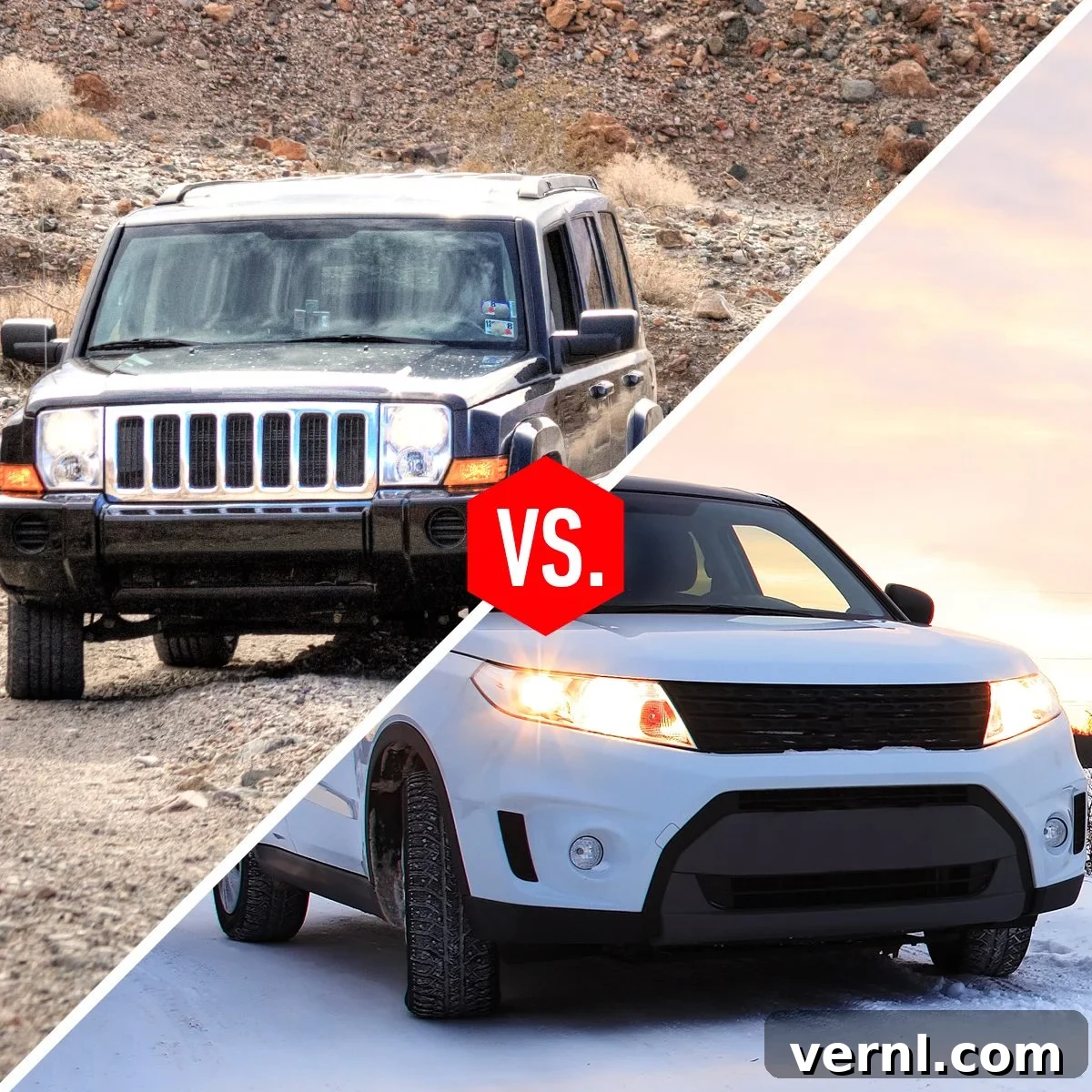
When navigating the vast world of automotive terminology, few concepts generate as much discussion and confusion as the difference between 4-wheel drive (4WD) and all-wheel drive (AWD). For many drivers, these terms are often used interchangeably, yet they represent distinct mechanical philosophies engineered for very different purposes. Understanding these differences is not just academic; it’s crucial for making informed decisions when purchasing a new vehicle, enhancing your safety on various road conditions, and optimizing your vehicle’s performance. Whether you’re an intrepid off-roader, a daily commuter facing challenging weather, or simply curious about how your car’s drivetrain operates, delving into the nuances of 4WD and AWD is an essential journey. Let’s buckle up and explore the intricate mechanisms that deliver power to all four wheels.
4WD vs. AWD: A Comprehensive Guide to Drivetrain Systems
Understanding Drivetrain Fundamentals: What Are 4WD and AWD?
At their core, both 4WD and AWD systems are designed to send power to all four wheels of a vehicle, an undeniable advantage over traditional two-wheel drive (2WD) systems. This capability significantly enhances traction and stability, particularly in adverse conditions. However, the fundamental difference lies in how and when they distribute this power, reflecting their intended applications and engineering philosophies.
- Four-Wheel Drive (4WD): Often synonymous with “4×4,” 4WD systems are robust, mechanically focused setups primarily found in trucks, large SUVs, and dedicated off-road vehicles. These systems are engineered to provide maximum traction and torque in the most challenging environments, such as deep mud, rocky trails, sand dunes, or unplowed snow. Historically, 4WD required manual engagement by the driver, offering distinct modes like 2WD, 4WD High (4H), and 4WD Low (4L). While modern advancements have introduced more sophisticated automatic 4WD systems, the essence remains: a rugged, heavy-duty solution for when the going gets tough. Its design prioritizes brute force and articulation over refined on-road manners.
- All-Wheel Drive (AWD): In contrast, AWD systems are generally more sophisticated, electronically controlled, and designed for enhanced stability and grip on paved or moderately unpaved roads. Commonly found in sedans, crossovers, and many SUVs, AWD operates continuously or engages automatically and seamlessly when wheel slip is detected. Its primary objective is to improve handling, acceleration, and safety on slick surfaces like wet roads, light snow, or gravel, without requiring driver intervention. AWD systems are typically lighter and more integrated into the vehicle’s overall design, focusing on adaptive response and improved on-road driving dynamics rather than extreme off-road capability.
Optimal Scenarios: When to Choose 4WD or AWD
The choice between 4WD and AWD largely depends on your primary driving environment and the challenges you regularly face. Each system shines in specific conditions, making them better suited for different lifestyles and adventures.
- When You Need 4WD: Conquering Extreme Terrain
If your adventures frequently take you off the beaten path, 4WD is your indispensable ally. It is purpose-built for extreme conditions where maximum, unwavering traction is paramount. Think:
- Rock Crawling: Navigating treacherous rock gardens requires the precise control and low-range gearing of a 4WD system, often paired with locking differentials, to ensure power is consistently delivered to wheels with grip.
- Deep Mud and Sand Dunes: The immense torque multiplication and robust construction of 4WD allow vehicles to power through viscous mud or climb steep, loose sand dunes without getting bogged down.
- Unplowed Winter Roads: In areas with heavy snowfall or icy, unmaintained roads, 4WD provides the necessary traction to break through snowdrifts and maintain forward momentum where AWD might struggle.
- Steep, Loose Inclines: When ascending or descending challenging grades with gravel, dirt, or loose rock, 4WD’s ability to lock axles and deliver consistent power prevents wheel spin and loss of control.
- Heavy Towing on Uneven Ground: For those who frequently tow large trailers, boats, or campers across fields, unpaved campgrounds, or launch ramps, 4WD offers the superior pulling power and stability needed.
4WD systems often involve a “low-range” gear setting (4L) that significantly multiplies engine torque, making it possible to crawl over obstacles slowly and with immense power. The driver typically engages these modes manually, providing ultimate control over the vehicle’s capabilities.
- When You Need AWD: Enhancing On-Road Stability and Safety
For most drivers, especially those living in regions with four distinct seasons or frequent precipitation, AWD offers a significant advantage in everyday driving. It’s designed to enhance safety and confidence on slick or challenging paved surfaces, without demanding any input from the driver. Consider AWD for:
- Rain-Slicked Highways: During heavy downpours, AWD systems automatically distribute power to prevent hydroplaning and maintain stability, making highway driving safer and less stressful.
- Light Snow and Icy Patches: In winter conditions, AWD provides better grip during acceleration and cornering on roads with light snow, slush, or black ice, greatly reducing the risk of skidding.
- Gravel Roads and Unpaved Driveways: While not for serious off-roading, AWD is perfectly capable of handling maintained gravel roads, ensuring consistent traction and preventing wheel spin.
- Spirited Driving: On dry, winding roads, some performance-oriented AWD systems can improve cornering stability and handling by optimizing power distribution, giving the driver a more connected and confident feel.
- Urban Commuting in Varied Weather: For city dwellers who encounter unpredictable weather, AWD offers a hands-free solution to ensure reliable traction from stoplights and through turns, without compromising fuel efficiency too much.
AWD systems are primarily about prevention and seamless adaptation. They react almost instantaneously to changes in traction, often before the driver even perceives a slip, providing a continuous safety net and improved driving dynamics.
The Mechanics Behind the Grip: How 4WD and AWD Function
Understanding the internal workings of these systems helps illuminate their specific strengths and limitations. While both transfer power to all four wheels, the underlying engineering is quite distinct.
- How 4WD Systems Work: Robust and Mechanical
4WD systems are characterized by their robust mechanical linkages and often employ a dedicated transfer case. This transfer case is the heart of the system, splitting the engine’s power between the front and rear axles. Unlike AWD, many traditional 4WD systems lack a center differential, which allows the front and rear axles to rotate at different speeds. This absence means that when 4WD is engaged (especially “part-time” 4WD), both axles are forced to rotate at the same speed. This direct, locked connection provides immense traction in slippery conditions but can cause “driveline bind” on dry, high-traction surfaces, making the vehicle difficult to steer and potentially damaging components. This is why part-time 4WD vehicles must typically switch back to 2WD on dry pavement.
More advanced 4WD systems, known as “full-time” 4WD, incorporate a center differential or a viscous coupling that allows for slight speed differences between the front and rear axles, enabling them to be driven on dry pavement. Furthermore, many serious off-road 4WD vehicles offer:
- Low-Range Gearing (4L): This gear setting, engaged via the transfer case, significantly multiplies engine torque at lower speeds. It’s invaluable for crawling over large obstacles, ascending very steep grades, or pulling heavy loads through challenging terrain.
- Locking Differentials: Front, rear, or sometimes both differentials can be manually or automatically locked. When a differential is locked, it forces both wheels on that axle to spin at the same rate, regardless of traction. This is critical when one wheel loses contact with the ground or is on a very slippery surface, ensuring power still goes to the wheel with grip.
In essence, 4WD is about raw, mechanically locked power distribution, providing unwavering traction by ensuring all wheels are working in unison, even if it means sacrificing some on-road refinement.
- How AWD Systems Work: Seamless and Adaptive
AWD systems, on the other hand, are designed for seamless, automatic operation. They continuously monitor various vehicle parameters, such as wheel speed, throttle input, steering angle, and sometimes even external temperature, using a network of sensors and an onboard computer. When a loss of traction is detected or anticipated, the system automatically and instantly redirects power to the wheels that have the most grip.
The key component in most AWD systems is a central differential or a clutch-based coupling (like a viscous coupling or multi-plate clutch) that manages power distribution between the front and rear axles. Unlike part-time 4WD, this component allows for speed differences between the axles, meaning AWD vehicles can operate safely on dry pavement without driveline bind.
Modern AWD systems can be quite sophisticated:
- Reactive vs. Proactive: Some systems are primarily reactive, engaging AWD only when slip is detected. Others are proactive, anticipating potential slip based on driver input and road conditions, and pre-emptively sending power to all wheels.
- Torque Vectoring: High-performance AWD systems may incorporate “torque vectoring,” which can distribute power not only between the front and rear axles but also between the left and right wheels on an axle. This advanced capability significantly improves handling, cornering stability, and traction during spirited driving.
- Variable Power Distribution: Many AWD systems operate with a front-wheel drive bias for efficiency, only sending power to the rear wheels when needed. Others might have a rear-wheel drive bias or be capable of splitting power 50/50, depending on the manufacturer’s design goals.
AWD’s strength lies in its intelligence and adaptability, providing enhanced safety and performance without any driver input, making it an ideal choice for everyday driving across varied conditions.
Impact on Your Wallet: Fuel Efficiency of 4WD vs. AWD
Beyond capability, the practicality of a drivetrain system often comes down to its impact on fuel economy. This is an area where 4WD and AWD diverge significantly, influenced by their design, weight, and operational principles.
- 4WD and Fuel Consumption: The Price of Robustness
In general, vehicles equipped with 4WD systems tend to exhibit lower fuel efficiency compared to their 2WD or AWD counterparts. Several factors contribute to this:
- Increased Weight: 4WD systems involve heavier, more robust components, including a substantial transfer case, beefier axles, and often stronger frames. This added weight demands more energy from the engine to move the vehicle.
- Parasitic Drag: The additional gears, shafts, and differentials within the 4WD system create more internal friction and resistance, known as parasitic drag, which constantly saps power from the engine, even when operating in 2WD mode.
- Aerodynamics: Vehicles designed for serious off-roading (typically 4WD) often have less aerodynamic shapes, higher ground clearance, and larger, more aggressive tires, all of which contribute to increased wind resistance and rolling friction, further reducing fuel economy.
- “Always On” Operation: Full-time 4WD systems constantly send power to all four wheels, maintaining the parasitic losses even on dry pavement. While part-time 4WD allows for 2WD operation, the heavier components are still carried.
If your driving primarily consists of commuting on paved roads and you rarely venture into extreme off-road scenarios, a 4WD vehicle might represent a significant and unnecessary drain on your fuel budget.
- AWD and Fuel Consumption: The Balance of Efficiency and Grip
AWD systems are generally more fuel-efficient than 4WD systems, though they typically consume slightly more fuel than comparable 2WD vehicles. This improved efficiency stems from their lighter design and intelligent operation:
- Lighter Components: AWD systems typically utilize lighter differentials, clutch packs, and half-shafts that are more integrated into the vehicle’s standard drivetrain. This reduces overall vehicle weight compared to a rugged 4WD setup.
- On-Demand Engagement: Many modern AWD systems operate predominantly in 2WD (often front-wheel drive) mode during normal cruising conditions to conserve fuel. Power is only sent to the secondary axle when wheel slip is detected or anticipated, minimizing parasitic losses when traction isn’t a concern.
- Electronic Optimization: Sophisticated electronic control units (ECUs) manage AWD systems, optimizing power distribution for maximum efficiency. They can disengage certain drivetrain components when not needed, further reducing drag.
- Aerodynamic Integration: AWD is commonly found in vehicles with more aerodynamic designs (sedans, crossovers), which inherently contributes to better fuel economy.
While an AWD vehicle will likely have a slightly lower MPG rating than its 2WD equivalent, the marginal increase in fuel consumption is often seen as a worthwhile trade-off for the enhanced safety and stability it provides in varied weather conditions. Technological advancements continue to push AWD fuel efficiency closer to that of 2WD vehicles.
Making the Smart Choice: Aligning Drivetrain with Your Driving Needs
Ultimately, the decision between 4WD and AWD boils down to a thorough assessment of your driving habits, environmental conditions, and intended vehicle use. There’s no universally “better” system; rather, there’s the right system for your specific requirements.
Factors to Consider Before Deciding:
- Primary Driving Environment: Do you spend most of your time on paved city streets and highways, or do rural, unmaintained roads, or even true off-road trails, factor into your regular routine?
- Local Weather Conditions: How frequently do you encounter significant snow, ice, heavy rain, or other slick conditions?
- Intended Vehicle Use: Will you be primarily commuting, taking family road trips, engaging in serious outdoor adventures (e.g., hunting, fishing in remote areas, overlanding), or towing heavy loads over challenging terrain?
- Budget Considerations: Beyond the initial purchase price, factor in the ongoing costs of fuel (4WD is generally less efficient) and potential maintenance for more complex systems.
- Personal Preference: Do you prefer the hands-off, automatic convenience of an AWD system, or do you appreciate the active engagement and robust control offered by selectable 4WD?
When AWD is Your Ideal Companion:
If your driving is predominantly on-road, but you frequently encounter adverse weather conditions like rain, light snow, or icy patches, AWD is likely the most practical and beneficial choice. It offers:
- Enhanced Safety: Improved grip during acceleration and cornering minimizes the risk of skids on slippery paved surfaces, contributing to safer commutes and family trips.
- Effortless Operation: The system works automatically and seamlessly, requiring no driver input, making it incredibly user-friendly.
- Balanced Performance: It provides a good balance between improved traction and reasonable fuel efficiency, without the added weight and complexity of a full-blown 4WD system.
- Versatility for Light Adventures: AWD is perfectly adequate for navigating gravel roads to a campsite, unpaved driveways, or light trails that are well-maintained.
AWD is often found in popular crossovers, sedans, and SUVs, making it an excellent upgrade for urban and suburban drivers seeking extra confidence year-round.
When 4WD is Your Indispensable Tool:
For those whose lifestyle or work demands navigating genuinely challenging landscapes, 4WD is not just a feature, but a necessity. Opt for 4WD if you:
- Are a Dedicated Off-Roader: If rock crawling, deep mudding, sand dune expeditions, or serious trail exploration are on your agenda, the robust mechanics, low-range gearing, and potential for locking differentials in a 4WD system are non-negotiable.
- Live in Remote or Unmaintained Areas: For homes accessed via challenging dirt roads, unplowed routes, or steep, slippery grades, 4WD provides the reliable traction needed to get you to your destination, regardless of conditions.
- Require Extreme Towing Capability: If you frequently tow heavy loads (e.g., large trailers, construction equipment) over uneven or soft terrain, the sheer pulling power and stability of 4WD are superior.
- Value Ultimate Control: Drivers who prefer to actively engage their drivetrain based on specific terrain and desire maximum mechanical advantage will appreciate the selectable modes of a 4WD system.
Vehicles with 4WD are typically pickup trucks, large body-on-frame SUVs, and specialized utility vehicles built for durability and resilience in the face of the toughest challenges.
In conclusion, both 4WD and AWD systems are engineered marvels designed to enhance a vehicle’s traction and control. Their differences, however, are critical and dictate their suitability for various driving conditions. By carefully considering your typical driving environment, local weather, and specific needs, you can confidently choose the drivetrain system that will keep you cruising smoothly, safely, and efficiently, no matter what road lies ahead.