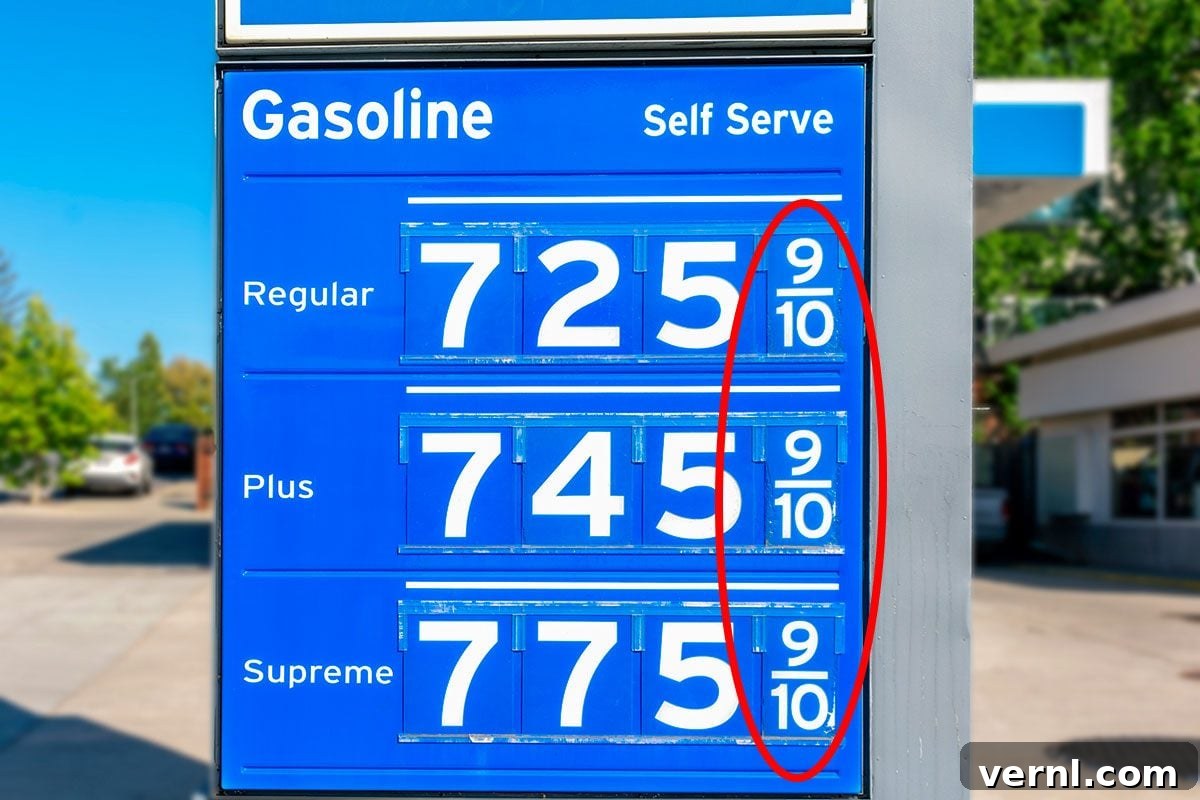
The Enduring Enigma: Why Gas Prices Still End in 9/10ths of a Cent
Every time you pull up to the pump, a familiar sight greets you: gas prices that seem to defy simple arithmetic. You see $3.49 and think it’s just that, ignoring the small, almost imperceptible “9/10” tacked onto the end. Most of us mentally round down, assuming a price that’s a cent lower than the actual cost per gallon. This isn’t just a casual oversight; it’s a deeply ingrained habit, a testament to a unique pricing strategy that has shaped the fuel industry for decades. While the fractional amount might appear insignificant when prices hover between $4 and $6 per gallon, it was a far more substantial figure back in the 1970s and earlier, when a gallon of gas cost less than a dollar.
Fractional pricing isn’t exclusive to gas stations; it’s a pervasive tactic across various retail sectors. Think of any product priced at $24.99 instead of a flat $25.00. This subtle difference is designed to trick consumers into perceiving the price as lower than it truly is. While an element of this psychological play is certainly at work in gas pricing, the story behind the 9/10th fraction is considerably more intricate. It’s a fascinating blend of historical tax policies, shrewd marketing, and deeply entrenched consumer expectations. To truly understand why this tradition persists, we consulted with leading experts in the field: fuel management specialist Eliot Vancil and esteemed automotive journalist Michael Satterfield, who shed light on its origins and enduring relevance.
The Economic Imperative and Consumer Expectation
One of the most immediate and tangible reasons for the persistence of fractional gas prices is their significant financial impact on retailers. As Eliot Vancil, a seasoned fuel management specialist, succinctly puts it, these seemingly minuscule fractions translate into substantial revenue. “A single station which fills 300,000 gallons monthly is getting a yearly increase of more than $32,000 on that one sub-cent increment,” Vancil explains. This figure underscores the critical role this fraction plays, especially given the notoriously thin profit margins in fuel retail, which typically range from a mere five to 15 cents per gallon of regular unleaded. For gas stations operating on such tight margins, that extra 9/10th of a cent isn’t a mere rounding quirk; it’s an intentional and vital line item contributing directly to their profitability, a detail most customers rarely stop to consider or inquire about.
Beyond the direct financial benefit, the continued use of 9/10th pricing is heavily influenced by deeply ingrained consumer habits and expectations. The practice has been around for so long that it has become an accepted norm. Consumers simply anticipate this fractional pricing for gasoline. Consequently, any attempt by stations to round up to the nearest full cent could easily trigger confusion or, worse, significant customer backlash. This isn’t mere speculation; history offers clear precedents.
According to Advancing Convenience & Fuel Retailing (NACS), the state of Idaho attempted to ban fractional pricing in 1985, even levying a $100 fine for non-compliance. However, this ban proved unsustainable and was repealed a mere four years later, demonstrating the deeply entrenched nature of the practice. A more recent example occurred in 2006 when a retailer in Palo Alto, California, experimented with dropping the 9/10th increment, advertising gas at a flat $2.99 per gallon instead of $2.999. The experiment yielded unexpected results. Some customers, conditioned to the fractional pricing, mistakenly assumed the retailer had rounded up the price. Others, perhaps hoping for a bargain, questioned why he hadn’t reduced the price even further if he was going to deviate from the norm. Ultimately, the experiment proved costly. The loss of that extra 9/10th cent in revenue amounted to approximately $23 a day for the retailer, based on an average daily sale of 2,500 gallons. These incidents vividly illustrate the challenges and financial risks associated with altering a pricing convention that has become second nature to both businesses and consumers.
Historical Roots: The Birth of Mil Pricing
To truly understand the 9/10ths phenomenon, we must delve into its historical origins, which trace back to the concept of “mil pricing.” A “mil” represents 1/1000th of a dollar, a unit of currency smaller than a cent (which is 1/100th of a dollar). The term itself is derived from the Latin “millesimum,” meaning “thousandth,” much like “cent” comes from “centum” for “hundred.” This denomination was officially recognized with the Coinage Act of 1792 in the United States, although it rarely materialized as a physical coin. While not commonly seen in everyday consumer transactions today, mil pricing is still widely used in specific financial contexts, such as calculating property tax assessments, determining stock issuances, and tabulating utility bills, where precise, sub-cent calculations are necessary.
The specific application of mil pricing to gasoline, however, began with a pivotal legislative act: the Revenue Tax Act of 1932. This act established a 1/10th-cent (or one mil) per gallon excise tax on gasoline. This federal tax, initially modest, has subsequently increased over the decades, now standing at 18.4 cents per gallon. The timing of this act is crucial. It was enacted during the tumultuous era of the Great Depression, a period marked by severe economic hardship and extreme price sensitivity among consumers. Gas prices at the time fluctuated dramatically, ranging from 20 to 30 cents a gallon, and in some areas, plummeting to as low as 10 cents a gallon.
In such a volatile economic climate, adjusting gas prices by a full cent represented a significant percentage change—anywhere from a 5 to 10 percent swing in the overall price. Such large, sudden fluctuations could easily unnerve an already strained public. To mitigate consumer anxiety and allow for more granular, less jarring price adjustments, retailers adopted the practice of making changes in mils rather than full cents. This strategy allowed them to pass on the new excise tax, and later respond to market shifts, with minimal psychological impact on customers, effectively softening the blow of price increases and making reductions feel more precise. What started as a practical solution to a tax imposition during an economic crisis quickly evolved into a standard industry practice.
From Necessity to Strategy: Modern Reasons for 9/10 Pricing
Initially, as Michael Satterfield explains, mil pricing for gasoline was simply a practical mechanism for gas stations to pass on the cost of the newly introduced federal excise tax without having to raise gas prices by a full, more noticeable cent. It was a direct response to a governmental mandate, a way to maintain stability in a fragile market. However, what began as a necessity quickly solidified into an industry standard. “The industry just never got away from it,” Satterfield notes, highlighting how deeply entrenched the practice became. Today, its primary function has evolved from a purely tax-driven mechanism to a sophisticated psychological marketing tool, akin to the common retail strategy of pricing an item at $1.99 instead of $2.00.
The widespread adoption and entrenchment of 9/10th pricing were significantly boosted in the late 1950s with the rapid development of the Interstate Highway System. As drivers traversed longer distances at higher speeds, gas stations strategically located along these major highways began advertising their prices prominently. These large signs displayed only the first two numbers, effectively masking the fractional ending. Drivers speeding by would quickly glance at the bold, dominant figures, instantly perceiving a lower price point without consciously registering the additional 9/10th of a cent. This visual trick became a powerful competitive advantage, solidifying the practice across the nation.
The convention was further reinforced, albeit temporarily altered, during President Nixon’s administration in 1971. Faced with rampant inflation, Nixon instituted freezes on prices and wages. During this period, a government-mandated formula briefly set fractional gas prices to values like 0.3 or 0.6 cents, rather than the standard 9/10. This departure from the norm, however, proved unpopular with both the public and retailers, leading to the swift return of the familiar 9/10th pricing. Since then, it has remained the steadfast rule in the United States, where gasoline is sold by the gallon.
Interestingly, the application of fractional pricing varies in countries where fuel is sold by the liter, such as Canada. In these nations, it is more common to see prices with fractions like 0.3 or 0.7 cents. This difference in fractional rate often stems from the fact that buying fuel in smaller quantities (liters instead of gallons) means the fractional impact on the final price can be more pronounced, necessitating different sub-cent increments for economic and psychological efficacy. The enduring presence of these fractions, regardless of the precise number, highlights the universal appeal of subtle price manipulation in the fuel retail sector.
The Reluctance to Round Up: Why Stations Stick to 9/10ths
Given the complexities and historical baggage associated with 9/10ths pricing, a logical question arises: why don’t gas stations simply round up to the nearest whole cent? The answer lies in a powerful combination of psychological marketing and practical revenue considerations, factors that make deviating from the established norm a significant financial risk for retailers.
Firstly, the psychological power of fractional pricing is undeniable. A price point like $2.999 per gallon inherently feels cheaper than a flat $3.00, even though the difference is less than a penny. This cognitive bias, often referred to as “charm pricing” or “left-digit effect,” makes consumers perceive the price as being within a lower price bracket. Rounding up to the nearest cent, even by a tiny fraction, shatters this illusion and pushes the price into a higher psychological category, potentially deterring price-sensitive customers. In a highly competitive market where drivers often choose stations based on perceived price advantages, losing this psychological edge can translate directly into lost sales.
Secondly, and perhaps more importantly from a business perspective, the extra 9/10th of a cent is a vital source of revenue for retailers. As previously highlighted by Eliot Vancil, for stations selling hundreds of thousands of gallons monthly, this seemingly insignificant fraction generates tens of thousands of dollars in additional annual income. Gas stations operate on notoriously thin profit margins, often earning only a few cents per gallon. In such an environment, every fraction of a cent is meticulously accounted for and contributes directly to the business’s viability. Abandoning this revenue stream would necessitate a fundamental shift in their business model, potentially forcing them to raise the base price by a full cent or more to compensate, thereby losing both the psychological advantage and a direct competitive edge. The historical examples of Idaho’s failed ban and the Palo Alto retailer’s costly experiment serve as stark reminders of the financial repercussions and consumer resistance faced by those who attempt to break from this long-standing convention. For gas stations, the 9/10th of a cent isn’t just a tradition; it’s a carefully calculated component of their economic survival.
Frequently Asked Questions (FAQ)
Why is gas one of the only consumer products priced in fractions of a cent?
The unique phenomenon of fuel being priced consistently below the cent, unlike virtually any other consumer product in the United States, is directly attributable to its historical origins. As Eliot Vancil explains, this distinction traces back to the Revenue Tax Act of 1932. This pivotal act established the federal excise tax on gasoline, which in turn necessitated the practice of mil pricing for fuel to allow for precise tax collection and price adjustments. Crucially, while this act set the precedent for gasoline, it did not extend similar fractional pricing requirements to any other consumer goods. Vancil adds an interesting historical note: the Revenue Tax Act of 1932 was never originally intended to be a permanent piece of legislation, yet its legacy in fuel pricing has endured for nearly a century.
Could gas stations legally drop the 9/10ths from their prices?
Yes, there is no federal law in the United States that explicitly prevents gas stations from pricing their fuel in full cents. In theory, a station owner could decide to charge $3.00 instead of $2.999 per gallon. However, for the myriad of reasons discussed throughout this article, stations are extremely reluctant to do so. The primary deterrents are the potential loss of competitive edge due to the psychological effect of fractional pricing and the significant reduction in profit margins. As demonstrated by past attempts to round up or eliminate the fraction, such a move often leads to decreased sales and direct financial losses, making it an impractical business decision in a highly competitive market.
About the Experts
- Eliot Vancil is the CEO of Fuel Logic LLC, a Dallas, Texas-based company specializing in comprehensive fuel management solutions, including nationwide delivery of various diesel types and gasoline.
- Michael Satterfield is an award-winning journalist, branding expert, and founder of The Gentleman Racer — a leading online publication covering automotive culture, travel, and lifestyle.
Sources
- Advancing Convenience & Fuel Retailing (NACS): Why Gas Is Priced Using Fractions of a Penny; (Accessed 2024)
RELATED:
- What Makes Gas More Expensive? Understanding the Factors Behind Fuel Costs
- Do You Know What That Little Button on Your Seat Belt Is For?
- What Those Lines on Your Backup Camera Really Tell You
- Here’s What The Small Panel On Your Car’s Front Bumper Is For