
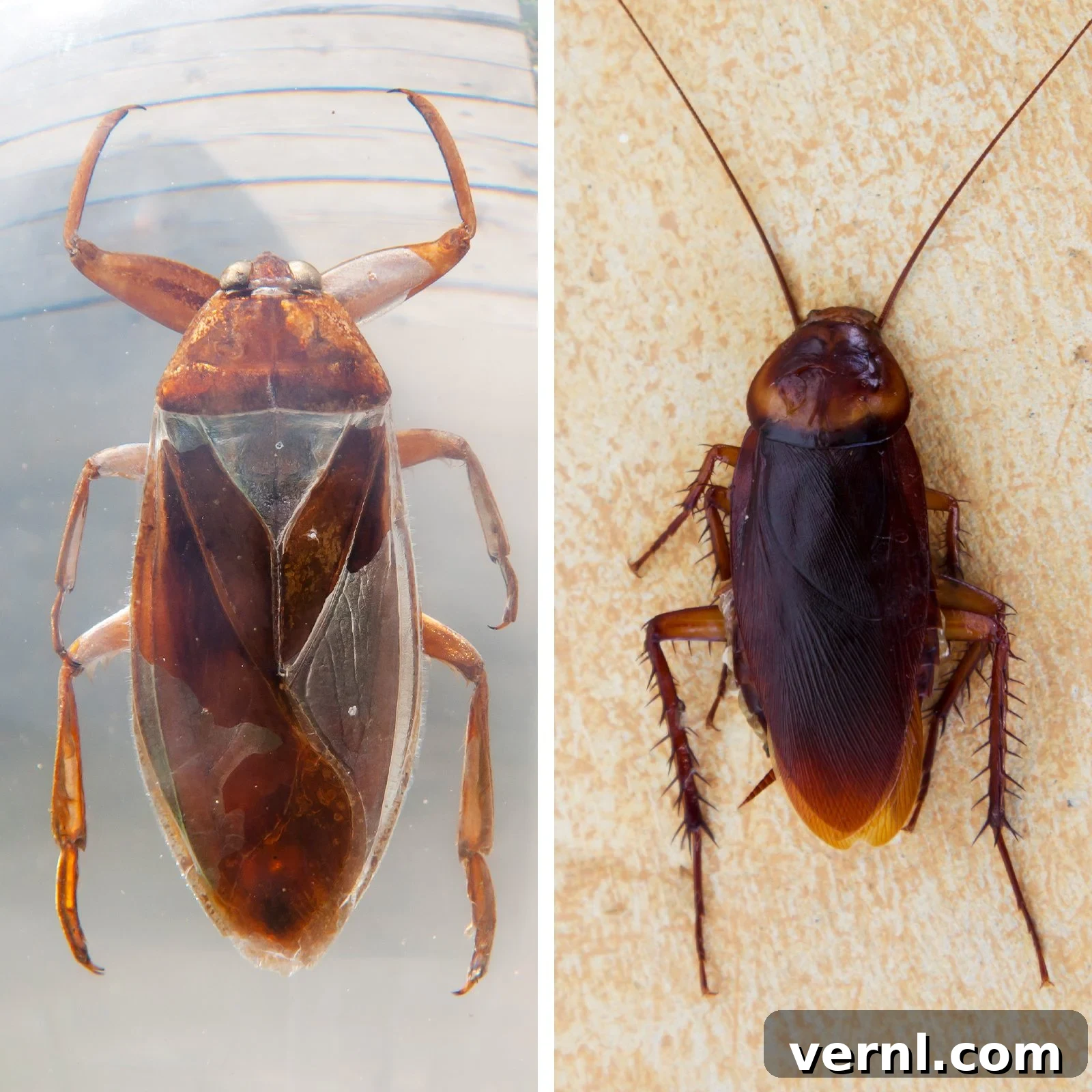
Water Bugs vs. Cockroaches: Unmasking the Truth About These Common Insects
For many, the mere sight of a large insect scurrying across the floor or floating in water can trigger a shiver of fear, often leading to misidentification. Among the most commonly confused insects are water bugs and cockroaches. While they might share a superficial resemblance, these creatures are vastly different in almost every aspect, from their preferred habitats and diets to their behaviors and the potential threats they pose. Understanding these distinctions is crucial for proper identification, effective pest management, and simply appreciating the unique biology of each species.
My own childhood encounters with “water bugs” in the local creek were a blend of curiosity and mild apprehension. Had I known then what I know now, I would have approached these fascinating creatures with far greater respect. These large insects, often dubbed “toe-biters,” possess a formidable defense mechanism: a powerful, venomous bite (technically an injection) that can deliver intense pain to an unsuspecting wader. This memorable experience underscores the importance of correctly identifying the insects we share our environment with.
Water bugs belong to the intriguing family Belostomatidae, a group comprising approximately 150 species of truly aquatic insects. They are giants in the insect world, with some species reaching impressive lengths of up to four inches. Their robust, oval-shaped bodies can indeed bear a passing resemblance to American cockroaches, often sharing similar earth-toned colorations of brown, black, or mottled gray. However, beyond this superficial similarity, their worlds rarely intersect, and telling them apart is far simpler than many assume.
The most fundamental difference lies in their habitat. As their name unequivocally suggests, water bugs are obligate aquatic inhabitants, thriving in ponds, marshes, and slow-moving streams. Cockroaches, on the other hand, are overwhelmingly terrestrial, with the vast majority actively avoiding water unless seeking moisture in damp environments. This primary distinction is often the easiest and most reliable way to differentiate between the two. While cockroaches are notorious scavengers, foraging for sustenance in our basements, pantries, and drains, water bugs are formidable predators, equipped to hunt and consume everything from tadpoles and small fish to other insects and even tiny frogs. Their role in their aquatic ecosystems is as vital as it is fearsome.
Water Bugs vs. Cockroaches: What Do They Truly Look Like Up Close?
While both cockroaches and water bugs possess oval bodies and six legs, a closer examination reveals a wealth of distinguishing features. Water bugs, particularly the larger species, are significantly more substantial than most cockroaches. Common cockroach species like the German or American cockroach typically measure around an inch to an inch and a half long, though the American cockroach can sometimes exceed two inches. In contrast, many water bug species, such as the giant water bug, can easily grow to two to four inches in length, with broader, more robust bodies. Both insect types tend to exhibit shades of brown or black, but water bugs often have a more uniform, duller gray-brown hue, while cockroaches might display reddish-brown or tan tinges, especially on their wings or pronotums.
One of the most immediate and telling differences is the presence or absence of antennae. Cockroaches are characterized by their long, filamentous antennae, which are crucial sensory organs used for navigation, detecting food, and communication. Water bugs, however, lack prominent antennae. Instead, their powerful front legs are highly specialized, appearing thick and raptorial, designed for grasping and holding prey. These legs are often mistakenly identified as antennae due to their forward projection. Furthermore, while cockroach eyes are often compound and partially obscured by their head and thorax, water bug eyes tend to appear more “normal” or prominent on the sides of their heads.
Wings are another important characteristic. Most adult cockroaches possess wings, though not all species are proficient flyers. Some, like the male American cockroach, are capable of strong flight, while others, such as the Oriental cockroach, have reduced wings and cannot fly. Water bugs also possess wings and are strong flyers, particularly when migrating between water bodies. The Oriental cockroach (Blatta orientalis) is frequently mistaken for a water bug due to its dark coloration and preference for damp environments; some even call them “water roaches.” However, unlike true water bugs, Oriental cockroaches typically lack functional wings for flight and possess those tell-tale antennae, making them relatively easy to differentiate upon closer inspection. Interestingly, cockroaches are known to make subtle noises for communication, a trait not commonly associated with the solitary water bug.
Water Bugs vs. Cockroaches: Distinct Habitats and Lifestyles
The names themselves provide the strongest clue regarding their preferred living environments. Water bugs are unequivocally aquatic, making their homes in the tranquil waters of ponds, marshes, and slow-moving streams throughout North America and beyond. Their unique physiology allows them to spend extended periods underwater. They achieve this feat thanks to a specialized breathing tube, or siphon, located at the rear of their abdomen, which they extend above the water’s surface to draw in atmospheric oxygen. This adaptation enables them to remain submerged, perfectly positioned for ambush predation.
Water bugs frequently float just an inch or two below the surface, camouflaged and motionless, waiting for an unsuspecting insect, tadpole, or small fish to swim by. This stealthy positioning is precisely why they’ve earned the notorious nickname “toe-biters.” An unwary wader stepping into their territory might inadvertently disturb one, provoking a swift and painful defensive bite. While the venom injected is not typically deadly to humans, it can cause excruciating localized pain, swelling, and discomfort, serving as a powerful deterrent. Knowing their habitat is key to avoiding these startling encounters.
In stark contrast, nearly all cockroach species are terrestrial, meaning they live exclusively on land. They are masters of adaptation and survival, preferring dark, moist, and secluded places to establish nests and breed. Indoors, homeowners might discover cockroaches in a variety of hidden locations: deep within basements, under sinks, behind appliances, inside kitchen cabinets, or any other area offering warmth, humidity, and proximity to food sources. Their nocturnal habits mean they often go unnoticed until an infestation becomes significant.
Outdoors, cockroaches find refuge under logs, within woodpiles, beneath rocks, or in leaf litter. They are prevalent throughout North America and across the globe, exhibiting remarkable resilience. During colder months, many outdoor cockroach species will seek warmth and shelter inside buildings, which is why infestations can sometimes appear seasonal. Understanding these distinct habitat preferences is paramount for both identifying the insect in question and implementing appropriate control or avoidance strategies.
Water Bugs vs. Cockroaches: Exploring Their Behaviors
The behavioral patterns of water bugs and cockroaches are as divergent as their habitats. Water bugs are often referred to as “electric light bugs” due to a peculiar behavior: when they embark on nocturnal flights to migrate from one body of water to another, they are strongly attracted to bright artificial lights. If you hear a large, buzzing insect circling your porch light or patio light at night, especially near a water source, there’s a significant chance it’s a water bug temporarily disoriented by the illumination. These flights are often driven by the need to find new food sources, mates, or escape drying habitats.
When not in flight, water bugs are typically ambush predators. They spend most of their time sitting motionless, either near the shore of a body of water or just beneath the surface, perfectly camouflaged, patiently waiting to pounce on unsuspecting prey. Their defense mechanisms are equally fascinating: if approached by a larger predator, a water bug can play dead, remaining perfectly still. Additionally, they are known to ooze an odorous, foul-smelling liquid from their anus as a chemical deterrent, a highly effective strategy to discourage potential threats. Unlike many insect species, water bugs are largely solitary creatures, preferring to operate independently rather than in groups.
Cockroaches, conversely, are highly social insects. The adage, “If you see one roach, there are probably many more nearby,” holds true. Their social structure is governed by pheromones, which guide them to congregate in preferred harborage areas. They are primarily nocturnal, becoming most active from a few hours before sunset until dawn, venturing out from their hiding spots to forage for food and water. Cockroaches exhibit thigmotaxis, a preference for tight, confined spaces where they can feel pressure on all sides of their bodies, which makes cracks, crevices, and under furniture ideal hiding spots.
Their collective behavior extends to reproduction and survival. If a cockroach colony grows too large for a given space, it will naturally split, with groups seeking out multiple nesting sites. This social dynamic, combined with their rapid reproductive rates, is why cockroach infestations can quickly escalate and become challenging to control. Unlike the predatory water bug, cockroaches are opportunistic omnivores and scavengers, consuming virtually any organic matter, from spilled food and crumbs to decaying plant material, paper, and even glue.
Water Bugs vs. Cockroaches: Effective Strategies for Pest Management
When faced with the presence of these insects, understanding how to manage them is key, and the approach differs significantly for water bugs versus cockroaches. Dealing with cockroaches often requires a multi-pronged strategy due to their social nature and rapid reproduction.
Managing Cockroach Infestations:
- Sanitation: The cornerstone of cockroach control is impeccable cleanliness. Regularly sweep and vacuum, wipe down surfaces, store food in airtight containers, and promptly clean up spills and crumbs. Eliminate all accessible food and water sources.
- Exclusion: Seal cracks and crevices in walls, floors, and foundations. Repair leaky pipes and faucets to eliminate moisture sources. Cockroaches can enter through incredibly small openings.
- Baits and Traps: Cockroaches are attracted to sweet substances. Mixing sugar or honey with boric acid creates an effective stomach poison for them. Place these baits in hidden areas where cockroaches are active. Gel baits containing insecticides are also highly effective and readily available. Sticky traps can help monitor activity and reduce populations.
- Insecticide Sprays: Use targeted insecticide sprays specifically formulated for cockroaches, applying them to harborage areas and entry points. Always follow product instructions carefully for safety and efficacy.
- Diatomaceous Earth: This natural, non-toxic powder can be sprinkled in areas where cockroaches travel. Its microscopic sharp edges abrade the insect’s exoskeleton, leading to dehydration and death.
- Professional Extermination: For large or persistent infestations, calling a licensed pest control professional is usually the most effective course of action. They have access to stronger treatments and expertise in identifying and treating the source of the problem.
Dealing with Water Bugs:
Unlike cockroaches, water bugs are rarely considered pests in the home. If you encounter a water bug indoors, it’s almost certainly an isolated incident. They may have flown in through an open window or door, attracted by lights, or simply wandered in by mistake. If you spot one, it’s highly improbable that there are more hidden nearby; they are solitary by nature. If you find what you suspect is a “water bug” and notice multiple individuals or a persistent presence, you are likely dealing with Oriental or American cockroaches, not true water bugs.
- Catch and Release: The best course of action for an indoor water bug is simply to catch it and release it outside, preferably near a natural water source. Use a cup and a piece of cardboard to scoop it up, or wear thick gloves if you must handle it directly.
- Avoid Barehanded Contact: Due to their powerful bite and venom, it is crucial never to handle a water bug with bare hands. Their bite is painful and should be avoided at all costs.
- Prevention: To prevent them from flying indoors, reduce outdoor lighting near entry points or use yellow “bug lights” during times when they might be active in flight. Ensure screens on windows and doors are intact.
In conclusion, while both water bugs and cockroaches might initially startle or confuse us, they are distinct insects with unique roles in their respective ecosystems. Proper identification is not just an academic exercise; it empowers us to react appropriately, manage potential threats effectively, and co-exist more harmoniously with the diverse insect life around us.