
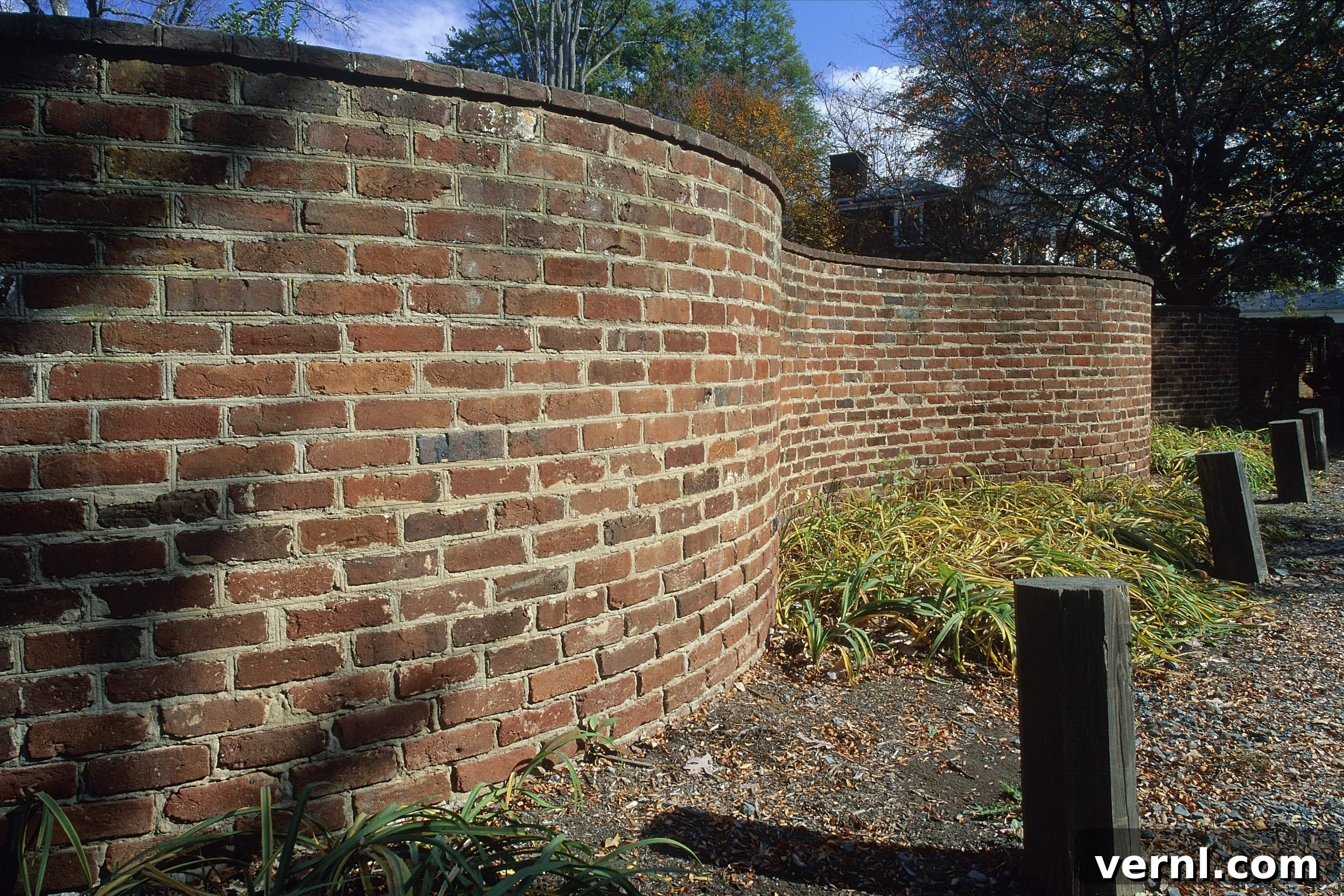
The Enduring Charm and Ingenious Engineering of Crinkle Crankle Walls
Every so often, one might encounter a brick wall that defies convention, opting for a graceful serpentine curve instead of a stark, straight line. These distinctive structures, known most commonly as crinkle crankle walls, are a testament to an ingenious blend of aesthetic appeal, structural integrity, and economic efficiency. While they are a more prevalent sight in the picturesque landscapes of England, their unique design has also found its way to various locations across the United States. Their transatlantic journey is notably attributed to the visionary mind of Thomas Jefferson, who famously incorporated them into the architectural fabric of the University of Virginia (UVA) in the early 19th century.
“Thomas Jefferson was truly a genius in many respects,” notes Gary Porter, technical director at the Masonry Advisory Council. “However, while many at the time believed Jefferson to be the innovator of this particular design, he was in fact brilliantly adapting a long-established and highly effective English style of construction. His genius lay in recognizing its value and integrating it into an ambitious American architectural project.” This adaptation speaks volumes about the timeless appeal and practical benefits of these fascinating walls.
What Are These Wavy Brick Walls Called? Exploring Their Diverse Nomenclature
The whimsical name “crinkle crankle walls” is thought to derive from an Old English word signifying “zigzag” or “winding path,” perfectly capturing their distinctive shape. Yet, this is merely one of several evocative names used to describe these undulating structures. They are also known as ribbon walls, due to their flowing, continuous form; wavy walls, a straightforward description of their primary characteristic; radius walls, reflecting the continuous curve of their construction; serpentine walls, for their graceful, snake-like movement; sinusoidal walls, a more technical term referencing the mathematical sine wave pattern they often follow; and even crinkum crankum walls, a delightful, alliterative variation of their most popular moniker.
Interestingly, the Dutch engineers who are credited with introducing and building many of the earliest examples of these walls in England referred to them as slang muur, which directly translates to “snake wall.” This array of names from different cultures and eras highlights the universal intrigue and visual impact of this unique architectural element, each name offering a slightly different perspective on their form and function.
The Ingenious Design: Why Are Crinkle Crankle Walls Wavy?
The curvilinear design of crinkle crankle walls is far from an arbitrary stylistic choice; it is rooted in profound principles of economy, structural strength, and indeed, aesthetic appeal. At first glance, one might assume that a wavy wall would require more materials and effort than a straight one. However, the opposite is true, and this is where the true brilliance of the design lies.
A conventional straight brick wall typically requires at least two rows of bricks to achieve sufficient stability and often needs additional buttresses or piers to withstand lateral forces over time. In stark contrast, a crinkle crankle wall, laid in a continuous sine wave pattern, achieves remarkable strength and stability using just a single row of bricks. This seemingly counterintuitive efficiency results in a significant reduction in material usage. For instance, at the University of Virginia, the construction of these walls is estimated to have required approximately 25 percent fewer bricks compared to a traditional straight wall of similar height and length.
“The primary motivation behind this design was efficiency,” explains Gary Porter. “These walls inherently act like a series of continuous arches, making them exceptionally strong and resistant to wind loads and other lateral pressures that might push against the structure. Each curve acts as a buttress for the adjacent section, distributing forces along the entire length of the wall rather than concentrating them at specific points.” This inherent structural advantage allows for a thinner, lighter, and ultimately more economical construction while maintaining or even exceeding the robustness of its straight counterparts.
However, while the structural and economic advantages of crinkle crankle walls are undeniable, the narrative at the University of Virginia carries a much more complex and somber dimension. In 2018, UVA conducted a comprehensive study examining its historical ties to slavery. This research revealed that Thomas Jefferson’s vision for the eight-foot-tall serpentine walls extended beyond mere architectural ingenuity and cost-saving. Tragically, he also intended for them to physically and visually segregate white students from the enslaved laborers who worked tirelessly on the campus. The walls served to mask the institution’s reliance on slave labor, preventing the enslaved individuals from seeing beyond the campus confines and simultaneously allowing slaveholders to more closely monitor their work. This painful revelation adds a layer of profound historical significance, reminding us that even objects of architectural beauty can be intertwined with difficult truths about human history.
The Origins and Global Journey of Wavy Brick Walls
While often associated with English gardens, the concept of the wavy brick wall boasts an ancestry that stretches back much further in time. Archaeological evidence suggests similar curvilinear wall structures existed in ancient Egypt, demonstrating that the idea of using curves for structural advantage or aesthetic appeal is not new. However, the crinkle crankle walls we most commonly recognize today primarily trace their documented history to England, where they flourished from the 17th to the 19th centuries.
The widespread adoption of these walls in England is largely attributed to Dutch engineers. These skilled craftsmen were instrumental in draining the vast marshlands of an area known as the Fens in eastern England. In this flat, often waterlogged terrain, stable and economical wall construction was paramount. The single-brick serpentine wall offered a perfect solution, providing strong enclosures with minimal materials and foundations. From these practical beginnings, their appeal expanded.
In England, many of these distinctive garden walls were strategically aligned from east to west. This orientation maximized their utility, particularly for horticulture. The south-facing curves of the walls, warmed by the sun throughout the day, created sheltered microclimates. This protected fruit trees and other delicate plants from harsh winds and frost, while also intensifying the sun’s warmth, thereby extending growing seasons and promoting better fruit ripening. This ingenious integration of engineering and agricultural benefit cemented their place in the English landscape, becoming a symbol of both practical design and rural charm.
Modern Relevance: Are Crinkle Crankle Walls Still Built Today?
Despite their historical ingenuity and undeniable charm, the construction of crinkle crankle walls has become a rarity in contemporary building practices. While they offered significant economic advantages a century or two ago, the landscape of modern construction has shifted dramatically, making them less viable today.
“It’s a design approach that has unfortunately faded out of common practice,” laments Gary Porter. He elaborates on the reasons for this decline: “Implementing this design today would demand a much higher level of specialized skill from bricklayers. Laying bricks along a precise radius is considerably more time-consuming and intricate than laying them in a straight line. Furthermore, the undulating footprint of a wavy wall naturally requires more ground space or ‘real estate’ than a straight wall of equivalent length. These factors, combined with increased labor costs for skilled masonry, translate into significantly higher construction expenses, making them less appealing for most modern projects focused on maximizing efficiency and minimizing budget.”
However, Porter expresses a hopeful desire for a resurgence of this unique architectural style. “They possess an undeniable attractiveness,” he states. “There’s a genuine need for this type of intricate masonry to reemerge. I live west of Chicago, and our downtown area is rich with older buildings. If you look up at their upper sections, you’ll discover a wealth of detailed ornamentation and unique features that imbue these structures with immense character. Such details are rarely seen in modern construction, primarily due to cost constraints. People are simply less willing to invest in these ‘expensive’ embellishments today.” This sentiment underscores a broader discussion about the value of craftsmanship, individuality, and aesthetic richness in an era often dominated by utilitarian and cost-effective designs.
Where Can You See Crinkle Crankle Walls Today? Preserving Architectural Heritage
For those eager to experience the unique beauty and structural elegance of crinkle crankle walls firsthand, several notable locations exist, though their documentation outside of England can be sparse. The highest concentration of these charming walls can be found in Suffolk County, nestled within the East Anglia region of England. Here, they continue to define the character of many historic estates, gardens, and village landscapes, a living testament to their enduring legacy. However, examples are scattered throughout other parts of the UK as well.
In the United States, beyond the prominent and historically significant examples at the University of Virginia, their presence is not as widely documented. Nevertheless, keen observers can still discover isolated instances. A few can be found adorning the grounds of a library in Chicago, adding an unexpected touch of historical masonry to an urban setting. Another known example graces a cemetery in Boulder, Colorado, offering a peaceful and contemplative setting for its undulating form. The limited number of documented sites in the U.S. makes each discovery all the more special.
The relative rarity of these walls outside of their English homeland only adds to their intrigue, inviting architectural enthusiasts and history buffs to seek them out. If you happen to know of a crinkle crankle wall in your local area, its discovery would be a valuable contribution to understanding the broader distribution and appreciation of these extraordinary architectural marvels. Sharing such insights helps to build a more comprehensive record of these walls and ensures their unique story continues to be told and celebrated.