
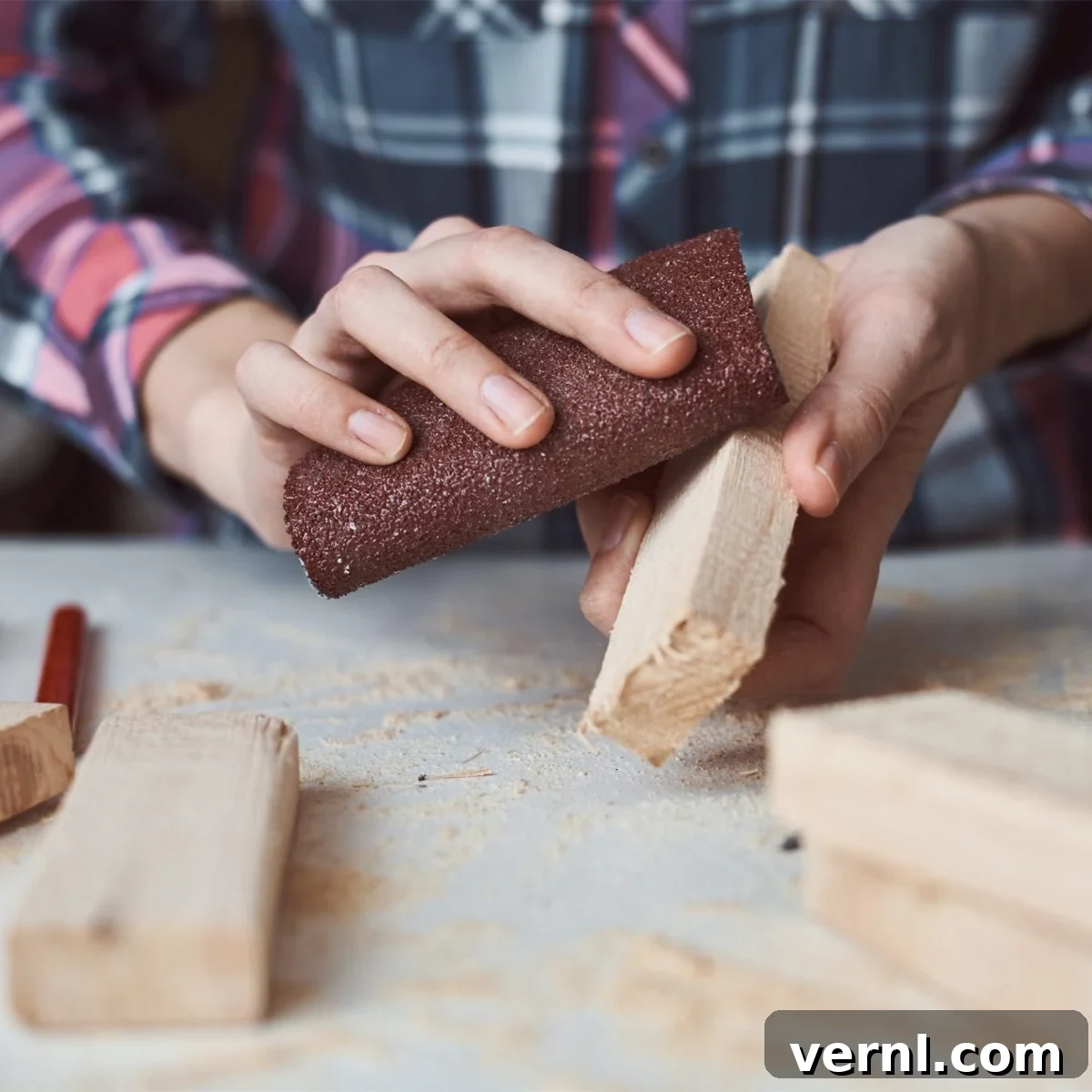
It’s challenging to envision a home improvement endeavor or a crafting project that doesn’t rely on the humble yet indispensable tool: sandpaper. From intricate woodworking projects to essential household repairs, sandpaper is the silent workhorse behind countless successful finishes. Woodworkers meticulously use it to smooth rough surfaces, shape intricate designs, and prepare wood for staining or sealing. Professional painters and casual DIY enthusiasts alike depend on it to strip away old finishes, feather edges, and polish new coatings to a flawless sheen. Even plumbers find a use for it, employing sandpaper to remove stubborn corrosion from metal pipes or to smooth the ends of plastic pipes, ensuring a perfect seal before applying adhesive.
Beyond these common applications, sandpaper proves its versatility in unexpected ways. Tackling drywall work or scrubbing old grout often calls for its abrasive touch. In a pinch, you can even use it to sharpen dull tools or, as many have discovered, to file fingernails! The sheer breadth of its utility underscores why understanding sandpaper is fundamental for anyone engaging in manual tasks around the home or workshop.
Given its widespread applications across so many different fields and tasks, it’s hardly surprising that sandpaper is available in a multitude of forms, each engineered for specific purposes. These variations are meticulously designed to optimize performance for different materials, tools, and desired outcomes. Key differentiators include:
- Abrasive material used: The type of grit material (e.g., aluminum oxide, silicon carbide, garnet, ceramic) dictates its hardness, durability, and suitability for specific surfaces like wood, metal, plastic, or finishes.
- Type of backing: The material to which the abrasive particles are adhered (e.g., paper, cloth, film) affects the sandpaper’s flexibility, tear resistance, and whether it can be used wet or dry.
- Format (sheet, belt, or disk) for specific sanding machines: Sandpaper comes cut into sheets for hand sanding or orbital sanders, belts for belt sanders, and disks for random orbital sanders or grinders, ensuring compatibility with a vast array of power tools.
Among these critical variables, grit stands out as one of the most defining characteristics. More than any other feature, the grit size fundamentally determines the appropriate applications and expected results from a particular piece of sandpaper. It’s the primary indicator of how aggressive or gentle the sanding action will be.
What Is Sandpaper Grit and Why Does It Matter?
Sandpaper grit is essentially a measure of its coarseness or fineness. This characteristic is determined by the physical size of the abrasive particles that are glued to its surface. Imagine tiny, sharp stones; the larger these stones are, the coarser the grit. This particle size directly impacts how the sandpaper interacts with the material it’s sanding.
A coarser grit, characterized by larger abrasive particles, will remove material much more quickly and aggressively. It’s excellent for rapid stock removal, stripping old paint, or leveling highly uneven surfaces. However, this efficiency comes with a trade-off: coarse grits invariably leave deeper scratches on the workpiece. In some scenarios, such as rough shaping or initial stripping, these scratches may not be a concern. But for projects requiring a smooth, refined finish, these initial deep marks must be systematically removed. This is achieved by progressively sanding with finer and finer grits until all previous scratch patterns are eliminated. This meticulous process, known among woodworkers, flooring installers, and furniture refinishers as “going through the grits,” is absolutely crucial for achieving a truly professional, blemish-free surface.
Understanding Grit Standards: CAMI vs. FEPA
To ensure consistency and quality across the industry, sandpaper grit standards are regulated by prominent organizations. In North America, the Coated Abrasive Manufacturers Institute (CAMI) system is widely adopted. In Europe and many other parts of the world, the Federation of European Producers of Abrasives (FEPA) system, often indicated by a ‘P’ prefix (e.g., P80, P220), is the prevailing standard. These organizations define grit numbers based on the size and density of holes in the screens used to filter the abrasive particles during manufacturing.
The logic behind the numbering system can initially seem counterintuitive. Larger abrasive particles, which create a coarser grit, pass through larger holes in the filtering screens. Because these particles are larger, fewer of them are required to fill a standard screen. Consequently, coarser grits are assigned smaller numbers. Conversely, finer grits, composed of much smaller particles, pass through smaller screen holes and are represented by larger numbers. This numbering convention is akin to how larger-diameter electrical wires are denoted by smaller gauge numbers in the American Wire Gauge system. For instance, in the CAMI system, sandpaper grits typically range from 24 (extra-coarse) to 1,000 (ultra-fine), and sometimes even higher for specialized polishing. In the FEPA system, this range broadly corresponds to P12 to P2,500.
Sandpaper Grits Are Categorized Into Grades for Clarity
While the manufacturing of sandpaper could theoretically allow for minute, incremental progressions in grit sizes, such a vast array would be impractical for both production and consumer choice, leading to unnecessary confusion. To simplify selection and ensure users choose the most appropriate abrasive for their tasks, manufacturers have wisely grouped specific grit numbers into distinct “grades.” These grades offer a practical framework, helping consumers quickly identify the type of sandpaper best suited for a particular purpose. As a general rule, the higher the grit number, the finer the abrasive and the smoother the finish it will produce. Therefore, grits progress from numbers like 24, 30, and 36 for extra-coarse applications, all the way up to 600, 800, 1,000, and even beyond for ultra-fine polishing.
These established grades — each encompassing one or more grit numbers — guide consumers in making informed decisions. For instance, the coarsest category is typically designated as “Extra-Coarse,” which includes grits such as 24, 30, and 36. At the other end of the spectrum, the finest grade, “Ultra-Fine,” often comprises 800- and 1,000-grit paper, designed for delicate finishing work. Understanding these grade categories is paramount because selecting the correct sandpaper grade is a critical step towards achieving desired results. Using a sandpaper that is too coarse for a particular stage of a project will inevitably leave unsightly scratches and potentially damage the surface, necessitating more work to rectify. Conversely, opting for a grit that is too fine for the initial stages will be inefficient, requiring excessive time and effort without making significant progress. For most general household projects and intermediate sanding tasks, a medium or fine grade typically offers the best balance of material removal and surface refinement.
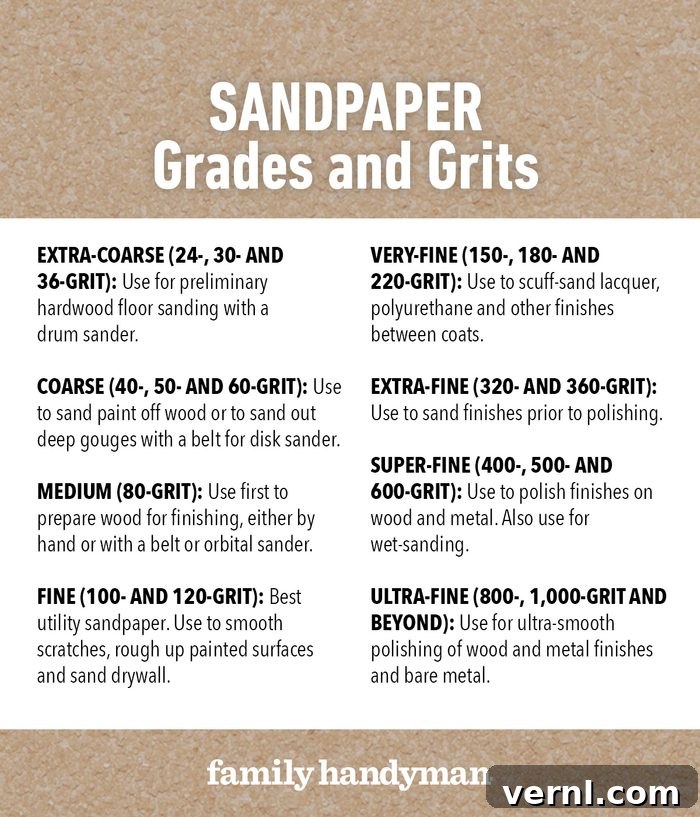
Detailed Breakdown: Sandpaper Grades and Grits for Every Task
The variety in sandpaper grades and grits reflects the diverse range of projects they are designed for. Generally, the coarsest sandpaper grades are engineered for heavy-duty applications, often paired with powerful machines like belt and drum sanders where aggressive material removal is paramount. Conversely, the finest grades are typically found on waterproof sheets, allowing for “wet-sanding” techniques that produce incredibly smooth, high-gloss finishes. Medium and fine grits are the most versatile, commonly available on standard 9 x 11-inch sheets for hand sanding or on precut backings compatible with popular power tools such as detail sanders, random orbital sanders, and vibrating sanders.
Here’s a comprehensive look at the sandpaper grades and grits you’ll commonly encounter at your local hardware store or specialty supplier, along with their ideal uses:
- Extra-Coarse (24-, 30-, and 36-grit): These are the most aggressive grits available, designed for heavy stock removal and initial shaping. They are primarily used for stripping old, thick finishes, aggressively sanding down rough-sawn lumber, or performing preliminary sanding on hardwood floors where significant material needs to be removed or leveled. You’ll typically find these grits in large belts for drum sanders or robust disks for edger sanders, optimized for industrial-level tasks.
- Coarse (40-, 50-, and 60-grit): Coarse grits are highly effective for removing substantial amounts of material quickly. They are ideal for tasks such as sanding stubborn layers of paint or varnish off wood, smoothing out deep gouges or scratches, and shaping wood in its early stages. These versatile grades are commonly available in 9 x 11-inch sheets for hand or block sanding, belts for drum and belt sanders, and disks for various types of disk sanders.
- Medium (80-grit): Often considered the workhorse of sanding, 80-grit is frequently the first grade chosen when commencing the “going through the grits” process to prepare wood for finishing. It strikes an excellent balance between material removal and surface refinement, making it suitable for smoothing surfaces after coarse sanding, removing minor imperfections, or preparing raw wood. It performs exceptionally well whether used for hand sanding or with a belt or orbital sander. Additionally, 80-grit is surprisingly effective for removing rust and general corrosion from metal surfaces.
- Fine (100- and 120-grit): This is arguably the best utility sandpaper for a wide array of household projects. Fine grades are perfect for smoothing out the scratch patterns left by coarser grits, ensuring a progressively smoother surface. They are also indispensable for “scuff-sanding” painted surfaces to create adhesion for a new coat of paint or primer. Furthermore, these grits are excellent for sanding drywall compound, ensuring a seamless finish before painting. For general hand-sanding tasks or use with an orbital sander, fine grit is the go-to choice for many DIYers.
- Very-Fine (150-, 180-, and 220-grit): These grits are essential for producing ultra-smooth surfaces on wood, particularly before applying clear finishes like stain, lacquer, or polyurethane. They are commonly used for the final sanding stage on bare wood to achieve a silky feel. Many professionals also utilize very-fine grits for “scuff-sanding” between coats of lacquer, polyurethane, or other finishes to improve inter-coat adhesion and eliminate minor imperfections without cutting too deeply into the previous layer.
- Extra-Fine (320- and 360-grit): Stepping into the realm of micro-abrasives, extra-fine grits are primarily employed for intricate sanding of finishes before the final polishing stage. They remove very minimal material, focusing instead on refining the surface texture to an incredibly smooth state, making it ideal for preparation before buffing or applying very thin final coats.
- Super-Fine (400-, 500-, and 600-grit): These high-grit papers are specifically designed for polishing finishes on wood and metal, as well as for achieving a refined shine on bare metal. They are frequently available on waterproof sheets, enabling “wet-sanding” techniques. Wet-sanding, often performed with water or a specialized lubricant, helps to clear away sanding dust, reduce friction and heat, and produce an even finer, smoother finish, often found in automotive detailing or fine furniture work.
- Ultra-Fine (800-, 1,000-grit and beyond): Representing the pinnacle of sandpaper refinement, ultra-fine grades are used for the ultimate polishing of wood and metal finishes, and for bringing bare metal to a mirror-like sheen. These grits are often used with wet-sanding methods to achieve the highest level of smoothness and gloss, typically seen in specialized applications like instrument making, jewelry polishing, or achieving show-quality finishes on custom projects.