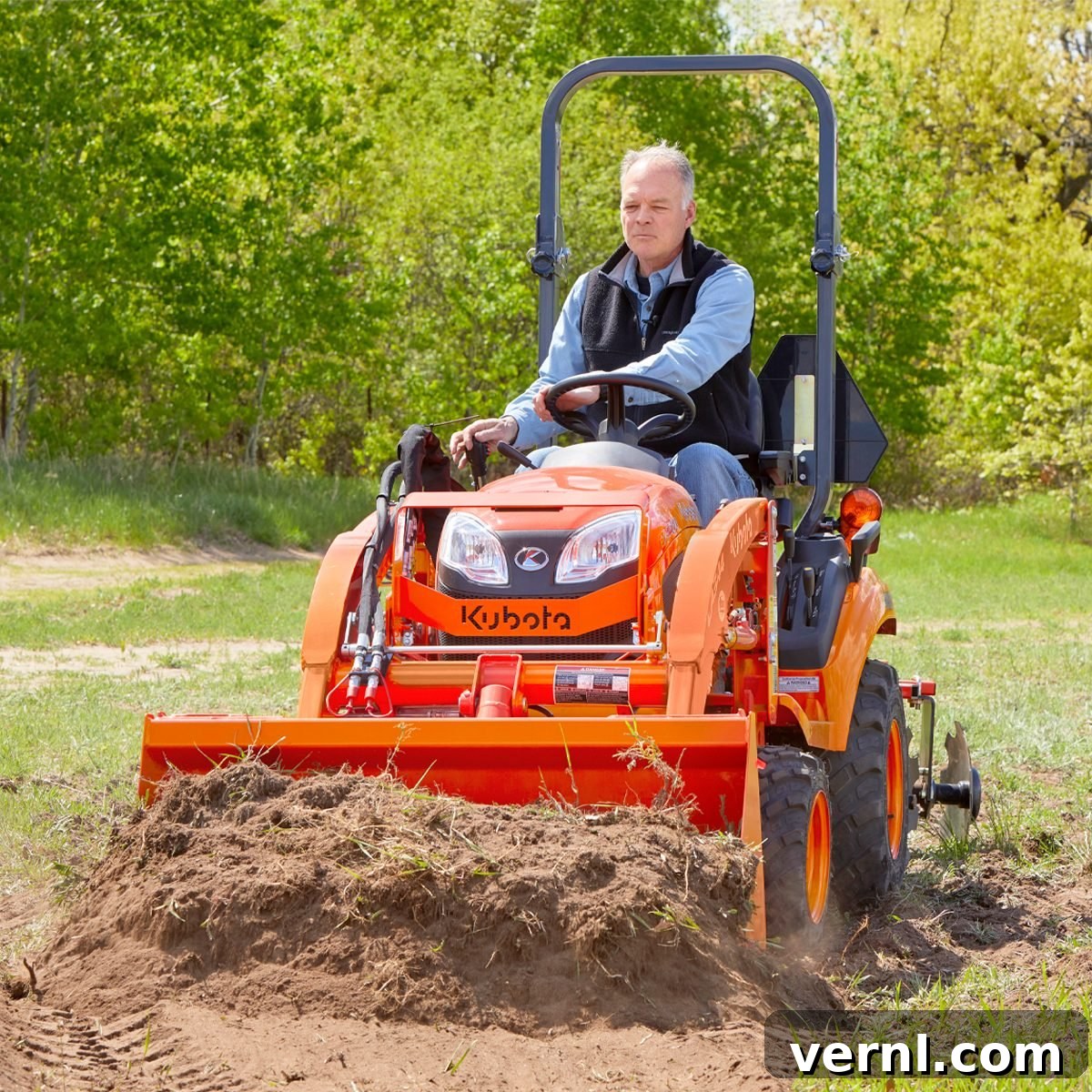
Subcompact tractors are indispensable tools for homeowners and DIY enthusiasts managing properties ranging from a single acre to multiple acres. These powerful yet adaptable machines, typically boasting up to 25 horsepower, expertly bridge the gap between basic lawn tractors and more robust agricultural equipment. They are designed to handle a diverse array of outdoor chores with efficiency and ease. Far more than just glorified lawnmowers, a subcompact tractor fundamentally transforms the way you approach land management, empowering you to unlock your property’s full potential.
From effortlessly moving soil, gravel, or mulch with a front-end loader to meticulously tilling a garden or clearing heavy snowfall, the right subcompact tractor paired with appropriate attachments significantly reduces manual labor. This allows you to achieve more in less time, making demanding tasks manageable and even enjoyable. However, before investing in such a long-term asset, it’s crucial to thoroughly understand their capabilities, the wide range of available attachment options, and the key characteristics that define these versatile machines. This comprehensive guide will illuminate everything you need to know to make an informed decision and maximize your subcompact tractor’s utility.
Understanding Subcompact vs. Compact Tractors
Tractors are broadly classified by their horsepower (hp) ratings, a critical factor influencing their capacity and suitability for various tasks. Subcompact tractors are specifically defined as having less than 25 horsepower. In contrast, compact tractors typically fall into the 25 to 50 hp range. While larger compact or utility tractors might be necessary for heavy-duty tasks such as lifting large, round hay bales, a subcompact tractor is perfectly sufficient for the vast majority of homeowner and small-acreage property management needs. Many subcompact models offer features commonly found in their larger counterparts, but in a smaller, lighter, and more budget-friendly package, making them an ideal choice for residential use.
The horsepower rating is a primary differentiator, but ultimately, the best subcompact tractor is the one that aligns most effectively with your specific tasks and property requirements, rather than simply chasing specifications. Focus on what you need to achieve, and then find the machine that can reliably perform those duties.
The Versatility of Subcompact Tractors: Why Choose One?
Choosing a subcompact tractor offers numerous advantages for property owners:
- Unmatched Versatility: These machines can perform a staggering number of tasks, making them a true multi-tool for your property. Their ability to switch between implements quickly means one machine can serve many purposes.
- Superior Maneuverability: Their smaller size makes subcompact tractors incredibly agile, allowing them to navigate tight spaces, intricate landscaping, and wooded areas where larger equipment simply cannot go. This is especially beneficial on properties with obstacles or varied terrain.
- Cost-Effectiveness: Generally, subcompact tractors have a lower upfront cost than compact or utility tractors. They also typically consume less fuel and may have lower maintenance expenses, offering long-term savings.
- Ease of Use: Many subcompact models are designed with user-friendliness in mind, often featuring automatic or hydrostatic transmissions that simplify operation, even for novice users.
- Reduced Manual Labor: Tackle physically demanding chores like digging, hauling, tilling, and mowing with significantly less effort and strain, transforming exhausting tasks into manageable ones.
- Enhanced Property Value: Regular and efficient property maintenance contributes to a more appealing and valuable landscape, and a subcompact tractor empowers you to achieve professional-level results.
Know What Implements You’ll Need
When embarking on the journey of purchasing a subcompact tractor, the initial and most crucial step is to define the tasks you intend to accomplish. As my personal experience with a Kubota BX2380 (current market prices vary; check with local dealers) highlighted, the tractor’s true power lies not in its standalone capabilities, but in its ability to integrate with a diverse range of attachments. A local dealer’s first question, “What implements do you want with it?”, perfectly encapsulates this philosophy. The tractor itself is merely the power unit; the implements are the tools that transform it into a highly specialized machine for specific jobs.
Your tractor shopping journey should always begin by answering the fundamental question: “What do you want to achieve with this machine?” Once you have a clear understanding of your property management goals, you can then pinpoint which subcompact tractor model and its compatible attachments will best suit your needs and budget. The right combination will enable you to perform tasks effortlessly and efficiently.
Popular Attachments for Subcompact Tractors
The versatility of a subcompact tractor largely stems from the extensive selection of attachments available. These add-ons dramatically expand the tractor’s functionality, making it an indispensable asset for nearly any outdoor task. While prices are illustrative and vary widely by manufacturer, dealer, features, and region, here are some of the most popular and beneficial attachments:
- Front-End Loader (FEL): Expect to invest several thousand dollars. This is arguably the most indispensable attachment. Mounted to the front, it features a bucket used for scooping, lifting, and transporting materials like soil, gravel, sand, mulch, snow, or debris. It’s excellent for grading, digging shallow trenches, and moving heavy objects.
- Mid-Mount Mower: Prices can range from $2,000 to $4,000+. Positioned beneath the tractor, this mower deck allows for precise and comfortable mowing, often preferred over pull-behind models for its maneuverability and ease of use, making the tractor an excellent lawn maintenance machine.
- Scraper Blade / Box Blade: Typically several hundred to over a thousand dollars. A scraper blade, or rear blade, attaches to the three-point hitch and is used for grading, leveling driveways, moving snow, and spreading gravel. A box blade is even more effective for grading, leveling, and backfilling, featuring scarifiers to break up compacted soil.
- Disc Harrow / Rotary Tiller: A disc harrow can range from $1,000 to $3,000+, while rotary tillers often fall in a similar range. A disc harrow breaks up and smooths soil, preparing it for planting. A rotary tiller provides a more thorough and finer soil preparation, ideal for creating garden beds, seedbeds, or cultivating existing gardens.
- Post-Hole Digger: This PTO-driven attachment is invaluable for fencing, planting trees, or installing signs, digging precise holes quickly and efficiently.
- Backhoe: While a significant investment, a subcompact backhoe attachment allows for digging trenches, excavating, and other light digging tasks, transforming your tractor into a mini excavator for specific projects.
- Snow Blower: Front-mounted or rear-mounted, a snow blower makes clearing large amounts of snow from driveways and pathways a breeze, often more efficient than a plow in heavy snow.
- Rotary Brush Cutter / Mower: Essential for clearing overgrown fields, thick brush, and small saplings, turning dense areas into manageable landscapes.
These diverse add-ons clearly demonstrate how subcompact tractors operate with a variety of implements. Tractors utilize a sophisticated hydraulic system to power and articulate a front-end loader, allowing for precise control over lifting, lowering, and tilting actions. For implements like the mid-mount mower or a rotary tiller, power is delivered via a power take-off (PTO) shaft, which transfers the engine’s power directly to the implement’s moving parts.
Many rear-mount implements are simple pull-behind or lift-and-lower attachments, mechanically operated by the tractor’s three-point hitch. However, you can also run powerful implements, such as a post-hole digger or a heavy-duty brush cutter, using a separate PTO shaft located at the rear of the tractor, which provides direct mechanical power for demanding tasks.
The Essential Three-Point Hitch System
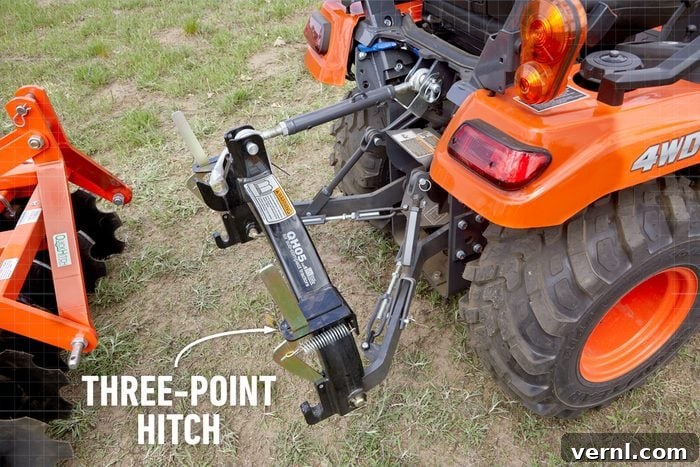
To effectively carry, pull, and precisely control nearly any rear-mounted accessory, tractors employ a robust three-point hitch system. This ingeniously designed triangular steel attachment, consisting of two lower lift arms and one upper link, serves as the universal interface for connecting implements. It functions by transferring the implement’s load efficiently to the drive wheels, enhancing traction and stability. Furthermore, it allows operators to easily switch between implements, a significant time-saver and convenience.
Most subcompact tractors utilize a Category 1 three-point hitch, which is standard for their size and horsepower range. Larger agricultural tractors, designed for more substantial loads and implements, feature higher categories, such as Category 2, 3, or even Category 4 hitches. A notable enhancement, like the quick-hitch accessory on my Kubota BX, further streamlines the process, allowing for implement changes directly from the driver’s seat. This convenience vastly improves efficiency and operator experience.
As the popularity and demand for subcompact tractors have surged, so too has the availability of compatible Category 1 three-point attachments. This expansion has been a game-changer, transforming subcompacts from mere “big lawn mowers” into incredibly versatile, multi-functional machines capable of tackling a wide array of property management and landscaping challenges.
Most Tractors Use a Hydrostatic Transmission
Modern subcompact tractors, including models like the Kubota BX series, predominantly feature a hydrostatic transmission, which essentially functions as a clutch-free automatic system. My test drive of the Kubota BX tractor vividly reminded me of the unique characteristics of this transmission type and its distinctive forward foot pedal operation. This system allows for seamless speed and direction changes without the need for a clutch or gear shifting, making operation remarkably smooth and intuitive.
During one instance, while attempting to fill the front-loader bucket with dense material, I instinctively pressed down hard on the forward pedal, much like accelerating a utility vehicle up a steep incline with a heavy trailer. However, with a hydrostatic transmission, this “pedal-to-the-metal” action doesn’t necessarily deliver more raw power to the wheels for digging. Instead, it effectively shifts the tractor into a higher gear range, which, in this scenario, was the opposite of what I needed. The tractor bogged down, struggling to fill the bucket.
I quickly realized my mistake. By easing off the foot pedal, selecting a lower gear range (typically “low” range), engaging 4-wheel drive, and then progressively increasing the throttle, the tractor was able to deliver the necessary torque to efficiently load the bucket. The reverse function in hydrostatic transmissions is typically controlled by a separate, heel-operated pedal, further simplifying directional changes.
While hydrostatic transmissions offer unparalleled ease of use, some subcompact tractors are still equipped with gear-driven manual transmissions. These manual systems are often considered more mechanically efficient, meaning they transfer a greater percentage of the engine’s power to the PTO-driven implements and drive wheels. This can result in more robust performance for demanding PTO applications and potentially better overall fuel mileage, though it requires more direct operator input for shifting gears.
Consider Comfort and Ergonomics
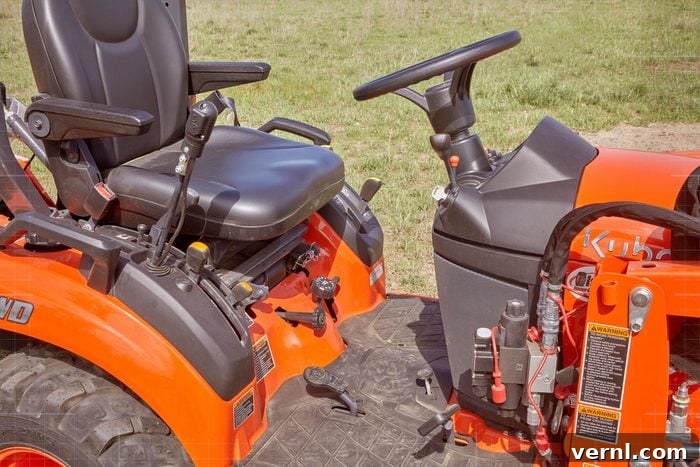
Given that you might spend hours at a time operating your tractor, operator comfort is not a luxury but a crucial consideration. Tractor operation involves manipulating a variety of controls, from steering and transmission operations to hydraulic levers, hitch controls, and PTO engagement. An ergonomically designed operator station can significantly reduce fatigue and enhance safety.
Features such as adjustable seating, intuitive control placement, and ample legroom are paramount. While armrests can be beneficial for support during long hours, their positioning should be carefully considered to ensure they don’t impede access to vital controls. Furthermore, depending on your local climate, a cab enclosure can be an essential addition, offering protection from the elements.
Soft-sided cabs, which provide shelter from wind, dust, and insects, can be an affordable option, often costing less than $2,000. For ultimate comfort and protection, hard cabs are available, though they typically cost four times as much. These premium enclosures allow for the integration of heating and air conditioning systems, transforming the tractor into a comfortable, all-weather workspace. Hard cabs can also include additional comfort features like a stereo system, enhancing the overall user experience. While aftermarket cabs can offer cost savings, investing in a factory-made cab system generally ensures a perfect fit, superior integration, and often better build quality and sound insulation.
Engine and Power Considerations
Most subcompact tractors are powered by robust and fuel-efficient diesel engines. These engines are known for their high torque at lower RPMs, which is ideal for heavy pulling, digging, and powering PTO-driven implements. When reviewing specifications, it’s important to differentiate between engine horsepower and PTO horsepower. Engine horsepower is the total power generated by the engine, while PTO horsepower indicates the power available at the power take-off shaft to run implements like tillers or mowers. For optimal performance with powered attachments, prioritize a tractor with sufficient PTO horsepower for your most demanding tasks.
Safety Features: Operating with Confidence
Safety should always be a top priority when operating any heavy machinery. Modern subcompact tractors come equipped with several important safety features designed to protect the operator:
- ROPS (Roll-Over Protective Structure): This sturdy frame is designed to protect the operator in the event of a rollover. Always ensure the ROPS is in the upright and locked position when operating on uneven terrain or near ditches, or if operating with it folded down, be extremely cautious.
- Seatbelts: Always wear your seatbelt, especially when the ROPS is engaged. It keeps you securely within the protective zone of the ROPS.
- PTO Safety Shields: These covers protect against entanglement with the rotating PTO shaft. Never operate a tractor with missing or damaged PTO shields.
- Parking Brake: A reliable parking brake is essential to prevent unintended movement when the tractor is stationary, particularly on inclines or when engaging/disengaging implements.
- Interlock Systems: Many tractors have safety interlocks that prevent the engine from starting or the PTO from engaging unless certain conditions are met, such as the operator being in the seat or the parking brake being set.
Maintenance and Dealer Support
Like any machine, a subcompact tractor requires regular maintenance to ensure its longevity and reliable performance. Adhere to the manufacturer’s recommended service schedule, which typically includes checking fluid levels, changing oil and filters, and lubricating grease points. Ease of access for routine maintenance tasks can be a significant benefit. Furthermore, selecting a reputable brand with a strong local dealer network is invaluable. A good dealer provides expert advice, readily available parts, and reliable service and repairs, which are crucial for minimizing downtime and keeping your investment running smoothly.
Common Applications for Subcompact Tractors
Subcompact tractors are incredibly versatile and can be used for a vast array of tasks around your property:
- Lawn & Garden Care: Mowing large lawns or rough fields, tilling garden beds, spreading seed, fertilizer, or topsoil.
- Landscaping Projects: Moving and grading soil, hauling gravel, mulch, or decorative rocks, digging small ponds or trenches.
- Property Maintenance: Clearing brush, cutting down small trees, removing snow from driveways and pathways, digging post holes for fences or mailboxes.
- Homesteading & Small Farming: Light tilling, hauling feed, moving firewood, light material handling in barns or small livestock areas.
- Driveway & Pathway Management: Grading and leveling gravel driveways, sweeping debris, compacting surfaces.
Maximizing Your Subcompact Tractor’s Potential
To get the most out of your subcompact tractor, always prioritize safety, read your operator’s manual thoroughly, and never attempt a task that exceeds the tractor’s or attachment’s capabilities. Regular cleaning and maintenance will extend its lifespan. Consider investing in a shed or garage for protection from the elements. Taking the time to learn proper operating techniques, especially for loader work and PTO attachments, will boost your efficiency and confidence, allowing you to tackle more projects with ease.
FAQ
How much land is a subcompact tractor best for?
A subcompact tractor typically excels on plots of land ranging from one to ten acres, though its effective range can extend somewhat bigger depending on the terrain and the specific work involved. With its power rating of less than 25 horsepower and compatibility with smaller implements, it is perfectly suited for general upkeep, landscaping, and light property management for homeowners or small plot owners. It is not designed for large-scale agricultural farming or demanding commercial operations that require significantly more power and size.
What are the limitations of a subcompact tractor?
The primary limitations of a subcompact tractor stem from its inherent size and power. It cannot lift large, round hay bales, nor is it engineered to plow deep across many acres, or undertake demanding commercial jobs that require substantial heavy lifting or ground engagement. Its usefulness is directly tied to owning the proper tools and implements for the work at hand. While highly useful, its smaller engine and lighter build mean it has reduced lifting capacity and overall power output compared to larger compact or utility tractors. Consequently, it cannot perform the same volume or intensity of work as these more robust machines. Ground clearance can also present a limitation on very rough, heavily rutted, or extremely uneven ground, where it may be prone to bottoming out.
What is the typical cost of a new subcompact tractor?
The price of a new subcompact tractor can vary significantly based on the brand, model, features, and included attachments. Generally, a new subcompact tractor without any major implements might start from around $12,000 to $18,000. However, once you add essential attachments like a front-end loader and a mid-mount mower, the total investment can easily climb to $20,000 to $30,000 or even higher. It’s always best to consult local dealers for current pricing and package deals.
How often should I perform maintenance on my subcompact tractor?
Routine maintenance intervals for subcompact tractors are typically outlined in the owner’s manual and are usually based on operating hours. Common intervals include daily checks (fluid levels, tire pressure), 50-hour inspections (lubrication, filter checks), and 200-hour or annual service (oil changes, filter replacements, more thorough inspections). Adhering to these schedules is crucial for the tractor’s longevity, efficiency, and safety.
Should I buy new or used?
Both new and used subcompact tractors have their advantages. A new tractor comes with a warranty, the latest features, and peace of mind. A used tractor can be a more budget-friendly option, but it’s essential to thoroughly inspect its condition, review service records, and ideally have it checked by a qualified mechanic. For first-time buyers, a new tractor might offer more reassurance, while experienced operators might find great value in a well-maintained used model.
ABOUT THE EXPERTS
ANBO Manufacturing is an American company specializing in the design and creation of heavy-duty attachments for tractors, skid steers, and loaders. They provide expertise on the effective use of implements like box blades, offering practical insights into optimizing ground engagement and material handling.
Mahindra is a global tractor and farm equipment manufacturer known for its robust and reliable machinery. The company offers valuable insights into tractor operation, including the critical importance of operator comfort for ensuring both safety and efficiency during long working hours.