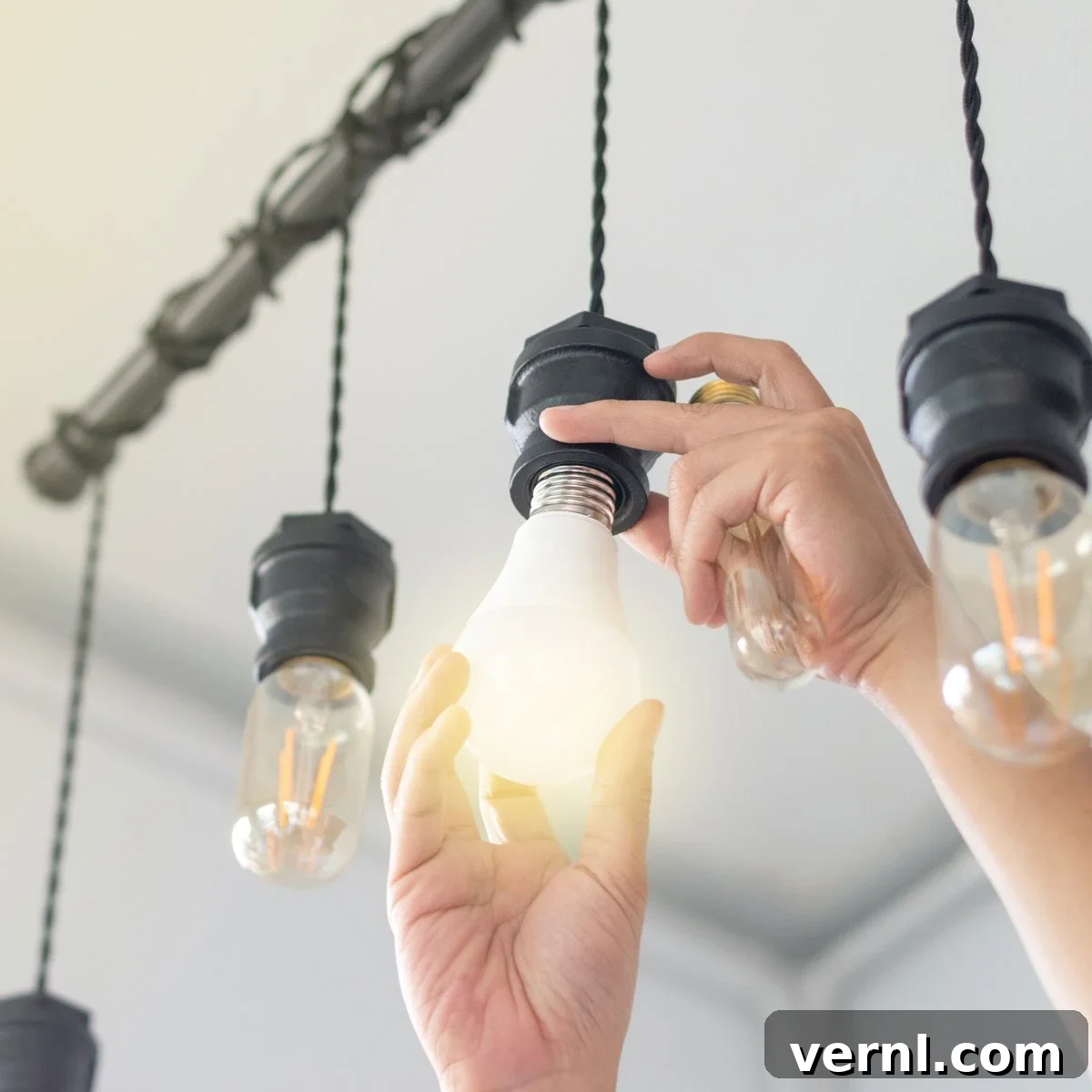
Lighting is far more than just illumination; it’s a cornerstone of home design, comfort, and energy efficiency. Often overlooked, the right lightbulbs can subtly yet powerfully transform any living space. They possess the unique ability to influence mood, make rooms feel expansive or cozy, and artfully highlight your cherished decor or architectural features – all while contributing to significant savings on your energy bills.
For many first-time homeowners, the intricacies of home lighting might not be top of mind. Yet, a thoughtful upgrade of the lightbulbs in your newly purchased house is one of the quickest, most impactful, and surprisingly affordable ways to imbue a new space with a sense of “home.” Beyond aesthetics, this simple change can dramatically cut down on utility costs. With an ever-evolving market, choosing the ideal lighting solution can indeed feel overwhelming. This comprehensive guide aims to demystify the process, offering a clear overview of modern lightbulb options to help you create a beautifully lit and energy-efficient home that truly shines.
Why an Effective Home Lighting Upgrade is Essential
Upgrading your home’s lighting isn’t just about replacing old bulbs; it’s a strategic enhancement that yields both immediate and long-term benefits. There are two primary, compelling reasons to re-evaluate and improve the lightbulbs in your new home:
Significant Savings on Energy Consumption
A substantial number of homes across the globe still rely on outdated incandescent lightbulbs. These traditional bulbs operate by heating a filament, making them notoriously inefficient – a staggering 90% of the energy they consume is converted into heat rather than light. Consequently, incandescent bulbs consume considerably more energy than their modern counterparts. Beyond the obvious environmental footprint, powering a home filled with these energy guzzlers will inevitably lead to a higher monthly utility bill.
Embracing newer, more energy-efficient lighting technologies is a smart financial move. By swapping out any remaining incandescent bulbs for modern options like compact fluorescent lightbulbs (CFLs), halogen, or especially LED bulbs, you can dramatically lower your carbon footprint and enjoy substantial savings on your electricity bill. These advanced bulbs not only use less power but also last significantly longer, reducing the frequency of replacements and further cutting down on costs and waste. This transition represents a practical step towards a more sustainable and economical household.
Crafting the Perfect Atmosphere and Ambiance
Have you ever noticed how some rooms feel inherently welcoming, while others remain stark or uninviting, even with the lights on? Poor lighting choices can make a new kitchen appear dim and uninspiring, or cause the elegant dining room chandelier to be blindingly bright, forcing you to squint every time it’s switched on. The right lighting is pivotal in defining a room’s character and functionality.
Different spaces within your home demand distinct lighting approaches. Functional areas, such as the kitchen, bathroom, home office, or a dedicated workspace, benefit immensely from bright, crisp white light that promotes visibility, focus, and productivity. Conversely, leisure-oriented rooms like the dining room, living room, or bedroom thrive when bathed in a soft, warm glow that encourages relaxation, comfort, and intimacy. Choosing lightbulbs that offer the ideal level of brightness (lumens) and color temperature (Kelvins) is crucial for setting the perfect mood and ensuring each room serves its purpose effectively and aesthetically. A well-lit home is not just about seeing clearly; it’s about feeling right.
Understanding the Main Types of Lightbulbs
The modern market offers a diverse range of lightbulb types, each with its unique characteristics concerning cost, energy efficiency, lifespan, and light quality. While they all aim to illuminate, their underlying technologies and overall performance vary considerably. Here are the five most common types of lightbulbs available today, helping you make informed decisions for your home lighting upgrade:
Incandescent Lightbulbs
For over a century, incandescent bulbs were the undisputed kings of domestic lighting. They operate on a simple principle: electricity heats a filament inside a vacuum or inert gas, causing it to glow. While they provide instant, warm light with excellent color rendering, their inherent inefficiency has led to their gradual phasing out in many regions. Incandescent bulbs are typically the cheapest to purchase upfront but are by far the most expensive to operate due due to their high energy consumption and short lifespan (approximately 750-1,000 hours). Their significant heat output also contributes to higher cooling costs in warmer climates. For environmental and economic reasons, it is highly recommended to replace these bulbs with more efficient alternatives. When disposing of them, incandescent bulbs can usually be tossed into your regular household trash, as they do not contain hazardous materials that require special recycling.
Compact Fluorescent Lightbulbs (CFLs)
CFLs represent a significant leap in energy efficiency compared to incandescents. These bulbs miniaturize the technology found in larger fluorescent tubes used in commercial and office settings, coiling them tightly to fit into standard light fixtures. CFLs work by passing an electric current through a tube containing argon and a small amount of mercury vapor, which then excites a phosphor coating to produce visible light. They are generally more expensive than incandescent bulbs but considerably less costly than LEDs. A key benefit of CFLs is their impressive lifespan, often lasting up to 10 times longer than traditional incandescents (around 8,000-10,000 hours), and using about 75% less energy. However, CFLs can take a short period to “warm up” to full brightness, and their dimming capabilities can be limited without specific compatible dimmers. A critical consideration for CFLs is their mercury content. While small, this makes them a hazard if broken and mandates proper recycling to prevent environmental contamination. Always check with your local recycling and waste collection services for specific guidelines on CFL disposal, as many areas have designated drop-off points.
Halogen Lightbulbs
Halogen bulbs can be thought of as an improved version of the incandescent bulb. They also use a tungsten filament, but it’s encased in a compact capsule with halogen gas. This gas helps to redeposit evaporated tungsten back onto the filament, increasing its efficiency and lifespan compared to traditional incandescents. Halogen bulbs typically use up to 30% less energy than standard incandescent bulbs while still providing an instantly bright, crisp white light. They are also fully dimmable, offering versatility in creating different moods. However, halogen bulbs operate at very high temperatures, making them hot to the touch and requiring careful placement away from flammable materials. They also have a relatively short lifespan compared to CFLs and LEDs (around 1,000-2,000 hours), making them a less sustainable long-term choice. Halogen bulbs can generally be disposed of with your regular household waste, similar to incandescents, as they do not contain mercury or other special hazardous materials.
LED Lightbulbs (Light Emitting Diodes)
LEDs are the vanguard of modern lighting technology and are widely considered the gold standard for home illumination. These bulbs produce light through electroluminescence, a highly efficient process that generates very little heat. While they represent the highest initial investment, LEDs are by far the most energy-efficient bulbs available, using up to 90% less energy than incandescents. Their most compelling feature is their extraordinary lifespan, which can range from 25,000 to 50,000 hours or even more, lasting approximately six times longer than CFLs and 25-50 times longer than incandescents. LEDs offer instant full brightness, are cool to the touch (reducing heat gain in a room), and contain no mercury, making them environmentally safer than CFLs. They are available in a vast array of shapes, sizes, and color temperatures, and many are designed to be dimmable. Some modern light fixtures even come with LED lights integrated directly into the design, known as integrated LEDs, which are not designed for bulb replacement. Standard LED lightbulbs can generally be disposed of with your regular household waste, though many recycling centers are now accepting them due to their increasing prevalence and the desire to recover valuable materials. It’s always a good idea to check with your local recycling service for any specific drop-off points or programs.
Smart LED or CFL Lightbulbs
Taking home lighting into the digital age, smart lightbulbs offer unparalleled control and customization. These are essentially LED or CFL bulbs equipped with integrated connectivity, allowing them to be controlled, customized, and scheduled remotely. This can be done via a dedicated smartphone app, popular smart assistants like Amazon Alexa or Google Assistant, or through a central home automation hub. Connectivity typically relies on WiFi, Bluetooth, or a proprietary smart home system protocol. The ability to precisely control brightness, color temperature, and even the color spectrum (for RGB smart bulbs) significantly enhances both the aesthetic and functional aspects of your home lighting. Beyond ambiance, smart lightbulbs significantly boost energy efficiency through scheduled operation, motion detection, and dimming features, further extending their already impressive lifespan. They also contribute to enhanced home safety and security by allowing you to simulate occupancy when away or integrate with security systems. Disposal for smart LED or CFL bulbs follows the same guidelines as their conventional LED and CFL counterparts, respectively, depending on the core technology of the bulb.
Crucial Lightbulb Performance Measurements
Selecting the right lightbulb goes beyond just choosing a type. Understanding key performance metrics—brightness, color temperature, and color rendering index—is essential for achieving the desired look, feel, and functionality for any room or space. Keeping these factors in mind will empower you to make precise choices for your lighting upgrade.
Brightness (Lumens vs. Watts)
Historically, we associated a bulb’s brightness with its wattage. However, wattage actually measures the energy consumed, not the light produced. With the advent of energy-efficient bulbs, lumens have become the standard unit for measuring the actual light output, or brightness, of a bulb. A bulb with higher lumens emits more light. For context, a standard 40-watt incandescent bulb typically produced around 450 lumens, while a 100-watt incandescent bulb offered approximately 1,600 lumens. Modern LED bulbs can achieve the same lumen output using significantly fewer watts.
When choosing light bulbs, consider the room’s function and size. For task-oriented areas like a kitchen, home office, laundry room, or garage, higher lumen levels (e.g., 5,000-10,000 lumens for general kitchen lighting, 800-1,600 lumens for a desk lamp) are ideal for ensuring clear visibility and preventing eye strain. In contrast, for creating a relaxing and inviting atmosphere in a living room, family room, or bedroom, opting for lower lumen levels (e.g., 400-800 lumens per fixture) is more suitable, contributing to a softer ambiance. Before purchasing, it’s also vital to confirm the correct light bulb base type (e.g., E26, E12, GU10) to ensure compatibility with your existing fixtures.
Color Temperature (Kelvins)
Color temperature describes the perceived warmth or coolness of the light emitted by a bulb and is measured in Kelvins (K). This metric significantly impacts the mood and functionality of a space. Lower Kelvin temperatures indicate warmer tones, appearing more yellowish-red, while higher Kelvin temperatures indicate cooler tones, appearing more bluish-white.
- **Warm White Light (2,000K to 3,000K):** These temperatures produce a soft, warm yellow or white tone, similar to traditional incandescent bulbs or candlelight. They are perfect for creating an intimate, cozy, and relaxing atmosphere, making them ideal for living rooms, dining rooms, bedrooms, and other areas where comfort and unwind are priorities.
- **Cool White to Daylight (3,500K to 5,000K+):** Lights in this range emit a crisp, bright white light that increasingly simulates natural daylight as the Kelvin value rises. Lights around 4,000K are excellent for task lighting in kitchens, bathrooms, and home offices, where clarity and focus are important. Temperatures closer to 5,000K (Daylight) offer maximum alertness and are suitable for workshops, garages, or areas requiring very precise visual tasks. Understanding color temperature allows you to tailor the lighting to the emotional and practical needs of each room, enhancing both aesthetics and comfort.
Color Rendering Index (CRI)
The Color Rendering Index (CRI) is a quantitative measure of a light source’s ability to reveal the true colors of objects accurately, compared to how those colors would appear under a natural light source (like sunlight). The CRI scale ranges from 0 to 100, with 100 representing perfect color rendering. This measurement is particularly relevant for CFL bulbs and LEDs, as older incandescents naturally had a high CRI (often 95-100). The higher the CRI value, the more accurately and vibrantly colors will be represented under the bulb’s light.
A high CRI is crucial in spaces where true color representation is important. For instance, in a bathroom vanity area, an 80+ CRI ensures makeup is applied accurately and skin tones appear natural. In art studios, photography setups, or dressing rooms, a CRI of 90 or higher is often desired to prevent color distortion. While not always a top priority for every room, aiming for a CRI value of 80 or higher in living spaces and functional areas can significantly enhance visual comfort and the overall aesthetic appeal of your home’s interiors.
A Practical Room-By-Room Lightbulb Guide
Navigating the best lightbulbs for each specific area of your home can seem daunting, but a strategic approach tailored to each room’s function and desired ambiance makes it simple. This quick guide offers practical recommendations to help you illuminate your new home perfectly:
-
Kitchen: The kitchen is often the busiest room in the house, demanding bright, functional lighting for cooking, cleaning, and socializing. Aim for general ambient lighting that produces 5,000 to 10,000 lumens, depending on the kitchen size and ceiling height. Overhead or recessed LED lights are excellent choices, offering immediate, bright illumination and long-term energy savings. Complement this with under-cabinet lighting to eliminate shadows on countertops, making food preparation safer and more efficient. Consider a color temperature of 4000K-5000K for a clean, invigorating atmosphere, and a high CRI for accurate color perception of food.
-
Bathroom: Bathrooms require a combination of moderate to bright general lighting, along with focused, high-CRI task lighting around the mirror and vanity. This ensures accurate grooming and makeup application. A color temperature of 3500K-4500K provides a crisp, clean look. It’s advisable to avoid CFLs in bathrooms because lights are frequently switched on and off, which can shorten the lifespan of CFL bulbs and prevent them from reaching full brightness efficiently. LEDs are ideal here due to their instant-on feature, long life, and wide range of color temperatures and CRIs.
-
Living and Dining Room: These spaces are primarily for relaxation, entertainment, and dining, necessitating a warm and inviting atmosphere. Install lightbulbs with low to moderate brightness and warm color temperatures, ideally around 2,000K to 3,000K, to cast a soft, welcoming glow. Dimmable LEDs are perfect for these areas, allowing you to adjust the light intensity from bright for social gatherings to dim for intimate evenings. Consider layering different light sources—such as overhead fixtures, floor lamps, and table lamps—to create depth and flexibility in mood.
-
Bedroom: Similar to living areas, bedrooms benefit from low to moderate brightness and warm color temperatures (2,000K-3,000K) to promote relaxation and sleep. The goal is to create a serene sanctuary. Crucially, avoid bulbs with cool tones or high Kelvin values in the bedroom. The bluish light emitted by cooler temperatures (above 4000K) can interfere with your body’s natural melatonin production, potentially disturbing your sleep cycle even after you turn them off. Opt for soft, diffused lighting and consider bedside lamps with adjustable brightness for reading.
-
Home Office or Workspace: Productivity and focus are paramount in a home office. Opt for bright general lighting that fills the room, ideally combined with focused task lighting for workspaces, such as a quality desk lamp. Cool tones with a color temperature of 4,000K or higher are highly recommended, as the crisp, white light helps to simulate daylight, keeping you more alert, focused, and productive throughout your workday. A high CRI is also beneficial to accurately render colors on documents or screens. LEDs are an excellent choice for home offices due to their energy efficiency, longevity, and range of cool color temperatures.