
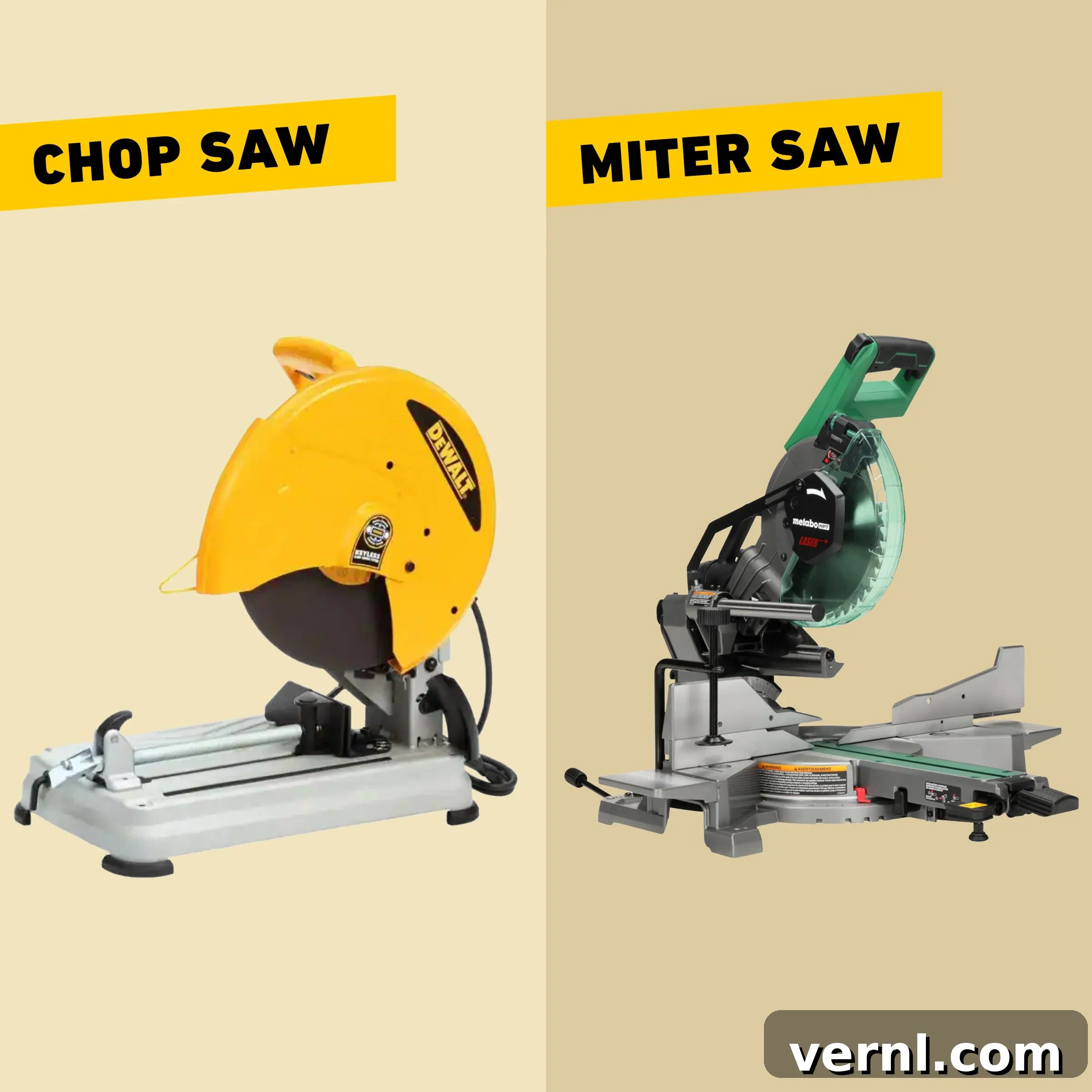
Carpenters who have been around a while probably remember a time when the answer to what a chop saw is was simple: a new, time-saving innovation on the jobsite. By performing one simple, yet crucial, function—precisely crosscutting trim and framing lumber—it profoundly streamlined the workflow on construction sites. Beyond professional settings, it also quickly became an indispensable tool in many home woodshops, revolutionizing how enthusiasts approached woodworking projects.
However, the journey of this remarkable tool didn’t stop there. Manufacturers, driven by innovation and user feedback, didn’t take long to introduce a basic yet transformative feature: the ability to rotate the saw. This ingenious addition greatly increased the chop saw’s usefulness, as it eliminated the laborious and often inaccurate process of cutting miters (angles) by hand with a miter box and hand saw. But the innovation didn’t cease with simple angle adjustments. Manufacturers continued to push boundaries, integrating other advanced features such as a tiltable blade that could cut bevels and, notably, a sliding track mechanism for effortlessly cutting wider boards. These advancements marked a significant evolution in cutting technology.
Saws equipped with these advanced capabilities are now universally known as miter saws. They represent a monumental leap from their chop saw predecessors, much like the sophisticated mobile devices of today differ from early personal digital assistants like the Apple Newton or PalmPilot. Yet, despite being largely supplanted in the woodworker’s primary tool collection by their more versatile miter saw descendants, traditional chop saws haven’t vanished entirely. While you might still encounter conventional chop saws designed for cutting wood in specific applications, the vast majority of modern chop saws have been reimagined and engineered primarily for cutting metal, carving out a distinct and essential niche in construction and fabrication.
Understanding the Traditional Chop Saw: Power and Purpose
If you’re wondering what precisely a chop saw is in its contemporary form, it’s essentially a robust cutting tool designed for making straight, perpendicular cuts—specifically crosscuts—through lengths of material, whether wood or metal, transforming them into shorter, manageable pieces. Its design is inherently focused on power and directness; it is not engineered for intricate angle cuts, bevels, curves, or rip cuts (which involve cutting along the length of a board). This singular focus on straight crosscuts is its defining characteristic and its primary strength.
The core cutting area of a chop saw typically consists of a sturdy table, often wider than it is deep, complemented by a fence positioned at the back to provide stable support for the material being cut. A crucial component for safe and accurate operation is a clamping device, which securely holds the workpiece in place during the cutting process. The cutting mechanism itself features a powerful circular saw blade mounted on a stand. This stand usually extends about a foot from the center of the table and is designed to pivot precisely up and down. The blade, depending on the material to be cut, can be either an abrasive disc for tougher metals or a toothed blade for specific applications.
Operating a chop saw is straightforward and efficient. To execute a cut, the user grips the handle conveniently located on the top of the saw, depresses the trigger to activate the motor and initiate blade rotation, and then smoothly lowers the spinning blade into the material. The saw is typically spring-loaded, meaning it automatically retracts and returns to its original, elevated position once the cut is completed and the user releases the handle. This simple, repetitive action makes it ideal for rapid, consistent crosscutting tasks where precision angles are not required, highlighting its role as a workhorse tool for heavy-duty, straight cuts.
The Evolution of Precision: How a Miter Saw Works
A miter saw bears a strong resemblance to its chop saw cousin in its fundamental design, but it distinguishes itself with several key enhancements that dramatically increase its versatility and precision. The most significant difference lies in its ability to pivot. Unlike a static chop saw, the stand that holds the miter saw can rotate left and right, commonly allowing for angles up to a maximum of 45 degrees in either direction. This rotational capability is what truly defines the “miter” in its name, enabling the creation of accurate angle cuts.
The front of a miter saw table is typically rounded or segmented, departing from the square design of a chop saw table. This design facilitates smooth rotation. An easily visible angle gauge is usually marked on the table, allowing users to select the exact cutting angle with precision. A handle, often extending from the front of the table, is used to rotate the saw, and a robust locking mechanism ensures that the saw remains firmly in place once the desired angle has been selected, preventing any deviation during the cut. This meticulous design allows for highly accurate miter cuts, essential for tasks like framing and trim work.
Further enhancing its capabilities, a compound miter saw introduces an additional layer of versatility. This type of saw can tilt on a horizontal axis, parallel to the table, and can be locked into a chosen angle. This tilting action enables users to make bevel cuts—cuts that are at angles other than 90 degrees in the vertical plane. The ability to combine both miter and bevel adjustments allows for “compound cuts,” which are simultaneous angle and bevel cuts, perfect for complex moldings like crown molding. Taking this even further, some compound miter saws are mounted on a horizontal track. This “sliding” feature allows the saw head to move back and forth, greatly increasing the crosscutting capacity and enabling the user to cut much wider pieces of wood that would otherwise be impossible with a standard miter saw. This makes sliding compound miter saws exceptionally versatile for a wide range of woodworking and construction tasks.
Applications: What Are the Uses for Chop Saws and Miter Saws?
The distinct evolutionary paths of chop saws and miter saws have led them to excel in different, albeit sometimes overlapping, applications. Understanding these specific uses is crucial for selecting the correct tool for your project.
Modern Chop Saw Applications: The Metalworking Powerhouse
As we previously highlighted, the vast majority of contemporary chop saws have been repurposed and redesigned as specialized metal-cutting tools. This specialization is evident in their construction: the table is often longer than it is wide, and it features an adjustable clamp, specifically engineered to secure various metal profiles. The blades used for metal cutting are interchangeable, offering versatility depending on the material. You can opt for an abrasive blade, which cuts slowly but is remarkably effective on nearly any type of metal, generating considerable sparks and heat. Alternatively, a tungsten carbide-tipped (TCT) blade with teeth offers a faster, cleaner cut, particularly suitable for tubing and other relatively thin metals. While the blade angle on a traditional metal chop saw isn’t typically adjustable, skilled users can still achieve angle cuts by carefully clamping the material to the table at the desired angle.
Chop saws are indispensable tools for cutting a range of tough materials, including:
- Metal rods, such as reinforcing bar (rebar) and angle iron, commonly found in structural work.
- Various types of metal and plastic pipes, crucial for plumbing and conduit installations.
- Robust metal building materials, including steel studs, gutters, and structural posts.
- Wood that may contain embedded nails, screws, or other metal obstructions, where a specialized blade prevents damage to the saw.
Miter Saw Applications: Precision Woodworking and Beyond
A miter saw effectively performs all the functions of a traditional wood-cutting chop saw, but its added versatility makes it a much more comprehensive tool for woodworkers and carpenters. A standard miter saw is capable of handling most common cuts required on a construction site, from framing to general carpentry. However, for more intricate or demanding tasks within a dedicated workshop, a compound miter saw or a sliding compound miter saw truly shines, offering unparalleled precision and range.
Miter saws are frequently used for a diverse array of cutting tasks:
- Making precise straight crosscuts in wood studs for framing, and intricate trim pieces such as baseboards, crown molding, and corner bead.
- Accurately cutting hardwood floorboards to the exact length required for installation.
- Producing the precise angles needed to construct durable and aesthetically pleasing frames for windows, doors, and picture frames.
- Cutting bevels for lap joints, which are significantly stronger and more aesthetically pleasing than simple butt joints made by cutting ends at 90 degrees.
- Creating complex compound angles, especially critical for professional-looking crown molding installations that fit perfectly into room corners.
- Rapidly processing large quantities of lumber for various construction and woodworking projects, thanks to their repeatability.
Choosing the Right Saw for Your Projects: A Comprehensive Comparison
When faced with the decision of which saw to employ for your upcoming project, it’s incredibly helpful to meticulously consider the specific types of cuts you’ll need, with particular attention to any angular requirements. Chop saws, miter saws, circular saws, and table saws each occupy a distinct and essential role within a well-equipped workshop. Every one of these powerful tools boasts unique strengths and inherent trade-offs, which are primarily dictated by the material you’re working with, the level of precision demanded, and the overall versatility required. Let’s delve into a more detailed comparison, focusing on critical aspects such as accuracy, safety, and ease of use, to help you make an informed decision.
Key Advantages of Using a Miter or Chop Saw
Both chop saws and miter saws offer compelling benefits, especially when compared to other cutting tools for specific tasks. Their design inherently lends itself to controlled, repeatable cuts.
- Precision: Both types of saws allow users to align a cut with significantly greater precision than what’s typically achievable with a handheld circular saw. The fixed nature of the blade’s pivot point means the blade maintains a consistent path, preventing it from wandering or deflecting during the cutting process, resulting in exceptionally straight and clean cuts.
- Repeatability: One of the most significant advantages is the ease with which you can make the exact same type of cut over and over again. Once the angle and depth are set, you can quickly and efficiently mass-produce identical parts, which is invaluable for production work, framing, or repetitive trim installations. This consistency saves considerable time and reduces material waste.
- Safety: While all power tools demand respect and proper safety protocols, cutting with a chop saw or miter saw can generally be considered safer for many crosscutting operations compared to attempting the same cut with a freehand circular saw or a large, intimidating table saw. The material is typically clamped or held firmly against a fence, keeping hands a safe distance from the blade, and the downward cutting motion is controlled and predictable.
- Ease of Use: For making straight crosscuts or precise miter cuts, both saws offer a relatively low learning curve. Their operation is intuitive, allowing both novices and experienced users to achieve good results quickly.
Considerations and Limitations of Miter and Chop Saws
Despite their advantages, these saws also come with inherent limitations that must be acknowledged when planning a project or outfitting a workshop.
- Specific Purpose: A primary drawback is their specialized nature. Chop saws and miter saws are predominantly designed for crosscuts. While miter saws add angular capabilities, neither tool is suitable for rip cuts (cutting along the length of a board), intricate curves, or dadoes and rebates, tasks for which other specialized saws like table saws or routers are better suited.
- Limited Stock Size: These saws are restricted in the dimensions of material they can effectively handle. Standard miter saws and chop saws have a finite crosscutting capacity. Even most sliding miter saws, which extend this capacity significantly, are typically limited to cutting stock no wider than 12 to 14 inches. For very wide panels or extremely thick timbers, alternative tools like a table saw or a track saw become necessary.
- Small Table: The integrated tables on both chop saws and miter saws are generally compact. While sufficient for supporting the immediate cutting area, they offer minimal support for long workpieces. This necessitates the construction or acquisition of external support systems, such as roller stands or dedicated miter saw stands with extendable wings, to ensure stability and accuracy when cutting lengthy lumber or pipes.
- Portability vs. Stability: While many miter saws are designed to be relatively portable, especially smaller models, their effectiveness often requires a stable setup, which can negate some of their “on-the-go” advantage if extensive support is needed.
Chop Saw vs Miter Saw: Investment and Cost Considerations
When evaluating the cost of a chop saw versus a miter saw, the price points reflect their differing capabilities and target applications. According to major retailers like Home Depot, you can acquire a decent entry-level chop saw, particularly those designed for metal cutting, for a little over $150. These typically offer robust performance for basic straight cuts on metal. However, if your projects demand more power, larger cutting capacity, or specific features such as a blade that tilts for cutting bevels (yes, some advanced metal chop saws do incorporate this feature for greater versatility in metal fabrication), the investment will likely increase, ranging closer to $400 or more. High-end industrial chop saws for heavy-duty metalwork can easily exceed this price bracket.
Conversely, the miter saw market is broader and typically offers more feature-rich options. Today, most miter saws available are compound miter saws, providing both miter and bevel cutting capabilities. You can find a budget-friendly compound miter saw for just over $180, offering excellent value for hobbyists and DIY enthusiasts. As you ascend the feature ladder, opting for a sliding compound miter saw—which significantly extends the crosscutting capacity for wider boards—the price range typically falls between $450 and $700. Within this diverse price spectrum, consumers can find both corded and cordless miter saws, with cordless options offering enhanced portability and freedom from power outlets, albeit often at a slightly higher premium for the battery and charger systems. Factors like brand reputation, motor power, integrated features (such as laser guides, LED work lights, and advanced dust collection), and overall build quality significantly influence the final price, allowing buyers to select a tool that perfectly matches their budget and project demands.
Essential Tips for Using Chop Saws and Miter Saws Safely
Operating any power tool, including chop saws and miter saws, demands an unwavering commitment to safety. Adhering to proper safety protocols is paramount to preventing injuries and ensuring a productive working environment. Always take a moment before starting your work to review these crucial guidelines.
- According to guidelines from West Virginia University, you should always wear industrial-rated safety glasses or a full face shield to provide comprehensive protection for your eyes from flying debris, sparks, and dust.
- Avoid wearing loose clothing, jewelry, or anything that could potentially get caught in the saw’s moving parts. Securely tie back long hair or tuck it under a cap to prevent entanglement.
- Utilize appropriate hearing protection, such as earplugs or earmuffs, as these saws can generate significant noise levels. Additionally, wear a dust mask or respirator, especially when cutting wood or generating fine metal particles, to protect your respiratory system.
- Before each use, meticulously inspect all blade guards and fences to ensure they are securely in place and functioning properly, providing maximum protection.
- Always use sharp, clean blades that are correctly installed and set for the material being cut. A dull or improperly set blade can cause kickback, bind, or require excessive force, increasing the risk of accidents.
- Allow the saw to work at its own pace. Never force the blade through the material; let the motor and blade do the work, applying steady, controlled pressure.
- Maintain a safe distance: always keep your hands and fingers at least four inches away from the rotating blade, even when the saw is powered off but connected.
- Thoroughly inspect your material for any hidden hazards such as nails, screws, knots, staples, or other foreign objects before making a cut. These can cause the blade to bind or shatter.
- Never attempt to cut small pieces of material that cannot be held securely and safely against the fence or with a clamp. Use specialized jigs if necessary.
- Absolutely avoid making freehand cuts. Always utilize the saw’s fence or a dedicated clamp to maintain control over the workpiece and ensure straight, accurate cuts.
- Firmly press the workpiece against the fence and use clamps whenever possible to prevent any shifting, twisting, or movement during the cut.
- Never reach behind, over, or under the blade while it is spinning or when the saw is connected to a power source. Always wait for the blade to come to a complete stop and ensure the power is disconnected.
- Before making any adjustments to the saw, performing maintenance, or changing the blade, always unplug the saw from its power outlet or remove the battery pack if it’s a cordless model.
- Keep your work area tidy. Regularly clear sawdust, scrap pieces, and offcuts from the table and the surrounding floor to reduce the risk of slipping, tripping, or fire hazards.
Frequently Asked Questions About Chop Saws and Miter Saws
What materials are chop saws designed to cut?
When considering the capabilities of a modern chop saw, it’s essential to understand its robust design for demanding materials. Among the many uses for chop saws are their exceptional ability to cut through tough materials like various types of steel, aluminum, iron pipes, and reinforcing bar (rebar). With the selection of the correct specialized blade, they can also efficiently handle PVC pipes and even wood that may contain embedded nails or screws, making them versatile for specific job site challenges where conventional woodworking saws might be damaged.
What specific types of cuts does a chop saw make?
According to Rotabroach, a reputable company specializing in annular cutting tools, chop saws are purpose-built for a specific type of cut: they are primarily limited to making straight, 90-degree crosscuts through materials. They fundamentally lack the mechanisms for making angled cuts, unlike a miter saw, which is explicitly designed for miter saw precision cutting and angular adjustments. The inherent strength of a chop saw lies in its capacity to deliver powerful, clean, and uncompromisingly straight cuts through tough materials both quickly and effectively, making it a workhorse for repetitive linear cuts.
Which saw is the superior choice for woodworking: a chop saw or a miter saw?
According to Woodsmith, a highly respected resource for woodworkers, the optimal choice between a chop saw and a miter saw for woodworking projects is entirely dependent on the specific material you intend to cut and the precise type of work you plan to undertake. If your projects involve fine woodworking, require intricate angles, or you’re already familiar with essential power tools for precision tasks, a miter saw is unequivocally the best saw for cutting various angles. This makes it the ideal tool for detailed tasks such as trim work, molding installation, or accurately cutting smaller lumber pieces to length and angle. In stark contrast, a traditional chop saw, particularly a metal-cutting one, is significantly better suited for rough, powerful straight cuts through thicker, often harder materials like large dimensional lumber (if using a wood chop saw) or, more commonly, various metals. Its powerful motor and robust blade are perfectly engineered for fast, repetitive crosscuts where raw power and efficiency outweigh the need for fine angular precision.
Can a miter saw cut metal?
While some specialized miter saws exist that are designed for cutting non-ferrous metals like aluminum with the appropriate blade, generally, a standard woodworking miter saw is not suitable for cutting metal. Using a woodworking miter saw to cut metal can be extremely dangerous, as it can shatter the blade, damage the tool, and cause serious injury. Dedicated metal-cutting chop saws or dry-cut metal saws are designed with appropriate motors, blade speeds, and guards for safely and effectively cutting various metals.
Conclusion: Selecting Your Cutting Companion
The journey from the rudimentary chop saw to the sophisticated miter saw illustrates a remarkable evolution in cutting technology, driven by the need for greater precision, versatility, and efficiency on the job site and in the workshop. While the traditional chop saw has found its modern niche as a powerful metal-cutting specialist, making fast, straight cuts through robust materials, the miter saw, with its ability to execute precise miter, bevel, and compound cuts, has become the indispensable tool for discerning woodworkers and carpenters.
Choosing between these two essential power tools boils down to a clear understanding of your project’s demands. If your work primarily involves rapid, straight crosscuts on metal or very rough cuts on wood without the need for angles, the raw power and durability of a chop saw make it the ideal choice. However, for any woodworking project requiring accurate angles, bevels, or intricate compound cuts—from framing a house to crafting delicate moldings—the versatility and precision of a miter saw, particularly a compound or sliding compound model, are unmatched. By considering the material, the type of cuts, and the level of precision required, you can confidently select the right cutting companion to ensure your projects are completed safely, accurately, and efficiently.
Sources:
- Woodsmith: “Chop Saw vs. Miter Saw: How To Choose the Right One for Your Project”
- Rotabroach: “Chop Saws vs Mitre Saws: A Comprehensive Guide”
- West Virginia University: “Miter and Chop Saw Safety”
- Home Depot: “Miter Saws”
- Home Depot: “Chop Saws”