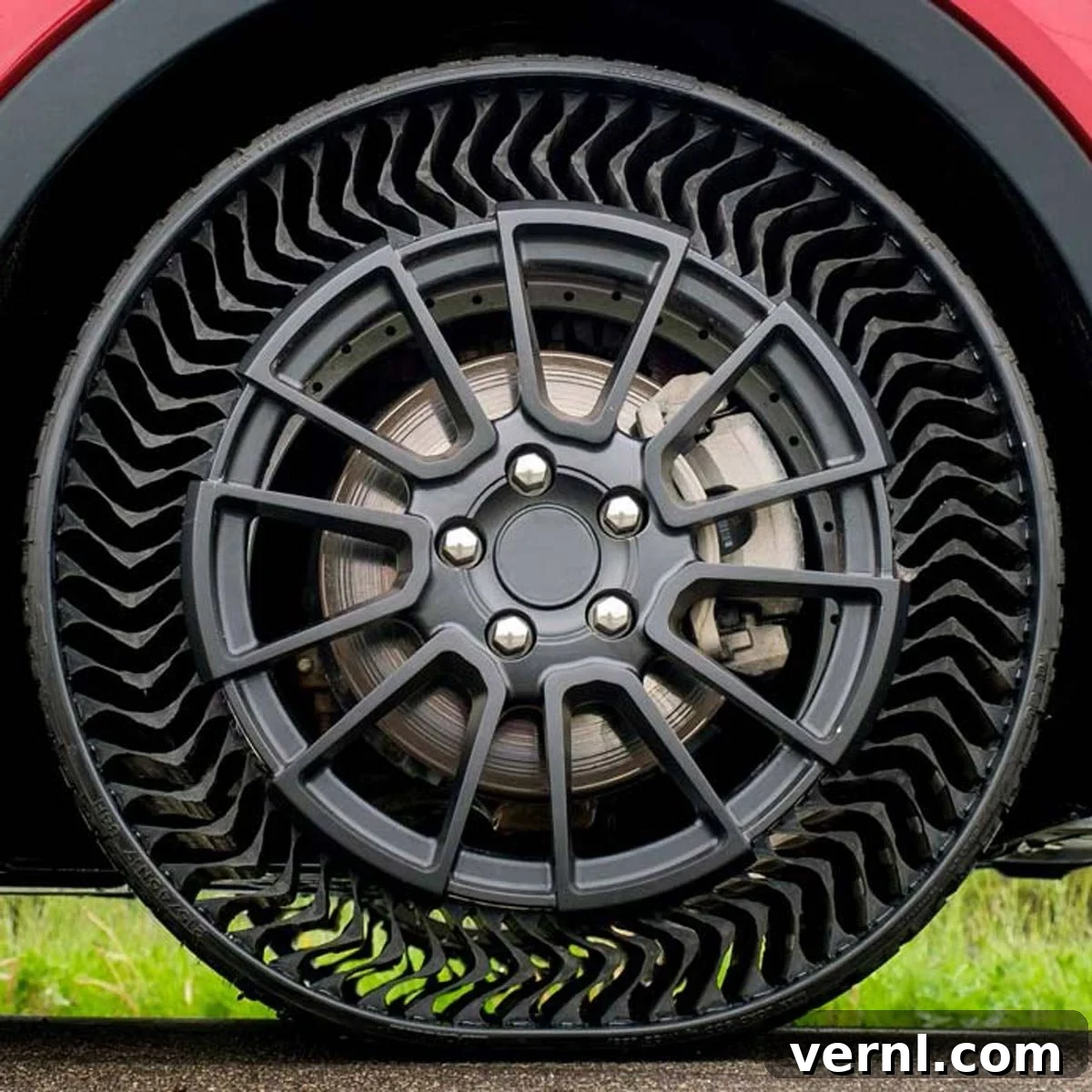
Imagine a future where the relentless worry about flat tires, inconvenient emergency roadside changes, sudden blowouts, and the constant need to meticulously check tire pressure becomes a distant memory. This vision is rapidly becoming a reality, thanks to the revolutionary advancements in airless car tire technology. It promises a fundamental shift in how we perceive and interact with our vehicle’s crucial contact points with the road.
“Conventional tires naturally lose pressure over time, a subtle but significant issue that directly impacts vehicle handling, braking distance, and overall fuel economy,” explains David Bodzioch, an ASE-certified Automotive Technology Instructor at North Montco Technical Career Center. “The reality is, most drivers simply don’t check their tire pressure regularly enough to maintain optimal performance and safety. Airless designs, by their very nature, completely eliminate this variable.” Bodzioch further emphasizes, “The most significant benefit for average drivers isn’t just the avoidance of flat tires—it’s the unparalleled consistency of performance these tires are engineered to provide throughout their lifespan.” This consistency translates into a more predictable and safer driving experience, removing a layer of uncertainty inherent with traditional pneumatic tires.
Understanding Airless Tire Technology: A Paradigm Shift in Mobility
Airless car tires, true to their innovative name, operate entirely without the need for compressed air inflation to support a vehicle’s weight or to provide the essential cushioning that absorbs road impacts. This marks a radical departure from conventional pneumatic tires, which are entirely dependent on internal air pressure to maintain their structural integrity and dampen vibrations from the road surface. Instead, airless tires employ ingeniously designed alternative structural systems to deliver comparable functionality without any of the risks associated with punctures, leaks, or pressure loss.
The foundational concept of airless tire technology is not a recent invention; it has, in fact, existed for several decades. However, it’s the recent confluence of remarkable advancements in materials science, sophisticated engineering principles, and precision manufacturing techniques that have propelled airless tires into a genuinely viable solution for mainstream vehicles. The majority of modern airless tire designs feature an intricate, flexible spoke structure. These spokes are typically crafted from highly advanced composite materials or specialized, high-performance rubber compounds, forming a robust connection between the outer tread component and the inner wheel hub. This unique architecture is what allows the tire to bear loads and deform to absorb shocks without the need for air.
One of the most widely recognized and promising airless tire prototypes currently undergoing rigorous development is Michelin’s Unique Puncture-Proof Tire System, aptly named Uptis. This groundbreaking design leverages an array of flexible composite spokes, meticulously arranged in a distinctive pattern, to effectively support the vehicle’s weight and absorb impacts. These spokes precisely mimic the shock-absorbing and load-bearing functions that air pressure would typically perform in conventional tires. Beyond Michelin, other global tire manufacturing giants, such as Bridgestone and Goodyear, are also at the forefront of this innovation. They have each developed their own proprietary versions of airless tire technology, employing diverse structural approaches and material compositions to achieve the same core objectives: unparalleled durability, consistent performance, and the complete elimination of flats. These ongoing developments underscore a collective industry commitment to redefine the future of automotive tires.
Key Materials and Advanced Durability Factors of Airless Tires
The exceptional resilience and performance of modern airless tires are a direct result of their sophisticated material composition. These tires typically combine advanced polymers, selected for their unique elastic and wear-resistant properties, with high-strength steel or cutting-edge composite belts. These belts are strategically integrated to provide crucial load-bearing capacity and structural rigidity. The U.S. Department of Energy’s Vehicle Technologies Office has reported impressive findings from various prototypes, noting that some are engineered to withstand an extreme temperature range from a frigid -40°F up to a scorching 140°F. This remarkable thermal resilience means airless tires can significantly outperform conventional pneumatic tires in a wider array of severe environmental conditions, ensuring consistent performance whether traversing icy tundras or blistering deserts.
Furthermore, the tread compounds utilized in airless tires often incorporate advanced additives such as highly refined silica or specially processed carbon black. These components are not merely fillers; they play a critical role in enhancing grip across diverse road surfaces, optimizing traction in both wet and dry conditions, and substantially reducing the rate of wear. This thoughtful combination of core structural materials and advanced tread compounds is fundamental to the extended lifespan and superior durability that airless tires are designed to offer, providing a more robust and dependable solution for diverse driving needs.
Transformative Advantages of Airless Tires Over Traditional Pneumatic Tires
Airless tire technology presents a compelling suite of potential advantages that could revolutionize the automotive industry and significantly benefit consumers. These benefits span critical areas including enhanced safety, dramatically reduced maintenance, and substantial positive environmental impacts.
Complete Elimination of Punctures and Blowouts: A New Benchmark for Safety
Perhaps the most immediate and intuitively appealing advantage of airless tires is their inherent immunity to punctures and the complete elimination of devastating blowouts. Since there is no internal air pressure to escape, external threats such as nails, shards of glass, sharp rocks, or other hazardous road debris become largely irrelevant to the tire’s functionality. This revolutionary feature effectively eradicates one of the most common, frustrating, and potentially dangerous roadside emergencies that drivers regularly encounter. Beyond the mere inconvenience, this immunity translates directly into a significant boost in road safety, as sudden tire failures are a leading cause of accidents, offering drivers and passengers unprecedented peace of mind.
Significantly Reduced Maintenance Requirements: Efficiency Redefined
Traditional pneumatic tires are demanding, requiring consistent and often inconvenient attention from drivers. This includes the necessity to frequently monitor air pressure, adjust for seasonal temperature fluctuations, and remain vigilant for signs of wear to ensure both optimal performance and uncompromising safety. In stark contrast, airless tires usher in an era of “set it and forget it” convenience. According to a comprehensive 2024 report by Michelin, airless tires are projected to last up to an impressive 30% longer than their traditional counterparts, a testament to their enhanced durability and robust design. This extended lifespan, coupled with minimal maintenance demands, translates into considerable cost savings over the vehicle’s operational life. The reduced need for routine checks and repairs is particularly valuable for large fleet operators and commercial applications, where minimized maintenance costs and substantial reductions in vehicle downtime can yield immense operational efficiencies and economic benefits.
Profound Sustainability Benefits: Paving the Way for a Greener Future
The environmental footprint of conventional tires is substantial. In the United States alone, approximately 290 million tires are discarded annually, creating colossal waste disposal challenges that burden landfills and recycling infrastructure, as highlighted by the U.S. Environmental Protection Agency (EPA). Airless tires offer a compelling solution to this growing environmental crisis. Their significantly longer lifespan directly translates into fewer tires being manufactured, fewer raw materials being consumed over time, and consequently, dramatically fewer tires ending up as waste. As this innovative technology becomes more widely adopted, it promises to drastically reduce the sheer volume of discarded tires, alleviating environmental pressures and fostering a more sustainable approach to mobility. Furthermore, the potential for modular designs, where only the worn tread can be replaced rather than the entire tire, holds even greater promise for waste reduction and resource conservation in the long term.
Significant Challenges Holding Back Widespread Adoption of Airless Tires
Despite their profound potential and clear advantages, airless tires are not yet a universal option for the vast majority of consumers. “I don’t expect we’ll see widespread adoption for everyday passenger vehicles until at least 2027 or 2028,” predicts Bodzioch, offering a realistic timeline. He elaborates, “The technology still requires considerable refinement, particularly for high-speed applications where performance demands are extreme, and manufacturers need additional time to scale their production processes efficiently to meet potential mass-market demand.”
Addressing Performance Limitations: The Quest for Parity with Pneumatic Tires
One of the most significant hurdles for airless tires is replicating the nuanced performance characteristics of traditional air-filled tires, especially concerning ride comfort. Conventional tires excel at absorbing minor road imperfections, primarily because the compressed air inside acts as a highly effective spring and damper, providing an exceptionally smooth ride. Current airless designs, while vastly improved, still tend to transmit more vibration and harshness directly to the vehicle chassis. This can result in a perceptibly harsher ride quality, a difference that becomes particularly noticeable at higher speeds or when navigating rough, uneven road surfaces. Engineers are actively working on innovative spoke designs and material composites to introduce more effective damping and isolation properties to mitigate this challenge.
Heat dissipation presents another complex engineering challenge. Air within conventional tires serves as an excellent thermal regulator, effectively drawing away and dissipating the significant heat generated by continuous flexing and friction during operation. In airless designs, the management of this internal heat relies solely on the structural elements themselves. This can lead to performance degradation as temperatures rise, especially during sustained high-speed driving where heat buildup can occur rapidly and intensely, potentially affecting the material integrity and dynamic performance of the tire. Furthermore, controlling noise, vibration, and harshness (NVH) remains an area of intense research, as the unique structural designs of airless tires can sometimes generate more road noise or transmit greater levels of vibration into the vehicle’s cabin compared to their pneumatic counterparts.
Navigating Cost Factors and Overcoming Market Availability Barriers
Perhaps the most formidable barrier preventing the immediate widespread adoption of airless tires for the average consumer is their current manufacturing cost. Due to the intricate designs, specialized materials, and complex production processes involved, airless tires are significantly more expensive to manufacture than traditional pneumatic tires. This increased production cost inevitably drives up retail prices, making them a premium product. Currently, most commercially available airless options can cost anywhere from three to five times more than even the highest-end conventional tires designed for the same vehicle type. This significant price differential makes them inaccessible for many consumers.
Limited market availability further constrains consumer adoption. The majority of airless tire products currently available are specifically engineered and marketed for specialized niches. These include applications for lawn equipment, golf carts, military vehicles, and heavy construction equipment—sectors where the benefits of puncture immunity and reduced maintenance often outweigh the higher upfront cost. Mainstream automotive applications, particularly for passenger cars, largely remain in advanced development and testing phases. Only a select few high-end vehicles or concept models might offer airless tires as an extremely premium, often experimental, option. When queried about broader adoption timelines, Bodzioch offers a pragmatic assessment: “We’ll likely see them first in fleet vehicles, urban delivery vans, and shared mobility applications where the profound maintenance benefits provide clear, quantifiable operational advantages and a quicker return on investment.” This strategic rollout allows manufacturers to refine the technology, reduce costs through economies of scale, and gradually introduce airless tires to the broader market.
Are Airless Tires Right for You? Evaluating Current Feasibility and Future Prospects
Given the unique blend of advantages and current limitations, the decision of whether to consider airless tires involves careful consideration of specific driving needs and use scenarios.
Ideal Use Scenarios for Current Airless Tire Technology
For the everyday driver, investing in airless tires only makes practical and economic sense in very specific situations where their core benefits provide genuine, tangible value. If your daily commute or typical driving routes frequently involve navigating through active construction zones, regularly traversing unpaved gravel roads, or operating in environments where the risk of tire punctures is consistently high, the superior puncture immunity of airless tires offers unparalleled peace of mind and genuine operational value. In these contexts, the significant reduction in downtime and the elimination of inconvenient repairs can outweigh the higher upfront investment.
Off-road enthusiasts, however, face a different set of considerations. Traditional air-filled tires offer a critical advantage in their adaptability: the ability to adjust tire pressure for different terrains. Lowering pressure for activities like driving on sand dunes or rock crawling significantly increases the tire’s contact patch, providing superior traction and articulation. Current airless designs, by their rigid nature, cannot yet match this crucial adaptability. Despite this, specialized off-road non-pneumatic tires (NPTs) are continually under development, showing promising early results for highly specific, fixed-pressure off-road applications, suggesting future potential in this niche.
Future Outlook for Widespread Consumer Adoption of Airless Tires
While airless tires are not yet a mainstream feature on passenger cars, industry experts like David Bodzioch, along with various industry projections, collectively suggest that airless tires will become widely available to the average consumer within the next 5 to 7 years. This timeline is supported by ongoing aggressive research and development efforts aimed at overcoming current performance and cost barriers. For now, early adopters should keep a close watch for limited releases from major tire manufacturers, particularly those targeting electric vehicles (EVs). For EVs, the weight savings offered by some airless designs and the potential for reduced rolling resistance provide additional compelling benefits, enhancing range and efficiency.
Before making any purchasing decision, it is absolutely critical to ensure that any airless tire product you are considering is fully compatible with your specific vehicle model and meets all manufacturer specifications. Carefully scrutinize the warranty coverage, as this is a new technology, and terms may differ significantly from conventional tires. Furthermore, it is essential to confirm the availability of service centers or specialized technicians in your area who possess the expertise and equipment necessary for mounting, balancing, and maintaining these specialized products. As the technology evolves, these practical considerations will become increasingly important for seamless integration.
About the Expert: David Bodzioch
- David Bodzioch serves with distinction as an Automotive Technology Instructor at North Montco Technical Career Center. He holds an esteemed ASE certification, signifying his profound expertise in automotive systems. Furthermore, he is certified by the Pennsylvania Department of Education as both an automotive technology instructor and a recreational power equipment technology instructor, demonstrating a broad range of technical knowledge. Bodzioch specializes particularly in emerging automotive technologies and their practical applications for everyday drivers, bringing a forward-thinking perspective to his teaching. His extensive background also includes significant experience in advanced vehicle systems diagnostics and complex repair, making him a highly authoritative voice in the automotive field.