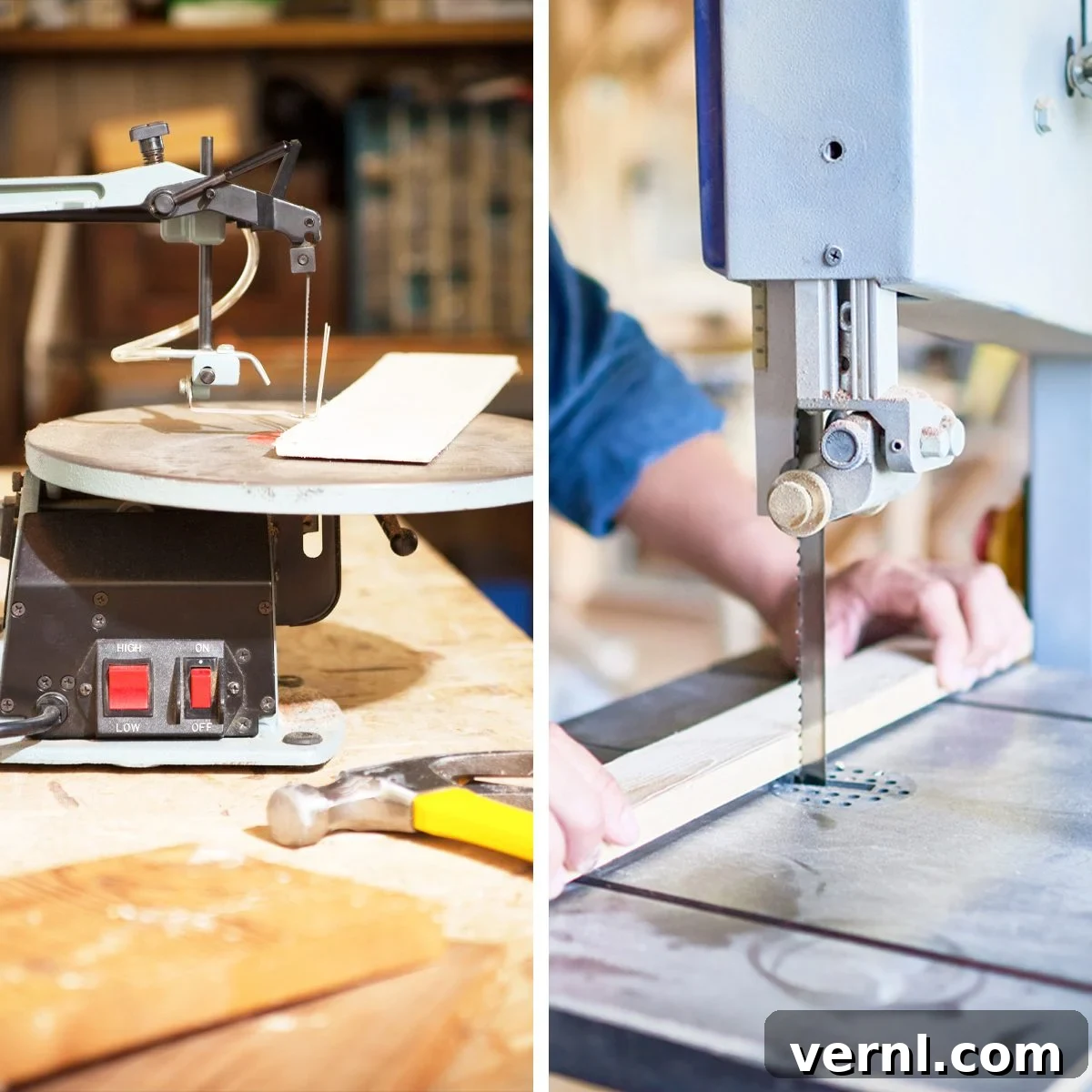
Mastering the Workshop: A Comprehensive Guide to Scroll Saws vs. Band Saws
For any woodworking enthusiast, the choice of power tools can significantly impact the success and quality of a project. Among the most fundamental cutting tools are the scroll saw and the band saw. While they might appear similar at first glance, understanding their distinct capabilities is crucial for selecting the right tool for the job. This guide delves deep into the nuances of scroll saws and band saws, helping you appreciate their unique strengths and applications, from intricate craftwork to heavy-duty material processing.
Years ago, a fellow woodworker demonstrated the art of crafting a band saw box. This involved meticulously cutting out the center of a solid wood block using a band saw, then attaching a bottom and securing the top with a pivot pin. This design allowed the top to rotate open or be completely removed, requiring a single cut through the side of the box, which was then carefully glued back together. This method, while effective, often left one wondering about alternative approaches.
A persistent question revolved around whether such a procedure could be executed more efficiently with a scroll saw. A scroll saw, known for its ability to perform internal cuts, features a removable blade that can be threaded through a pre-drilled hole in the material. This unique characteristic eliminates the necessity of cutting through the side of the box, offering a seemingly ideal solution for intricate internal work. However, despite this appealing feature, it’s highly improbable that a scroll saw would be suitable for constructing these types of boxes, particularly given the specific demands of a band saw box.
To truly grasp why these tools excel in different domains, it’s essential to understand the fundamental distinctions between scroll saws and band saws. This comprehensive comparison will illuminate their best uses, enabling you to make informed decisions for your woodworking projects, whether you’re a novice or a seasoned artisan.
What Exactly Is a Scroll Saw? Understanding Its Precision and Versatility
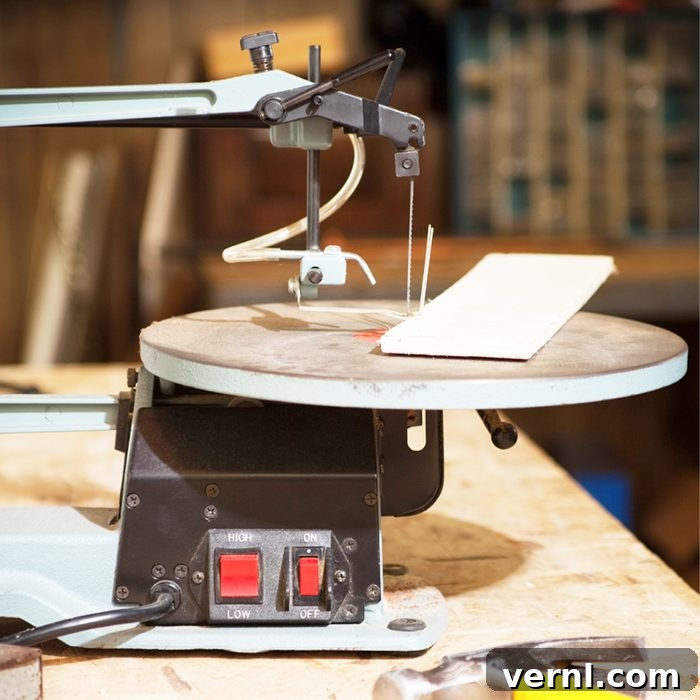
A scroll saw is a specialized benchtop power tool primarily designed for cutting incredibly intricate curves and delicate patterns in a variety of materials, including wood, thin metals, and plastics. Its design emphasizes precision and control, making it indispensable for detailed artistic work.
The most common scroll saw configuration features a sturdy vertical column that supports a metal cutting surface, or table. Above this table, an articulated arm extends, holding a slender cutting blade that typically ranges in length around eight inches, depending on the specific model. Unlike other saws, the scroll saw blade is held at both ends – clamped to the upper and lower arms – and cuts via a rapid reciprocating up-and-down motion, much like a jigsaw, but with far greater finesse.
Scroll saw blades are remarkably thin, with widths varying significantly, from coarser #12 blades (.065 inches) down to ultra-fine #2/0 blades (.024 inches). This wide array of blade sizes, combined with various tooth orientations and pitches, allows the user to select the perfect blade for the type and thickness of the material being cut, ensuring clean, tear-out-free edges. The blade is supported from underneath the table, extending through a small hole, ensuring stability during the cutting process.
A critical specification for any scroll saw is its throat width. This measurement, taken from the blade to the vertical column at the back of the tool, dictates the maximum width of material that can be cut. While a 12-inch throat is common and sufficient for most DIY and hobbyist applications, larger models with up to 30-inch throats are available for handling wider workpieces. A longer throat essentially translates to a greater capacity for maneuverability when cutting large sheets of material.
Modern scroll saws often come equipped with features designed to enhance user experience and cutting accuracy. Many tables are tiltable, allowing for precise bevel cuts up to 45 degrees. Convenience features such as an integrated dust blower keep the cutting line clear of sawdust, improving visibility, while foot-powered levers provide instant blade speed control, freeing up hands for precise material manipulation. These features collectively contribute to the scroll saw’s reputation as the go-to tool for fine, detailed craftsmanship.
What Is a Band Saw? Exploring Its Power and Utility

In contrast to the delicate precision of a scroll saw, a band saw stands out as a more robust and versatile cutting workhorse, a staple in many professional and home workshops. These powerful machines are available in various configurations, including floor-standing models for heavy-duty work, compact benchtop units for smaller spaces, and even specialized handheld versions for specific tasks.
The defining characteristic of a band saw is its continuous loop blade. This long, toothed metal band is stretched around two (or sometimes three) wheels or drums – one positioned above and one below the cutting table. As these drums rotate, the blade moves continuously in one direction, driving the teeth downwards through the material. The teeth are consistently oriented to pull the material into the cut, ensuring a steady and efficient sawing action.
Band saws are celebrated for their exceptional versatility. They are adept at heavy-duty rip cutting, crosscutting, and re-sawing thick lumber, as well as shaping curves and intricate designs. The specific capabilities of a band saw largely depend on its size, motor power, and the type of blade installed. Band saw blades come in a wide range of widths, from a slender 1/8-inch for detailed curve cutting to a sturdy one-inch for straight, powerful rips. Thicknesses vary from .014 to .063 inches. Generally, wider and thicker blades are preferred for straight cuts, ripping, and re-sawing, offering stability and resistance to deflection, while narrower, thinner blades are essential for navigating tighter curves and fine detail work. Blade selection also involves considering teeth per inch (TPI) and tooth orientation, which impact cut speed, finish, and material suitability.
Similar to scroll saws, band saws are categorized by their throat depth. In the case of a band saw, this refers to the sideways distance from the blade to the inner housing or column of the machine. This measurement determines the maximum width of material that can be fed through the saw, impacting its ripping capacity. For typical home workshop use, throat depths commonly range from 10 to 18 inches. However, industrial-grade band saws, designed for processing massive timber or metal, can boast impressive throat depths of up to 48 inches, showcasing their capacity for large-scale operations.
Many band saws also feature a tiltable table, allowing for precise angled cuts. Their sturdy construction and continuous cutting action make them ideal for tasks that demand power, speed, and the ability to process thicker and denser materials than a scroll saw could handle.
Key Differences Between Scroll Saws and Band Saws: A Comparative Overview
While both scroll saws and band saws are essential cutting tools for various workshops, their operational principles and ideal applications differ significantly. Understanding these distinctions is paramount for any woodworker seeking to optimize their workflow and achieve superior results. The table below highlights the core differences:
| Feature | Scroll Saw | Band Saw |
| Blade Type | Thin, reciprocating up-and-down blade | Continuous loop or spiral blade |
| Detail Precision | Exceptionally high, ideal for intricate designs | Moderate to low, depending on blade width; better for smooth curves |
| Cut Thickness | Restricted by arm height, typically thin materials | Allows for much thicker materials and re-sawing |
| Curve Cutting | Capable of sharp, complex, and internal curves | Excels at smooth, larger radius curves; limited for tight angles |
| Ideal Materials | Thin wood, soft metals, plastics, delicate composites | Thick wood (hardwoods, logs), metals, plastics, composites |
| Portability | Typically benchtop, compact, and relatively lightweight | Benchtop or floor-standing; larger models are heavy and stationary |
Beyond the table, the operational differences are equally important. A scroll saw’s reciprocating blade allows for incredibly tight turns and piercing cuts, making it the undisputed champion for fretwork, intarsia, and intricate puzzle pieces where the blade needs to be inserted into a pre-drilled hole to cut internal shapes. The continuous cutting action of a band saw, conversely, offers greater speed and power for straight cuts and broader curves, especially when dealing with thick stock. Its blade, being under constant tension, provides stability for re-sawing and cutting denser materials, a task where a scroll saw’s delicate blade would quickly deflect or break.
Common Projects and Applications: Tailoring the Tool to the Task
Whether you’re exploring woodworking tips for beginners or a seasoned craftsperson engaged in intricate intarsia, a clear understanding of the “scroll saw vs band saw” debate will profoundly influence your tool selection and project outcomes. Each saw is a specialist in its own right, designed to excel in particular applications.
A scroll saw project is synonymous with precision and artistic flair. Its fine blades can glide through various materials, from plywood and hardwoods to plastic sheets and even thin metals. As Frank Rath, a freelance blogger and passionate craftsman, points out regarding band saws, “Larger band saws are also ideal for splitting, halving in the longitudinal direction, boards and beams. For this, you use a wider band saw blade with a rough toothing.” This highlights the stark contrast in their primary functions.
Scroll Saw Projects: Where Artistry Meets Precision
The scroll saw is the tool of choice for projects demanding meticulous detail and internal cuts. Its ability to navigate sharp angles and create intricate patterns makes it indispensable for:
- Inlay and Marquetry: Creating stunning decorative patterns by fitting together precisely cut pieces of wood or other materials.
- Toy and Puzzle Production: Crafting custom wooden toys, complex jigsaw puzzles, and intricate educational games for children.
- Signs and Jewelry Boxes: Producing decorative signs with personalized lettering and carving out delicate components for jewelry boxes.
- Musical Instrument Components: Shaping specific, intricate parts for stringed instruments or other musical devices that require fine detail.
- Fashioning Dovetail Joints: While often done with hand tools or routers, a scroll saw can be used for precise, decorative dovetail joints in smaller applications.
- Fretwork and Silhouette Art: Cutting detailed, openwork patterns that create a lace-like effect or intricate silhouette designs.
Band Saw Applications: The Powerhouse for Material Processing
The band saw, with its continuous blade and powerful motor, is built for tasks requiring robust cutting capacity and speed, especially with thicker stock. Its primary applications include:
- Re-sawing Wide Boards: Splitting thick boards into thinner planks, maximizing material yield and creating book-matched panels.
- Ripping Wood: Efficiently cutting along the grain to reduce the width of boards, a task it performs with greater safety and precision than a table saw for irregular pieces.
- Sawing Thick Hardwoods and Logs: Breaking down large, rough timber into manageable sizes, often the first step in processing raw material.
- Handheld Pipe Cutting: Certain specialized handheld band saws are ideal for cutting metal pipes, conduit, and rebar on job sites.
- Curved and Straight General Cuts: Creating smooth curves for furniture components, architectural elements, or roughing out shapes before finer detailing, as well as general straight cuts for dimensioning lumber.
- Cutting Tenons and Joinery: Efficiently cutting tenons for mortise and tenon joints, or other larger joinery components.
Scroll Saw vs Band Saw – Pros and Cons: A Balanced Perspective
Choosing between a scroll saw and a band saw often comes down to weighing their respective advantages and disadvantages against the demands of your specific project. Each tool has its unique operational characteristics that make it suitable for different tasks.
A scroll saw is undeniably more of a specialty tool. While it excels at cutting intricate curves and internal cut-outs, its design presents certain limitations. The fixed distance between the table and the overhead arm restricts the maximum thickness of material that can be fed through it. Moreover, the thin, delicate blade, crucial for its precision, is prone to bending or breaking when attempting to cut overly thick or dense materials, leading to inaccurate cuts and potential blade damage.
Conversely, a band saw offers greater overhead clearance and typically has no obstruction directly behind the blade, allowing for virtually unlimited material length when ripping. Its sturdier blade and more powerful motor provide significant advantages for processing heavier stock. While a band saw can be used with a rip fence for straight cuts (a common inclusion) or for cutting free-form shapes, it generally cannot achieve the same level of intricate detail and tight radius curves as a scroll saw due to its wider, continuous blade.
Scroll Saw Pros:
- Best Suited to Fine, Intricate Work: Unmatched for delicate fretwork, detailed inlays, custom puzzles, and precise internal cuts.
- Safer for Beginners Due to Smaller Blades: The small, rapidly reciprocating blade poses a lower risk of serious injury compared to the continuous, powerful blade of a band saw, making it an excellent starting point for new woodworkers.
- Silent Running: Generally operates with less noise than a band saw, making for a more pleasant workshop environment.
- Easy Blade Changes for Internal Cuts: Blades can be quickly detached and reattached, allowing them to be threaded through pre-drilled holes for interior cuts without breaking the outside line of the workpiece.
- Excellent Control: The foot pedal and variable speed options provide exceptional control over the cutting process, ideal for delicate operations.
Scroll Saw Cons:
- Limited to Thin Materials: Primarily designed for thin wood, plastic, and soft metals; struggles with or cannot cut thick stock due to arm clearance and blade delicacy.
- Less Powerful Motor: Not built for heavy-duty cutting, leading to slower progress on anything beyond light materials.
- Slower Cutting Speed: The reciprocating action means it cuts slower than a band saw, especially on longer cuts.
- Blade Breakage: Thin blades are prone to breaking if forced or used on inappropriate materials.
Band Saw Pros:
- Cuts Thick, Dense Stock: Capable of re-sawing large timbers, cutting thick hardwoods, and processing other dense materials with relative ease.
- Adaptable to Various Cut Styles: Excellent for straight ripping, crosscutting, and cutting large radius curves, offering great versatility for foundational woodworking tasks.
- Long-Lasting Blades: Band saw blades are generally more robust and durable than scroll saw blades, offering a longer lifespan even with heavy use.
- Efficient and Fast: The continuous cutting action allows for quicker material removal and faster progress on larger projects.
- Great for Irregular Shapes: Can safely cut irregular or round stock that would be difficult or dangerous on a table saw.
Band Saw Cons:
- Less Accurate on Tight Turns: The wider blades typically used on band saws make it challenging to execute very tight curves or intricate internal cuts.
- Takes More Time and Effort for Setup: Blade tensioning, guide adjustment, and drift compensation can sometimes require more setup time and experience.
- Can Be Noisy: Generally produces more operational noise than a scroll saw, particularly larger models.
- Higher Risk of Injury: The continuous, powerful blade presents a greater potential for serious injury if safety precautions are not strictly followed.
Selecting the Correct Saw for Your Woodworking Project: Making the Right Choice
Ultimately, the decision between a scroll saw and a band saw boils down to the specific requirements of your woodworking project. Understanding their core strengths will guide you toward the most efficient and effective tool for your task. In broad strokes, a scroll saw is the undisputed champion for detailed cutting and intricate patterns, where precision and finesse are paramount. Band saws, conversely, are the workhorses for heavy-duty cutting, processing thicker materials, and performing tasks that require robust power and speed.
So, how does one navigate the choice between a scroll saw vs. band saw with confidence? Consider these guiding principles:
- For Beginners or Crafters Dealing with Intricate Patterns: If your passion lies in creating delicate designs, artistic fretwork, custom puzzles, or detailed inlays, the scroll saw is your ideal companion. Its inherent safety features, coupled with its unparalleled precision, make it the perfect tool for starting your journey into detailed woodworking.
- For DIYers or Professionals Working with Pipe or Lumber Cutting: When your projects involve breaking down large pieces of lumber, re-sawing thick boards, cutting larger curves for furniture, or even processing metal pipes, the band saw is the tool that will deliver. Its power and capacity make it indispensable for foundational and heavy-duty cutting tasks.
Beyond these primary distinctions, always take into account your available workspace, your allocated budget, the specific type and thickness of the material you’ll be working with, and your personal safety preferences. A well-considered choice will not only enhance your project’s outcome but also make your woodworking experience more enjoyable and productive.
Cost Comparison Between Scroll Saw and Band Saw: Investment Considerations
The financial investment required for a scroll saw versus a band saw can vary significantly, reflecting their different capabilities, sizes, and target users. Understanding these price ranges is crucial for budgeting your workshop tools effectively.
Scroll Saw Prices: Accessible for Hobbyists
Scroll saws are generally more budget-friendly, making them an accessible entry point for hobbyists and those new to woodworking. Prices typically range between $100 to $1,000. Beginner-friendly models, often found at the lower end of this spectrum, are perfectly adequate for most scroll saw projects, offering solid performance for intricate work without a significant upfront cost. More advanced models, featuring larger throat depths, variable speed controls, and robust construction, will naturally command higher prices.
Band Saw Prices: A Wider Range for Diverse Applications
The price range for band saws is considerably wider, reflecting the greater variety of models available for diverse band saw applications, from compact benchtop units to industrial floor-standing machines. Costs can range from $200 to over $3,000. Job-site models, designed for portability and efficiency on construction sites, typically fall between $200 and $600. Larger, more powerful benchtop or floor-standing models for serious home workshops or professional use can easily exceed $1,000, with industrial-grade machines reaching several thousand dollars.
Tip for Weekend Enthusiasts: For those who enjoy woodworking on weekends, mid-priced units (often between $300-$800 for either tool) that include features like foot pedals for speed control and dust blowers often provide the best value. These models balance performance, features, and durability without requiring a professional-grade investment.
Safety Tips for Scroll Saw vs Band Saw: Prioritizing Workshop Well-being
Woodworking tools, including the scroll saw and band saw, offer immense convenience and precision, but they also present inherent safety hazards if proper precautions are not meticulously followed. Adhering to fundamental safety rules is paramount to protect yourself from injury when undertaking any project with these powerful machines.
Safeguarding Advice for a Scroll Saw: Precision with Prudence
While often considered safer due to its smaller, reciprocating blade, a scroll saw still requires careful handling:
- Always Wear Appropriate Personal Protective Equipment (PPE): This includes safety glasses to protect against flying debris and a dust mask or respirator to prevent inhaling fine sawdust, which can be harmful to your respiratory system.
- Check the Blade Before Every Use: Inspect the blade for sharpness, damage, or any signs of fatigue. A dull or damaged blade can bind, break unexpectedly, or produce poor quality cuts.
- Ensure the Blade Guard is Secure and Properly Adjusted: The blade guard, if present, should be positioned as close to the workpiece as possible without interfering with the cut, minimizing blade exposure.
- Work Only with Dry, Stable Wood: Moisture in wood can cause the blade to slip, bind, or warp, leading to unpredictable cutting behavior and potential kickback.
- Keep Your Fingers Away from the Blade Path: Always maintain a safe distance between your hands and the blade, especially when performing intricate cuts that require close control. Utilize push sticks or hold-down clamps when necessary.
- Maintain a Clean Work Area: Clutter around the saw can impede movement and lead to accidents.
Safeguarding Advice for a Band Saw: Power with Precaution
Band saws, with their continuous, powerful blades, demand even greater respect and adherence to safety protocols:
- Select the Appropriate Blade: Always choose the correct blade width, TPI, and type for your specific material and cut. Using the wrong blade can lead to binding, excessive strain on the motor, or blade breakage.
- Maintain Your Hands at a Safe Distance from the Blade: Never allow your hands to be directly in line with the cutting path. Keep them to the sides of the blade and use push sticks or feather boards when cutting narrow or small pieces.
- Switch Off the Power Immediately: If the band blade breaks, jumps off the wheels, or if you encounter any unexpected binding, immediately turn off the power. Do not attempt to clear jams or adjust the blade while the machine is running.
- Hold or Clamp Your Workpiece Securely: Ensure your material is firmly held against the table and fence (if used) to prevent movement, twisting, or kickback during sawing.
- Cut Small or Narrow Pieces with Push Sticks or Guides: Never use your bare hands to feed small workpieces through the blade. Dedicated push sticks or guides provide a safe means of control while keeping your hands away from danger.
- Adjust Blade Guides and Tension Correctly: Proper blade tension and guide settings are crucial for safe and accurate operation, preventing blade wander and breakage.
- Never Wear Loose Clothing or Jewelry: These can get caught in the rotating blade or wheels, pulling you into the machine.
By diligently following these safety guidelines for both scroll saws and band saws, you can minimize risks and enjoy a productive and safe woodworking experience.
Frequently Asked Questions (FAQs)
How is a scroll saw different from a band saw?
A scroll saw utilizes a narrow, reciprocating blade that moves up and down to create fine, intricate cuts and internal patterns, primarily suitable for thinner materials. A band saw, on the other hand, employs a continuous loop blade that moves in one direction to cut thicker materials, handle larger woodworking projects, re-saw lumber, and make smooth curves.
Which is better for detailed work, a scroll saw or a band saw?
When it comes to detailed work, a scroll saw is unequivocally better. Its fine blades and precise control allow for incredibly intricate designs, sharp turns, and internal cut-outs that are simply not possible with a band saw.
Which projects are best suited for a scroll saw?
A scroll saw is best used for small and intricate work such as wooden puzzles, decorative inlays (marquetry), fretwork, custom lettering for signs, making jewelry box components, and cutting delicate curves and complex joints in thin materials.
Which projects are best suited for a band saw?
A band saw is best suited for more robust tasks including re-sawing wide boards into thinner planks, ripping lumber to size, cutting thick hardwoods and logs, creating large radius curves for furniture parts, and general crosscutting and pattern cutting in substantial materials.
Can a scroll saw cut metal?
Yes, a scroll saw can cut thin, soft metals like brass, copper, and aluminum, provided you use the appropriate metal-cutting blade and operate the saw at a slower speed. It is not suitable for cutting thick or hardened metals.
Can a band saw cut metal?
Absolutely. Many band saws are designed to cut metal, especially those with variable speed controls and appropriate metal-cutting blades (often called bi-metal blades). Industrial metal-cutting band saws are common in fabrication shops, capable of cutting steel, aluminum, and other alloys.
About The Experts:
Jenny Stanley: Jenny Stanley is an author at Family Handyman, a trusted resource for home improvement and DIY projects, including woodworking.
Frank Rath: Frank Rath is a freelance blogger and a passionate craftsman. He is known for providing practical tips and tricks about various power tools, particularly Einhell tools, sharing his expertise with fellow enthusiasts.
Sources
- Band Saw vs Scroll Saw: “My Honest Take After Years of Use” – A practical perspective from an experienced user.
- Old World Timber: “Scroll Saw vs Band Saw: What’s the Difference?” – An in-depth comparison from a timber and woodworking specialist.
- Pittsburgh Spray Equipment: “Scroll Saws vs. Band Saws: Comparing Two Powerhouse Tools” – A guide emphasizing tool selection based on project needs.
- Harvard Book Store: “Scroll Saw for Beginners: The Complete Handbook to Craft 20 Beautiful Woodworking Scroll Saw Patterns and Projects with Tools and Tips Included (Paperback)” – A resource for those starting with scroll saw woodworking.