
Navigating Your Future: Trade School vs. Traditional College – Which Path is Right for You?
In today’s dynamic educational landscape, the journey after high school presents a pivotal decision, shaping career trajectories and financial futures. While the traditional four-year university degree has long been lauded as the gold standard, it’s increasingly clear that a conventional academic path isn’t suitable for everyone. Before committing to an educational route that could lead to substantial student loan debt and uncertainty about your chosen field, it’s crucial to thoroughly explore and weigh the distinct advantages and disadvantages of attending a traditional college against enrolling in a trade school. Understanding these differences empowers you to make an informed choice that aligns with your individual learning style, career aspirations, and financial goals.
Understanding the Appeal of Trade Schools: Fast-Tracking Your Career
Trade schools, often referred to as vocational or technical schools, offer a specialized education designed to prepare students for specific skilled professions. This focused approach makes trade school an ideal choice for individuals with certain characteristics and career objectives.
Trade School Is Ideal for Someone Who:
- Possesses a Clear Career Vision: You have a defined interest in a particular industry or trade, such as welding, HVAC repair, automotive technology, culinary arts, medical assisting, or plumbing, and are eager to master the practical skills required for that specific role.
- Thrives in Hands-On Learning Environments: Your learning style is predominantly kinesthetic. You grasp concepts best by actively engaging with tools, equipment, and real-world scenarios rather than through abstract theories or extensive lectures. Trade schools emphasize practical application, allowing students to “learn by doing.”
- Prioritizes Rapid Entry into the Workforce: You are keen to acquire necessary credentials and join the professional workforce quickly, minimizing the time spent in formal education and accelerating your journey toward financial independence.
These institutions focus intensely on vocational training, equipping students with job-specific skills that are immediately applicable in the workplace. The curriculum is streamlined, cutting out general education requirements in favor of concentrated, industry-relevant training, which significantly reduces the overall time commitment.
Exploring the Traditional College Experience: A Broad Educational Foundation
Conversely, a traditional four-year college or university offers a broader educational experience, often encompassing liberal arts studies alongside a chosen major. This path is particularly well-suited for individuals who benefit from a more comprehensive academic journey.
College Is Ideal for Someone Who:
- Excels in a Classroom Setting: You learn effectively through lectures, discussions, research, and theoretical exploration, enjoying the structured environment of academic coursework and intellectual discourse.
- Is Prepared for a Longer Educational Commitment: You are able and willing to dedicate three or more years to your education, understanding that this extended period allows for deeper academic exploration and personal development.
- Seeks a Well-Rounded Education: You desire to take a range of general class credits—such as history, literature, mathematics, and science—alongside classes specific to your desired career field, believing in the value of a broad educational foundation for critical thinking and diverse perspectives.
A bachelor’s degree program typically encourages a holistic approach to learning, fostering critical thinking, analytical skills, and a wide base of knowledge that can be applied across various industries and roles, including those requiring advanced degrees or professional licenses.
Cost Comparison: Financial Investment in Your Future
One of the most significant factors in choosing an educational path is the financial investment required. The cost difference between trade schools and traditional colleges is substantial and can have long-lasting implications for a student’s financial health.
Trade School Costs: A More Affordable Gateway
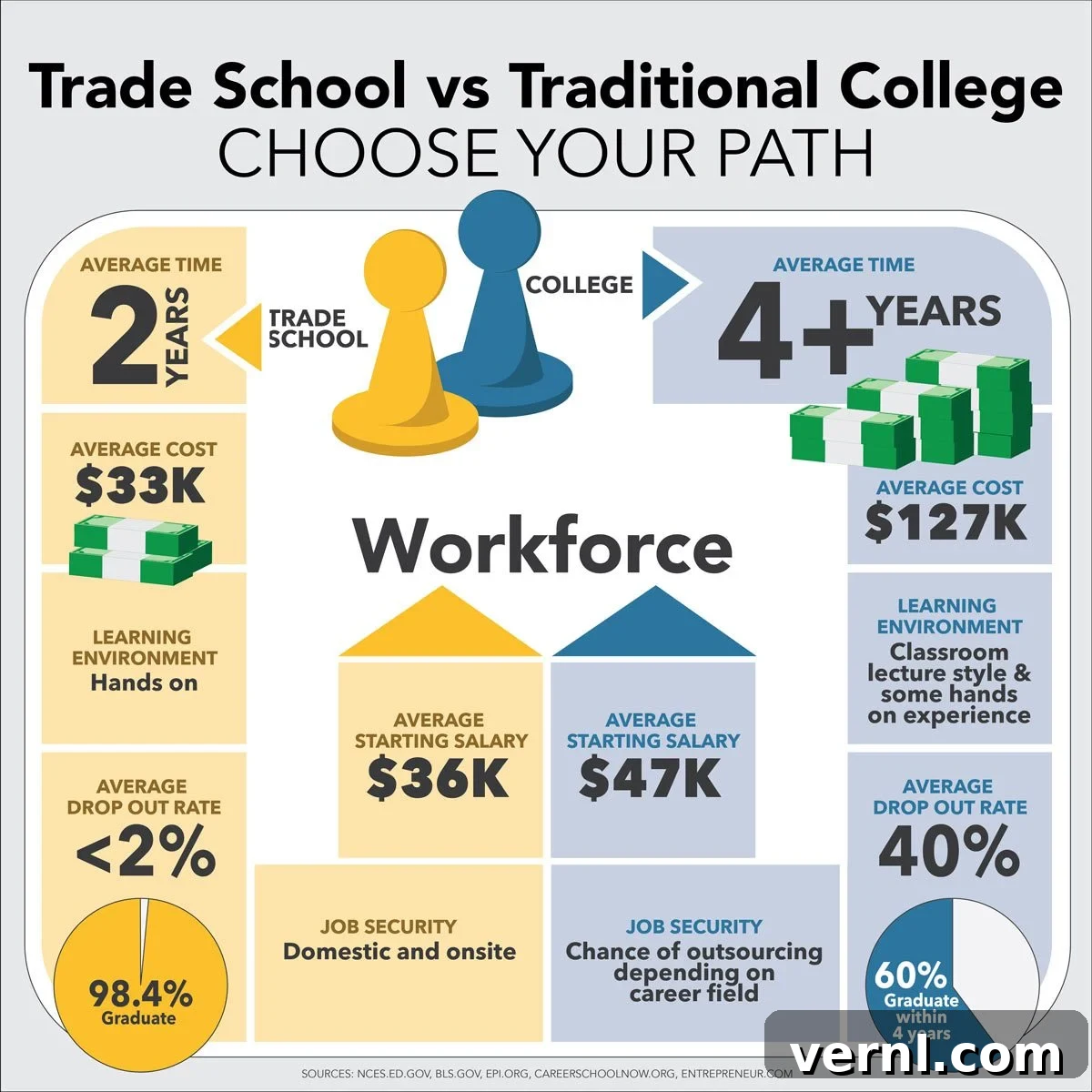
On average, the total cost for a trade school program, from enrollment to completion, typically ranges around $33,000. Many trade school graduates find themselves with approximately $10,000 remaining in student loans upon completion. This represents a substantial monetary saving for students pursuing vocational training compared to those attending traditional universities. The focus on practical, job-specific skills and the shorter program durations contribute directly to these lower overall expenses, making trade school a financially accessible option for many.
Traditional College Costs: A Heavier Financial Burden
In stark contrast, the average cost for obtaining a bachelor’s degree from a four-year institution can be as high as $127,000 from start to finish. This figure varies significantly based on whether the institution is public or private, in-state or out-of-state, and whether the student secures scholarships or grants. Consequently, many university graduates carry an average of $37,000 in student loan debt upon graduation. This considerable debt can impact future financial decisions, from homeownership to retirement planning, underscoring the importance of careful financial planning when considering a four-year degree.
Length of Study: Time as a Crucial Resource
The duration of study is another critical differentiator, directly impacting when graduates can enter the workforce and begin earning income.
Trade School: Expedited Skill Acquisition
Trade schools provide a hands-on, technical education that is intensely focused on acquiring specific trade skills. Because these programs omit general education courses and concentrate solely on career-specific classes, the classroom time is dramatically reduced. Depending on the chosen trade and whether the student attends full-time or part-time, some programs can be completed in as little as six weeks, while others may take up to two years. This accelerated pace means trade school graduates can enter their chosen professions much sooner, gaining valuable work experience and earning potential ahead of their traditionally educated peers.
Traditional College: Comprehensive and Extended Learning
Earning a bachelor’s degree typically requires anywhere from three to four or more years, contingent on factors such as the student’s course load, major, and whether they pursue double majors or minors. The extended duration of this type of education is largely attributable to the inclusion of numerous general course credits designed to provide a well-rounded academic experience, in addition to the major-specific curriculum. While this longer commitment offers opportunities for deeper academic exploration and personal growth, it also means a delayed entry into the full-time professional workforce.
Earning Potential: Beyond Initial Salaries
When evaluating educational paths, earning potential is a key consideration. While initial salaries may show a disparity, a deeper look reveals a more nuanced picture, especially when factoring in debt and time to market.
Initial Earnings: A Snapshot
The average starting salary for entry-level trade positions is approximately $36,000 per year. In comparison, bachelor’s degree holders typically command an annual starting salary averaging around $47,000. This $11,000 difference may appear significant at first glance, suggesting a clear financial advantage for college graduates.
Long-Term Perspective: Debt, Experience, and Entrepreneurship
However, it is vital to factor in the cost of repaying student loans. As previously noted, the average student loan debt for a bachelor’s degree holder is $37,000, significantly higher than the average $10,000 for trade school graduates. Moreover, trade school graduates typically enter the workforce, on average, two years sooner than traditional college students. This head start translates into two extra years of full-time income and professional experience, which can quickly narrow the initial salary gap. Over time, experienced skilled tradespeople can achieve substantial earning potential through specialization, entrepreneurship, and continued professional development, often surpassing the earnings of some college-educated professionals without the burden of extensive debt. Many trades also offer opportunities for overtime and project-based work, further boosting income.
Job Security and Industry Demand: Future-Proofing Your Career
Job security is an increasingly critical factor in career planning, and the skilled trades often offer advantages that certain other career fields may lack.
Inherent Stability of the Trades
Many industry jobs in the United States, particularly those that are office-based or amenable to digital work, face the risk of being outsourced overseas. In contrast, trade workers often enjoy a greater level of inherent job security. This is because virtually all trade jobs, such as those performed by electricians, plumbers, HVAC technicians, and automotive mechanics, are domestic and require an onsite presence to deliver essential services. You cannot outsource the repair of a local air conditioner or the installation of plumbing in a new building.
Robust Demand and Positive Outlook
Furthermore, according to the U.S. Bureau of Labor Statistics (BLS), there is a consistently positive job outlook for those interested in pursuing a skilled trade. For instance, employment for electricians is projected to grow by 14 percent between 2014 and 2024, significantly faster than the average for all occupations. Similarly, those working as plumbers, pipefitters, and steamfitters are expected to see a robust 12 percent occupational growth. This strong demand is driven by an aging workforce, infrastructure development, and the ongoing need for maintenance and repair services across residential, commercial, and industrial sectors. The persistent “skills gap” means there are more available skilled trade positions than qualified workers, further enhancing job security for graduates of vocational programs.
Making the Right Choice: A Personalized Decision
While a college degree remains essential for certain occupations requiring extensive theoretical knowledge, research capabilities, or advanced professional licensure (such as doctors, lawyers, or engineers), trade schools offer an invaluable alternative. They provide a direct, efficient pathway for students to enter a specialized workforce in a significantly quicker timeframe and with considerably less debt. The decision between trade school and traditional college is not about one being inherently “better” than the other, but rather about identifying which path best aligns with your personal strengths, aspirations, and circumstances.
To make the most informed decision, consider the following:
- Self-Assessment: Honestly evaluate your learning style, interests, and long-term career goals. Do you prefer practical application or theoretical study? Do you have a specific trade in mind, or are you exploring various academic disciplines?
- Financial Reality: Assess your financial situation and your comfort level with student debt. How quickly do you want to become financially independent?
- Market Demand: Research the current and projected job markets for fields you are considering, both within the trades and degree-requiring professions. Look at growth rates, average salaries, and job security.
- Informational Interviews and Shadowing: Speak with professionals in both traditional and trade careers. Consider shadowing someone in a field that interests you to gain firsthand insight into daily responsibilities and work environments.
By diligently researching and weighing the pros and cons of various career fields and educational pathways, you will feel confident and empowered in making the right choice for your future. Both trade schools and traditional colleges offer legitimate and rewarding routes to professional success; the key is choosing the one that is truly right for you.