
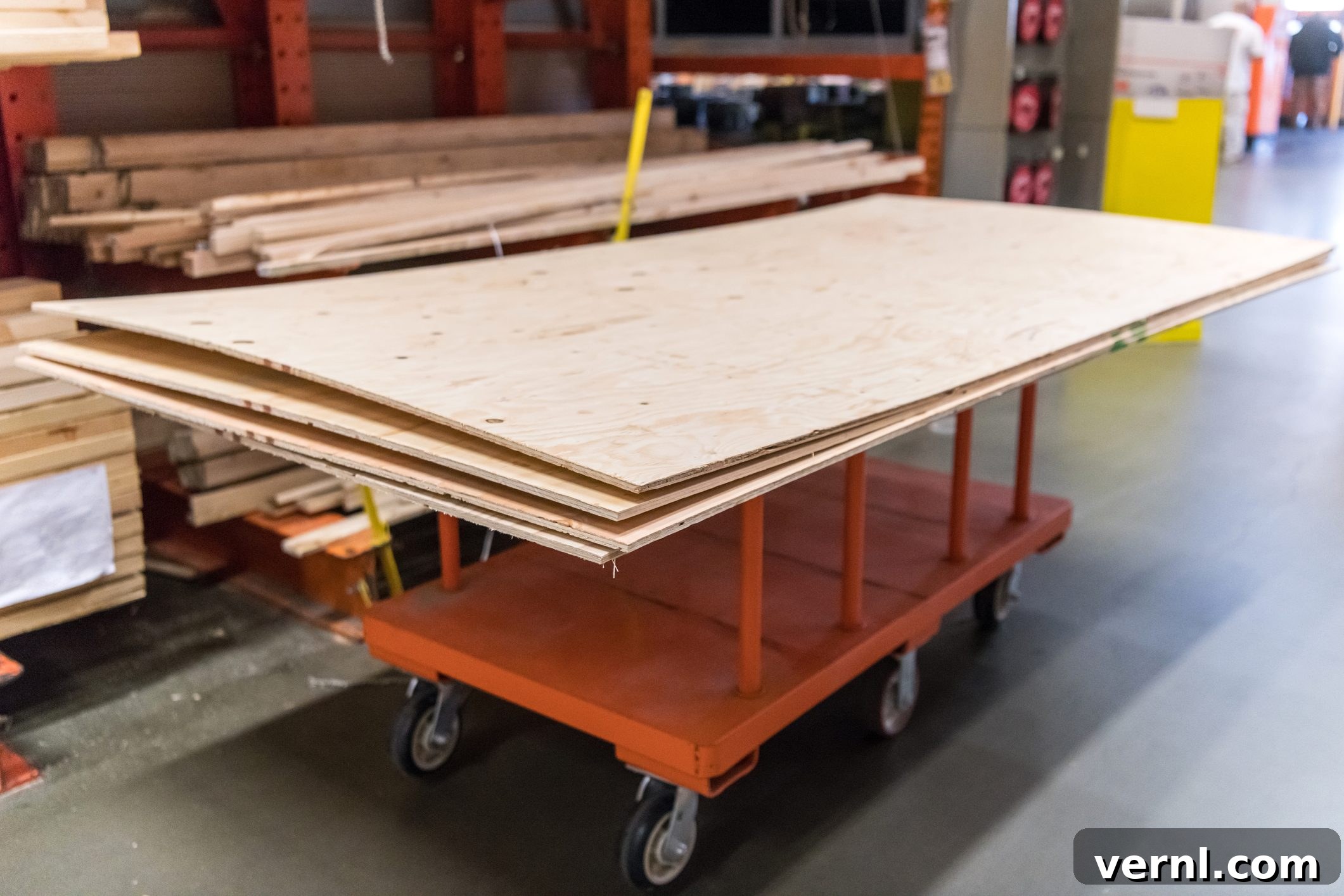
For generations, plywood has been an undisputed workhorse in the construction and DIY realms, an indispensable building material that has shaped homes, businesses, and countless projects across North America. Its versatility, strength, and relative affordability made it the go-to choice for everything from structural sheathing to cabinetry. The U.S. Forest Service even links its widespread adoption in the 1920s to the dawn of the industrial age, a testament to its foundational role in modern building practices.
However, the global landscape shifted dramatically with the onset of the COVID-19 pandemic in 2020, ushering in unprecedented challenges for the construction industry. Suddenly, a material once readily available became a rare commodity, with prices skyrocketing and lead times extending. This ongoing situation has forced builders, contractors, and DIY enthusiasts alike to re-evaluate their strategies and actively seek out reliable and cost-effective alternatives to plywood. Understanding the root causes of this shortage and exploring viable substitute materials is no longer just an option—it’s a necessity for successful project planning and execution in today’s dynamic market.
The Perfect Storm: Why Plywood Supplies Are Tight and Prices Are High
The scarcity and elevated cost of plywood are not isolated issues but rather symptoms of a complex interplay of global and regional factors, creating what many in the industry describe as a “perfect storm.” This crisis extends beyond just plywood, affecting the broader lumber market, and has ripple effects throughout the economy.
Unprecedented Demand Meets Crippled Supply
- Pandemic-Induced Shifts: The initial lockdowns in 2020 led to temporary shutdowns of sawmills and manufacturing plants. Simultaneously, with more people working from home and restricted travel, there was an explosion in home improvement projects and new housing demand. This surge in consumer spending on home-related goods and services quickly outstripped the diminished production capacity.
- Wildfires and Climate Change: Western North America, a critical region for lumber production, has been ravaged by increasingly severe wildfires. In the summer of 2021 alone, millions of acres burned in British Columbia, home to three of the continent’s largest lumber producers, as well as in Washington and Oregon, significant plywood manufacturing states. These fires destroyed timberland, disrupted logging operations, and forced major producers like Canfor to drastically cut back production. The Center for Climate and Energy Solutions highlights climate change as a primary driver behind the escalating frequency and intensity of these destructive events, posing a long-term threat to timber supply.
- Labor Shortages: The pandemic triggered widespread labor shortages across various sectors, including the lumber industry. Sawmills struggled to maintain adequate staffing levels due to health concerns, quarantine protocols, and a general shift in the labor market. As the Washington Post reported, this created bottlenecks in production, contributing directly to soaring lumber prices. Even with increased wages, attracting and retaining a full workforce remains a challenge for many facilities.
- Supply Chain Disruptions and Inflation: Beyond production, getting lumber and plywood from mills to consumers has become a logistical nightmare. A significant shortage of truck drivers, port congestion, and other global supply chain issues have driven up transportation costs exponentially. Compounded by rampant inflation across the economy, the final price consumers pay for plywood and other building materials has reached unprecedented levels.
While production issues are slowly improving, the interconnected nature of these challenges means that a swift return to pre-pandemic pricing and availability is unlikely. Conner Industries suggests that prices may eventually fall once supply chain and labor issues stabilize and inflation eases, but the exact timeline remains uncertain. This ongoing volatility underscores the critical need for builders and homeowners to explore and understand reliable plywood alternatives.
Choosing the Right Plywood Alternative: Key Considerations
When selecting a substitute for plywood, it’s essential to consider the specific demands of your project. No single alternative is a perfect one-to-one replacement for all of plywood’s applications, so informed decision-making is crucial. Here are key factors to evaluate:
- Structural Integrity: For applications like subflooring, wall sheathing, or roofing, the material must possess sufficient strength and stiffness to bear loads and withstand environmental stresses.
- Moisture Resistance: Exterior applications, bathrooms, kitchens, and basements require materials that can resist moisture absorption, swelling, and degradation.
- Appearance: For interior cabinetry, furniture, or visible shelving, the surface finish, paintability, or ability to accept veneers is paramount.
- Cost-Effectiveness: While the primary driver for seeking alternatives is often cost, it’s important to balance initial purchase price with long-term durability and performance.
- Workability: Consider how easily the material can be cut, fastened, sanded, and finished with standard tools.
- Environmental Impact: Many alternatives are made from recycled wood fibers, offering a more sustainable choice compared to virgin timber products.
- Availability: Even alternatives can experience regional shortages, so checking local supply is always a good first step.
Top Plywood Alternatives for Modern Construction and DIY Projects
Fortunately, the construction industry offers several proven and effective alternatives that can step in where plywood falls short in availability or cost. Each has its own unique characteristics, making them suitable for different applications.
Oriented Strand Board (OSB)
OSB, often referred to as “chipboard” by some, is arguably the most common and direct alternative to plywood for structural applications. It’s widely used interchangeably with plywood for roof and wall sheathing, as well as subflooring, making it a familiar sight on construction sites. OSB panels are manufactured by layering specially oriented strands of wood chips (hence “oriented strand”), bonding them together with adhesives under immense heat and pressure, and often treating them with wax or resin to enhance water resistance.
- Pros:
- Strength and Consistency: OSB offers comparable structural strength to plywood, especially along its primary axis. Its manufacturing process results in a more consistent and uniform product, often without the knots or voids found in some plywood grades.
- Cost-Effective: Historically, OSB has often been more affordable than plywood, although current market fluctuations mean prices can sometimes be similar, as seen with a 4-ft. x 8-ft. sheet of 19/32-in. OSB sometimes costing around $56 compared to $48 for comparable plywood sheathing at the time of writing.
- Sustainability: OSB can be manufactured from fast-growing, smaller timber, reducing reliance on old-growth forests and making it a more environmentally friendly option.
- Availability: Due to its efficient manufacturing process, OSB is often more readily available, even when plywood supplies are constrained.
- Cons:
- Moisture Sensitivity: While treated for water resistance, OSB is more prone to swelling along its edges if exposed to prolonged moisture than plywood. This can affect its structural integrity and cause delamination over time.
- Weight and Workability: OSB panels can be slightly heavier than plywood of the same thickness. The textured, interwoven surface, while excellent for grip, makes it less suitable for applications where a smooth finish is required without significant preparation.
- Appearance: Its distinct chip pattern makes OSB unsuitable for decorative applications without extensive finishing or overlay.
- Common Uses: Roof decking, wall sheathing, subflooring, temporary enclosures, hoarding, packaging, and in some cases, I-joist webs.
Medium Density Fiberboard (MDF)
For interior applications where a smooth, stable surface is paramount, Medium Density Fiberboard (MDF) shines. It’s a favorite among cabinetmakers and interior woodworkers, frequently fashioned into trim, cabinet doors, wall paneling, and furniture components. MDF is engineered by breaking down hardwood and softwood residuals into fine wood fibers, combining them with wax and a resin binder, and then forming panels under high temperature and pressure.
- Pros:
- Smooth Finish: MDF has an incredibly smooth, grain-free surface that is ideal for painting, laminating, or applying wood veneers. It takes paint exceptionally well, resulting in a flawless finish.
- Consistent Density: Its uniform density allows for precise machining, routing, and drilling without splintering or tear-out, which is common with solid wood or plywood.
- Stability: When properly finished, MDF is less prone to warping or cracking than solid wood, offering greater dimensional stability in varying humidity and temperature conditions.
- Environmental Choice: Made from recycled wood fibers and sawdust, MDF is considered a greener building product, diverting waste from landfills.
- Cons:
- Weight: MDF is significantly heavier than plywood, making a 4-ft. x 8-ft. sheet with a thickness of 5/8-in. weigh around 85 pounds, often requiring two people to handle.
- Moisture Susceptibility: MDF is highly susceptible to water damage; it will swell and lose structural integrity if exposed to moisture, making it unsuitable for outdoor or high-humidity environments unless specially treated.
- Fastener Holding: It doesn’t hold screws as well as plywood, especially on edges, requiring pre-drilling and careful fastener selection.
- Formaldehyde Emissions: Some traditional MDF products contain urea-formaldehyde, though low-VOC (Volatile Organic Compound) and formaldehyde-free options are increasingly available.
- Common Uses: Cabinetry (especially doors and panels), furniture components, shelving, decorative trim, speaker boxes, display cases, wall panels, and interior doors.
High Density Fiberboard (HDF)
High Density Fiberboard (HDF), often known as hardboard or Masonite, is a close relative of MDF but with enhanced properties due to a more intense compression process. The wood fibers are pressed with significantly more force, resulting in a denser and harder finished product. This increased density contributes to its greater durability and smoother surface.
- Pros:
- Extreme Density and Hardness: HDF is exceptionally dense, making it resistant to impact and surface damage. This hardness makes it very stable and long-lasting.
- Smooth Surface: Like MDF, HDF offers an incredibly smooth surface, ideal for painting, printing, or lamination, often with a melamine overlay for added durability.
- Thinness and Flexibility: HDF is typically available in thinner sheets than MDF or plywood, making it useful for applications requiring less bulk or some degree of flexibility. Common thicknesses include 1/8-in. hardboard.
- Cons:
- Limited Thicknesses: Plywood-sized sheets of HDF are typically only available in thin gauges, restricting its use in structural applications or where significant thickness is required.
- Weight and Brittleness: While hard, thin HDF can be brittle and prone to snapping if flexed too much. Its high density also makes it quite heavy for its size.
- Moisture Sensitivity: Similar to MDF, HDF is not suitable for environments with high moisture without special treatment or coatings.
- Common Uses: Flooring underlayment (especially for vinyl and linoleum), furniture back panels, drawer bottoms, pegboard, door skins, wall panels, interior trim, whiteboard surfaces, and temporary signage.
Particleboard
Particleboard stands out as one of the most budget-friendly plywood alternatives, particularly appealing when cost is a primary concern. It is also an excellent example of a recycled building material, crafted by pressing together larger wood particles (such as wood chips, shavings, and sawdust) with a synthetic resin adhesive under heat and pressure. The resulting matrix is less dense and often rougher than MDF or HDF.
- Pros:
- Cost-Effectiveness: Particleboard is generally the least expensive engineered wood panel product, making it ideal for projects with tight budgets.
- Recycled Content: It makes excellent use of wood waste, contributing to sustainable construction practices.
- Consistency: Despite its appearance, unlaminated particleboard offers a fairly consistent thickness and density throughout the panel.
- Versatility (Laminated): Available in factory-laminated versions with melamine or wood veneer finishes, which can be quite attractive and durable for applications like building cabinets, shelves, and economical interior furnishings. For example, laminated particleboard is very popular in store-bought vanities and kitchen cabinets.
- Cons:
- Low Strength and Durability: Particleboard is not very strong or dense compared to plywood or even MDF. It can sag under heavy loads and is prone to chipping and crumbling, especially at edges.
- Extreme Moisture Sensitivity: It is highly susceptible to moisture damage, swelling significantly and rapidly losing its structural integrity when wet. This makes unlaminated particleboard unsuitable for any application where moisture might be present.
- Poor Fastener Holding: Screws and nails do not hold well in particleboard, and it can strip out easily.
- Appearance: Unlaminated particleboard has a rough, unattractive appearance even when painted, limiting its aesthetic uses.
- Common Uses: Economical shelving, cabinet carcasses (especially when laminated), furniture components (e.g., desktops, drawer sides), subflooring for carpet, underlayment for certain flooring types, and core material for laminate countertops.
Embracing Adaptability in Construction
While plywood’s historical dominance is undeniable, the current market realities necessitate a more flexible and informed approach to material selection. The ongoing challenges of lumber shortages, inflated prices, and supply chain disruptions mean that understanding and utilizing plywood alternatives is no longer merely an option for niche projects—it’s a fundamental strategy for maintaining project schedules, managing budgets, and ensuring successful outcomes.
By carefully evaluating the specific requirements of each project against the unique strengths and weaknesses of materials like OSB, MDF, HDF, and particleboard, builders and DIYers can make smart choices that deliver performance, aesthetics, and cost-effectiveness. The construction landscape is continuously evolving, and embracing these versatile alternatives is a testament to the industry’s enduring capacity for innovation and adaptation.