Master Uneven Surfaces: Your Ultimate Guide to Ladder Levelers for Safe DIY Projects
Working at heights is an inherent part of many home improvement and maintenance tasks. Whether you’re reaching for the top of a wall to paint, cleaning gutters, or making essential roof repairs, a ladder is an indispensable tool. However, the world outside our homes is rarely perfectly flat. Uneven ground, sloping driveways, staircases, and rough terrain often pose significant challenges to setting up a ladder safely and stably. For too long, people have resorted to risky makeshift solutions like wedging a board, a brick, or a block of wood under a short leg, compromising both their safety and the integrity of their ladder setup.
Fortunately, there’s a simple, effective, and incredibly safe solution: the ladder leveler. These adjustable and lightweight devices are designed to revolutionize how you approach tasks on challenging surfaces, transforming a wobbly, hazardous ladder into a stable, secure platform. This comprehensive guide will delve into everything you need to know about ladder levelers, ensuring you can stabilize ladders effortlessly for painting over staircases or whenever a flat spot is nowhere to be found. Prepare to stay safe on your ladder, even when the ground is anything but even.
What Exactly is a Ladder Leveler?
A ladder leveler is an essential accessory engineered to provide a safe and stable foundation for your ladder on a multitude of irregular surfaces. Imagine trying to paint the exterior of your house on a sloped lawn, or reaching a high ceiling in a stairwell; without a leveler, these tasks become incredibly dangerous, if not impossible. A ladder leveler eliminates the need for precarious shims or blocks, offering a robust and reliable way to compensate for differences in ground elevation.
This ingenious device is a must-have for anyone who regularly uses a ladder for DIY projects or professional work. It ensures your ladder can be used safely on slanted surfaces, stairways, uneven pavement, sloped hillsides, and even rocky or muddy terrain. Regardless of your ladder’s type – be it a tall extension ladder, a versatile multi-position ladder, or a compact stepladder – installing a ladder leveler means that working high off the ground to paint, make repairs to your home, clean windows, or trim trees will be significantly less worrisome, stressful, and dangerous. It’s an investment in your safety and peace of mind, allowing you to focus on the task at hand rather than constantly fretting about stability. Additionally, for precision projects, understanding how to use a level over long distances can complement your leveling efforts.
The Mechanics Behind Stable Heights: How Ladder Levelers Work
At its core, a ladder leveler operates on a simple yet highly effective principle: creating an artificial, level base for your ladder, irrespective of the ground beneath. When affixed securely to the outside rails of a ladder, typically at the base of the legs, a ladder leveler employs telescoping legs. These legs are the heart of the system, designed to extend or retract independently to match the varying elevations of the ground.
The retractable mechanism allows for precise adjustment. When one side of the ladder rests on lower ground than the other, the leveler on the shorter leg extends, effectively lengthening that leg until both sides of the ladder’s base are at the same horizontal plane. This balancing act ensures that the ladder stands perfectly upright and plumb, even on the most challenging slopes or steps. Once the desired level is achieved, the mechanism is securely locked into place, preventing any accidental retraction or extension while you’re working.
This intelligent design removes the guesswork and instability associated with traditional methods. Instead of relying on a precarious stack of materials, the ladder leveler provides a sturdy, integrated extension that becomes an integral part of the ladder’s structure. You can then climb the ladder rungs with newfound confidence, knowing that the risk of tipping, wobbling, or shifting accidents has been dramatically reduced.
Key Features and Innovations in Ladder Leveler Technology
Ladder levelers have evolved significantly, offering a range of features and innovations designed to enhance safety, ease of use, and versatility. Understanding these options will help you choose the best leveler for your specific needs.
Types of Ladder Levelers: Manual vs. Automatic
- Manually Adjustable Ladder Levelers: These are the most common type. They typically come with base units that attach permanently or semi-permanently to your ladder’s side rails, along with an extending leveler for each leg. Adjustment involves releasing a pin or lever, extending the leg to the required length, and then locking it back into place. While they require a bit more effort and time to adjust, they are generally robust, reliable, and cost-effective.
- Automatic (Self-Leveling) Ladder Levelers: Representing a significant innovation, automatic ladder levelers amazingly conform to different supporting surface heights with minimal user intervention. Many utilize a ratchet-style operation with spring-loaded locks. As the ladder is set down, the legs automatically extend or retract until the ladder finds its level plane, then lock in place. This offers incredible speed and convenience, especially when frequently moving the ladder across varied terrain, though they often come at a higher price point.
Grip and Stability Enhancements
Beyond leveling, a crucial aspect of safety is ensuring the ladder doesn’t slip. Modern ladder levelers incorporate features to maximize grip on various surfaces:
- Sturdy Swivel Shoes: Many models feature robust swivel shoes at the base of the extending legs. These shoes pivot to maintain full contact with the ground, regardless of the angle, distributing the ladder’s weight evenly.
- Ice Pick Cleats: For added grip on soft ground like soil, grass, or even ice, some swivel shoes are equipped with sharp, retractable ice pick cleats. These pierce the surface, preventing slippage.
- Non-Marring Rubber Pads: For use on hard, finished surfaces like concrete, decking, or indoor flooring, the shoes often have durable, non-slip rubber pads that prevent scratching and provide excellent friction.
Material Durability and Construction
The longevity and strength of a ladder leveler depend heavily on its construction. High-quality levelers are typically made from:
- Aircraft-Grade Aluminum: Known for its exceptional strength-to-weight ratio, making the leveler robust without adding excessive bulk to your ladder.
- Heavy-Duty Steel: Offers incredible durability, often used in components that experience high stress.
These materials ensure the leveler can withstand the rigors of outdoor use, heavy loads, and repeated adjustments, providing a reliable safety solution for years to come.
Additional Features to Look For
- Universal Fit: Many levelers are designed to fit most common ladder types and brands, making them a versatile investment.
- Quick-Connect Systems: Some advanced systems allow for easy attachment and detachment, meaning you can move the levelers between different ladders or remove them when not needed.
- Integrated Level Indicators: Some levelers include a small bubble level, helping you verify perfect horizontal alignment without needing a separate tool.
A typical ladder leveler, regardless of its specific innovations:
- Lets you work more safely on uneven surfaces;
- Fits most ladders and attaches in seconds (for quick-connect types);
- Works on either side of the ladder;
- Provides hands-free stabilization;
- Comes with mounting hardware and clear instructions.
Step-by-Step Guide: Effectively Using Your Ladder Leveler
Once you’ve chosen and installed your ladder leveler, using it correctly is crucial for maximizing safety. While specific instructions may vary slightly by model, the general process remains straightforward.
1. Pre-Installation and Familiarization
Before you begin, ensure your ladder is in good condition, free from damage, and rated for the weight you intend to place on it. If your ladder leveler is not pre-installed, attach the base units and the two levelers securely to each side rail of your ladder according to the manufacturer’s instructions. This might involve drilling holes and bolting the units in place, or using a quick-connect system. Always double-check that all bolts and fasteners are tightened correctly.
2. Positioning Your Ladder
Place your ladder where you intend to work, ensuring that the ladder’s feet are positioned on the most uneven part of the terrain that requires leveling. For stairs, place one leg on a lower step and the other on a higher one, or adjust for the angle of the incline.
3. Adjusting the Leveler (Manual Systems)
For manually adjustable levelers:
- Identify the ladder leg that is on the lower side of the uneven surface.
- Engage the release mechanism for that leg’s leveler (often a foot pin, lever, or button).
- Extend the leg outwards until it firmly makes contact with the ground and the ladder begins to feel stable and level.
- Release the locking mechanism, ensuring it clicks securely into place.
- You may need to gently rock the ladder or apply some pressure to ensure both leveler feet are fully seated on the ground.
- Take a step back and visually assess the ladder’s levelness. For ultimate precision, use a spirit level placed on a rung or the cross-member of the ladder. Fine-tune the extension if necessary until the ladder is perfectly horizontal and stable.
4. Adjusting the Leveler (Automatic Systems)
For automatic or self-leveling systems:
- Simply place the ladder in the desired position on the uneven ground.
- The levelers will automatically extend or retract, often with a distinct clicking sound, until the ladder finds its level and the locking mechanism engages.
- Listen for the locks to engage and ensure the feet are firmly planted.
- Again, a visual check or a spirit level can confirm perfect leveling.
5. Final Verification Before Climbing
This is arguably the most critical step. Before you climb a single rung:
- Check Stability: Give the ladder a firm shake from the base. It should not wobble or shift.
- Lock Confirmation: Ensure both levelers are securely locked into place. You should hear or feel a positive engagement.
- Ground Contact: Verify that both feet of the ladder, equipped with their levelers, are making full and firm contact with the ground. There should be no gaps or unstable resting points.
- Angle: Ensure the ladder is set at the proper angle (the 4:1 rule – for every four feet of ladder height, the base should be one foot away from the wall).
Only after you are completely satisfied with the ladder’s stability and levelness should you proceed to climb up to paint, repair, or reach those hard-to-reach areas. Taking these few extra moments can prevent serious accidents.
Who Needs a Ladder Leveler? Essential for Every DIYer and Professional
The versatility and critical safety benefits of ladder levelers make them an indispensable tool for a wide range of individuals and professions. While often seen as an accessory, it truly transforms a standard ladder into a far safer and more adaptable piece of equipment.
- Homeowners: For the average homeowner, a ladder leveler opens up a world of possibilities for tackling exterior projects with confidence. Imagine effortlessly cleaning gutters on a sloped driveway, washing second-story windows, reaching high eaves for painting, or inspecting a roof. It makes annual maintenance and ambitious DIY DIY projects around the house and yard significantly safer and more accessible.
- Painters: Professional painters frequently encounter diverse and challenging environments, from residential stairwells to uneven exterior landscapes. A ladder leveler allows them to achieve consistent, high-quality work without compromising safety or efficiency, easily navigating tricky spots indoors and out.
- Landscapers and Gardeners: Working in gardens often involves navigating hills, uneven terrain, and soft ground. A leveler ensures ladders are stable when trimming tall hedges, pruning trees, or installing outdoor lighting.
- Construction Workers: Job sites are rarely perfectly flat. From framing to finishing, construction workers often need to access different heights on irregular surfaces. Ladder levelers provide the necessary stability to work safely and efficiently, reducing workplace hazards.
- Window Cleaners: For those who regularly clean windows on multi-story homes or commercial buildings, a leveler is crucial for ensuring a safe and stable platform on potentially slick or uneven outdoor surfaces.
- Anyone Prioritizing Safety: Ultimately, anyone who uses a ladder, regardless of their profession or the frequency of use, should consider a ladder leveler. The cost of an accident far outweighs the investment in this essential safety device.
Investing in Safety: Cost and Where to Purchase Your Ladder Leveler
For anyone who owns a ladder, a leveler is an extremely useful and affordable accessory that will significantly increase the number of projects you can accomplish safely around the house and yard. The price point makes it an accessible safety upgrade for most budgets.
Cost Considerations
Prices for ladder levelers typically start at around $80 for basic, manually adjusted models and can go upwards of $200-$300 for advanced automatic, quick-connect, or heavy-duty professional systems. Factors influencing the cost include:
- Type of Leveler: Manual systems are generally less expensive than automatic or self-leveling ones.
- Materials and Construction: Aircraft-grade aluminum and heavy-duty steel will command a higher price than lighter-duty materials.
- Brand Reputation: Established brands known for quality and durability may have higher prices.
- Features: Additional features like integrated levels, advanced grip systems, or quick-connect mechanisms can increase the cost.
Consider this a vital investment in your safety and efficiency, not just an expense. The peace of mind and prevention of potential injuries are priceless.
Where to Buy
Ladder levelers are widely available, making them easy to acquire:
- Home Improvement Stores: Major retailers like Lowe’s, Home Depot, and other select painting and home improvement retailers typically stock a variety of ladder levelers. This allows you to see the product in person and often get advice from store associates.
- Online Retailers: Websites like Amazon, eBay, and specialty safety equipment suppliers offer a vast selection, often with competitive pricing and customer reviews to help guide your choice. Shopping online provides convenience and access to a wider range of models.
- Specialty Tool Stores: Stores catering to contractors and professionals often carry robust, high-quality ladder levelers designed for heavy-duty use.
Recommended Ladder Levelers
To help you get started, here are a couple of highly regarded options:
- LeveLok Quick Connect Ladder Leveler Kit: We think the LeveLok Quick Connect Ladder Leveler Kit is one great choice. Made of ultra-strong structural aircraft aluminum for maximum durability, this system offers quick and easy attachment and detachment. Its robust design is ideal for frequent use and demanding tasks, providing exceptional stability and peace of mind on uneven terrain.
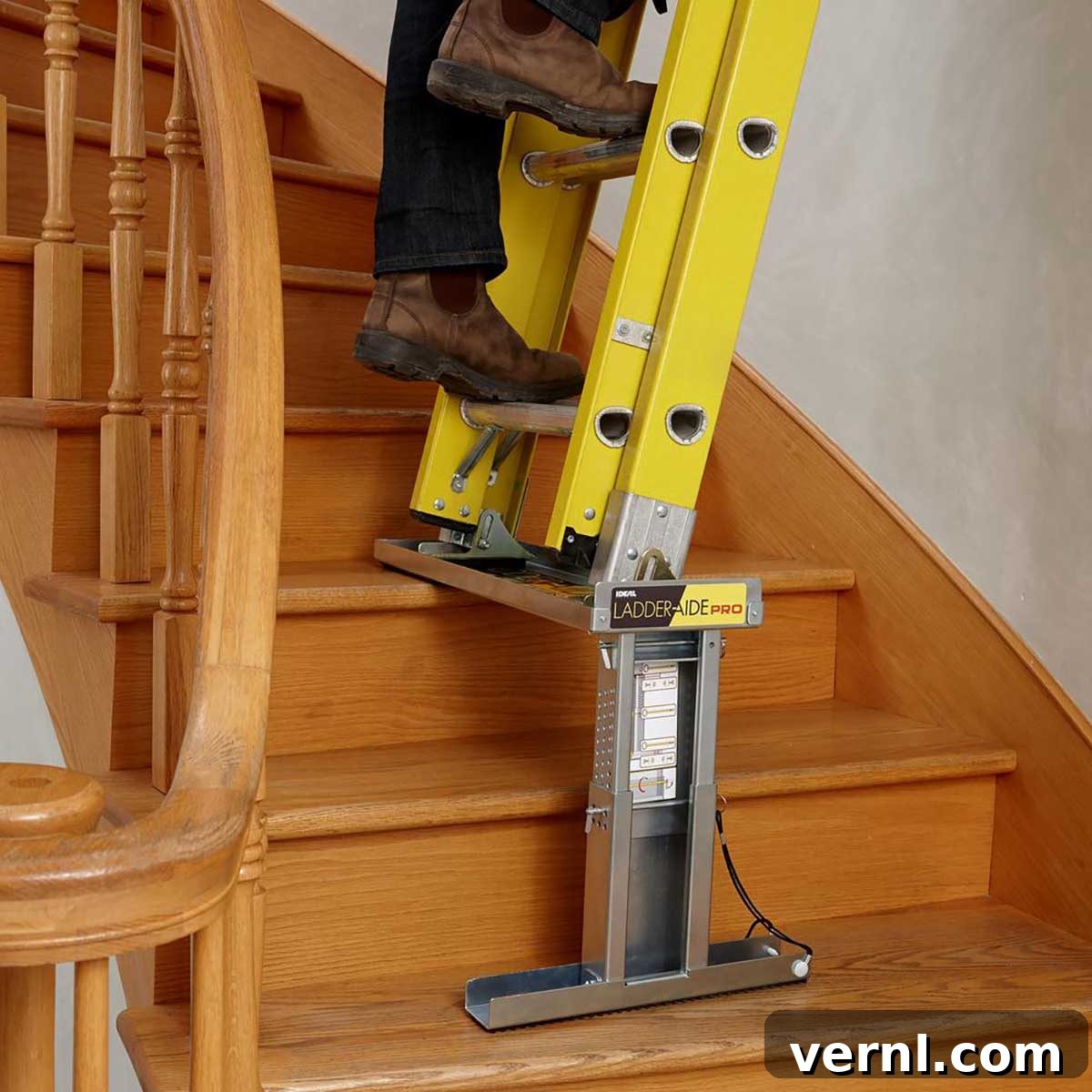
- Ladder-Aide by Ideal Security: For a portable and compact option, the Ladder-Aide by Ideal Security is especially handy if you plan to work on stairs a lot. This innovative device is designed specifically to level ladders on staircases, offering a simple yet effective solution for this common challenge. Its compact nature makes it easy to transport and store.
When choosing, consider your specific needs: what type of ladder do you own? What kind of uneven surfaces will you most frequently encounter? How often will you be using the leveler? Answering these questions will help you find the ladder leveler that works best for you and keeps you safe.
Beyond Leveling: Essential Ladder Safety Tips
While a ladder leveler significantly enhances safety, it’s crucial to remember that it’s part of a broader set of ladder safety practices. Always combine your leveler with these fundamental rules to ensure maximum protection:
- Always Inspect Your Ladder: Before each use, quickly check the ladder for any damage, loose rivets, missing rungs, or corrosion. Never use a damaged ladder.
- Maintain Three Points of Contact: When climbing or descending, always keep three points of contact with the ladder (two hands and one foot, or two feet and one hand).
- Proper Angle (4:1 Rule): Set up extension ladders at the correct angle. For every four feet of height the ladder extends, the base should be one foot away from the wall or support structure. This prevents the ladder from sliding out or falling backward.
- Avoid Overreaching: Never overreach to the side. Keep your belt buckle (your center of gravity) between the ladder rails. If you can’t reach, climb down and move the ladder.
- Respect Weight Limits: Always adhere to the ladder’s weight capacity, which includes your body weight plus tools and materials.
- Clear Work Area: Ensure the base of the ladder and the surrounding work area are clear of debris, tools, or anything that could cause a trip or instability.
- Electrical Safety: Never use metal ladders near electrical lines. Be aware of overhead power lines, even when using fiberglass ladders.
- Secure the Top: Whenever possible, tie off or secure the top of an extension ladder to prevent it from slipping sideways.
- One Person at a Time: Ladders are designed for one person unless explicitly stated otherwise.
Conclusion: Elevate Your Safety, Elevate Your Projects
The days of precarious balancing acts on uneven ground are over. Ladder levelers represent a vital leap forward in ladder safety, transforming potentially hazardous tasks into manageable and secure undertakings. From painting a vaulted ceiling over a tricky staircase to performing exterior maintenance on a sloping lawn, these ingenious devices provide the stability and confidence needed to tackle any project at height.
By investing in a quality ladder leveler, you’re not just buying an accessory; you’re investing in your safety, enhancing your efficiency, and gaining the peace of mind that comes with knowing your ladder is always on solid ground. With options ranging from simple manual adjusters to sophisticated automatic systems, there’s a ladder leveler out there to suit every need and budget. Make the smart choice today and equip your ladder with a leveler – it’s an essential tool for every serious DIYer and professional who values safety above all else.