
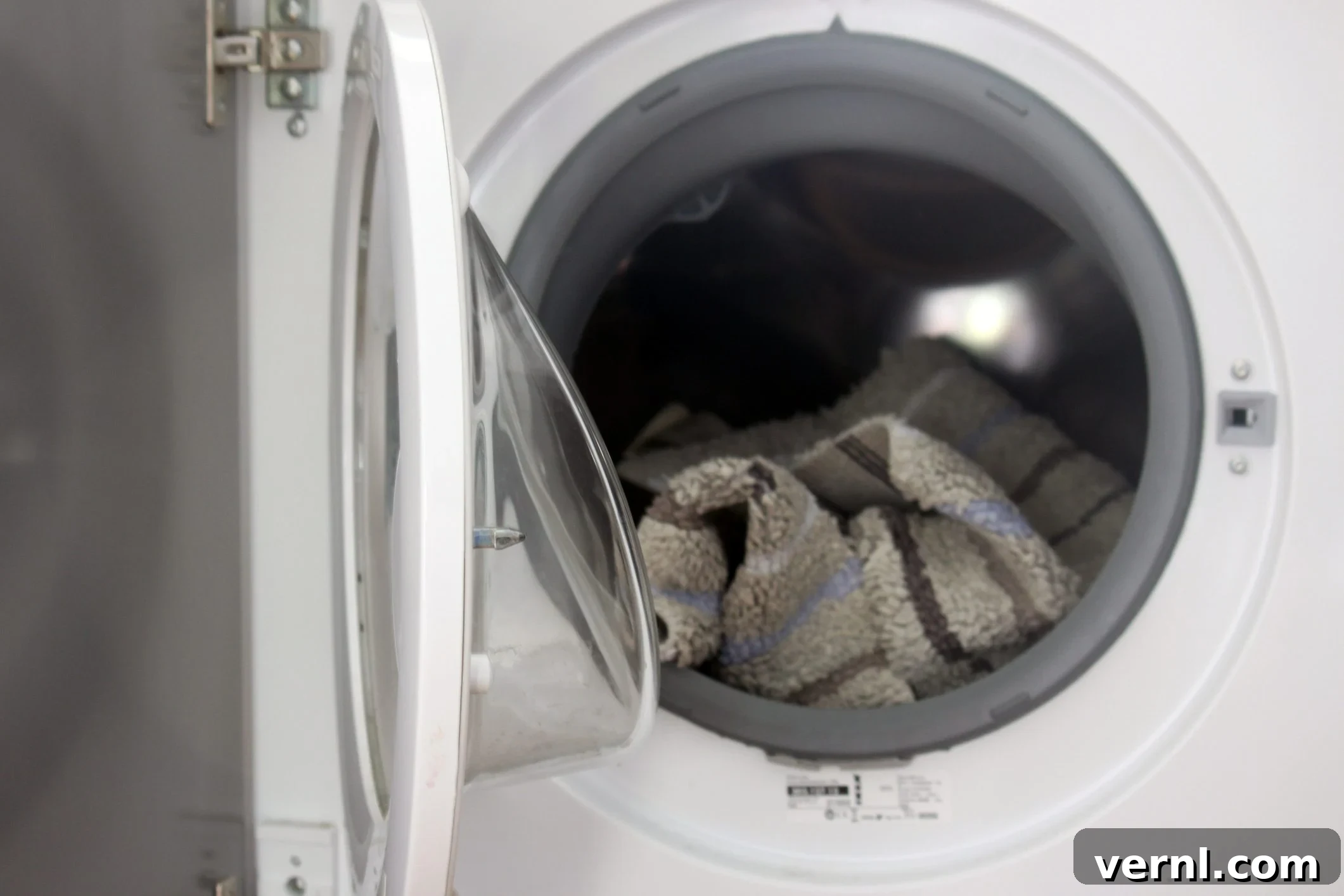
With over three decades of hands-on experience as an appliance technician, I’ve witnessed firsthand the devastating consequences of common laundry mistakes. One of the most frequent and costly errors consumers make involves their otherwise reliable front-load washing machines: using them to wash heavy, water-absorbent items like bathroom mats. It’s a scenario I’ve encountered countless times, where a perfectly good, often new, front-loader is rendered irreparable simply because it was tasked with a load it was never designed to handle, such as a pair of plush bath mats.
The simple, unequivocal truth is this: you should never attempt to clean bathroom mats in your standard home washing machine. This isn’t just a recommendation; it’s a critical piece of advice that can save you hundreds, even thousands, of dollars in repair costs or the expense of a premature washer replacement. Before we dive into the mechanical specifics, consider this: many homeowners are now discovering the superior hygiene and convenience of stone bath mats, which offer a refreshing alternative to traditional fabric mats that pose such a risk to your appliance.
Why Are Bathroom Mats So Damaging to Your Washing Machine?
Modern front-load washers are engineered with spacious spin baskets, designed to accommodate larger items like blankets and bedding. This generous capacity often leads consumers to a false conclusion: that their washer can handle any item, regardless of its weight or how much water it might absorb. However, this assumption overlooks a fundamental design limitation and the physics involved in high-speed laundry cycles.
The core problem with even the best bathroom mats lies in their incredible absorbency. What starts as a relatively lightweight, dry mat transforms into an extraordinarily heavy, water-logged mass once submerged in the wash cycle. This sudden and substantial increase in weight far exceeds the design specifications for your washer’s internal components. Coupled with the incredibly fast spin rates of modern machines—which can reach upwards of 1,200 revolutions per minute (RPM) during a high-speed spin—this excessive weight generates enormous amounts of centrifugal force. This force, when applied to an unbalanced, heavy load, places immense, unbearable stress on the washer’s delicate internal mechanisms, effectively tearing the appliance apart from the inside out.
Ignoring this critical warning can lead to two particularly expensive and common mechanical failures:
It Can Catastrophically Ruin the Drain Motor and Pump System
Many bathroom mats feature a rubberized or non-slip backing, a seemingly innocuous feature that becomes a severe liability in the wash cycle. The harsh detergents, hot water, and aggressive tumbling action cause this rubber backing to disintegrate over time, shedding countless tiny rubber particles. These minuscule pieces then embark on a destructive journey through your washer’s drainage system. They inevitably find their way to the drain pump, where they can severely clog its motor and drain line, impeding the crucial process of water expulsion.
A compromised drain motor is a common culprit behind a washing machine that fails to drain or leaves clothes soaking wet. The repair often necessitates the complete replacement of the drain motor and pump assembly, a service that typically averages around $240 for parts and labor. But even mats without a rubber backing aren’t entirely safe. Some possess long, synthetic fibers that can break off during the vigorous wash cycle, similarly contributing to blockages and clogged drain lines. The integrity of your drainage system is paramount for efficient and hygienic laundry, and bath mats present a significant threat to it.
It Can Destroy the Spin Basket Bearing and Spider Bracket
Perhaps the most severe and costly damage heavy bath mats inflict is upon the rear bearing that supports the spin basket. This critical component is designed to facilitate the smooth rotation of the drum, but it bears the brunt of the extreme weight and the immense centripetal force generated by an unbalanced, overloaded spin cycle. When subjected to such extraordinary stress repeatedly, the bearing wears out prematurely, leading to excessive friction, noise, and eventual failure. The cost to replace a failed spin basket bearing alone can easily exceed $500, a repair that often makes the washing machine uneconomical to fix, especially on older models.
Adding to this potential disaster is the “spider bracket,” a crucial, often aluminum alloy, component that connects the spin basket to the shaft and the rear bearing. This bracket is particularly vulnerable to corrosion from detergents and moisture, and its structural integrity is severely compromised when continuously stressed by heavy, water-logged loads. When the spider bracket breaks, it can lead to catastrophic failure of the spin basket, often tearing it free from its mounting. Repairing a broken spider bracket can incur another cost in the vicinity of $500, making a combined bearing and bracket repair prohibitively expensive.
Just recently, I handled a case involving a two-year-old LG washer. The customer contacted me reporting an extremely loud spin cycle, akin to a jet engine taking off, which is a tell-tale sign of a severely worn-out rear bearing. Upon inquiry, he admitted to routinely washing large blankets and, crucially, heavy bathroom mats in his machine. The news I had to deliver was grim: with a repair cost exceeding $500 for the bearing (and likely the spider bracket), it was financially more sensible to replace the entire washer. This unfortunate individual now faces an unexpected expense of around $1,200 for a new appliance, and another bulky item ends up in a landfill, destined to decompose over millennia. This highlights a critical oversight: washing machine manufacturers truly should include more prominent warnings against washing heavy, water-absorbent items like bathroom mats!
What If I’ve Already Laundered My Bathroom Mats? Is It Too Late?
If you’ve inadvertently washed bathroom mats in your machine in the past, it may not be too late to mitigate further damage or to assess the current health of your appliance. Early detection of wear can prevent complete failure and potentially save you from a major repair bill.
A simple visual and tactile check can provide valuable insight. Open your washer’s door and gently try to move the metal spin basket relative to the fixed outer plastic tub. If the play, or movement, between these two components is less than 1/8-inch, your washer likely still has many years of service ahead. Next, manually spin the silver metal spin basket by hand. It should rotate easily and smoothly, producing minimal noise. Any significant resistance, grinding sounds, or a distinct “clunking” noise as you spin it by hand are strong indicators that internal damage has already occurred, and it might be too late for a simple fix.
To perform a more definitive test to ascertain if your washer is beyond economical repair, follow these steps:
- With one hand, firmly grasp the front lip of the large plastic outer tub.
- With your other hand, grip the silver metal spin basket.
- While keeping the outer plastic tub as still as possible, try to rock the spin basket up and down. There should be very little to no discernible play or movement. Significant play indicates excessive wear on the bearing and/or spider bracket.
Furthermore, if your washer emits a really loud, roaring sound during its high-speed spin cycle—a sound often likened to a jet engine spooling up for takeoff—this is an unmistakable sign of a severely worn-out rear bearing. While your washing machine might continue to operate for a few more months with this symptom, the noise will progressively worsen, and eventually, the spin function will fail entirely, leaving you with a machine that cannot properly dry your clothes.
How Should I Clean My Bathroom Mats and Other Heavy Items?
A recurring question from my customers is, “What am I supposed to do with my dirty blankets and heavy bathroom mats if I can’t wash them at home?” My expert advice is consistently the same: utilize the robust and powerful machines found at a coin laundry facility. These commercial-grade washers are specifically designed with heavy-duty components, superior suspension systems, and larger capacities to handle bulky, water-heavy items without incurring damage. They are built to withstand the stresses that would quickly destroy a residential machine.
Alternatively, if you insist on regularly washing heavy items like large blankets, comforters, or multiple bath mats in your home appliance, you must be prepared for the financial reality: you will likely need to buy a new washing machine every two to three years, as opposed to the typical 10-13 year lifespan of a well-maintained unit. This translates to significant recurring costs that are easily avoidable with proper laundry practices.
Other Items You Should Never Wash at Home
The principle of avoiding heavy, water-absorbent items extends beyond just bathroom mats. Numerous other household items are simply too bulky or too heavy for standard at-home washing machines. Washing these items will dramatically shorten your washer’s life span and can often cause irreparable damage to the spin basket or other critical components in just a single wash cycle:
- Comforters (especially king or queen size, or those with dense fillings)
- Sleeping bags (particularly synthetic-filled or heavy-duty camping bags)
- Dog beds (especially those with dense foam or heavy fabric covers)
- Drapes and heavy curtains (their sheer weight when wet, plus metal grommets, can be problematic)
- Weighted blankets (their inherent design makes them exceptionally heavy and dense)
- Large area rugs or mats (similar to bath mats, they absorb too much water)
For all these items, the recommendation remains consistent: it is far safer, more economical in the long run, and better for your home appliance to use the specialized, heavy-duty machines available at a commercial coin laundry facility. Prioritizing correct usage and understanding your appliance’s limitations is key to ensuring its longevity and avoiding expensive, avoidable repairs.