
Turning Trash into Treasure: Recycled Cardboard Revolutionizing Sustainable Construction
In a world increasingly focused on sustainability, innovative solutions are emerging from unexpected places. One such breakthrough comes from researchers at RMIT University in Australia, who are exploring the potential of recycled cardboard as a viable building material. This seemingly mundane material, often discarded after a single use, is being transformed into a sustainable alternative to traditional construction materials like concrete, offering a promising path towards a greener future.
Imagine the endless piles of cardboard boxes that accumulate daily – outside homes after deliveries, in warehouses awaiting disposal, and at recycling centers. These researchers saw beyond the waste and envisioned a new purpose: a building material that could significantly reduce the environmental impact of the construction industry. Their experiments have led to the creation of a unique composite material made from cardboard, soil, and water, exhibiting properties suitable for construction applications. This groundbreaking development, known as cardboard-confined rammed earth, holds immense potential for builders seeking to minimize their reliance on high-emission materials such as concrete.
This article delves into the science behind this innovative material, exploring its composition, testing results, and potential applications. We will uncover why cardboard-confined rammed earth could be a game-changer for the construction industry in the years to come, offering a sustainable and cost-effective alternative to conventional methods.
The Science Behind Cardboard-Confined Rammed Earth
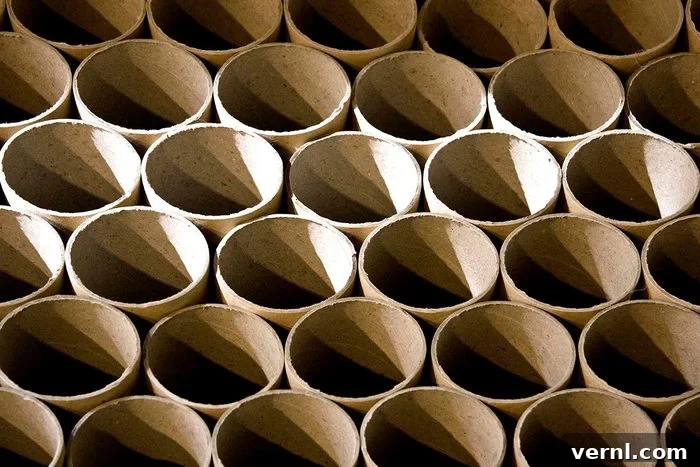
The concept of cardboard-confined rammed earth is remarkably simple yet ingenious. Researchers at RMIT University have developed a process where thick cardboard tubes are formed and then filled with a mixture of soil and water. This mixture is then compacted, or “rammed,” to create a solid core. The cardboard tube acts as a confinement, providing support and structure to the rammed earth core as it hardens. This combination results in a robust building material suitable for various construction applications, particularly smaller structures and load-bearing walls.
Rammed earth construction has a long and rich history, dating back centuries. Traditional rammed earth structures are known for their durability and thermal properties. However, modern rammed earth construction often incorporates cement to enhance stability and strength. The RMIT team’s innovation lies in eliminating the need for cement altogether. By relying on the compressive strength of the compacted soil and the structural support provided by the cardboard tube, they have created a material that is both sustainable and cost-effective.
The absence of cement significantly reduces the environmental footprint of the material. Cement production is a major contributor to greenhouse gas emissions, accounting for a substantial portion of global carbon dioxide emissions. By eliminating cement, cardboard-confined rammed earth offers a dramatically lower-emission alternative.
Furthermore, the material promotes resource efficiency. Soil is readily available on most construction sites, minimizing the need for transportation. Cardboard, sourced from recycled waste streams, further reduces the reliance on virgin materials. The entire process is designed to minimize waste and maximize the use of locally available resources.
The construction process itself is also streamlined. Crews can assemble the cardboard tubes on-site, utilizing readily available soil. This eliminates the need for transporting heavy loads of concrete or brick, further reducing transportation costs and emissions. The simplicity of the process makes it particularly attractive for construction projects in remote areas where access to traditional building materials is limited.
The Importance of Cardboard-Confined Rammed Earth for Future Building
The construction industry is under increasing pressure to reduce its environmental impact. Concrete, a ubiquitous building material, is a major source of global emissions. As the world grapples with the challenges of climate change, the search for sustainable alternatives to concrete has become a critical priority.
Cardboard-confined rammed earth presents a compelling solution. It offers a practical and scalable alternative to concrete, addressing both environmental and economic concerns. The material’s lightweight nature and ease of transport make it suitable for a wide range of construction applications.
The combination of cardboard and soil creates a building material that significantly reduces the emissions associated with cement production. By utilizing recycled cardboard, the material also diverts waste from landfills and promotes a circular economy. This approach aligns with the principles of sustainable development, minimizing environmental impact while maximizing resource utilization.
The RMIT researchers have developed a design formula that correlates cardboard thickness to structural strength. This formula provides builders with a clear understanding of how to size columns and wall sections for optimal performance. This scientific approach ensures that the material can be used safely and effectively in a variety of construction projects.
Furthermore, the team has explored the possibility of enhancing the material’s strength by incorporating carbon fiber. In a separate study, they demonstrated that combining carbon fiber with rammed earth could achieve strength levels comparable to those of high-performance concrete. This suggests that even stronger versions of cardboard-confined rammed earth are possible, opening up new possibilities for its application in more demanding construction projects.
Applications and Future Research Directions
Cardboard-confined rammed earth is particularly well-suited for regions with soil types conducive to rammed earth construction. Many parts of Australia, for example, have soil compositions that are ideal for this type of construction. The material’s reliance on locally available resources makes it an attractive option for construction projects in remote and underserved communities.
Rammed earth walls are known for their excellent thermal mass properties. They absorb heat during the day and release it slowly at night, helping to regulate indoor temperatures and reduce energy consumption for heating and cooling. Cardboard-confined rammed earth retains this advantage while minimizing its overall environmental footprint.
The RMIT researchers are continuing to refine the material and are actively seeking collaborations with industry partners to test its performance in real-world construction projects. These field tests will provide valuable insights into the material’s durability, workability, and long-term performance.
The research team envisions a future where recycled waste streams play a direct role in building more sustainable structures. Cardboard, often regarded as a disposable material, could become a key component of a new generation of low-impact construction techniques. This vision represents a paradigm shift in the way we think about waste and its potential to contribute to a more sustainable future.
The development of cardboard-confined rammed earth represents a significant step towards a more sustainable construction industry. By harnessing the potential of recycled materials and minimizing the reliance on high-emission materials, this innovative approach offers a promising path towards a greener future.
Further research and development are needed to fully realize the potential of cardboard-confined rammed earth. However, the initial findings are encouraging, suggesting that this material could play a significant role in transforming the construction industry and reducing its environmental impact.
As awareness of the environmental challenges facing the planet grows, the demand for sustainable building materials will continue to increase. Cardboard-confined rammed earth is well-positioned to meet this demand, offering a practical, cost-effective, and environmentally responsible alternative to traditional construction methods.
The transformation of discarded cardboard into a viable building material is a testament to the power of innovation and the potential to find sustainable solutions in unexpected places. This groundbreaking research from RMIT University offers a glimpse into a future where waste is viewed as a resource and where sustainable construction practices are the norm.
Sources:
- RMIT University, “Cardboard and earth reshape sustainable construction” 2025
- RMIT Research Repository, “Cardboard-confined rammed earth towards sustainable construction” 2025