
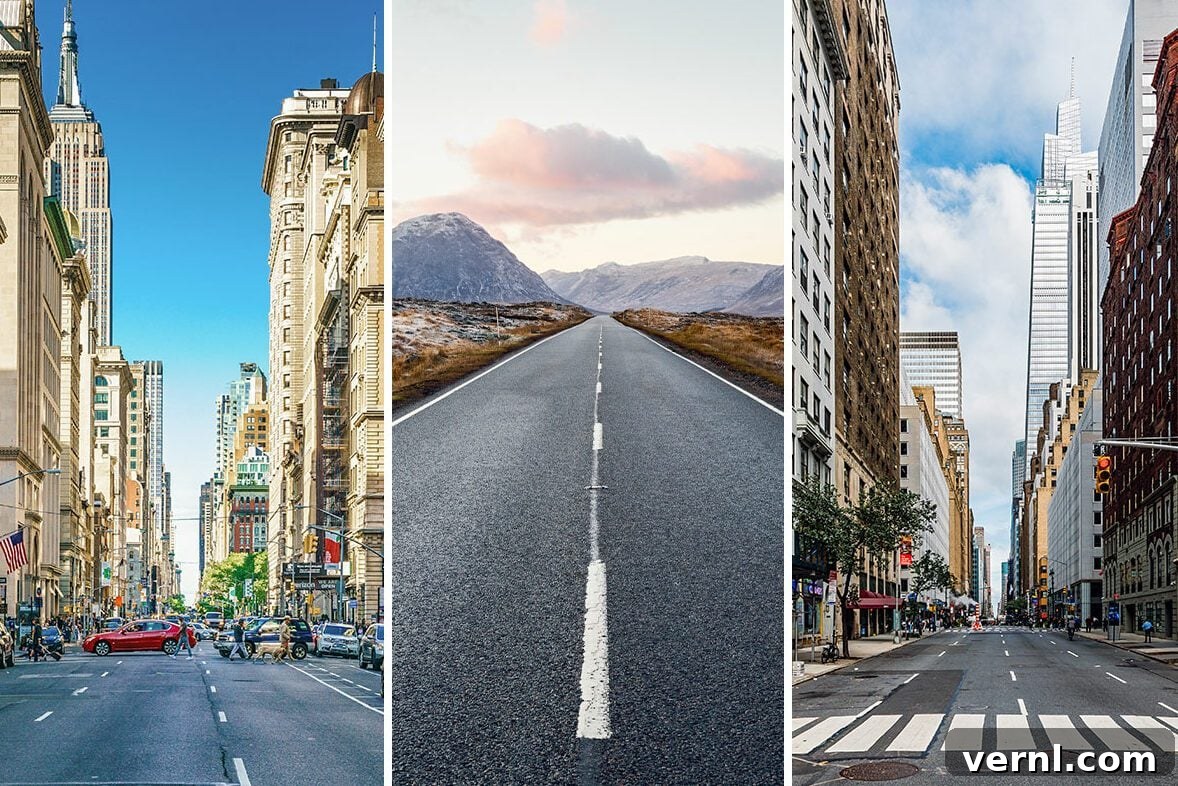
Have you ever paused to consider the names of the roadways you travel daily? From winding “lanes” to bustling “highways,” the designations often appear arbitrary, yet they form an integral part of our urban fabric. My own journey from a mountain home to town might encompass a tranquil “lane,” two steep “grades,” a pair of conventional “roads,” a multi-lane “highway,” and a scenic “drive.” Sometimes, I even find myself navigating “Redwood Circle,” a name that evokes a curve but, paradoxically, describes a perfectly straight stretch of asphalt. Our towns are replete with “avenues,” “boulevards,” “crescents,” and expansive “freeways,” each carrying a unique identifier.
“This is indeed a captivating subject,” observes Reetie Lubana, an expert who collaborates closely with architects, engineers, and infrastructure teams on intricate urban projects. “Road naming is a phenomenon people encounter every single day, yet it’s seldom questioned.” Whether you’ve pondered the origins of road names previously or not, Lubana, alongside British transport consultant Michael Okubajo, is here to illuminate the rich history and underlying rationale behind these everyday labels, formally known as odonyms.
The Deep Roots: Historical Origins of Road Naming Conventions
The naming conventions for roadways across North America inherently reflect their colonial past. “Modern road naming traditions are largely inherited from older European planning philosophies, particularly those forged in iconic cities like Paris and London,” Lubana elucidates. In their initial conception, these terms carried very precise meanings. “A ‘street’ was typically a paved urban route, often the epicenter of commerce and community life. ‘Avenues’ were generally more formalized, grander approaches, frequently distinguished by tree-lined paths and designed for visual impact. ‘Boulevards,’ on the other hand, originated from fortified city walls that were dismantled and transformed into wide, prominent thoroughfares, intended for leisurely strolls and carriage rides.”
Beyond these foundational European influences, road names frequently encapsulate profound geographical and local cultural significance. In Spanish-speaking territories, for instance, a route might be designated a “calle,” the direct translation for “street,” or a “camino,” meaning “path” or “way,” often evoking an older, less formalized route. A “paseo” refers to a small, often pedestrian-friendly walking lane, perfect for leisurely ambles. Venturing into French-speaking regions like Quebec, the term “camino” transforms into “chemin.” Furthermore, an urban road winding along mountainous terrain in Quebec wouldn’t be termed a “grade” but rather a “côte,” signifying a hillside or slope, a testament to the region’s distinct topography and linguistic heritage. These localized terms underscore how language and landscape intertwine to shape our understanding and identification of pathways.
Navigating the Lexicon: Common Types of Roadways and Their Nuances
A cursory review of odonyms in any North American city reveals an astonishing diversity of designations. While an exhaustive list would be impractical, understanding the most prevalent terms provides valuable insight into urban design and historical intent. Here are some common roadway classifications you’ll encounter in almost any urban or suburban setting, along with their distinguishing characteristics:
- Road – This is perhaps the most ubiquitous and flexible term. Often serving as a default designation, “road” can refer to virtually any paved thoroughfare, regardless of its size, traffic volume, or specific function. It can encompass anything from a quiet residential street to a sprawling inter-city artery. Its generic nature makes it highly adaptable, but it also means it offers the fewest clues about its inherent characteristics.
- Street – According to Lubana, a “street” is a quintessential urban road, intrinsically linked to buildings and often designed with pedestrians in mind. Streets are the arteries of city life, lined with shops, homes, and community spaces. They are typically public ways in a city or town with buildings on both sides. “Main Street” is the quintessential example, often serving as the historical and commercial heart of a community, fostering a sense of place and activity.
- Avenue – Lubana notes that an “avenue” typically handles a higher volume of traffic or is conceptualized with grandeur, scale, and visual presence as primary considerations. Avenues are often wider than streets, sometimes featuring a central median or prominent landscaping. Think of the iconic 7th Avenue in New York City, known for its significant traffic flow and imposing architectural backdrop. Confusingly, Toronto, Ontario, boasts a major thoroughfare named “Avenue Road,” which paradoxically incorporates both terms, leading to amiable local debates about its precise classification.
- Boulevard – Similar to an avenue in its scope and often its purpose, a “boulevard” distinguishes itself primarily by the presence of a central dividing median, which is frequently landscaped with trees, flowers, or walking paths. This median often lends boulevards a more stately, park-like appearance, encouraging leisure alongside transportation. Los Angeles’s famed Sunset Boulevard, for instance, adheres to this distinction in segments like West Hollywood, showcasing its landscaped median, but deviates in other parts, illustrating the fluid application of these terms.
- Drive – A “drive” typically suggests a roadway that follows or “meanders” along natural terrain, such as a coastline, a river, or a hillside. These roads are often designed to be scenic, offering picturesque views and a less direct, more winding route. California’s Seventeen-Mile Drive on the Monterey Peninsula is an internationally renowned and breathtaking example, celebrated for its coastal beauty and winding path.
- Lane – The term “lane” generally denotes a smaller, often narrower residential roadway characterized by light traffic. These are typically found in quieter neighborhoods, prioritizing local access and a tranquil environment. I reside on a “Lane” myself—a diminutive, single-lane thoroughfare with a sedate 15 mph speed limit, epitomizing the intimate scale associated with this designation. Similar designations that evoke a sense of quiet residential living include “way,” “crescent,” and, yes, even “circle” (despite its potential for straight segments).
- Way – Often implying a less direct or more winding path, “way” can be similar to a lane or a small residential street. It suggests a route that isn’t a primary thoroughfare but rather a means to access specific areas, often within a neighborhood.
- Crescent – A “crescent” is a curving street, often semi-circular, that typically returns to the same main street it started from, or forms a loop within a residential area. It conveys a sense of enclosure and community.
- Circle – While implying a circular path, a “circle” in road naming can also refer to a street that forms a loop or simply a cul-de-sac. As my own experience with “Redwood Circle” suggests, the name doesn’t always perfectly align with the physical geometry.
- Place – A “place” is usually a short street or cul-de-sac, often found in residential areas, suggesting a quiet, localized area with limited through traffic.
- Court – Similar to a “place” or “cul-de-sac,” a “court” is a short street that typically ends in a turnaround, designed to minimize traffic and create a secluded residential feel.
- Highway/Freeway – A “highway” serves as a primary artery, designed to connect different cities or significant parts of a large metropolitan area, facilitating efficient long-distance travel. A “freeway” shares this fundamental purpose but is distinguished by several key design features: it typically boasts more lanes, is completely free of intersections at grade (requiring on- and off-ramps for access), and accommodates significantly higher speed limits. Freeways are engineered for maximum traffic flow and continuous movement, minimizing interruptions.

The Evolving Truth: Do Road Names Always Match Their Function?
In an ideal world, the name of a road would perfectly describe its characteristics and function. However, reality often diverges. As Okubajo points out, while roadway terms historically offered a clear descriptor of how a route was used, these precise distinctions have largely eroded in the realm of modern urban planning.
“I’ve been involved in projects where a road explicitly engineered to handle substantial traffic volumes is nonetheless labeled a ‘lane,’ purely to cultivate a more residential and less intimidating perception,” Okubajo recounts. “Conversely, the term ‘boulevard’ might be strategically employed to signal a higher-quality, more ‘place-led’ environment, even if the underlying road geometry or traffic capacity doesn’t significantly differ from a standard distributor road.” In this light, road naming has transcended mere description; it has evolved into a sophisticated, subtle instrument for place-making and managing public perception, influencing how residents and visitors experience and interpret their surroundings.
Lubana succinctly concurs: “A considerable amount of road naming today is attributable to historical legacy, the branding decisions made by developers, or even broader marketing strategies, rather than strict adherence to contemporary planning standards or functional classifications.” This means that what you see on the sign isn’t always what you get on the ground, reflecting a complex interplay of history, commerce, and design intent.
Consistency in Terminology: A Mismatch Between Public and Technical Definitions
In their historical and technical definitions, road terms might possess a degree of consistency, but in practical application, this is not always the case. Okubajo emphasizes that professional planners and engineers categorize roads primarily based on their functional attributes: considerations such as traffic flow capacity, connectivity within the broader transportation network, and the specific role they play in moving people and goods. “Regrettably, the public-facing name rarely mirrors this technical classification,” he states. “This disparity explains why one might encounter a ‘High Street’ that carries remarkably little traffic, or a generic ‘Road’ that, in practice, functions primarily as a local access street, serving only a handful of properties.” This disconnect highlights the challenge of reconciling historical naming conventions with modern engineering principles and public perception.
The Art and Science: Road Naming in Urban Planning
The intricate process of road naming typically occurs at the municipal level, where urban planners are tasked with balancing a multitude of considerations. Lubana explains that this involves meticulously weighing zoning regulations, honoring historical context, and addressing critical practical needs, such as ensuring absolute clarity for emergency responders to quickly locate addresses. “Beyond the technical and historical aspects, there’s frequently a significant community or cultural element woven into the naming process,” she adds, “especially when city authorities aspire for names that authentically reflect and reinforce local identity, history, or natural landmarks.”
Modern urban planning also integrates principles of wayfinding, where road names contribute to a cohesive and intuitive navigational system. Thoughtful naming can enhance a city’s character, create a sense of belonging, and even serve as a form of civic storytelling, commemorating local heroes, significant events, or indigenous heritage. Conversely, poorly chosen or confusing names can lead to disorientation and frustration, underscoring the profound impact of these seemingly simple labels on the daily lives of residents and visitors alike.
Beyond Navigation: The Broader Impact of Road Names
The implications of road names extend far beyond mere navigation; they subtly influence perception, community identity, and even economic value. The distinction between a “lane” and a “street” can evoke vastly different images in the mind of a potential resident or investor. The concept of “place-making,” as mentioned by Okubajo, is deeply intertwined with these designations, as names contribute to the overall ambiance and perceived quality of an area.
Consider how a “boulevard” often suggests grandeur and public spaces, while a “lane” conjures images of quiet intimacy. These perceptions, though often subconscious, play a significant role in how we interact with our environment. The aesthetic and emotional weight of a road name can therefore be a powerful tool for urban developers and planners seeking to shape public sentiment and attract specific demographics to a neighborhood.
Frequently Asked Questions About Road Names
Exploring the world of odonyms often leads to a few common inquiries. Here, we address some of the most pressing questions regarding road naming conventions:
Why do road names matter beyond simple identification?
One compelling reason road names hold significant weight is their surprising impact on home values, a phenomenon highlighted in an article by the New York Times. Research suggests that prospective home buyers frequently perceive properties situated on a “lane,” “way,” or “place” as more desirable than those on a “street” or “boulevard.” This preference stems from the inherent connotations: the former designations typically evoke images of small, intimate, and family-friendly neighborhoods, suggesting tranquility and reduced traffic. In contrast, the latter often conjure associations with heavy business activity, significant traffic, and a more urban, less residential character. Beyond property values, names also matter for fostering a sense of community identity, historical continuity, and efficient wayfinding for residents and emergency services.
What is the distinction between a highway and a parkway?
Both parkways and highways are meticulously designed thoroughfares engineered to facilitate the rapid movement of substantial volumes of traffic. However, their primary difference lies largely in their fundamental purpose and design philosophy, as explained by Lubana. “Highways are predominantly constructed for maximum efficiency and high traffic volume, prioritizing speed and direct connections between major points,” she notes. “Parkways, conversely, are typically conceptualized and designed to be more scenic routes, often winding through natural landscapes or green spaces. They frequently incorporate aesthetic elements, have stricter controls on access, and may impose limitations on the types of vehicles allowed, commonly prohibiting heavy commercial vehicles to preserve their recreational and aesthetic appeal.”
What is an “Odonym”?
An odonym is simply the official name of a road or a street. The term is derived from the Greek words “hodos” (road, way) and “onyma” (name). It’s the academic and technical term used to describe street names, lane names, avenue names, etc. Understanding odonyms helps in the study of urban history, geography, and cultural identity, as they often preserve historical events, local figures, or geographical features.
How do urban planners choose new road names?
The process of choosing new road names is multifaceted. Planners consider several factors, including historical relevance (e.g., commemorating local figures or events), geographical features (e.g., Riverbend Road, Hilltop Lane), cultural significance (e.g., indigenous names, local flora/fauna), and practical considerations like clarity for emergency services (avoiding confusingly similar names). Community input is also often sought to ensure the names resonate with local residents and reflect the area’s identity. Modern trends sometimes favor thematic naming within new developments, such as using tree names or literary figures for all roads in a new subdivision.
Are there any common pitfalls in road naming?
Yes, several pitfalls exist. These include creating names that are too long or difficult to pronounce, using names that are duplicates or very similar to existing ones (causing confusion for navigation and emergency services), or choosing names that become outdated or controversial over time. Developers sometimes use overly generic or bland names that fail to contribute to a sense of place. The ideal road name is memorable, unique, easy to spell, and contributes positively to the area’s identity.
About the Esteemed Experts
- Reetie Lubana serves as the marketing director at Tejjy Inc., a distinguished architectural engineering firm headquartered in Washington, D.C. Her insights are invaluable in bridging the gap between design and urban functionality.
- Michael Okubajo is a highly respected consultant with Captial Transport Planning. With over a decade of hands-on experience, he has contributed significantly to infrastructure and development projects across the United Kingdom, offering a global perspective on transport planning.
Sources and Further Reading
- YourDictionary: Odonym Definition; (Accessed 2026)
- The New York Times: The Secret of Street Names and Home Values; (Published 2015)