
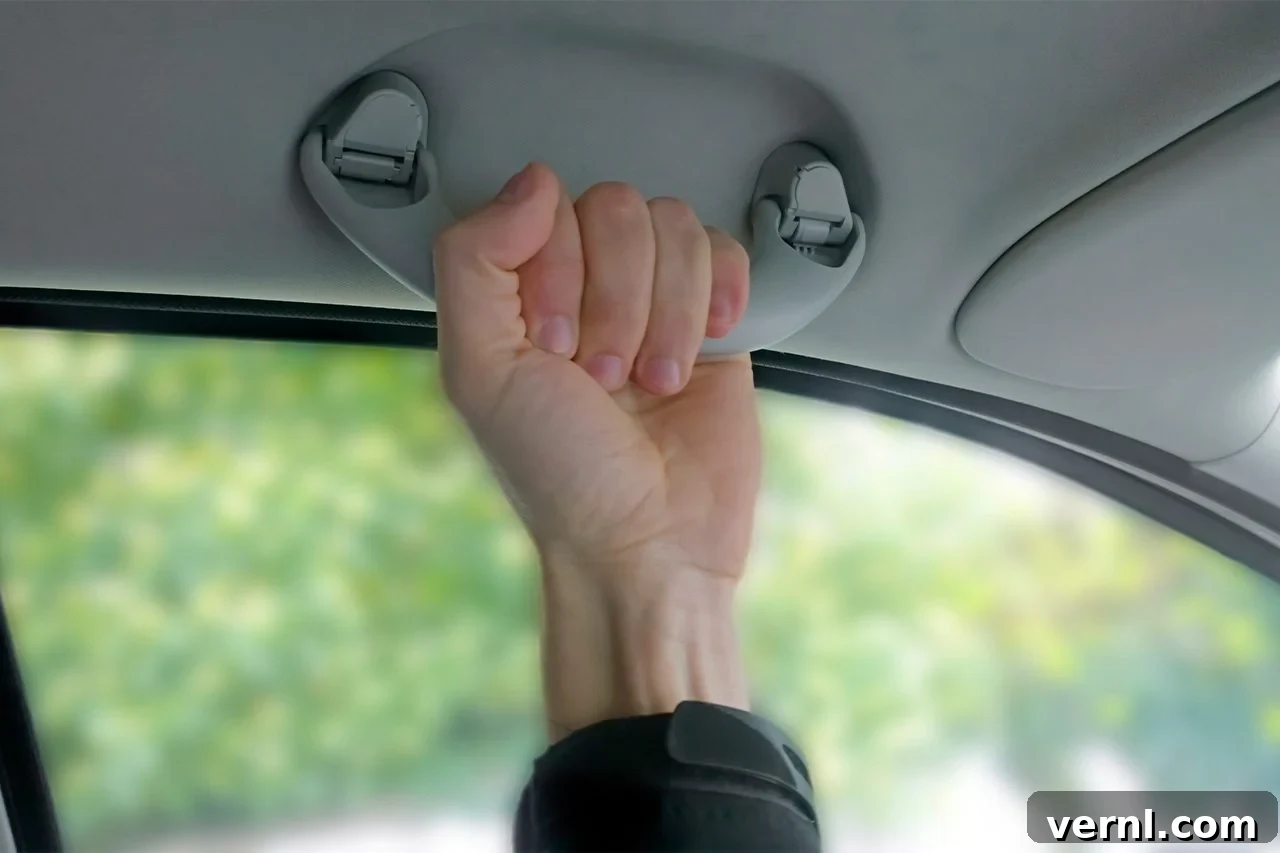
Most drivers recognize vehicle grab handles, often called “assist grips.” These fixtures are usually mounted in the headliner or ceiling above the side seats and are intended to provide light support for occupants. They’re common features, but their placement varies from vehicle to vehicle.
In my own car, I rarely use these handles, so it took me over a year to notice there isn’t one above the driver’s seat. Every other passenger position has a handle; the driver’s position simply has a recessed spot where one might be installed but no actual grip. That omission isn’t a mistake. After checking the issue, I learned it’s a deliberate choice on many models. Below is an explanation of why some cars lack a driver-side grab handle and what these handles are actually meant to do.
Why Some Cars Don’t Have a Grab Handle Above the Driver’s Seat
There’s no single rule that automakers follow when deciding whether to install a grab handle above the driver. Placement is based on a combination of interior design, ergonomic considerations, and how each seat is expected to be used.
Manufacturers typically describe assist grips as supports for occupants while seated and while the vehicle is in motion. For example, some automakers explain that these grips help stabilize or support a passenger’s body while seated. Because the stated purpose is to assist someone who is already sitting, some manufacturers choose not to fit a handle above the driver’s seat. In other models, however, a driver-side grip is provided, so there is variation across makes and models.
What the Grab Handles Above Car Doors Are Actually Designed to Do
Overhead grab handles are designed for limited support and to help passengers steady themselves while seated. They are not engineered to bear a person’s full weight or to serve as a robust handhold for entering or exiting the vehicle.
Many owner’s manuals caution against using assist grips to pull yourself into or out of a seat. If subjected to heavy loads, an assist grip can fail, potentially causing injury. For that reason, drivers and passengers should avoid relying on these handles to lift their entire body weight.
Similarly, the steering wheel is not an appropriate substitute for a missing grab handle. The steering system is not built to resist the kinds of sideways or upward forces that occur when someone uses it to hoist themselves into or out of a seat. Pulling on the wheel can damage steering components or create unsafe situations.
Another common theory—that curtain airbags are the reason some cars lack a driver-side handle—is not a universal explanation. Many vehicles have both assist grips and curtain airbags located in roughly the same areas without issue. Automakers do, however, place safety warnings around certain uses of the grips that relate to airbag deployment.
For example, manuals often advise against hanging heavy or pointed objects from assist grips or coat hooks. During an airbag deployment, such items could detach and become dangerous projectiles. A heavy or sharp object flung into the cabin by an inflating airbag can cause serious injury.
In short, the presence or absence of a driver-side grab handle usually reflects a design decision based on intended use, ergonomics, and safety guidance. The grips that are installed serve as light supports for occupants while seated, not as load-bearing anchors for entering and exiting the vehicle.
Sources
- Family Handyman, “Here’s What the Grab Handles On Your Car Are Actually For”
- Mazda, 2026 CX‑30 Owner’s Manual, “Assist Grip”
- Toyota, Aurion Owner’s Manual, “Assist Grips”