
In the annals of home construction, the mid-20th century marked a pivotal shift in residential electrical safety. As the post-war building boom gained unprecedented momentum in the 1950s, a quiet revolution began to unfold within North American homes: the gradual replacement of traditional fuse boxes with more advanced electrical service panels featuring circuit breakers. This transformation accelerated through the 1960s and was largely complete by the close of the 1970s, yet echoes of the past persist. Even today, a significant number of older homes continue to rely on the venerable fuse box, while fuses themselves retain crucial roles in protecting specific high-demand appliances. Understanding the evolution of these systems, their fundamental differences, and their respective functions is paramount for any homeowner seeking to maintain a safe and efficient electrical environment.
Both fuses and circuit breakers serve as the vigilant guardians of your electrical system, performing the identical and critical function of interrupting the flow of electricity under hazardous overcurrent conditions. These conditions typically fall into three categories: an overload, where too many devices draw power from a single circuit; a short circuit, caused by an unintended direct connection between live and neutral wires; or a ground fault, where electricity deviates from its intended path and flows to the ground. Without these protective devices, such events could lead to overheating wires, appliance damage, and potentially catastrophic electrical fires. While their ultimate goal is the same, their mechanisms for achieving it differ significantly, impacting convenience, safety, and troubleshooting for the homeowner.
Fuses vs. Circuit Breakers: A Matter of Convenience and Protection
The primary distinction between fuses and circuit breakers lies in their resettability. Circuit breakers offer unparalleled convenience. When an electrical fault occurs, causing a breaker to trip, it simply flips a switch to an “off” or “tripped” position. To restore power, you merely reset the switch. This immediate feedback and ease of reset make troubleshooting more straightforward. If a breaker trips repeatedly after being reset, it’s an unmistakable signal that a persistent problem — such as an overloaded circuit or a faulty appliance — demands immediate diagnosis and repair by a qualified electrician.
Fuses, by contrast, are single-use devices. When a fuse blows, its metallic link, designed to melt under excessive current, breaks permanently. This means the fuse must be physically replaced with a new one of the identical amperage rating. If a newly installed fuse blows again immediately, it strongly indicates an underlying electrical issue that requires professional attention. While less convenient, fuses offer robust and reliable protection, often reacting faster to extreme overcurrent conditions than some mechanical circuit breakers, especially in older systems. The trade-off is the need for spares and the minor inconvenience of replacement, which has contributed to their decline as the primary household electrical protector.
The Enduring Role of Fuses in Modern Homes
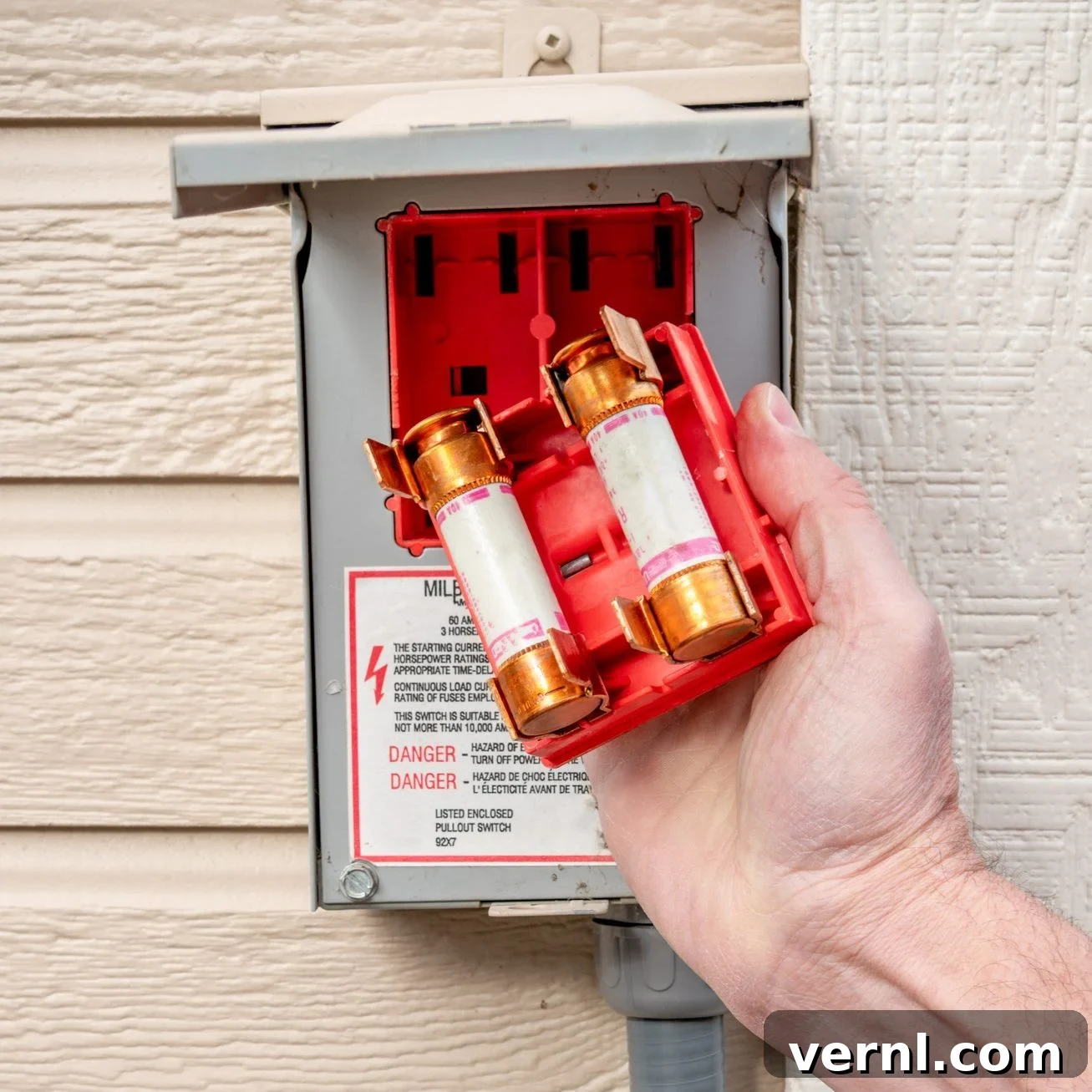
Despite their general obsolescence in main service panels, fuses continue to perform vital functions in many contemporary homes, particularly in specialized applications. They are frequently employed to protect large, high-power appliances that demand dedicated, robust overcurrent protection, such as air conditioning units, heat pumps, furnaces, well pumps, and electric water heaters. These appliances are often connected via manual disconnect switches, which sometimes incorporate fuses directly into their housing. The purpose here is to safeguard sensitive internal components from sudden current surges and to provide an easily accessible cut-off point for maintenance or emergencies.
These fusible disconnect switches are common fixtures. For instance, if your heating, ventilation, and air conditioning (HVAC) system unexpectedly ceases operation, one of the initial and most crucial troubleshooting steps involves checking the fuses within its manual disconnect. Manufacturers often specify fuse protection for these appliances due to their ability to handle large inrush currents without nuisance tripping, while still providing rapid protection against dangerous overloads or short circuits. Therefore, while no longer the central command for an entire home’s electricity, fuses remain an integral part of the distributed electrical protection strategy for critical home systems, ensuring their longevity and safe operation.
What Is an AC Fuse Box? Deconstructing the Precursor to Modern Panels
The AC fuse box, often an artifact of pre-1970s construction, served as the central control hub for all electrical circuits within a home. It effectively performed the same role as today’s circuit breaker panel: receiving incoming alternating current (AC) from the utility provider and distributing it safely to various branch circuits throughout the property. A typical fuse box features large lugs designed to securely connect the main service wires entering the home. From these main connections, power is routed to several individual spaces, each dedicated to powering a specific circuit. Crucially, each of these spaces is protected by a removable fuse, acting as a sacrificial safety device.
Older main service fuse boxes typically house two distinct types of fuses. The main fuses, often cartridge-style and protected by pull-out blocks, guard the entire electrical service, providing protection for the entire panel. Branch circuit fuses, which are usually the familiar plug-type fuses, protect individual circuits dedicated to lighting, outlets, and smaller appliances. The total amperage capacity of these older fuse boxes was considerably lower than modern breaker panels, typically 60 or 100 amps, which often proves insufficient for the demands of contemporary electrical appliances and technology. This limited capacity, coupled with the single-use nature of fuses, eventually paved the way for the more robust and user-friendly circuit breaker panel.
Types of Fuses: Plug Fuses and Cartridge Fuses
The fuses found in residential settings primarily come in two forms, each designed for specific applications:
-
Plug Fuses: These are the classic, old-school fuses typically found in main service fuse boxes. Enclosed in a round, often glass-topped container, they feature threaded bases that allow them to be screwed into place, much like a light bulb. The heart of a plug fuse is a thin strip of metal, known as the fusible link, which has a precisely calibrated low melting point. This link is usually visible behind a small glass window. When an overcurrent condition occurs, the excess heat melts this metallic strip, creating an open circuit and stopping the flow of electricity. A visual inspection through the glass will clearly show a broken or charred link, signaling that the fuse has blown. Plug fuses are generally rated for lower amperages, typically up to 30 amps, and are suited for lighting and general-purpose outlet circuits.
-
Cartridge Fuses: In contrast, fuses for protecting higher-amperage appliances like HVAC equipment are typically cylindrical cartridges. These opaque fuses often snap into specialized fuse holders located inside manual disconnect boxes. Unlike plug fuses, their internal components are not visible. Cartridge fuses come in various lengths and diameters, correlating with their amperage ratings, which can range from a few amps to hundreds. When a cartridge fuse blows, there’s usually no visible indicator on the outside, although sometimes discoloration or bulging can occur. To determine if one has blown, it typically requires testing with a multimeter, or, as is common practice, simply replacing it as a first diagnostic step. Cartridge fuses are designed for higher current loads and often incorporate fillers (like sand) to safely quench arcs during interruption.
Where Is the AC Fuse Box or Fusible Disconnect Located?
Locating your electrical protection system is crucial for safety and troubleshooting. If you primarily rely on a fuse box for your home’s main electrical service, your house almost certainly predates the 1950s. These main fuse boxes are commonly situated in basements, utility closets, or sometimes even in less conventional spots due to older electrical codes that were less stringent about placement. For example, it wasn’t unheard of for an old 60-amp fuse box to be mounted on an interior wall near a front door, a location that would be strictly prohibited by modern electrical codes.
For the fusible manual disconnects specifically protecting your HVAC system or other large appliances, electrical codes mandate that they must be visible and accessible from the unit they control. Furthermore, they generally cannot be more than 50 feet (approximately 15 meters) away. For an outdoor air conditioning condenser unit, the fusible disconnect is almost invariably mounted on the exterior wall of the house, adjacent to the unit itself. For an indoor furnace or air handler, you’ll typically find the disconnect box on the furnace room wall, or directly mounted to the side of the furnace itself. These strategic placements ensure that technicians or homeowners can quickly and safely cut power to the appliance before performing any maintenance or troubleshooting.
What’s Inside an Old-School Fuse Box (Main Service Panel)?
Upon opening the door of a traditional, old-school main service fuse box, you’re typically greeted by a visually distinct layout. The most prominent feature is often a row of glass plug fuses, usually numbering no more than six or eight, each responsible for protecting an individual branch circuit. These houses typically had fewer electrical demands than modern residences, hence the limited number of circuits. Each plug fuse has its amperage rating clearly marked on its face, and they are designed to be easily removed by unscrewing them, much like an incandescent light bulb.
The mechanism behind these plug fuses is quite ingenious in its simplicity. When a plug fuse is screwed in tightly, a small metal nib at the tip of its threads makes contact with the “hot” bus bar within the fuse box. Electricity then flows through the fuse’s internal fusible link and exits via the metal screw-shell threads to power the connected circuit. This design ensures a direct and protected pathway for current. Adjacent to or positioned above this row of plug fuses, you’ll typically find two Bakelite or plastic fuse pullouts, often equipped with sturdy metal handles for safe removal. Behind these pullouts reside the main cartridge fuses. These cylindrical fuses are held securely in place by robust metal fuse holders and are designed to protect the entire electrical service. When a main cartridge fuse blows, the entire pullout block can be extracted, allowing for easy replacement with an identical, correctly rated fuse.
How to Tell if a Fuse Has Blown: Diagnosis and Troubleshooting
Identifying a blown fuse is a critical step in restoring power and diagnosing electrical problems. The method for detection depends on the type of fuse you are dealing with.
Diagnosing Plug Fuses:
For transparent plug fuses, the process is straightforward: simply visually inspect the fuse. When a plug fuse blows, the fusible link within the glass enclosure will appear visibly broken, often charred, or melted. The glass itself may also show signs of discoloration or burning, providing clear evidence of an overcurrent event. If you see an intact link, the fuse is likely still good, and the problem lies elsewhere.
Diagnosing Cartridge Fuses:
Cartridge fuses, being opaque, offer no direct visual indication of their internal state. While some may show signs of discoloration, bulging, or even a burnt smell if they’ve experienced a significant fault, these aren’t always present or conclusive. Therefore, a more definitive method is required:
-
Safety First: Disconnect Power! Before touching any fuse, always ensure the power to the circuit or appliance is completely turned off at the main service panel or dedicated disconnect switch. This is paramount to prevent electrocution.
-
Remove the Fuse: Carefully extract the cartridge fuse from its holder. For main pullout fuses, remove the entire block. For individual appliance fuses, they usually snap out.
-
Perform a Continuity Test with a Multimeter:
-
Set the Multimeter: Turn your multimeter to the ohms (Ω) resistance setting, or to the continuity test mode (which often emits a beep). Make sure the leads are plugged into the correct ports (usually COM and VΩmA).
-
Test the Fuse: Touch one probe of the multimeter to one metal end cap of the cartridge fuse and the other probe to the opposite metal end cap. Ensure good contact with the metal.
-
Interpret the Reading:
-
If the fuse is good: The multimeter will display a reading of zero or near-zero ohms of resistance (indicating a continuous path for electricity), or it will emit a distinct beep if you’re in continuity mode.
-
If the fuse has blown: The multimeter will show an “OL” (Open Line) or an infinite resistance reading. If in continuity mode, it will remain silent and show no indication of a circuit. This confirms the fuse has blown and needs replacement.
-
-
If a fuse is determined to be blown, always replace it with a new fuse of the exact same amperage and type. Never use a fuse with a higher amperage rating, as this can lead to serious electrical hazards and damage. If the new fuse blows immediately, do not attempt further replacements; instead, consult a licensed electrician to diagnose the underlying electrical fault.
Electrical Safety: Prioritizing Protection in Fuse-Equipped Homes
Working with any electrical system, especially older fuse boxes, demands extreme caution. Always remember to prioritize safety. Before replacing any fuse or performing any electrical inspection, ensure the power to the affected circuit or the entire panel is completely shut off. Never bypass a blown fuse by inserting a coin or foil, as this removes all overcurrent protection and creates a severe fire hazard. Fuse boxes, particularly those installed decades ago, may pose additional safety concerns. Their limited capacity can be easily overwhelmed by modern appliances, leading to frequent blown fuses or, worse, overheating wires. Additionally, the components within these old panels can degrade over time, increasing the risk of arcing or electrical shock.
If your home still relies on a fuse box for its main electrical service, it is highly recommended to have a professional electrician conduct a thorough inspection of your entire electrical system. An upgrade to a modern circuit breaker panel can significantly enhance safety, reliability, and the capacity of your home’s electrical infrastructure, ensuring it can safely meet the demands of contemporary living. While fuses still play their part in specific applications, understanding their limitations and the benefits of modern electrical protection is key to maintaining a secure home environment.
Conclusion: The Legacy and Future of Electrical Protection
The journey from the ubiquitous fuse box of the mid-20th century to today’s sophisticated circuit breaker panels highlights an ongoing commitment to electrical safety and efficiency. While circuit breakers now dominate the landscape of residential main electrical protection, fuses maintain their vital role in safeguarding high-demand appliances, serving as a silent, steadfast protector against damaging current surges. Understanding the fundamental differences between these two guardians of your home’s electrical system – their operation, identification, and proper handling – empowers homeowners to make informed decisions about their electrical maintenance and safety.
Whether you live in a home with an antique fuse box or a modern breaker panel, the principles of overcurrent protection remain constant. Always respect the power of electricity, never compromise on safety, and when in doubt, consult a qualified professional. By recognizing the critical functions of fuses and circuit breakers, homeowners can ensure their electrical systems continue to operate safely and reliably for years to come, protecting both property and lives.