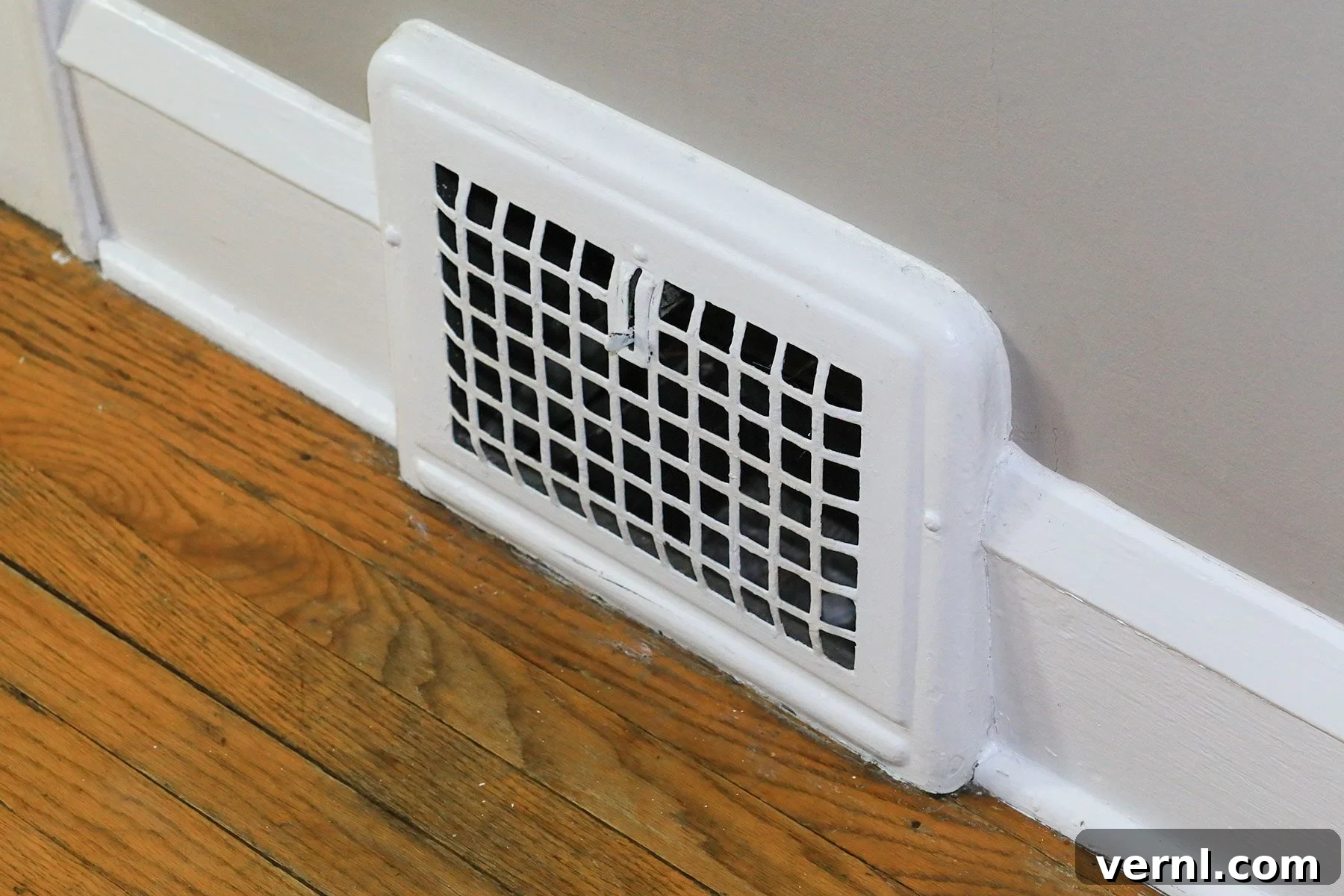
If your home relies on a forced-air HVAC system for heating and cooling, understanding the role of your return air vents is paramount. These often-overlooked components are vital for the efficient and healthy operation of your entire system. Ensuring they remain consistently free, clear, and open is not just a recommendation—it’s a necessity for optimal home comfort and energy savings.
To shed light on this crucial topic, we consulted two seasoned industry experts: Jason Ryan, HVAC Project Manager at Boulanger’s Plumbing and Heating, and Joshua Smith, Operations Manager at Berkshire Heating and Air Conditioning. Together, they explain the essential function of your return air vents, detail the detrimental effects of blockages, and outline the serious issues these obstructions can create for your heating and cooling equipment and indoor environment.
What Exactly Is a Return Air Vent and How Does It Work?
Return air vents are strategically positioned components of your forced-air HVAC system. You’ll typically find them located in your ceiling, floor, or walls, connecting directly to the network of ductwork that crisscrosses throughout your home. Their primary purpose is to draw air from various rooms back to your central furnace or air conditioner. This air then undergoes a conditioning process, where it’s either warmed during colder months or cooled when temperatures rise. Once conditioned, this treated air is then reintroduced into your living spaces through separate supply vents, completing a continuous cycle.
“It’s a big cycle, much like the lungs of your home,” explains Joshua Smith. “The supply side delivers the temperature-controlled air you desire, while the return side efficiently pulls the existing air from your living space, bringing it back to the central unit for reconditioning.” This sophisticated process continues uninterrupted until your thermostat registers that the desired set temperature has been achieved, at which point the system momentarily pauses, awaiting the next call for heating or cooling.
The configuration of these essential vents can vary from one home to another. Some forced-air systems utilize one large, central return vent, often found in a hallway or common area. Other, more sophisticated systems may feature multiple return vents, with one located in nearly every room, designed for more balanced airflow. Regardless of their placement, these vents are typically identifiable by a slatted cover or a decorative grate. A key distinction to remember is their operational difference from supply vents: return vents are designed exclusively to draw air in, never to blow air out. Understanding this fundamental difference is the first step toward appreciating their critical role in your home’s climate control.
Is Blocking a Return Air Vent Really That Bad? Understanding the Risks
In no uncertain terms, yes, intentionally or accidentally blocking a return air vent is detrimental to your HVAC system and can lead to a cascade of negative consequences. When these critical pathways are obstructed, your forced-air system cannot function as designed, leading to a significant imbalance in its operation.
The delicate equilibrium of your HVAC system relies on a precise amount of air being drawn back to the furnace or air conditioner through the return vents. This volume of air should ideally match the amount of conditioned air that the system is simultaneously pushing back into your rooms through the supply vents. It’s a closed-loop system designed for efficiency and optimal performance. “If this vital cycle is disrupted,” Jason Ryan warns, “the system effectively starves for air. This prevents proper heat transfer from the heat exchanger in your furnace or efficient cooling from the cooling coil in your air conditioner, simply because there isn’t enough new air circulating to be conditioned.”
The immediate result is an HVAC system that works considerably harder while delivering significantly less output. This increased strain, coupled with reduced effectiveness, can set the stage for a host of serious and costly problems, which we will explore in detail below. While you should never deliberately close or block your return vents, accidental obstructions are a common occurrence. “It often happens when homeowners aren’t paying close attention,” Smith notes. “A thick rug might be thrown over a floor vent, or a couch without adequate feet might be pushed directly against a wall return, effectively sealing it off.” To prevent such issues and ensure proper airflow, it is strongly recommended to keep furniture, drapes, and other household items at least 10 inches away from all return air vents.
What Specific Problems Arise If a Return Air Vent Becomes Blocked?
The consequences of a blocked return air vent are far-reaching and can impact your comfort, your wallet, and the longevity of your valuable HVAC equipment. Here are some of the most significant problems you might encounter:
1. Significantly Lowered System Efficiency and Higher Energy Bills
One of the most immediate and noticeable effects of even a single blocked return vent is a drastic reduction in your forced-air system’s efficiency. With limited airflow, the system struggles to perform its basic function. “The system isn’t able to pull in the necessary volume of air it needs to properly condition,” Smith explains. “As a result, it runs for much longer periods, constantly trying to reach the temperature setting on your thermostat, but often failing to do so effectively.”
This inefficiency translates directly into a lower output of conditioned air. Ryan elaborates, “If you cover a return, you’re simply not pulling in as much air for treatment, which means you’re subsequently not pushing out as much conditioned air into your living spaces.” This forces your furnace or air conditioner to work harder and for extended durations, consuming more energy without delivering the desired results. Over time, this constant overexertion can severely diminish the lifespan of your expensive HVAC equipment, leading to premature wear and tear on critical components like the blower motor and compressor. The increased run times also directly translate to higher utility bills, needlessly draining your finances.
2. Inaccurate Room Temperatures and Uneven Comfort
A blocked return air vent profoundly impacts your home’s ability to maintain consistent and accurate temperatures. When air cannot effectively return to the furnace or air conditioner for heating or cooling, that specific room, or even larger zones of your home, will struggle to reach or maintain the desired temperature. “If you block off the return, you’re primarily just pumping air into a room without allowing for proper recirculation,” says Smith. “If your thermostat is set to 70 degrees, but you have a significant return blockage, you may never truly get to 70 degrees because that air isn’t cycling back through the system for reconditioning.”
This leads to frustrating hot and cold spots throughout your home. One room might be stifling hot while an adjacent one remains uncomfortably cool, making it nearly impossible to achieve uniform comfort. The thermostat, often located in a common area, will continue to signal for heating or cooling, exacerbating the problem as the system runs endlessly trying to compensate for an air circulation issue it cannot resolve.
3. Damage to Heating and Cooling Elements: Furnace Overheating and Coil Freezing
The critical internal components of your HVAC system, specifically the furnace’s heat exchanger and the air conditioner’s cooling coils, are highly dependent on a consistent and adequate flow of air from the return vents to regulate their operating temperatures. A reduced airflow due to a blocked return vent can have severe and potentially dangerous consequences:
- Furnace Heat Exchanger Damage: The heat exchanger is responsible for safely transferring heat from the combustion gases to the air circulating through your home. If insufficient cool air is drawn over the heat exchanger, it can overheat dangerously. “In extreme examples,” Smith warns, “this overheating can cause the heat exchanger to crack and fail.” A cracked heat exchanger is not only a very expensive repair but also poses a severe safety risk, as it can allow lethal carbon monoxide gas to leak into your home’s living spaces.
- Air Conditioner Cooling Coil Freezing: Similarly, the evaporator (cooling) coils in your air conditioner rely on warm return air to prevent them from freezing. If the airflow is restricted, the coils can become excessively cold, causing the condensation on their surface to freeze into a solid block of ice. “When that block of ice eventually melts, it can drip down directly into your system’s electrical components,” Smith explains, “potentially shorting out blower motors, control boards, and other sensitive parts, leading to costly electrical failures and system breakdowns.”
Both scenarios highlight how proper airflow is fundamental not just for efficiency, but for the safety and functional integrity of your entire HVAC system. These components are meticulously designed to operate within specific airflow parameters, and any deviation can throw the entire system “out of whack,” leading to serious and expensive damage.
4. Drastically Lowered Home Indoor Air Quality
Perhaps one of the most insidious consequences of blocked return air vents is the degradation of your home’s indoor air quality. “If the return air vent is blocked, your furnace or air conditioner will instinctively try and pull air from absolutely anywhere it can find a pathway,” Jason Ryan points out. This means that instead of drawing clean, filtered air from your living spaces, the system will seek out the path of least resistance. If there are any gaps, leaks, or unsealed connections in your ductwork, especially those running through unconditioned areas, the system will pull air from these undesirable sources.
Consider the implications: “If you have numerous gaps in your ductwork located within a damp, moldy basement, or a dusty attic, your system is going to actively pull that contaminated basement or attic air into your living environment,” Smith cautions. “Air is inherently lazy; it always takes the path of least resistance.” This can introduce a host of undesirable contaminants into your home, including mold spores, mildew, excessive dust, pet dander, allergens, insulation fibers, construction debris, and even volatile organic compounds (VOCs) that might be lingering in these hidden spaces. The continuous circulation of this polluted air can significantly reduce your home’s overall indoor air quality, potentially leading to respiratory issues, allergic reactions, and a general decline in occupant comfort and health. Maintaining clear return vents is therefore not just about efficiency, but also about ensuring a clean and healthy breathing environment for you and your family.
About the Experts
- Joshua Smith is the highly experienced operations manager at Berkshire Heating and Air Conditioning, based in West Springfield, Massachusetts. With over two decades of dedicated HVAC experience, he currently holds a Massachusetts Oil Burner and Refrigeration License, making him a trusted authority in the field.
- Jason Ryan serves as the knowledgeable HVAC project manager for Boulanger’s Plumbing and Heating in Easthampton, Massachusetts. Having been with Boulanger’s since 2001, Jason brings extensive practical experience and holds a prestigious Master Plumber License in the State of Massachusetts.