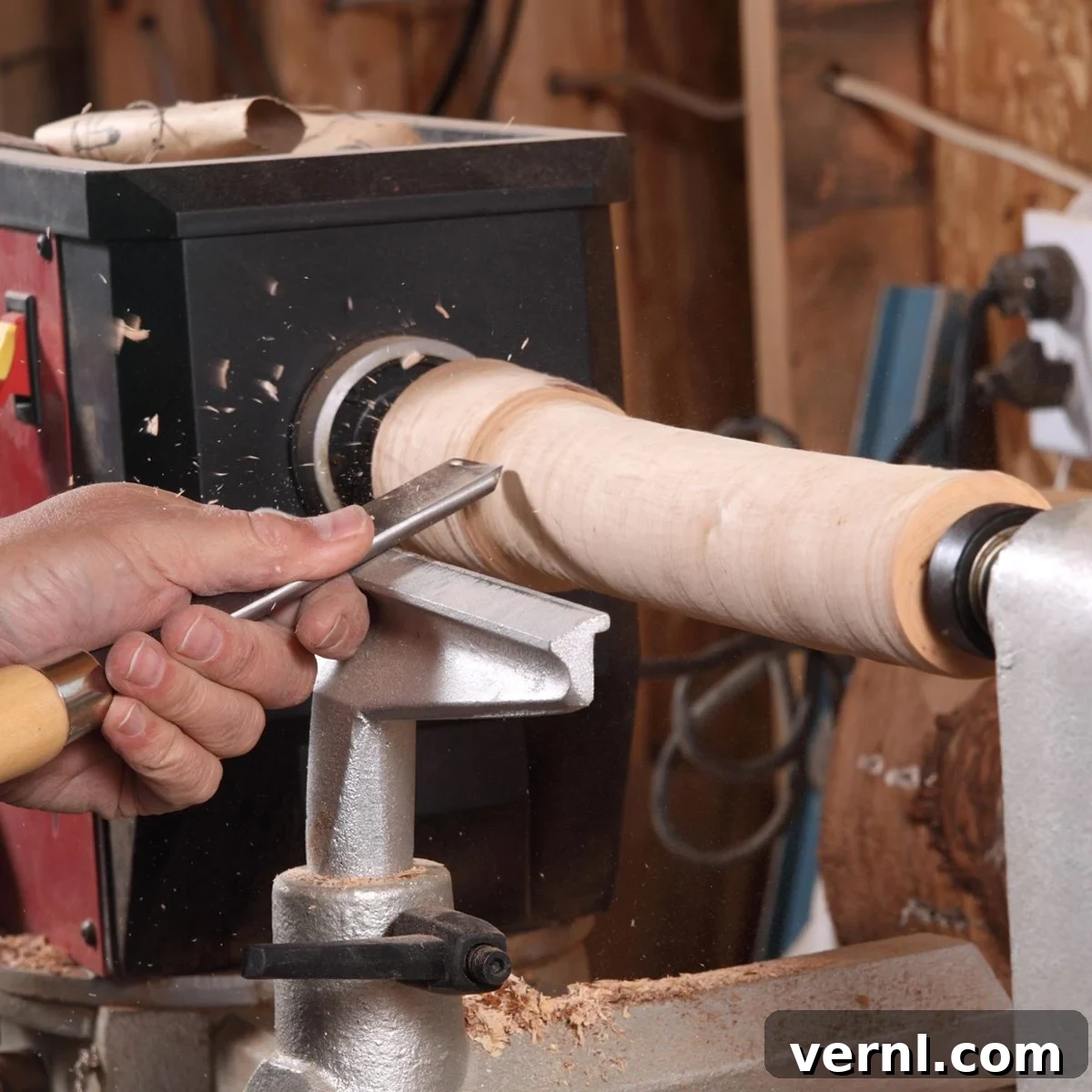
Before embarking on the captivating journey of woodturning, many aspiring artisans, myself included, view the lathe machine and its intricate process with a profound sense of awe and wonder. The sight of a skilled woodturner at a bustling craft fair, with a piece of timber spinning at incredible speeds and wood chips gracefully arcing through the air, evokes a timeless romance with the craft. It’s a dance between human precision and natural material, transforming raw wood into objects of beauty and utility.
When I finally had the opportunity to step up to a lathe and create my very first piece, the experience was everything I had imagined and more. While my initial creations were far from masterpieces, they possessed a fundamental perfection: they were perfectly round. This small taste of lathe work wasn’t just satisfying; it ignited an insatiable appetite for mastering the art of woodturning and exploring its boundless possibilities. It’s a craft that combines artistry with mechanical understanding, offering endless creative challenges and rewards.
What is a Wood Lathe? An Essential Woodturning Machine
At its core, a wood lathe is a machine tool designed to rotate a piece of wood on a central axis, allowing for the precise shaping of cylindrical or symmetrical objects. It functions on principles strikingly similar to a potter’s wheel in ceramics, albeit for a different medium. The spinning motion is fundamental, enabling the turner to apply cutting tools to the workpiece consistently around its circumference. This ingenious design facilitates the creation of a vast array of turned items, from delicate pens to robust furniture components.
The history of the lathe is as rich and ancient as woodworking itself, with turned wooden parts tracing their origins back to the sixth century B.C. This makes the lathe one of humanity’s oldest and most enduring machine tools, a testament to its fundamental utility and efficiency. Throughout centuries, its basic design has remained remarkably consistent, adapting with technological advancements but retaining its core functionality.
Integral to the operation of any lathe are sharp chisels and turning tools, meticulously supported by the lathe’s tool rest. These specialized tools, guided by the turner’s hand, are the means by which wood is skillfully removed, gradually transforming a rough block into a refined shape. No other machine can replicate the unique ability of a lathe to produce perfectly circular forms, whether it’s the elegant curve of a wooden bowl, the graceful taper of a spindle, or the intricate details of a decorative finial. Understanding the symbiotic relationship between the spinning wood, the stationary tool rest, and the cutting tool is the first step in unlocking the magic of woodturning.
How Does a Wood Lathe Work? Understanding Lathe Operation
A wood lathe typically consists of a sturdy bed, often made of cast iron, which supports the various components of the machine. It usually sits on a workbench, dedicated legs, or a heavy column, positioning the spinning axis horizontally for comfortable operation. The fundamental principle involves mounting a wooden blank securely between two points along this horizontal axis. One end of the workpiece is attached to the motor-driven side, known as the headstock, which provides the rotational power. The other end, particularly for longer pieces, is supported by the tailstock, ensuring stability throughout the turning process.
Once the workpiece is mounted and the lathe is engaged, the wood begins to spin rapidly. This is where the artistry begins. Turning tools, often referred to as chisels, are then carefully positioned on the tool rest, a sturdy, adjustable support running parallel to the spinning workpiece. With precise control, the turner gently pushes these tools into the rotating wood, allowing their sharp edges to pare away material layer by layer. This continuous process of cutting and shaping effectively carves the wood into the desired form, revealing its hidden beauty and grain patterns.
The dimensions of a lathe dictate the size of the projects it can handle. The “swing over bed” refers to the distance between the center of the spinning axis and the lathe bed, which determines the maximum diameter of a piece that can be turned. For instance, a lathe with a 12-inch swing can comfortably turn a bowl up to 12 inches in diameter. Conversely, the “distance between centers” measures the maximum length of a workpiece that can be mounted between the headstock and tailstock. This specification is crucial for projects like long spindles or chair legs.
Different projects require different mounting strategies. Short, wider pieces such as bowls, platters, or small decorative vessels are typically mounted firmly to a faceplate. This circular plate screws directly onto the headstock spindle, providing a robust anchor for the workpiece, which is then screwed onto the faceplate itself. For slender pieces exceeding 10 or 12 inches in length, like chair or stair spindles, the support of both the headstock and tailstock becomes essential. One end is mounted to the headstock using a spur drive, while the other end is held by a live center in the tailstock, ensuring concentric rotation and preventing vibration or wobbling during turning. This dual support system is critical for maintaining accuracy and safety when working with longer stock.
Types of Wood Lathes: Choosing the Right Machine for Your Projects
Wood lathes are broadly categorized by their size and power, directly corresponding to the scale and type of turning projects they are designed to handle. This classification helps turners choose a machine that best suits their specific needs and workshop environment. Generally, smaller, more intricate parts are best turned with smaller lathes and finely-ground chisels, while larger, heavier workpieces demand more robust tools with longer handles to manage the greater forces and vibrations generated during shaping. Each category of lathe also comes with a range of accessories specifically tailored to its size and capabilities, enhancing its versatility.
Mini-Lathe: Precision for Small Projects
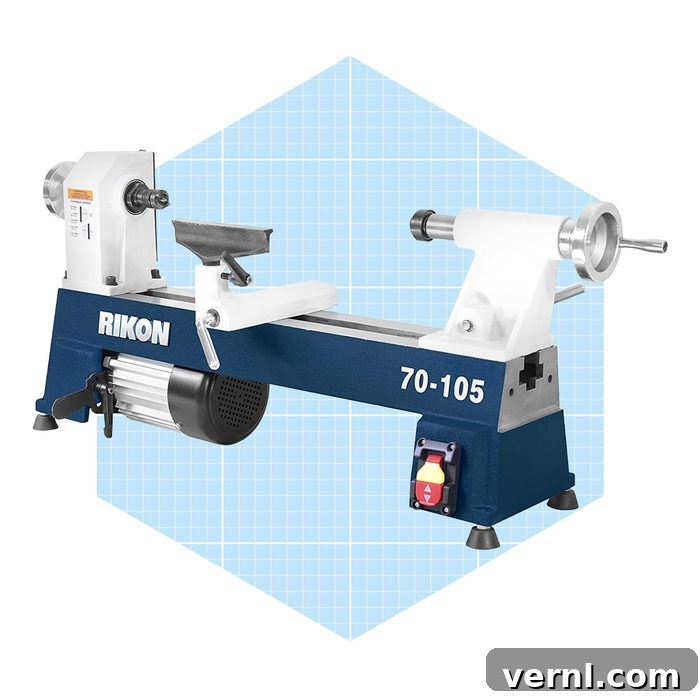
The mini-lathe is the smallest and often most accessible type of wood lathe, making it an excellent choice for beginners, hobbyists, or those with limited workshop space. These compact machines excel at turning small, detailed objects that require precision rather than brute force. Common projects perfectly suited for a mini-lathe include pens, bottle stoppers, chess pieces, chopsticks, small decorative finials, and jewelry components. Their relatively quiet operation makes them ideal for use in a basement or garage without disturbing others.
A prime example, the Rikon Mini-Lathe, typically offers multiple speeds, often controlled by belt changes, allowing the turner to adjust for different wood types and stages of turning. It can generally handle parts up to 18 inches in length and 7 inches in diameter, making it surprisingly capable for its size. Powered by small motors, usually around 1/2-horsepower, these machines can be conveniently plugged into a conventional residential outlet, eliminating the need for specialized electrical wiring. Despite their sturdy cast iron construction, most mini-lathes weigh less than 75 pounds, making them relatively easy to install, move, and store in a compact workshop.
Midi-Lathe: The Versatile Mid-Range Option
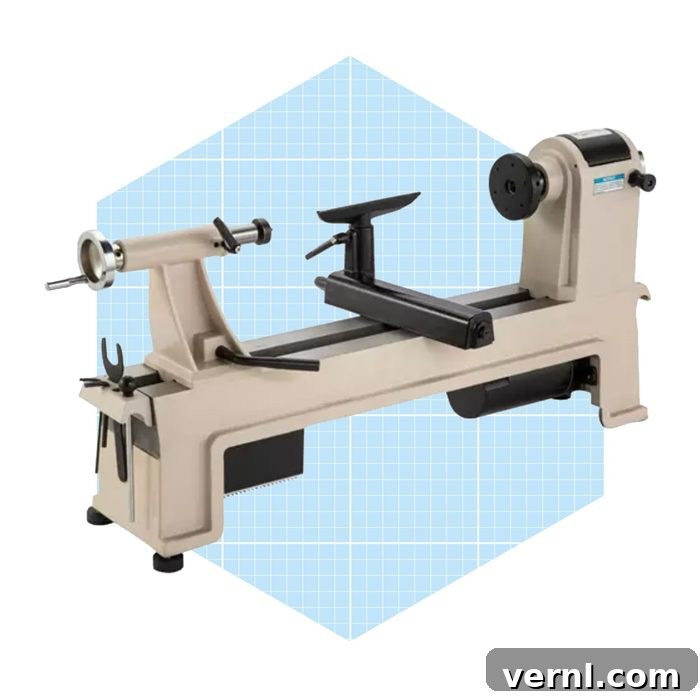
Stepping up in size and power from the mini-lathe, the midi-lathe represents a highly versatile mid-range option for woodturners. These machines offer a significant increase in capacity and motor strength, bridging the gap between hobbyist and serious enthusiast. Midi-lathes can be placed on a sturdy workbench or mounted on optional stands or legs, providing greater flexibility in workshop setup. They are well-suited for a broader range of projects, including small to medium-sized bowls, larger spindles, lamp parts, and small furniture components.
An example such as the Grizzly Variable Speed Bench-Top Wood Lathe demonstrates the enhanced capabilities of this class. It can typically turn a part up to 20 inches in length and a substantial 14 inches in diameter, opening up possibilities for more ambitious creations. To handle these larger and often heavier parts, midi-lathes incorporate more powerful motors (often 3/4 HP to 1.5 HP) and feature a more robust, heavier frame. This increased mass is crucial for absorbing vibrations and maintaining stability, which is especially important when turning unbalanced or irregularly shaped blanks.
While midi-lathes require a good understanding of woodturning techniques, they don’t necessarily demand additional skill beyond what is needed for smaller lathes. However, the greater forces generated by larger workpieces necessitate the use of lathe tools with longer handles to provide better leverage and control. Many modern midi-lathes boast electronic variable speed control, a highly desirable feature that allows for on-the-fly speed adjustments without stopping the machine to change belts. Conveniently, most lathes of this scale can still be plugged into a standard, surge-protected residential outlet, making them a practical choice for home workshops.
Full-Size Lathe: The Powerhouse for Grand Creations
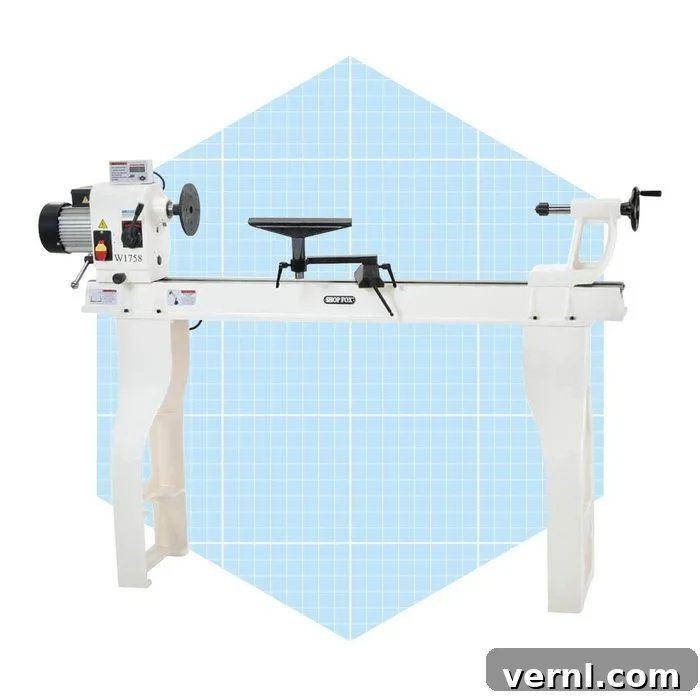
The full-size lathe represents the pinnacle of woodturning machinery, designed for serious professionals and dedicated enthusiasts who tackle the most ambitious and large-scale projects. These formidable machines are capable of turning virtually anything, from massive architectural columns to intricate furniture components. They routinely handle parts that are two feet or longer and 18 inches or more in diameter, making them ideal for crafting furniture-sized pieces such as chair legs, newel posts, large bowls, platters, and even hollow forms.
Lathes like the Shop Fox Wood Lathe are distinguished by their heavy-duty construction, typically featuring robust cast iron legs and weighing upwards of 330 pounds, with some industrial models far exceeding this. This immense mass is critical for providing the necessary stability to counteract the substantial spinning weight and forces generated by larger blanks, minimizing vibration and ensuring smooth, precise cuts. While a standard full-size lathe might turn a part up to 46 inches long, optional bed extensions can be added to significantly increase the distance between centers, enabling the turning of exceptionally long items like solid bed posts or fence columns.
A common limitation for turning very large diameter bowls on a traditional full-size lathe is the “swing over bed” dictated by the motor’s position relative to the bed. To overcome this, many high-end full-size lathes feature a headstock that can swivel or rotate. This allows the turner to position the headstock at a 90-degree angle to the bed, effectively turning the workpiece “outboard” of the main bed. This outboard turning significantly increases the maximum possible diameter of a bowl or platter that can be created. For this specialized type of work, a separate tool rest designed for outboard turning is absolutely necessary to provide stable support for the turning tools.
Buying a Wood Lathe: Key Considerations for Your Workshop
Choosing the right wood lathe is a significant investment and a crucial decision that will shape your woodturning journey. Rather than simply opting for the largest or most powerful machine, it’s essential to carefully consider your specific needs, the types of projects you envision, and your available resources. In the realm of woodturning, bigger isn’t always better; the ideal lathe is one that perfectly matches your aspirations and practical constraints. Here are the primary factors to evaluate before making your purchase:
Cost: Budgeting for Your Woodturning Setup
The financial investment in a wood lathe can vary dramatically. Mini- and midi-lathes are significantly more affordable, making them excellent entry points for new turners or those primarily interested in smaller, less demanding projects like bottle stoppers, drawer pulls, or ornamental pieces. These smaller machines typically range from around $300 to $800, offering good value for their capabilities.
Conversely, a full-size, fully outfitted lathe, especially one with advanced features like variable speed control, a swiveling headstock, and robust cast iron construction, can quickly escalate in price, often topping $5,000 or more. Beyond the lathe itself, remember to budget for essential accessories such as turning tools, chucks, faceplates, sanding supplies, and crucial safety gear like eye protection and dust masks. Factoring in these additional costs will provide a more realistic picture of the total investment required to get started.
Size and Space: Matching the Lathe to Your Workshop
The physical footprint of a lathe is a major consideration, especially if your workshop space is limited. Smaller machines, like mini- and midi-lathes, are much easier to install, move, and store. Their individual components also weigh significantly less, simplifying setup and adjustment. If you primarily intend to make small objects or pens and plan to work out of a compact basement corner or a shared garage space, a mini- or midi-lathe is undoubtedly the most practical and efficient option.
Full-size lathes, with their extensive beds and often heavy cast iron stands, require a dedicated and substantial amount of floor space. Consider not only the machine’s dimensions but also the necessary clearance around it for comfortable operation, access to the workpiece, and room for lumber storage. Ensure that your workshop can comfortably accommodate the machine and still allow for safe and efficient movement.
Power Requirements: Understanding Motor Strength and Electrical Needs
The power of a lathe’s motor directly correlates with its ability to turn larger and denser wood blanks without bogging down. Most mini- and midi-lathes are designed to plug into a standard 120V household outlet, making them convenient for typical residential electrical systems. However, many full-size machines, equipped with larger, more powerful motors (often 1.5 HP to 3 HP or more), may require increased amperage or even a dedicated 240V circuit.
Attempting to run a high-power lathe on an inadequate circuit can lead to tripped breakers, motor damage, or even electrical hazards. It is always wise to consult with a qualified electrician to assess your specific workshop’s electrical capacity and ensure that any new lathe purchase aligns with your existing wiring or to plan for necessary upgrades. Understanding these power requirements upfront can prevent costly and inconvenient surprises down the line.
Lathe Maintenance and Repair: Ensuring Longevity and Performance
Wood lathes are remarkably simple and robust machines, which contributes to their longevity and relatively low maintenance demands. Most modern motors, including those found in lathes, are designed for minimal upkeep, often featuring sealed bearings that require no lubrication. This simplicity means that routine maintenance primarily focuses on keeping the mechanical components clean, rust-free, and properly adjusted.
The lathe bed, typically unpainted cast iron, is the most vulnerable component to environmental wear. It is prone to rust development if neglected, which can lead to pitting over time. Pitting on the bed’s surface can impede the smooth movement of the headstock, tailstock, and tool rest, affecting precision and potentially damaging the sliding components. To prevent this, the bed should be regularly cleaned of dust and wood chips, then waxed with a high-quality paste wax or treated with a rust-inhibiting spray. This protective layer repels moisture and lubricates the sliding surfaces.
Beyond the bed, periodically check the drive belts for tension and wear, adjusting or replacing them as needed to ensure consistent power transfer from the motor to the spindle. Keep all moving parts free of debris and ensure that all fasteners remain tight. A well-maintained lathe not only performs better and lasts longer but also operates more safely, providing years of reliable woodturning enjoyment.
Essential Tips for Woodturning Success: Beyond the Machine
Mastering woodturning involves more than just owning a lathe; it requires attention to detail, continuous learning, and a commitment to safety. Here are some crucial considerations for a rewarding woodturning experience.
Preparing Wood Blanks for Turning
The process of turning large pieces on full-size machines often begins long before the wood even touches the lathe. Larger workpieces typically originate from raw logs or substantial lumber sections, which must be carefully prepared. This often involves using other heavy-duty tools such as a chainsaw to break down logs into manageable blanks or a bandsaw to further refine the shape and remove excess material before mounting it on the lathe. Proper blank preparation is crucial for balancing the workpiece, reducing vibration, and ensuring safe operation, especially with larger, heavier pieces.
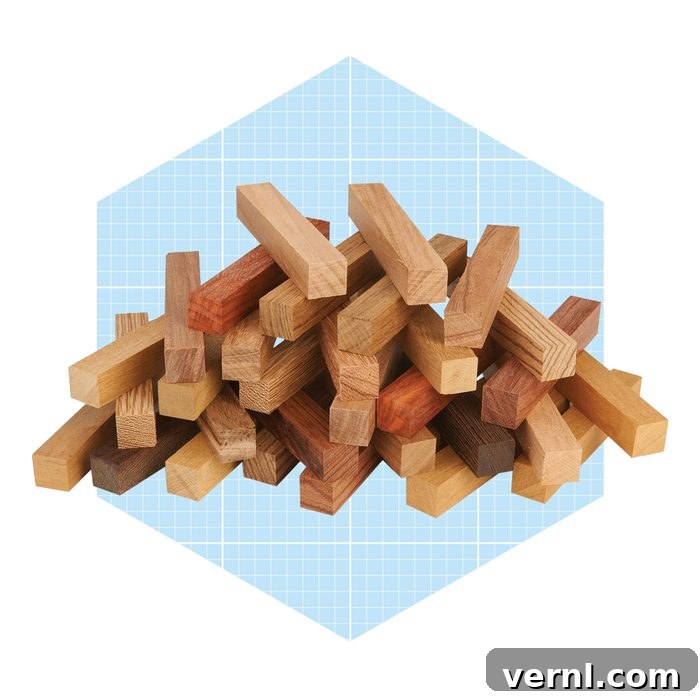
In contrast, for smaller machines like mini-lathes, the preparation process is often much simpler. Many turners purchase pre-sized and pre-dried blanks specifically designed for small projects. For example, a beginner making pens can readily find pre-cut blanks like 32 Pieces of African Hardwood, eliminating the need for extensive wood processing. This convenience allows turners to focus directly on the turning process and skill development.
The Critical Importance of Sharp Tools
Perhaps one of the most fundamental principles in woodturning is the absolute necessity of maintaining sharp tools. Dull tools are not only ineffective, leading to torn grain, rough surfaces, and an increase in effort, but they are also inherently dangerous. A dull tool is more likely to catch, grab the wood, or push back at the turner, potentially causing injury or damaging the workpiece. Sharp tools, on the other hand, slice cleanly through the wood, producing smoother cuts, requiring less force, and delivering more accurate results.
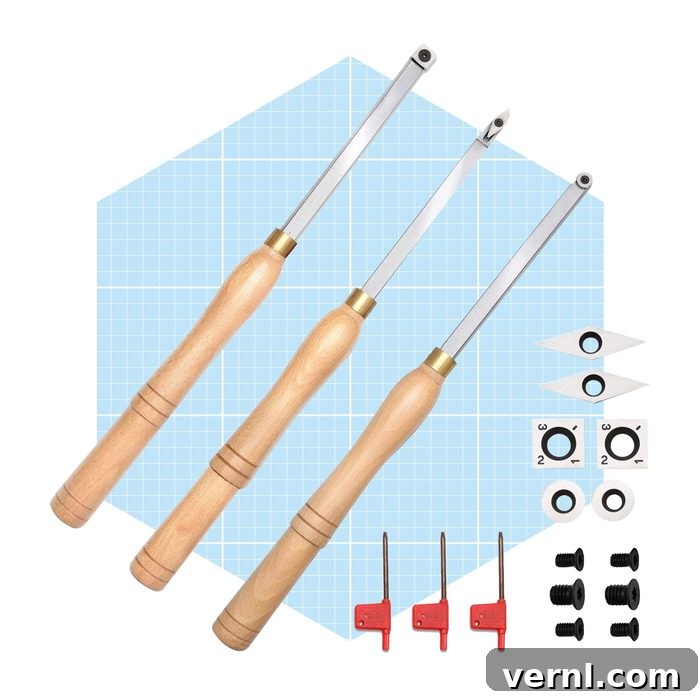
Regardless of the size or scale of your woodturning projects, you will need a reliable method to maintain sharp tools. Traditionalists often favor a bench grinder equipped with specialized jigs for consistently grinding bevels on high-speed steel (HSS) turning tools. These grinders allow for precise control over the cutting edge. Alternatively, many modern turners opt for lathe tools with replaceable carbide tips. These tools, like a set of three full size tools with replaceable tips, offer the convenience of simply rotating or replacing a dull tip, eliminating the need for grinding.
Prioritizing Safety in the Woodturning Workshop
Safety is paramount in any woodworking endeavor, and woodturning is no exception. While lathes are generally quieter than many other power tools, allowing you to often skip hearing protection, certain other safeguards are absolutely non-negotiable.
- Eyewear: This is an absolute must. Spinning wood can splinter, and turning tools can occasionally break, sending fragments flying. Always wear sturdy safety glasses, and for enhanced protection, a full-face shield is highly recommended, especially when roughing out unbalanced blanks or turning large diameters.
- Dust Protection: Wood dust, particularly from exotic species or finely sanded work, can be a respiratory irritant and a long-term health hazard. Wearing a dust mask or, for extended sessions, a respirator is crucial to protect your lungs from airborne particles.
- Appropriate Clothing: The spinning nature of the lathe means loose clothing, jewelry, or long hair can pose a serious entanglement risk. Always tie up long hair, remove any dangling jewelry, and ensure sleeves are rolled up or snug-fitting. Avoid baggy clothing that could get caught in the rotating workpiece or spindle.
- Clear Workspace: Keep your work area tidy and free of clutter. Ensure there’s enough space to move freely and that access to the lathe’s emergency stop button is unobstructed.
By consistently adhering to these safety practices, turners can minimize risks and enjoy the rewarding craft of woodturning with peace of mind.