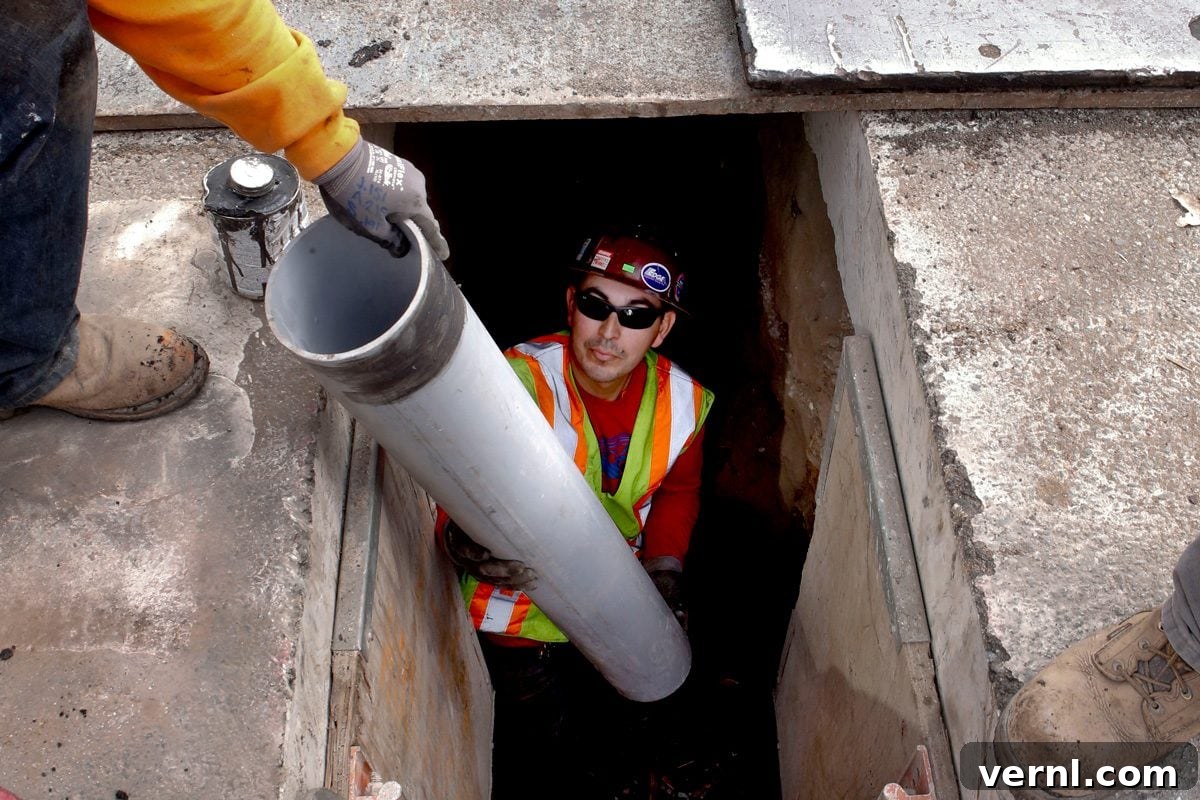
Rigid Polyvinyl Chloride (PVC) conduit is a fundamental component in modern electrical installations, offering a robust, cost-effective, and versatile solution for protecting electrical wiring. My own journey with PVC conduit began unexpectedly during a particularly brutal, windy Minnesota autumn, installing 4-inch PVC conduit underground at a new downtown Minneapolis bus station. This experience was truly eye-opening, challenging my preconceived notions formed from years of working exclusively with metal conduit. The job, situated on the site of an old bottling company, even offered a fascinating historical aside – I unearthed an antique beer bottle from a brewery dating back to around 1910 while digging trenches! Beyond the historical finds and the physical demands of hauling pipe and using a flame torch to bend plastic, I gained invaluable practical knowledge about PVC’s applications and benefits. It became clear that PVC isn’t just for large commercial projects; its advantages extend to a wide range of home electrical applications. This guide will delve into the world of this durable and adaptable electrical conduit, providing essential tips for its proper and safe installation.
Understanding PVC Conduit Types: Schedule 40 vs. Schedule 80
When selecting PVC electrical conduit, you’ll primarily encounter two main designations: Schedule 40 and Schedule 80. It’s crucial to distinguish these from PVC plumbing pipe, which, despite sharing the material, serves an entirely different purpose and possesses different specifications for water pressure rather than electrical protection. Understanding the differences between Schedule 40 and Schedule 80 is key to ensuring compliance with electrical codes and the longevity of your installation.
- Schedule 40 PVC Conduit: This is the more commonly used and thinner-walled variant of PVC electrical conduit. Schedule 40 is ideal for applications where the conduit is not exposed to significant physical stress or potential damage. Its lighter weight and lower cost make it a popular choice. It is suitable for both above-ground and underground installations, and can be used in both indoor and outdoor environments. Typical uses include residential wiring extensions, irrigation systems, communication lines, and applications where the conduit is buried sufficiently deep or otherwise protected from impact.
- Schedule 80 PVC Conduit: Representing a heavier-walled and notably thicker conduit, Schedule 80 is designed for environments where the possibility of physical damage is a legitimate concern. This added thickness provides superior impact resistance, making it suitable for locations where it might be struck, stepped on, or exposed to heavy loads. A common application is where the conduit emerges from the ground (known as “emerging from grade”) and is therefore vulnerable to mechanical damage. While more expensive than Schedule 40, its enhanced durability offers increased protection. Schedule 80 can be installed anywhere Schedule 40 is used, offering an extra layer of security when peace of mind or code requirements dictate greater protection.
Optimal Applications for PVC Electrical Conduit
PVC conduit stands out as an excellent choice for any electrical project requiring a weather-resistant, sturdy, and reliable conduit that excels in challenging environments. Its intrinsic properties make it highly resistant to corrosive elements, rust, and many chemicals, factors that can rapidly degrade metal alternatives. Beyond its chemical resilience, PVC boasts several practical advantages:
- Cost-Effectiveness: Generally, PVC conduit is significantly more affordable than comparable metal conduits, reducing overall project costs without compromising safety or performance.
- Lightweight and Easy Handling: Its light weight makes PVC easier to transport, cut, and install, reducing labor effort and simplifying the installation process, especially in long runs or complex layouts.
- Durability and Longevity: PVC does not rust, rot, or corrode, ensuring a long service life even in harsh outdoor or underground conditions. This resilience translates to fewer maintenance concerns over time.
- Versatility in Installation: PVC is approved for a wide range of uses, including direct burial underground, in concrete slabs, and in exposed locations. Its adaptability makes it suitable for residential outdoor lighting, shed wiring, agricultural buildings, and even some industrial applications.
One minor drawback often cited is aesthetics; some find PVC to be “uglier” than metal conduit, particularly in highly visible interior installations. However, if visual appeal isn’t a primary concern—as is often the case for utility runs, underground installations, or in unfinished spaces—PVC emerges as an exceptionally versatile and durable wiring method that offers significant benefits.
Essential Tips for Installing PVC Conduit Safely and Effectively
Installing PVC conduit properly is crucial for the safety and integrity of your electrical system. Adhering to best practices and National Electrical Code (NEC) requirements will ensure a reliable and long-lasting installation. Here are key considerations and techniques to remember when working with PVC conduit:
The Importance of Primer and Proper Cementing
The debate among electricians regarding the necessity of primer before applying PVC cement is common, but my experience, backed by many inspectors and product manufacturers, strongly favors its use. Primer is not just an aesthetic step; it chemically cleans and softens the surface of the PVC pipe, preparing it for a superior, more secure bond with the cement. This ensures a watertight and robust connection, essential for preventing moisture intrusion and maintaining structural integrity. Many inspectors look for the tell-tale purple residue left by standard primers as proof of proper technique, which also aligns with NEC requirements that mandate following product labeling instructions. To achieve an optimal bond, liberally apply primer to the end of the pipe and the inside of the fitting, then quickly apply PVC cement. Immediately push the pipe ends together, giving the pipe a swift quarter turn as you push to distribute the cement evenly and create a stronger, fused joint. Hold the connection firmly for a few seconds to prevent the pipe from pushing itself back out.
Deburring PVC Conduit for Wire Protection
Whether you cut PVC conduit with a hacksaw, circular saw, or a specialized PVC cutter, the cutting process inevitably leaves a rough edge, known as a burr, on both the inside and outside of the pipe. It is absolutely critical to smooth these edges down, or “deburr” them, before attempting to pull any electrical wires through the conduit. Failure to deburr can lead to damaged wire insulation, creating potential short circuits, ground faults, and serious safety hazards. Additionally, burrs make the wire pulling process significantly more difficult and time-consuming. You can use various tools for deburring, including a utility knife, a metal file, a reaming tool designed for conduit, or even the back edge of a pair of pliers. After removing the visible burrs, run your fingers along the reamed edges to ensure all small bits of plastic are gone and the surface is perfectly smooth. This simple step is vital for protecting your conductors.
Understanding and Following Conduit Fill Requirements
Conductors generate heat as electricity flows through them, and excessive heat can degrade wire insulation, leading to system failure or fire. To prevent this, the National Electrical Code (NEC) imposes strict limits on the number of wires that can be installed in any conduit, including PVC. These “fill requirements” depend on several factors: the internal diameter of the conduit, its type (Schedule 40 or 80, which affects internal diameter), the number of conductors, and their individual dimensions (gauge and insulation type). Calculating these requirements often involves consulting the NEC’s Chapter 9, Table 1, for dimensions and percentages, and Informative Annex C for specific wire combinations. A general rule of thumb for many residential applications, such as pulling a single circuit with a hot, neutral, and equipment grounding conductor (EGC), is that the total cross-sectional area of the wires should not exceed 40% of the conduit’s internal diameter. For common scenarios where all wires are the same size, the NEC helpfully provides tables listing the maximum number of wires by wire type and conduit size, simplifying the process. Always consult the latest NEC edition or a qualified electrician to ensure compliance and safety.
Strategic Use of Plastic Bushings and Metal Locknuts
Properly securing PVC conduit to electrical boxes is essential for both structural integrity and wire protection. When attaching PVC and male adapters to boxes, always begin by using a metal locknut on the outside of the box. Metal locknuts provide a much sturdier and more reliable connection than plastic alternatives, preventing the conduit from easily pulling out or twisting. Once the locknut is securely fastened, add a plastic bushing to the inside of the box connection. The primary purpose of the plastic bushing is to provide a smooth, rounded edge at the point where conductors enter the box, protecting the wire insulation from sharp edges and friction during the pulling process. This two-part approach—robust metal for structural integrity and smooth plastic for wire protection—ensures a secure and safe termination.
Ensuring Adequate Burial Depth for Underground PVC Conduit
Safety for underground electrical installations is paramount, and the NEC provides very specific depth requirements in Table 300.5 for all conduit runs underground. These depths are designed to protect the wiring from physical damage caused by digging, landscaping, or other disturbances. If you’re running a circuit out to a shed, a detached garage, or for outdoor lighting, strictly adhering to these rules is non-negotiable to avoid potentially damaging the circuit and creating dangerous situations. The default minimum burial depth for PVC conduit is generally 18 inches when directly buried. However, there are specific qualifications and exceptions that can allow for shallower burial depths. For example, if you are installing a 120-volt, 20-amp or less circuit that is continuously protected by a Ground-Fault Circuit Interrupter (GFCI), the required depth for PVC conduit can be reduced to 12 inches. Always consult Table 300.5 of the current NEC edition to confirm the exact requirements for your specific application, location, and protection scheme.
Limiting Conduit Bends to 360 Degrees
The act of pulling electrical wire through conduit becomes progressively more difficult with every bend, due to increased friction. Excessive bends can lead to damaged wire insulation, difficulty in installation, and potential future maintenance challenges. To mitigate these issues, the NEC limits the total amount of bends in any single conduit run to a maximum of 360 degrees between pulling points or junction boxes. This applies universally to all types of conduit, including PVC. Practically, this means you can have, for instance, four 90-degree turns before you are required to install a junction box. Junction boxes serve as accessible points to pull wires, make splices, or change direction. While 90-degree elbows are common, remember that bends also come in 45-degree and 22.5-degree configurations. When planning your conduit layout, always add up the cumulative degrees of all bends in a continuous run and ensure they do not exceed 360 degrees. Careful planning can save significant time and effort during the wire-pulling phase.
Opting for Metal Elbows in Underground PVC Runs
While PVC conduit is excellent for underground applications, a critical exception arises when it comes to elbows in buried sections. The intense friction generated when pulling wires through the tight curve of an underground PVC elbow can literally slice through the plastic, damaging the wire insulation and compromising the integrity of the conduit. This creates a dangerous situation, potentially exposing conductors and leaving the pipe open to water intrusion. To avoid this, it is strongly recommended to use metal elbows for all bends in underground PVC conduit runs. Metal elbows offer superior durability and resistance to the abrasive forces of wire pulling. Normally, all metal parts of an electrical wiring system must be electrically bonded to the grounding electrode system to ensure safety. However, for metal elbows used within an otherwise PVC underground run, the NEC provides an important exception: if the run is buried at least 18 inches deep, this bonding step for the metal elbows is typically not required, due to the stable underground environment limiting voltage differences.
Supporting PVC Conduit at Correct Intervals
Like all electrical conduits, PVC must be properly supported at regular intervals to prevent sagging, maintain its structural integrity, and ensure the long-term safety of the wiring system. The specific distance between supports is dictated by the conduit’s size, with smaller diameters requiring more frequent support than larger ones. For typical home wiring projects, you’ll likely be working with 1/2-inch or 3/4-inch PVC conduit. For these common sizes, supports must be spaced no more than 3 feet apart. You have the option of using either plastic PVC straps, which blend seamlessly with the conduit, or metal straps, which offer robust fastening. Beyond the general spacing, it’s also a critical NEC requirement that PVC conduit be supported within 3 feet of any conduit termination, such as an outlet box, junction box, or panelboard. This ensures stability at connection points, preventing strain on fittings and wiring.
Utilizing Expansion Fittings for Long PVC Runs
One of the most remarkable, yet often underestimated, characteristics of PVC is its significant thermal expansion and contraction in response to temperature fluctuations. This property is particularly relevant in regions with wide temperature swings. Consider a place like Minnesota, my old home state, where annual temperatures can easily fluctuate by 100 degrees Fahrenheit or more—say, from 90 degrees in the summer to -10 degrees or colder in the winter. On a 100-foot run of PVC conduit, this 100-degree temperature difference can cause the pipe to expand and contract by approximately four inches! If an expansion fitting is not incorporated into a long, exposed run, the immense stress from these thermal movements will inevitably lead to severe problems. The PVC will either crack, buckle, or pull itself violently out of the rigid fittings, creating a potentially dangerous situation with exposed wiring and necessitating an annoying and costly repair. The NEC’s Table 352.44(A) provides detailed guidelines outlining the expected thermal expansion for various temperature swings and run lengths, helping you determine where and when expansion fittings are necessary. It’s important to note, however, that expansion fittings are typically not required for underground PVC runs, as the earth provides a relatively stable and consistent temperature environment, minimizing thermal movement.
Always Pull an Equipment Grounding Conductor (EGC) with PVC
A fundamental safety distinction when working with PVC conduit, as opposed to metal conduit, is its insulating nature. Because PVC is plastic and therefore not electrically conductive, it cannot serve as the equipment grounding path for your electrical system. This means it is absolutely essential to pull a dedicated equipment grounding conductor (EGC) alongside your circuit conductors (hot and neutral wires) within every PVC conduit run. The EGC provides a critical, low-impedance path back to the electrical panel and ultimately to the grounding electrode system. In the event of an unintentional current path—such as a short circuit or a ground fault—the EGC safely carries this fault current, quickly tripping the circuit breaker and preventing electric shock or fire. This is in contrast to metal conduit, which can often function as the EGC itself, provided every single connection point within the run is properly bonded together to ensure continuous conductivity. With PVC, you don’t have that luxury; the separate EGC is a non-negotiable safety component that ensures fault currents are safely managed and your electrical system remains protected.