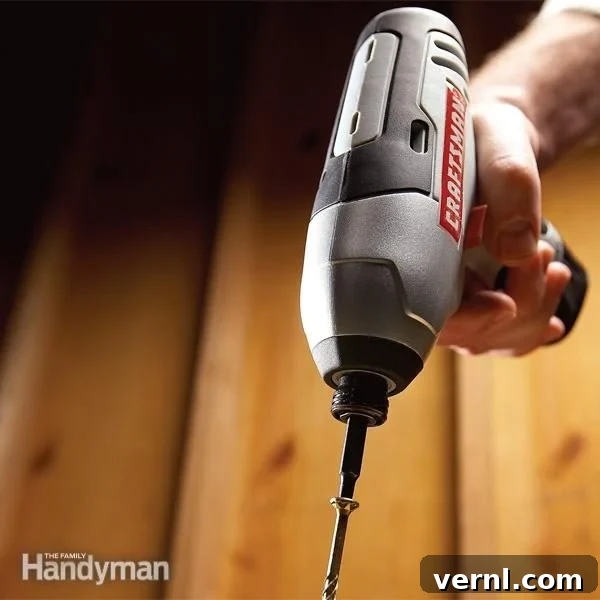
Just a decade ago, the sight of a cordless impact driver on a jobsite was a rarity, often considered a specialized tool for niche applications. Today, these powerful and versatile tools have undergone a remarkable transformation, becoming an indispensable staple in toolboxes across the globe. Walk into any hardware store or construction site, and you’ll find an array of models, their distinctive, rapid-fire chatter a constant backdrop to any building project. This comprehensive guide aims to demystify the impact driver, helping you understand its unique capabilities and why it has earned its place as a must-have power tool for both professional tradespeople and enthusiastic DIYers alike.
The Heart of the Beast: Understanding Torque
The single most compelling advantage an impact driver holds over a standard drill or driver is its immense torque output. In simple terms, torque is the rotational force that allows a tool to twist or turn an object. Impact drivers are engineered to deliver a concentrated burst of this twisting power, enabling them to drive large, stubborn fasteners and bore sizable holes with astonishing ease, often in materials that would cause a conventional drill to stall or strip screw heads.
Unlike a standard drill that applies continuous rotational force, an impact driver uses a unique hammer-and-anvil mechanism. When the motor encounters resistance, instead of simply trying to power through it, a spring-loaded hammer mechanism engages. This hammer repeatedly strikes an anvil, delivering rapid, powerful rotational blows (impacts) that essentially ‘punch’ the screw forward with immense force. These percussive impacts are what generate the extraordinary torque that defines the tool.
You might intuitively assume that such extreme torque would translate into excessive strain on your wrist or arm, leading to fatigue or even injury. However, the opposite is true. Thanks to the ingenious design of its impact mechanism, an impact driver actually generates significantly fewer wrist twists and kickbacks compared to a conventional drill. The short, sharp bursts of torque from the impacts dissipate rotational energy efficiently into the fastener, rather than transferring it back to the user. This means you can drive long, heavy-duty screws or bolts for extended periods with remarkable comfort and reduced physical exertion, making it a safer and more ergonomic tool for repetitive tasks.
Versatility Beyond Fastening: Drilling with an Impact Driver
While their name suggests a primary role in driving screws, modern impact drivers are far more versatile, excelling as capable drilling machines as well. With the right accessories, an impact driver can seamlessly transition from driving screws to boring holes in various materials, proving its worth as a multi-functional power tool on any job site.
For smaller diameter bits, typically up to 1/4-inch or so, impact drivers operate much like standard drills, offering impressive speed and precision. In this mode, they leverage their high RPM (revolutions per minute) to quickly and cleanly drill through wood, metal, or plastic. In fact, many cordless impact drivers boast RPMs nearly twice as high as those found in most cordless drills, allowing for faster work and smoother holes in lighter applications.
The true power of an impact driver for drilling becomes apparent when tackling larger diameter holes. When a larger bit encounters significant resistance, the tool’s internal hammer mechanism kicks into its high-torque impact mode. This allows the impact driver to deliver those powerful rotational blows, enabling it to bore through tough materials or create larger holes that would quickly overwhelm a conventional drill. It’s crucial, however, to use drill bits specifically designed for impact drivers, featuring a hex shank for secure chuck engagement and robust construction to withstand the tool’s intense percussive action.
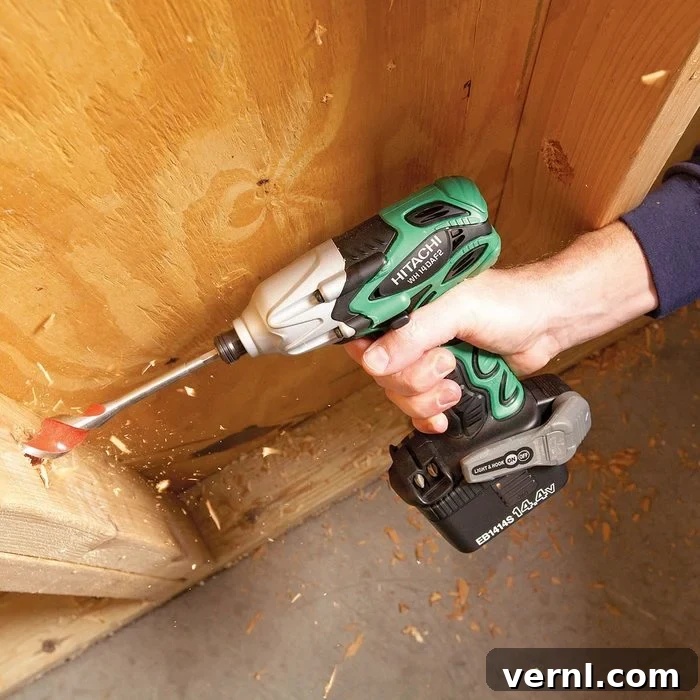
From pre-drilling pilot holes for screws to boring holes for wiring, plumbing, or hardware installation, impact drivers equipped with the correct impact-rated hex-shank drill bits can handle a surprising range of drilling tasks. This dual capability further solidifies their position as an essential tool for carpenters, electricians, plumbers, and DIY enthusiasts who need both fastening and drilling power in a compact, efficient package.
Effortless Control: The Power of One-Handed Operation
One of the most appreciated ergonomic benefits of an impact driver is its ability to facilitate comfortable, one-handed operation, particularly in challenging positions. With a standard drill or driver, you typically need to apply significant steady forward pressure to prevent the bit from “camming out” – an irritating occurrence where the bit slips out of the screw head, stripping the fastener and often damaging your workpiece. This usually requires two hands or a strong bracing position, limiting maneuverability.
Impact drivers largely eliminate this issue. The same ingenious hammer mechanism that generates tremendous rotational torque also produces a subtle yet effective amount of forward pressure on the fastener. This means you don’t have to push nearly as hard to keep the bit engaged in the screw head. The tool does much of the work for you, reducing the likelihood of cam-out and preserving both your screws and your peace of mind.
This inherent forward pressure, combined with the tool’s often compact and lightweight design, makes one-handed driving not just possible, but often preferable. Imagine needing to drive a screw overhead while holding a piece of material with your other hand, or reaching into a tight, awkward space where only one hand can fit. In such “stretch-and-drive” situations, an impact driver truly shines, allowing for precise control and efficient fastening without the struggle of maintaining constant manual pressure. This capability significantly improves workflow, reduces user fatigue, and enhances safety by allowing users to maintain better balance and control in confined or difficult access areas.
A Symphony of Power (and Noise): Addressing Decibel Levels
There’s no sugarcoating it: impact drivers can be remarkably loud tools. The characteristic rapid-fire “machine-gun” chatter they produce is a direct result of their internal mechanism – metal hammer striking metal anvil at high speeds. While this mechanical action is precisely what gives them their exceptional power and torque, it also generates significant noise levels that can be startling, and more importantly, detrimental to your hearing over time.
Operating an impact driver without proper hearing protection is a serious health hazard. Prolonged exposure to high decibel levels can lead to irreversible hearing damage, including tinnitus (ringing in the ears) and permanent hearing loss. It’s not a matter of “if” but “when” if you regularly use these tools without protection. Therefore, investing in quality hearing protection – whether earmuffs or earplugs – is not an option but a critical necessity for anyone using an impact driver, even for short periods. Think of it as an essential accessory, just as important as the bits you’re using.
While the loud operation is a inherent characteristic, advancements in power tool technology are starting to address this. Some manufacturers now offer “oil-pulse” or “hydraulic” impact drivers, which use a hydraulic fluid rather than a direct metal-on-metal impact mechanism. These tools tend to be significantly quieter, though they may offer a slightly different feel and torque characteristic. For most users, however, traditional impact drivers remain the standard, making personal hearing protection an absolute priority for safeguarding your long-term hearing health.
Clarifying Roles: Impact Driver vs. Hammer Drill
Due to their similar names and the percussive sound they both produce, impact drivers are often confused with hammer drills. While both tools utilize a “hammering” action, their mechanisms and primary applications are fundamentally different. Understanding this distinction is crucial to selecting the right tool for the job and preventing damage to the tool or the workpiece.
An impact driver’s internal components are meticulously engineered to generate immense rotational torque. Its hammer strikes are delivered perpendicular to the drive shaft, intensifying the turning force to drive screws and bolts. The impacts are designed to overcome rotational resistance, making it ideal for fastening tasks where sheer twisting power is needed to sink a fastener quickly and efficiently.
Conversely, a hammer drill, as its name implies, is designed to deliver rapid, powerful axial blows directly *into* the workpiece, along the same axis as the drill bit. This forward hammering action, combined with simultaneous rotation, is specifically intended to pulverize and chip away at tough masonry materials like concrete, brick, and stone. The impacts from a hammer drill are meant to break up material, allowing the drill bit to penetrate much more effectively than a standard drill.
Therefore, an impact driver is no substitute for a hammer drill when tackling concrete or other masonry. Attempting to use an impact driver with a masonry bit on concrete will, at best, be agonizingly slow and ineffective, and at worst, could damage your impact driver or dull your bits. While an impact driver generates rotational impacts for torque, it lacks the powerful forward thrust required to effectively break down hardened materials. For drilling into concrete, brick, or stone, a dedicated hammer drill or, for heavier duty applications, a rotary hammer, is the unequivocally correct and most efficient tool.
Learn more about drilling into concrete with the right tools.
The Right Fit: Understanding Hex Shafts and Quick-Change Chucks
One of the convenient features that sets impact drivers apart from traditional drills is their unique chuck design. Instead of a three-jaw keyless chuck that requires tightening around a round drill bit, impact drivers typically feature a quick-release 1/4-inch hex chuck. This design is specifically engineered for speed, efficiency, and secure bit retention under high-torque conditions.
Changing bits on an impact driver is remarkably fast and straightforward. You simply pull forward on the collar of the chuck, insert a hex-shank bit into the opening, and release the collar. The bit snaps securely into place, ready for action. This allows for rapid transitions between different types of bits – from a pilot drill bit to a driving bit, or from a Phillips head to a square drive – without any fumbling or wasted time, significantly boosting productivity on the job.
However, this quick-change mechanism comes with a crucial caveat: you must exclusively use hex-shaft drill bits and driving bits. Standard drill bits with round shanks simply will not fit or be securely held by the hex chuck. Attempting to force them in or use them improperly will not only be ineffective but could also damage the chuck or create unsafe operating conditions where the bit could slip or fly out under impact. Fortunately, the market is now flooded with a wide array of impact-rated hex-shank accessories, including drill bits for various materials, screwdriver bits for every fastener type, nut setters, socket adapters, and extensions, ensuring complete versatility for your impact driver.
Beyond the Basics: Key Considerations When Choosing an Impact Driver
With the impact driver market constantly expanding, choosing the right model can seem daunting. Beyond the core benefits discussed, several factors warrant consideration to ensure you select a tool that perfectly matches your needs and work style:
- Voltage and Power: Cordless impact drivers typically come in 12V, 18V (or 20V Max in some systems), and occasionally 36V platforms. 12V models are compact and ideal for lighter-duty tasks and tight spaces, offering excellent maneuverability. 18V/20V Max models are the most popular and versatile, providing a balance of power, runtime, and compatibility with a vast range of other tools in the same battery ecosystem. Higher voltage often translates to greater torque and sustained performance for demanding jobs.
- Brushless Motors: Modern impact drivers frequently feature brushless motors. Unlike traditional brushed motors, brushless technology uses electronic sensors to control power delivery, resulting in greater efficiency, longer runtimes per charge, increased power output, and significantly extended tool life due to reduced heat and friction. While typically a higher upfront investment, brushless impact drivers offer superior performance and durability over the long term.
- Ergonomics and Size: Consider the weight, balance, and grip of the tool. A well-balanced impact driver reduces fatigue, especially during extended use or overhead work. Compact and sub-compact models are excellent for working in confined spaces, while larger, more powerful units might be better suited for heavy-duty applications where size isn’t a primary constraint.
- Battery System and Ecosystem: If you already own other cordless tools, it often makes sense to stick with the same brand and battery platform. This allows you to interchange batteries and chargers, reducing costs and maximizing convenience. Evaluate the battery capacity (Ah – Amp-hours) as well, as higher Ah ratings mean longer runtimes.
- Additional Features: Many impact drivers come with useful extras like integrated LED lights to illuminate the work area, belt clips for easy access, multiple speed/torque settings for greater control, and battery fuel gauges. These small additions can significantly enhance the user experience and productivity.
Maximizing Your Investment: Tips for Optimal Use and Maintenance
To ensure your impact driver performs optimally and lasts for years to come, proper usage and diligent maintenance are key. Adhering to these guidelines will not only extend the life of your tool but also enhance safety and efficiency on all your projects:
- Use Impact-Rated Accessories: This cannot be stressed enough. Always use bits, sockets, and adapters specifically designed and rated for impact drivers. These accessories are constructed from tougher steel alloys to withstand the high torque and percussive forces, preventing premature breakage, stripping, or warping. Using non-impact-rated bits is dangerous and can damage both the bit and the tool.
- Proper Bit Selection: Match the bit type and size to the fastener. Using the correct Phillips, Torx, or square drive bit ensures maximum engagement and prevents cam-out and stripped screw heads. For drilling, select hex-shank drill bits appropriate for the material you’re working with.
- Control and Technique: While impact drivers reduce the need for excessive forward pressure, maintaining a firm grip and stable stance is still important. Let the tool do the work; avoid pressing too hard or trying to force it, especially when the impact mechanism engages. Allow the impacts to break loose stubborn fasteners or sink screws smoothly.
- Keep it Clean: Regularly clean your impact driver, especially the chuck area, to remove sawdust, dirt, and debris. A build-up of gunk can hinder the smooth operation of the quick-release chuck mechanism. Use a dry cloth or compressed air; avoid liquids.
- Battery Care: Follow the manufacturer’s recommendations for battery charging and storage. Avoid completely draining lithium-ion batteries, and store them in a cool, dry place when not in use. Proper battery care prolongs their lifespan and ensures consistent power delivery.
- Hearing and Eye Protection: As previously mentioned, always wear appropriate hearing protection (earmuffs or earplugs) and eye protection (safety glasses) when operating an impact driver. These tools can generate high noise levels and propel debris, making personal protective equipment non-negotiable for your safety.
From its humble beginnings as a specialized tool, the cordless impact driver has rapidly evolved into an indispensable powerhouse for tradespeople and DIYers alike. Its unparalleled torque, combined with comfort, versatility, and efficiency, makes it a superior choice for driving fasteners and often for drilling tasks. By understanding its unique mechanics, knowing its limitations, and investing in the right accessories, you can harness the full potential of this remarkable power tool, making your projects faster, easier, and more enjoyable.