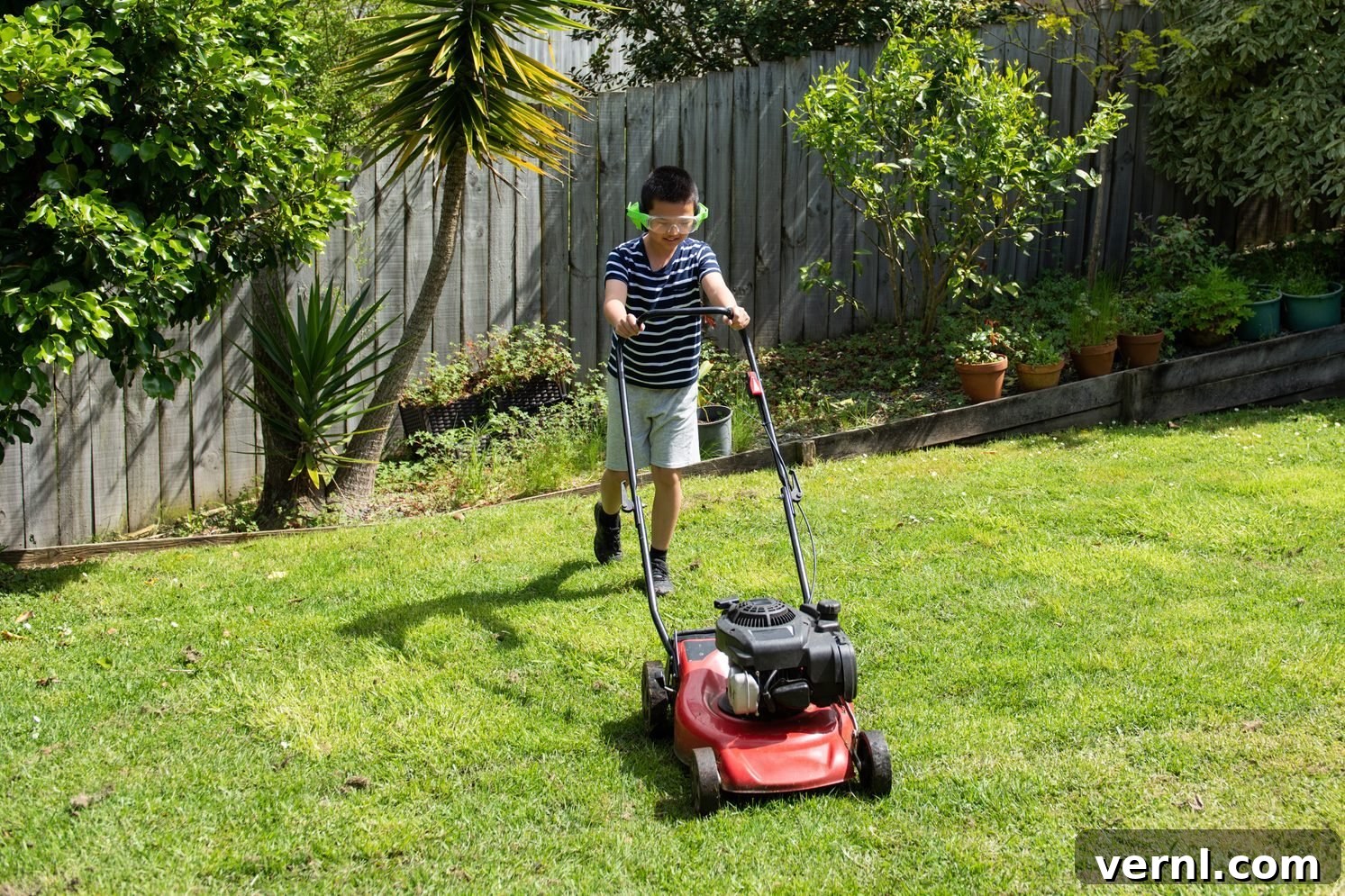
When Can Kids Mow the Lawn? A Comprehensive Guide to Child Lawn Mower Safety
For generations, the rhythmic hum of a lawn mower has symbolized a significant rite of passage, often marking a child’s first major responsibility. Mowing the lawn offers invaluable lessons in work ethic, physical activity, and financial independence. It’s an opportunity for kids to contribute to the household and gain a sense of accomplishment.
However, beneath the surface of this seemingly simple chore lies a significant responsibility that should not be taken lightly. Operating a lawn mower demands good judgment, sufficient physical size, and the strength necessary to control powerful machinery safely. When safety precautions are overlooked or children are rushed into the task before they are truly ready, the consequences can be devastating and tragically life-altering.
The statistics paint a stark picture: Nationwide Children’s Hospital reports that every single year, nearly 8,500 children are rushed to emergency rooms across the country due to lawn mower-related injuries. Even more concerning, the Amputee Coalition identifies lawn mower accidents as the leading cause of major limb loss in children under the age of 10. These figures underscore the critical importance of prioritizing safety above all else.
Parents contemplating whether their child is ready for this significant chore must carefully evaluate several key factors. Beyond just age, consider the child’s overall maturity, their ability to follow instructions diligently, and the specific physical demands presented by your lawn mower and property. This holistic assessment is crucial for ensuring a safe and positive introduction to lawn care.
What Age is Appropriate for Lawn Mowing?
Determining the right age for a child to start mowing the lawn is a critical first step in ensuring their safety and success. Many reputable hospitals and safety organizations universally recommend that parents adhere to the American Academy of Pediatrics (AAP) guidelines. These guidelines serve as a benchmark for child safety regarding lawn care equipment:
- Children should be at least 12 years old to safely operate a push mower.
- Children should be at least 16 years old to safely operate a riding mower.
These age recommendations are not arbitrary; they are based on developmental milestones, including motor skill development, cognitive ability to assess risks, and physical coordination. Furthermore, the AAP strongly advises that children under the age of 12 should be kept entirely away from running lawn mowers. This means absolutely no riding on the back bumper of a mower, or on a parent’s lap while they are operating the machine. The rotating blades and moving parts pose an extreme hazard, even from a distance.
While age provides a valuable framework, it tells only part of the story. Bryan Clayton, a seasoned lawn care expert and co-founder of GreenPal, emphasizes that appropriate maturity is just as vital as physical age for safe mower operation. “A child ready to mow the lawn should demonstrate a genuine willingness to learn and an unwavering commitment to following instructions closely,” he advises.
Clayton, who started mowing at a young age and eventually built a successful landscaping business, cautions parents against assuming a child is ready simply because they appear physically capable. The task goes far beyond mere physical strength. “It’s not just about turning the mower on and pushing it across the grass,” he explains. “They need to understand the most efficient and safest patterns for mowing, how to properly handle the mower on various slopes and inclines, where to walk to avoid obstacles and uneven terrain, and, crucially, how to respect the machine’s inherent power and potential dangers.”
As a parent, a crucial self-assessment is necessary: Does your child consistently follow directions in other aspects of their life? Do they naturally adhere to safety precautions for smaller tasks? If they struggle with responsibility for minor chores, it’s highly unlikely they possess the consistent judgment and focus required to operate a potentially dangerous piece of machinery like a lawn mower safely. Maturity involves understanding cause and effect, anticipating potential hazards, and maintaining focus throughout the entire task, not just for a few minutes.
If your child demonstrates the requisite maturity and responsible behavior, the next critical step is to evaluate their physical capability in relation to the specific lawn mower you own and the unique characteristics of your property.
When Can Kids Use Push Mowers?
Before entrusting your child with a push mower, a thorough evaluation of several physical and environmental factors is essential. A push mower, while less complex than a riding mower, still presents significant risks if not operated correctly.
Height Requirements for Push Mowers
Correct handle height is paramount for both safety and efficiency when operating a push mower. For most users, the mower handle should comfortably fall somewhere between their waist and chest level. This ergonomic positioning allows for optimal control, reduces strain, and prevents improper posture. Unfortunately, there isn’t a universal height requirement, as different mower models feature varying handle lengths and adjustable angles. The real question is whether your child’s height is appropriate for your specific mower.
To determine this, conduct a simple, non-running test: Have your child push the mower around the yard with the engine off. Observe them closely. Do the front or rear wheels consistently lift off the ground as they push or pull? If the handle is too high, a child might apply upward force as they push, attempting to bring the handle down to a more comfortable position. Conversely, if they’re reaching too low, they might pull down excessively. Either motion can cause one end of the mower to rise, leading to an uneven cut and, more importantly, creating unstable and potentially unsafe operating conditions where control can be compromised. An improperly balanced mower is harder to steer and can lead to fatigue, increasing the risk of an accident. Consider mowers with adjustable handles if your child is still growing, as this feature can extend the safe usability period.
Strength and Maneuverability for Push Mowers
Operating a lawn mower effectively requires sufficient strength to maneuver the machine, especially around obstacles, on inclines, or through dense grass. The weight of mowers can vary significantly:
- Gas-powered mowers are generally the heaviest, due to their engine components and fuel tanks.
- Battery-powered mowers are typically lighter than gas models but heavier than corded electric mowers due to the weight of the battery pack.
- Corded electric mowers are usually the lightest option, but they come with the added hazard of managing an electrical cord.
Consider the overall weight of your mower and whether your child can comfortably push, pull, and turn it without excessive strain. Fatigue directly impacts a child’s ability to maintain focus and control, significantly increasing the risk of accidents.
Self-propelled mowers offer distinct advantages, particularly for heavier models or properties with uneven terrain, as they reduce the physical effort required to push the mower. However, they also come with their own set of considerations for child operators. Not all self-propelled mowers feature adjustable speeds. If your child has to run or sprint to keep pace with the mower, it creates a dangerous situation where they could lose control, trip, or be pulled into the path of the blades. A better, safer option for a child would be a self-propelled mower that allows the assist speed to be precisely matched to the user’s comfortable walking pace. This ensures controlled movement and reduces the risk of fatigue or loss of balance.
Beyond the mower itself, consider the terrain of your property. Extremely hilly, rocky, or heavily landscaped yards will require more strength and dexterity to navigate safely than a flat, open lawn. A child should be able to maintain firm footing and stable control of the mower at all times, regardless of the ground conditions.
When Can Kids Use Riding Mowers?
The transition to a riding mower represents a significant leap in complexity and potential danger. The AAP guidelines are very clear on this, suggesting that a riding mower should be treated with the same respect and responsibility as operating a car, hence the stringent age guideline of 16 years old. This recommendation aligns with the age at which many teenagers begin learning to drive, acknowledging the cognitive and physical maturity required for such machinery.
Operating a riding mower involves not just pushing, but steering, braking, managing throttle, engaging blades, and being aware of a much larger operating footprint. The child needs to possess legs long enough to comfortably reach and operate the brake pedal with adequate force, as well as sufficient arm reach to manipulate the steering wheel and other controls without stretching or losing balance. Critically, they must also have enough weight to properly activate the safety seat switch. Most modern riding mowers are designed to automatically shut off the blades and/or engine if the operator leaves the seat, a vital safety feature. If a child is too light, they might inadvertently trigger this cut-off when bouncing over rough terrain, leading to unexpected stops or, worse, losing control. (As a scrawny teenager, I personally experienced triggering this cut-off frequently when encountering bumps, highlighting the importance of appropriate weight.) Common sense, sound judgment, and advanced maturity are absolute prerequisites for this task.
Some parents mistakenly assume that if a child is responsible enough to handle motorsports like ATVs or dirt bikes, they are automatically prepared for a riding mower. This is a dangerous assumption. Mowers are not designed for recreation or speed; they are heavy, powerful cutting machines with exposed blades that can cause catastrophic injuries. It is crucial to instill in children that a riding mower is a tool for a specific job, not a toy to be ridden like it’s on a dirt racetrack. Speeding, making sharp turns, attempting stunts, or operating on steep inclines are all extremely hazardous practices that can lead to roll-overs, loss of control, or contact with the blades. Emphasize that operating a riding mower requires undivided attention and a serious, focused approach to safety.
Additionally, riding mowers are particularly dangerous on slopes. Operating across a slope significantly increases the risk of a roll-over. It’s generally recommended to mow up and down slopes, not across, and to avoid very steep inclines altogether. Never allow a child to carry passengers on a riding mower, as this can impede visibility, affect balance, and put a second person at extreme risk.
Other Ways Children Can Help With Lawn Work
Introducing children to lawn care responsibilities at an earlier age, before they are ready for a mower, can be an excellent way to build foundational skills, instill a sense of responsibility, and gauge their readiness for more complex and powerful tools. Iesha Mulla, founder of Parental Questions, advocates for this gradual approach, explaining that it allows parents to track their child’s ability to handle the responsibility of increasingly complex tasks.
Tasks that might seem simple, such as raking leaves or trimming small bushes, are invaluable learning opportunities. As Mulla wisely points out, “This will give you an idea of their awareness of safety protocols in relation to moving machinery and sharp blades.” These introductory tasks help children develop an understanding of spatial awareness, the importance of protective gear, and the proper handling of tools, all without the high risk associated with powered mowers.
Here are several beginner-friendly tasks that can introduce children to the world of lawn care, progressively building their skills and sense of responsibility:
- Collecting Yard Waste: This is arguably the lowest-risk way to start kids off in gardening and lawn care. Tasks like picking up fallen branches, twigs, or larger debris before mowing helps them understand the importance of preparing a safe work area. It teaches them to identify potential hazards that could damage equipment or be flung by mower blades.
- Planting: Engaging children in planting flowers, vegetables, or small shrubs introduces them to basic gardening tools like trowels and spades. It’s an excellent way to observe how they handle delicate tasks, follow instructions for depth and spacing, and respect the living elements of the yard. This also fosters a connection to nature.
- Using a Manual Reel Mower: This is an excellent stepping stone for introducing children to the concept of mowing with significantly less risk of injury. Manual reel mowers require physical effort and teach children how the cutting action works without the speed, noise, and power of a motor. It helps them develop a sense of rhythm and precision for cutting grass, and they are inherently safer due to the absence of rapidly spinning blades or an engine.
- Using a String Trimmer (with extreme caution): For older, responsible children, a string trimmer can serve as an introductory power tool. While it still carries risks (flying debris, kickback, noise), it is generally considered less dangerous than a full-sized lawn mower, especially smaller, battery-powered models. This task allows parents to evaluate if their child can safely and responsibly carry out a task requiring a powered tool, emphasizing the importance of eye protection, long pants, closed-toe shoes, and strict adherence to safety zones. Supervision is paramount for this step.
- Raking Leaves: A classic chore that builds stamina and teaches organization. It helps children understand the concept of clearing large areas and preparing for other lawn tasks.
- Watering Plants/Lawn: This simple task teaches consistency and the needs of plants, while familiarizing children with hoses and sprinklers.
- Weeding (Manual): Using hand trowels for weeding teaches attention to detail and patience, and helps children identify different plant types.
As a child consistently demonstrates responsibility, aptitude, and a commitment to safety with these smaller tasks, parents can gradually reward them with more freedom and eventually, more powerful tools. The ultimate goal is for them to become proficient and safe lawn mowers, but the exact pace of this progression is entirely up to you as the parent. Each step should be supervised and evaluated before moving on to the next, building confidence and competence incrementally.
“Every child develops differently,” Mulla wisely reminds us. “Trust your judgment!” Your intimate knowledge of your child’s personality, maturity level, and physical capabilities is the most valuable tool in determining their readiness for the significant responsibility of lawn mowing. Prioritize safety, patience, and progressive learning to ensure a positive and safe experience for everyone.