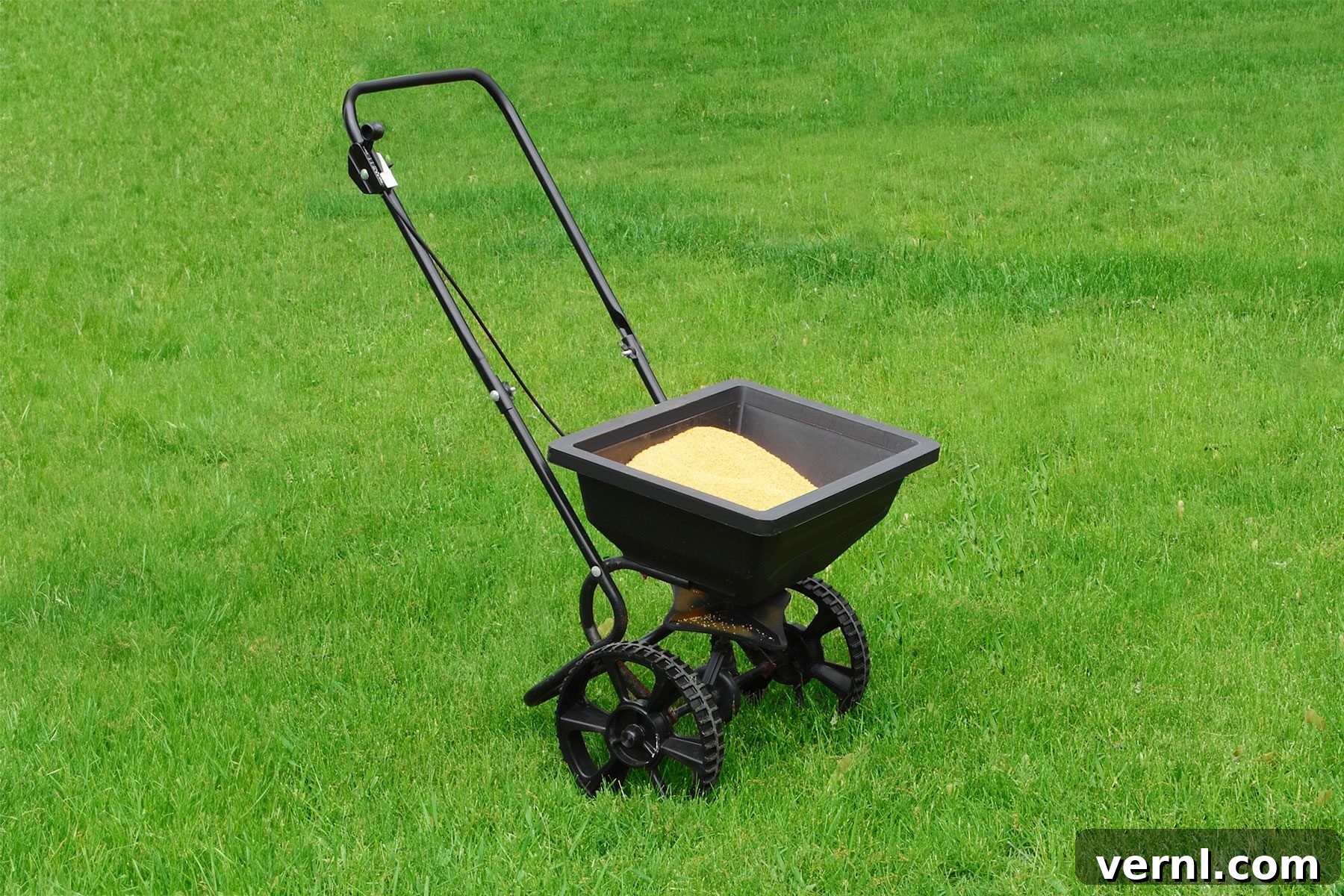
Achieving a lush, vibrant lawn is a dream for many homeowners, but it’s a goal that demands a significant investment of hard work, precise knowledge, impeccable timing, and often, a little help from favorable weather conditions. Beyond the basic chores, it involves the careful and consistent application of essential lawn products such as grass seed, nutrient-rich soil builders, and specialized fertilizers. Each of these products comes with its own specific application requirements and recommended spread rates. Applying too much can lead to costly waste and potentially harm your lawn, causing burns or chemical imbalances, while applying too little will render the effort ineffective, failing to deliver the desired results.
This is where a high-quality broadcast spreader becomes an indispensable tool in your lawn care arsenal. Designed to distribute granular products evenly and accurately, the right model allows you to deliver precisely the recommended volume for your lawn size. The key lies in selecting a spreader that offers adjustable spread rate settings, ensuring uniform application across the left, center, and right sections of its dispersal pattern. Such precision is crucial for a consistently healthy and attractive lawn.
Broadcast spreaders are not only effective but also reasonably priced and readily available at most garden centers, home improvement stores, and online retailers. Understanding how to use your grass seed or fertilizer spreader effectively can dramatically transform your lawn care routine, saving you time, minimizing product waste, and ultimately cultivating a more beautiful and resilient lawn. This comprehensive guide will walk you through everything you need to know to master your broadcast spreader.
What Is a Broadcast Spreader?
Often referred to simply as a “broadcaster” or rotary spreader, a broadcast spreader is a mechanical device designed to distribute granular materials over a wide area. Its primary function is to efficiently spread substances like grass seed, lawn fertilizer, ice melt, lime, and even pest control granules. These versatile tools are particularly well-suited for covering larger properties, typically yards exceeding 4,000 square feet, where manual application would be impractical and uneven. Their design ensures a broad and relatively quick application, making them a favorite among homeowners and professional landscapers alike for tasks requiring widespread coverage.
How Does a Broadcast Spreader Work?
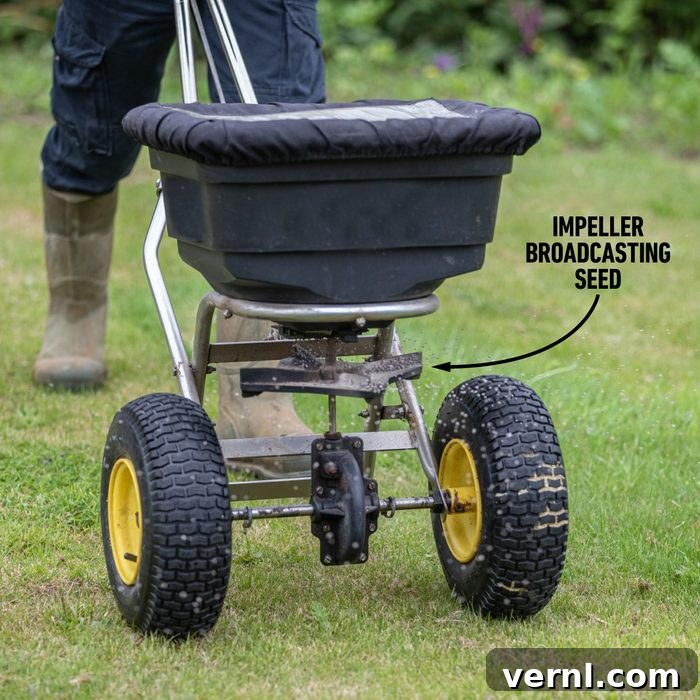
The operational principle behind a broadcast spreader is both ingenious and straightforward. As you push the spreader across your lawn, one of its wheels is engaged in a geared mechanism. This drive wheel rotation powers a whirling impeller plate, located directly beneath the hopper. The hopper, which holds the granular material (your “payload”), has an adjustable opening at its base controlled by a shutoff plate.
When the shutoff plate is opened, the granular material drops from the hopper onto the spinning impeller plate. The fins on this plate then powerfully throw the material outwards in a wide, approximately 180-degree arc. The width of this spread pattern, typically ranging from 7 to 11 feet, is influenced by several factors: the specific granular size of the product you’re applying, the design and speed of the impeller, and most importantly, your consistent walking speed. A consistent pace ensures a consistent and even throw, crucial for preventing patchy coverage. This efficient mechanism allows for rapid coverage of large areas, making light work of what would otherwise be a labor-intensive and time-consuming task.
Broadcast Spreaders vs. Drop Spreaders
While both broadcast and drop spreaders are push-powered workhorses commonly used for granular lawn product application, they differ significantly in their spreading mechanisms and ideal use cases. Understanding these differences is key to choosing the right tool for your specific lawn care needs.
What’s a Drop Spreader?
A drop spreader operates on a much simpler principle: it literally “drops” a trail of material directly beneath its hopper. The width of this trail is precisely the width of the spreader’s hopper, typically less than 24 inches. This controlled, narrow application makes drop spreaders ideal for specific scenarios. They excel on small lawns where precision is paramount, or in yards with intricate landscaping featuring numerous flowerbeds, winding sidewalks, patios, or other obstacles that require careful control over the spread pattern. Because the material falls directly down, there’s minimal risk of scattering product onto unwanted areas.
However, this precision comes with its own set of challenges. To achieve full and even coverage with a drop spreader, you must be exceptionally meticulous about lining up adjacent passes. Any slight misalignment can result in areas where the payload is laid too thick (leading to over-application, potential burns, or clumping) or, conversely, areas that are completely missed. This often results in visible striping on the lawn, compromising the uniform appearance you’re striving for. Covering large areas with a drop spreader is also significantly slower and more labor-intensive, as it requires many more passes compared to a broadcast spreader.
Shared Features and Key Differences
Despite their distinct spreading patterns, both types of spreaders share fundamental components. At the heart of each is a robust hopper designed to hold granular materials. Beneath the hopper, adjustable holes allow for the controlled release of the product. A finely calibrated gauge, typically mounted on the spreader’s handlebar, enables you to accurately set the size of these holes according to the recommended settings often found on bags of lawn products. This ensures that the proper volume of material uniformly exits the hopper.
Additionally, both types feature a flow lever. This lever provides crucial control over the application process, allowing you to open and close a plate located under the hopper holes. This mechanism prevents product from spilling when not in motion and allows you to initiate or stop the flow precisely. The primary distinction, however, lies in *how* the material is distributed after it leaves the hopper. A drop spreader releases it straight down, creating a narrow band, while a broadcast spreader uses a spinning impeller to project the material outwards in a wide arc. Choosing between the two ultimately depends on the size and complexity of your lawn, as well as the specific level of precision required for the task at hand.
How to Use a Broadcast Spreader for Optimal Results
Whether you’re reseeding your lawn to repair bare spots or simply applying routine maintenance treatments like fertilizer, the overarching goal when operating a broadcast spreader is to achieve consistent, even dispersal at the correct concentration. This precision ensures healthy growth, prevents damage, and maximizes the effectiveness of your lawn products.
Find the Right Setting and Test the Dispersal Pattern
Before you even step onto your lawn, accurately setting your spreader and understanding its unique dispersal pattern is critical. Begin by dialing in the product manufacturer’s recommended setting onto your spreader’s rate gauge. However, these settings can sometimes be generic, so it’s essential to perform a personal test.
Conduct your dispersal pattern test in a clear, flat, and hard-surfaced area, such as your driveway or a concrete patio. Ensure the area is swept clean of any dirt or debris that could interfere with your observation. With a broadcast spreader, you’ll notice that the right side of the dispersal pattern often extends a foot or two wider than the left. This is a common characteristic of their design. Use this test to establish the specific pattern you’ll use to push the spreader across your yard, aiming for total coverage with a slight overlap—typically 6 inches to 1 foot—between passes. To avoid forgetting these crucial measurements, jot down the “wide side” and “narrow side” distances on a piece of masking tape and affix it to the back of the hopper. This visual reminder will be invaluable during application.
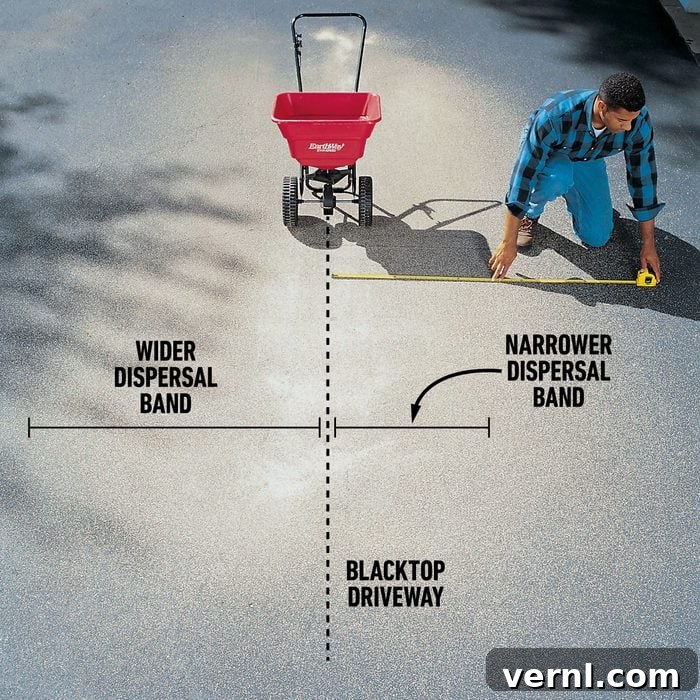
Important Safety Note: Never sweep, blow, or wash any of the test material into the street or storm drains. This can lead to environmental contamination. Always sweep it up carefully and return it to the hopper for proper use or disposal.
If the product you’re using doesn’t list a recommended setting for your specific spreader model, consult your spreader’s owner’s manual for generic equivalents or a guide to calculating settings. Alternatively, you’ll need to rely on a controlled trial-and-error approach. Start by setting the spreader to a very light coverage (e.g., a 1/4-inch to 3/16-inch opening in the hopper). Apply the product over a known square footage area. Then, check how much product remains in the hopper. Adjust the dial to spread the remaining material over the same area, making passes perpendicular to your initial pattern. This iterative process helps you fine-tune the setting for optimal coverage. Patience and careful observation during this step will prevent costly mistakes and ensure effective treatment.
Start Spreading Product on Your Lawn
Once your spreader is correctly set, you’re ready to begin. A smart strategy is to start your yard pattern by spreading across any hilly or uneven terrain first. The reason for this is practical: having a fuller hopper provides more consistent pressure for material flow, which helps reduce “skipping” or inconsistent application over irregular surfaces. Always fill your hopper on a hard surface, like a driveway, rather than directly on the lawn, to contain any spills and prevent concentrated patches of product that could damage your grass.
Keep a Steady Pace
Maintaining a consistent walking speed is one of the most critical factors for achieving even coverage with a broadcast spreader. Aim for a moderate, steady pace, similar to what you’d use for a brisk walk—approximately 3 miles per hour. Your walking speed directly impacts both the width of the throw and the density of the product applied. Walking too slowly will reduce the throw width and increase the product density in the applied area, potentially leading to over-application and “striping.” Conversely, walking too fast will thin out the coverage, resulting in insufficient application and patchy results. Practice maintaining a uniform pace before you start, using visual markers to help you stay consistent.
Stopping and Turning
Precise control over the product flow is essential, especially when stopping or making turns. Each time you’re about to stop or change direction, it’s crucial to close the flow lever on your spreader. Continue walking for approximately one more stride after closing the lever. This allows any residual material on the impeller to be fully dispersed before you come to a complete halt or begin your turn. This technique drastically reduces waste and, more importantly, prevents damaging your lawn from oversaturation or concentrated product buildup that can cause burns. Similarly, avoid pulling the spreader backward when the flow lever is open, as this will disproportionately release more product in one spot, leading to uneven distribution.
Keep the Spreader Level
For uniform distribution, it’s imperative to operate your broadcast spreader, keeping the impeller plate as close to level as possible. Tilting the handlebar up or down from a level position will alter the trajectory of the thrown product. Tilting it too high will cause the product to fly higher and potentially farther, but with less density directly beneath, while tilting it too low will result in a shorter, denser spread. Both scenarios lead to uneven coverage, manifesting as lighter or darker green streaks in your lawn. Be mindful of your posture and how you’re holding the spreader to ensure consistent application.
Don’t Overdo It!
Perhaps the most vital piece of advice for any lawn care application is to strictly adhere to the recommended coverage rates for each product, especially when dealing with fertilizers and weed killers. Overuse and overapplication are not only wasteful but can also have severe consequences. Excess chemicals can “burn” your lawn, leaving unsightly brown patches. Furthermore, over-applied products often lead to runoff that contaminates lakes, streams, and groundwater, harming aquatic ecosystems and potentially impacting drinking water sources. Always read product labels thoroughly and use appropriate personal protective equipment, such as gloves and a nuisance dust mask, when handling chemical lawn products containing pesticides and herbicides, to safeguard your health and the environment.
Optimal Broadcast Spreader Pattern for Your Lawn
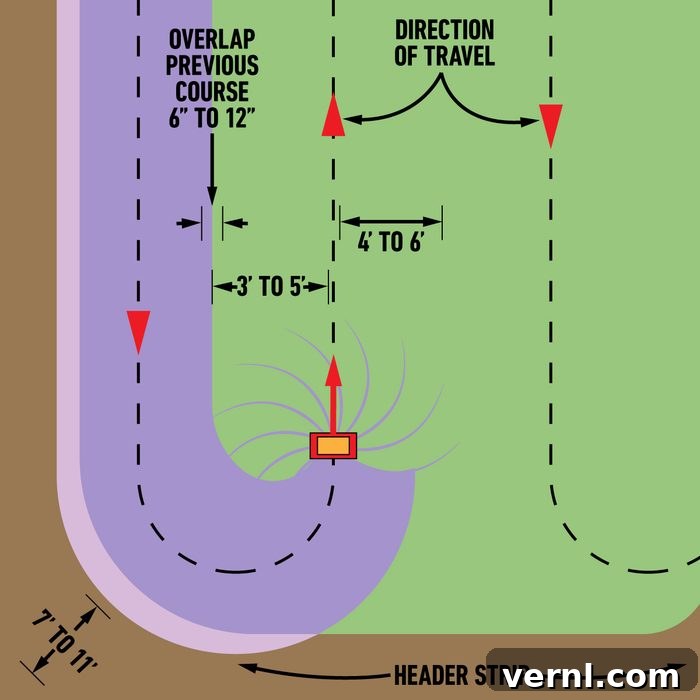
To achieve the most uniform and effective coverage with your broadcast spreader, follow this optimal application pattern:
Establishing the Header Strip
Begin by applying a “header strip.” This involves circling the spreader once around the entire perimeter of your yard. This creates a clear boundary and provides a buffer zone for your subsequent passes. When walking along the perimeter, be mindful of adjacent flowerbeds, gardens, or paved areas. To avoid throwing material into these unwanted zones, position the spreader back from those areas by the distance your initial driveway test showed as the “narrow side” of your throw pattern. This technique ensures that your product lands precisely where it’s intended.
Executing the Serpentine Route
Once the header strip is complete, proceed to cover the main body of your lawn using a serpentine route. Push the spreader back and forth in the longest practical direction across your lawn. This strategy minimizes turns and optimizes efficiency. During each pass, ensure you overlap the throw patterns by approximately one foot. This overlap is crucial; it compensates for the feathered edges of the broadcast pattern and guarantees that every inch of your lawn receives an even application, preventing missed spots or “striping.”
Turning and Flow Control
As you approach the end of each row and near the header strip, shut off the flow lever when the spreader is within approximately 5 feet of the perimeter. Keep the lever off throughout your turn to prevent product dumping and waste. Once you’ve completed the turn and are ready to begin the new row in the opposite direction, reopen the flow lever precisely as you start moving forward. This precise control over the flow ensures that product is only dispersed while the spreader is in motion and in the intended areas, contributing to a consistently healthy and beautiful lawn.