
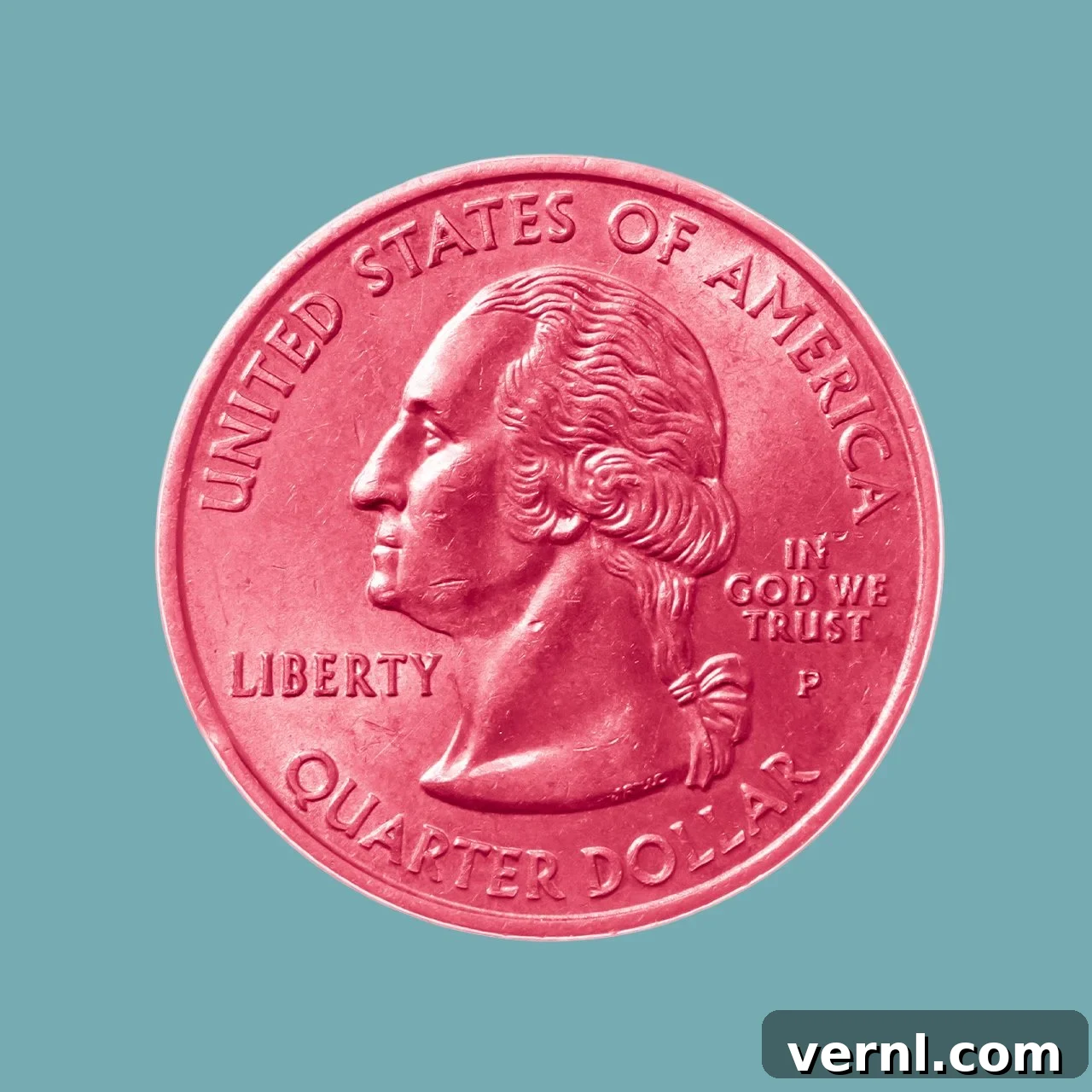
There are many curious details hidden in United States coinage, and red-painted quarters are one of the more intriguing examples. At first glance, a quarter with red paint across George Washington’s portrait looks like a careless stain. In many cases, however, that red mark was intentionally applied for a practical reason.
Often called “red quarters,” “house coins,” or “shill coins,” these marked quarters were particularly common in the mid-20th century. Below is a clear explanation of why businesses painted quarters red, where and how they were used, whether such coins carry extra value for collectors, and what to check before setting a red quarter aside.
Why Businesses Painted Quarters Red
Businesses marked quarters with red paint so staff could quickly identify coins that belonged to the establishment rather than to customers. The simplest purpose was inventory control: when employees emptied coin-operated machines, the marked coins were easy to pick out and return to the business instead of being mixed in with customer payments.
Jukeboxes provide one of the best-known examples. A bar, diner, or restaurant could drop a marked quarter into a jukebox to play a selection. Later, when the machine was emptied, the painted quarter stood out and could be removed and reused by the business. This prevented paying customers’ coins from being consumed as employee tests or promotional plays.
Arcades and laundromats used the same practice. Arcade operators and maintenance staff would use marked quarters to test games or trigger payouts without using customers’ money. In laundromats, technicians or attendants could run a test cycle on a washer or dryer with a house coin, or compensate a customer with an extra cycle using a marked quarter when a machine malfunctioned.
Red paint showed up clearly on the silver or copper-nickel surface of a quarter, which is why it was commonly chosen. Contemporary accounts and oral histories often mention red nail polish as a readily available marking medium. That said, businesses did not follow a single universal system: some used different colors or marking methods, so the presence of paint alone does not identify a specific business or location.
Are Red-Painted Quarters Worth More Than Regular Quarters?
In most cases, red paint does not increase a quarter’s monetary value. A painted quarter typically remains worth face value—25 cents—unless there is another factor that makes the coin collectible or intrinsically valuable.
The most significant value drivers for Washington quarters are date, mint mark, metal composition, and condition. Quarters dated 1964 and earlier were struck in 90% silver, which gives those pieces intrinsic precious-metal value above face value. Beginning in 1965, quarters were produced with a copper-nickel clad composition. Therefore, when you find a painted quarter, the first step is to check the date and mint mark.
Cleaning or attempting to remove the paint is strongly discouraged. Improper cleaning can damage a coin’s surface, remove original patina, scratch the metal, and reduce any numismatic value. For older silver quarters or coins that appear to have collectible potential, leaving the coin in the condition in which it was found and consulting a reputable coin dealer or grading service is the safest approach.
Collectors sometimes value painted or marked coins for their historical context—stories of jukeboxes, arcades, and laundromats—but that interest is distinct from intrinsic numismatic worth. Unless a painted quarter is also a scarce date, has an unusual mint error, or contains silver, the paint itself is typically more of a historical curiosity than a premium feature.
How to Evaluate a Red Quarter
- Check the date: If the quarter dates to 1964 or earlier, it may have silver content and could be worth more than face value.
- Look for mint marks: Certain mint marks and specific dates can be more desirable to collectors.
- Avoid cleaning: Do not scrub the paint off; cleaning can irreversibly harm the coin.
- Consult an expert: If the coin appears old, unusually well-preserved, or shows signs of mint errors, have it evaluated by a reputable coin dealer or grading service.
- Consider provenance: The paint can offer clues about the coin’s past use in jukeboxes, arcades, or laundromats, which can be interesting but not necessarily lucrative.
For most red-painted quarters, the painted mark is a practical relic of past business practices rather than a signal of higher monetary value. These coins tell small but vivid stories about how coin-operated machines were tested, serviced, or managed decades ago. If you find a red quarter in circulation or tucked away in a drawer, a quick date check will usually tell you whether it is merely a curious artifact or a coin worth investigating further.
Sources
- U.S. Mint, “Quarter”
- U.S. Mint, “Historic Coin Production”
- American Numismatic Association, “Coin Collecting FAQs”
- The E-Sylum, “The Mystery of the Red Quarters”
- APMEX, “Why Are Some Quarters Painted Red?”