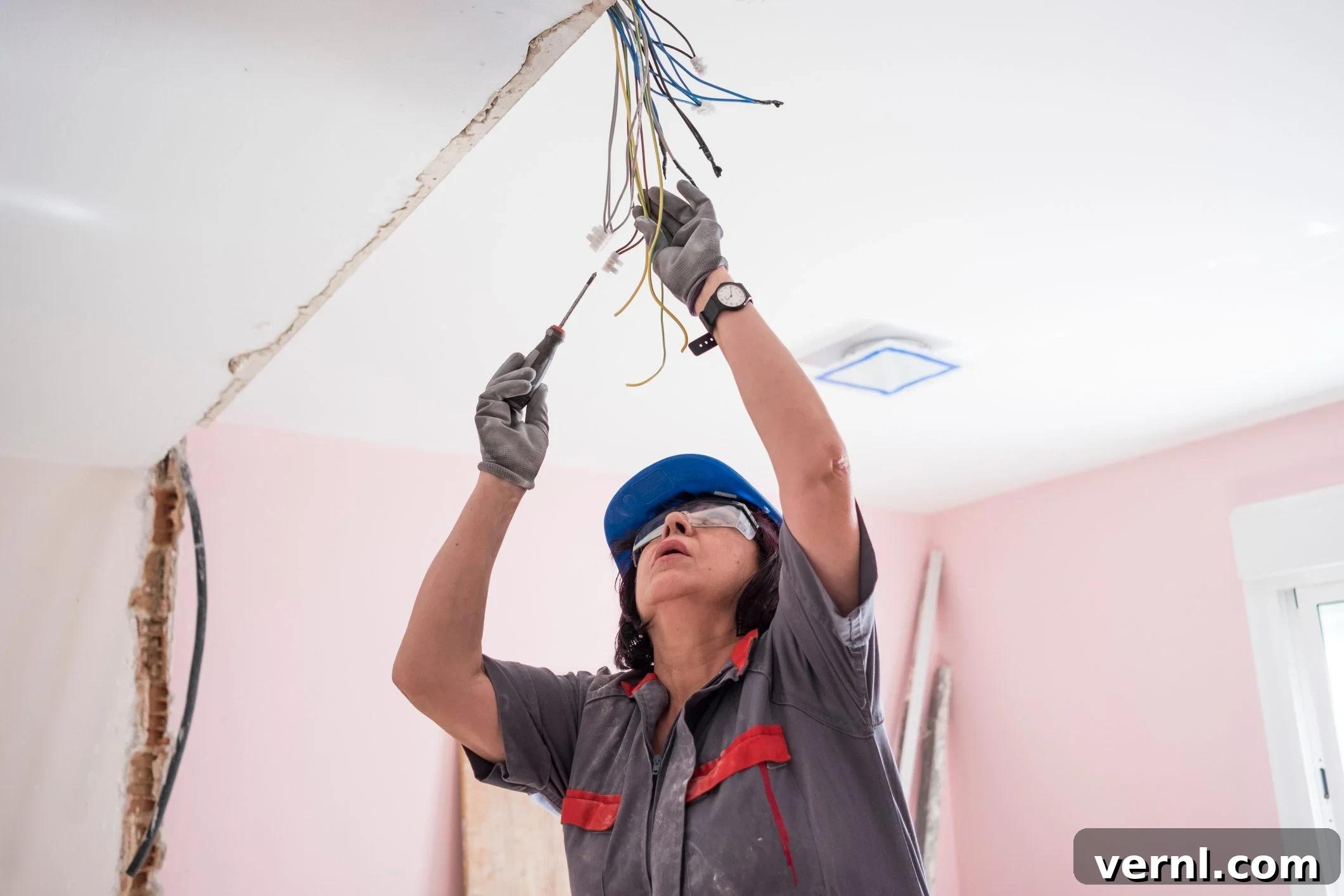
Even in an era dominated by advanced wireless technology, a safe, reliable, and robust wired electrical system remains the foundational backbone of every modern home. It continuously supplies the essential power for our everyday appliances, sophisticated electronic equipment, vital heating and cooling systems, and countless other conveniences that define contemporary living. As our reliance on electricity grows, the integrity and capacity of your home’s wiring system become paramount.
If your home’s existing electrical infrastructure is showing signs of age, struggling to meet modern demands, or simply no longer complies with current safety standards, it might be the opportune moment to consider a comprehensive rewiring project – or at least targeted upgrades in specific areas. While the complexity of such a task often necessitates the expertise of a licensed electrical contractor, understanding the scope and challenges involved empowers you to be an informed and active participant throughout the process. The duration of this significant home improvement can vary widely, potentially ranging from a swift day or two for minor updates to several weeks for extensive overhauls, largely depending on the original construction period of your residence and the extent of the work required.
This detailed guide will walk you through the era-specific considerations and common electrical challenges you might encounter when rewiring a house. By understanding what to anticipate based on your home’s age, you can better prepare for the project, communicate effectively with your electrical professional, and ensure your home’s electrical system is not only safe but also perfectly equipped for the future.
Home Electrical Rewiring and Upgrades by Era
Rewiring and Upgrading a House Built in the 1990s to Present

Homes constructed from the 1990s onward generally boast a significantly more robust and modern electrical infrastructure compared to their older counterparts. If your residence falls within this build period, your existing electrical system is likely in relatively good condition, adhering to more contemporary safety and capacity standards.
Typically, these homes feature a substantial electrical service panel, often rated at 100-ampere, 200-ampere, or even a robust 400-ampere capacity, providing ample power for a wide range of household needs. You’ll likely find a generous number of branch circuits dedicated to general-purpose lighting and receptacle outlets, ensuring adequate power distribution throughout the home. Furthermore, modern code requirements mean you’ll have specific 20-ampere circuits in high-demand areas like the kitchen, alongside dedicated circuits for essential spaces such as bathrooms, laundry rooms, garages, major appliances (like ovens and dryers), and heating and cooling systems. These dedicated circuits are crucial for preventing overloads and enhancing safety.
You can also expect wall switch-controlled lighting in all habitable spaces, stairways, basements, and other key locations, contributing to both convenience and safety. While homes from this era generally have a good supply of receptacle outlets in every room, the ever-increasing number of electronic devices and gadgets often leaves homeowners wishing for just a few more!
Despite their inherent modernity, even homes from this period can benefit from strategic electrical updates to enhance safety, efficiency, and functionality:
- Install Additional Circuits and Receptacle Outlets: As our digital lives expand, so does the demand for power. Adding additional circuits and receptacle outlets is a common and highly beneficial upgrade, particularly for dedicated home offices, elaborate entertainment spaces, or smart home hubs. This prevents overloading existing circuits and ensures stable power for all your devices.
- Implement Whole-House Surge Protection: Protect your substantial investment in expensive electronics and smart home devices with whole-house surge protection. This crucial safeguard defends against voltage spikes that can originate from lightning strikes, utility grid fluctuations, or even large appliance cycling within your home, potentially saving you thousands in repair or replacement costs.
- Upgrade to Tamper-Resistant Receptacles: For enhanced child safety, especially if you have young children or frequent visitors, replacing standard duplex receptacles with tamper-resistant (TR) ones is a smart choice. These outlets feature internal shutters that prevent the insertion of foreign objects, significantly reducing the risk of electrical shock.
- Install Advanced AFCI and GFCI Protection: While your home likely has some GFCI protection, consider upgrading to the latest arc-fault circuit-interrupter (AFCI) and ground-fault circuit-interrupter (GFCI) technology. AFCI protection offers advanced fire safety by detecting and interrupting dangerous electrical arcs that can lead to fires. GFCI protection guards against severe electrical shock by rapidly shutting off power when it detects a ground fault. Integrating these technologies throughout your home provides maximum fire and life safety protection.
- Modernize Lighting with LED Technology: Replace outdated incandescent or fluorescent lighting fixtures with energy-efficient and long-lasting modern LED lighting solutions. LEDs consume significantly less energy, have an extended lifespan, and offer versatile lighting options. Pro tip: Explore LED recessed can lighting retrofit kits, which can be easily installed from below the ceiling, eliminating the need for extensive drywall work.
- Prepare for Electric Vehicles: With the growing popularity of electric vehicles, installing dedicated electric-vehicle charging equipment is a forward-thinking upgrade that adds significant convenience and value to your home.
- Address Unpermitted Wiring: Have a professional electrician inspect and correct any unpermitted and/or uninspected wiring installations that may have been improperly performed by previous owners. This ensures all work meets safety codes and prevents potential hazards.
Rewiring and Upgrading a House Built in the 1970s Through 1980s

Homes constructed during the 1970s and 1980s represent a transitional period in electrical code evolution. While they generally feature more advanced systems than homes from earlier decades, a complete rewiring is often not necessary. These residences typically boast 100-ampere or 200-ampere service panels equipped with modern circuit breakers, a significant upgrade from older fuse panels. You’ll likely find dedicated circuits for high-demand areas such as the kitchen and laundry room, designed to handle the power requirements of major appliances. Furthermore, this era saw the widespread adoption of Ground-Fault Circuit Interrupter (GFCI) protection on receptacles installed in wet or outdoor locations, including garages, bathrooms, near kitchen sinks, and for amenities like hot tubs and hydromassage bathtubs. For outdoor installations, such as those for hot tub wiring, proper GFCI protection is absolutely critical for safety.
Beyond the general electrical improvements applicable to all homes (as discussed in the 1990s section, such as adding AFCI protection or LED lighting), there is one particularly crucial consideration for homes built in this specific timeframe: identifying the type of wiring used. It is imperative to determine if your home was wired with aluminum cable, rather than the more common and generally safer standard copper, nonmetallic-sheathed cable. A qualified and licensed electrical contractor is best equipped to perform this assessment and identify any aluminum wiring present.
If your home is indeed found to have aluminum wiring, it does not automatically necessitate a complete and expensive rewiring project. The primary concern with aluminum wiring stems from its properties, which can lead to specific hazards over time. Aluminum has a higher rate of thermal expansion and contraction compared to copper, and it is more susceptible to oxidation at connection points. These factors can cause connections at receptacle outlets, light switches, fixtures, and appliances to loosen and corrode. Loose or corroded connections create increased electrical resistance, which in turn generates excessive heat. This overheating at connection points presents a serious fire hazard.
An experienced electrical contractor will meticulously inspect these connection points for signs of corrosion, scorching, or loose terminals. Fortunately, there are several approved and effective devices, connectors, and methods available today to safely mitigate the risks associated with aluminum wiring without the need for a full rewiring. These solutions often involve installing specialized connectors that provide a stable, long-lasting transition from aluminum to copper wire at each termination point, thereby making existing aluminum connections safe and compliant. Addressing aluminum wiring proactively is a critical safety upgrade for homes from this era.
(For more in-depth information on aluminum cable and its remediation, you can visit the Consumer Product Safety Commission website and search for “aluminum wiring.”)
Rewiring and Upgrading a House Built in the 1950s Through 1960s
Homes built during the flourishing post-World War II housing boom of the 1950s and 1960s benefited from significant advancements in electrical technology and safety standards. This era marked a shift towards more standardized and safer wiring practices. Key innovations included the widespread adoption of nonmetallic-sheathed cable (often referred to as Romex), which offered vastly improved wire insulation and, critically, began to include a bare equipment grounding conductor. This grounding wire was a monumental step forward in electrical safety, providing a safe path for fault currents and reducing shock hazards.
The installation process also became more efficient with the introduction of thermoplastic twist-on wire connectors, which greatly simplified the splicing of wires within junction boxes. Furthermore, this period saw the standardization of spacing requirements for receptacle outlets in habitable rooms, a practice that largely remains consistent today, ensuring a more convenient and functional distribution of power. Most notably, the mid-century saw three-prong grounding-type receptacle outlets become mandatory, replacing the ungrounded two-prong outlets and providing a vital safety feature for appliances and electronics.
While these advancements were significant, homes from the 1950s and 1960s often still require substantial electrical upgrades to meet the demands of modern living and current safety codes. In addition to the general improvements mentioned in previous sections (like advanced AFCI/GFCI protection and LED lighting), here are a few critical areas you may need to address:
- Upgrade the Service Panel Size: This is often the most significant electrical project for homes of this age. Many homes from the 50s and 60s were equipped with 60-ampere or 100-ampere service panels, which are often insufficient for today’s power-hungry households. Upgrading to a modern 200-ampere or higher capacity panel is a major undertaking best entrusted to a licensed electrical contractor. This project typically involves costs of $1,500 or more and requires close coordination with your local electric utility company. The benefits are numerous: it replaces outdated, often undersized fuse panels with modern, safer circuit breaker panels, significantly increases the overall electrical capacity to support additional branch circuits, and allows for the installation of crucial AFCI and GFCI circuit breakers for enhanced safety. Beyond immediate safety and functionality, a service panel upgrade adds considerable value to your home and can satisfy requirements mandated by insurance and mortgage companies.
- Replace Two-Prong Receptacle Outlets with Properly Grounded Three-Prong Outlets: The presence of ungrounded two-prong outlets is a common issue in homes from this era. Replacing these with properly grounded three-prong receptacle outlets is vital for safety, as it allows modern appliances and electronics to utilize their grounding pins, preventing shock hazards. This upgrade will likely involve more than just swapping out the outlet; it often means replacing the original electrical boxes in the wall, which are frequently too small to accommodate the larger dimensions of modern three-prong duplex receptacle outlets, GFCI or AFCI devices, and contemporary lighting controls or dimmer switches. Proper grounding must be extended to these new outlets, often requiring new wiring runs.
- Add Branch Circuits to Comply with Today’s Code: Early electrical systems were designed for far fewer appliances. There was a time when an old 60-amp fuse panel might only supply three to five general-purpose lighting and receptacle circuits for an entire house, perhaps with one or two 240-volt circuits for an electric range or water heater. However, modern homes have vastly greater electrical demands. The National Electrical Code (NEC) outlines the minimum requirements for safety and functionality. Today, it mandates at least two 20-amp small-appliance circuits specifically for kitchen counter receptacles, at least one 20-amp circuit for laundry receptacles, at least one 20-amp circuit for bathroom receptacles, and at least one 20-amp circuit for garage receptacles. Crucially, all these are dedicated circuits, meaning they cannot be used for lighting or additional outlets. Beyond these dedicated circuits, you will also likely need to add more general-purpose circuits to adequately power the rest of your home, preventing overloaded circuits and tripped breakers.
Rewiring and Upgrading a House Built in the Early 1900s Through 1940s

For homes constructed during the early 20th century, specifically from the early 1900s through the 1940s, the list of potential electrical improvements and necessary safety upgrades lengthens significantly. These venerable properties often harbor a legacy of original wiring methods that are critically inadequate and potentially hazardous by today’s standards. Upgrading the electrical system in such a home is not merely about convenience; it is fundamentally about ensuring the safety and longevity of the property and its occupants.
In the nascent days of home electrification, concealed knob-and-tube (K&T) was the predominant, and often the only, wiring method available. This system involved individual, insulated copper wires routed through porcelain knobs and tubes, meticulously installed within the hollow spaces of walls, ceilings, and floors. K&T wiring relied on air circulation for cooling, with individual wires separated to prevent heat buildup.
The 1930s brought about a pivotal advancement with the invention of cable-type wiring methods. This innovation saw insulated wires enclosed within a protective outer metallic or nonmetallic sheath, dramatically improving safety by containing potential faults and significantly reducing installation costs. This quickly became the new standard. However, a critical issue arose in the 1970s during the energy crisis, which spurred widespread efforts to insulate older homes. Consequently, blown-in insulation or batting was often installed, filling the very hollow spaces where knob-and-tube wiring was designed to breathe. When K&T wiring is encapsulated in insulation, it loses its ability to dissipate heat, leading to dangerously high temperatures that can degrade the wire’s brittle insulation and create a severe fire hazard. Furthermore, K&T wiring lacks a grounding conductor, a fundamental safety feature in modern electrical systems.
Updating and rewiring homes from this time period typically involves much more extensive work, higher costs, and a comprehensive approach. The key things that almost certainly need to be done include:
- Replace All Existing Wiring: Older homes frequently possess a patchwork of wiring from various eras, including the original knob-and-tube, early forms of armored cable (BX), or even lead-sheathed cable. Due to the inherent safety risks of knob-and-tube (especially when insulated), the deterioration of old insulation, the lack of grounding, and the potential for improper modifications over decades, it is rarely practical, and often unsafe, to reuse any of the existing wiring. A complete replacement of all wiring with modern, grounded, nonmetallic-sheathed cable is almost always necessary to meet current code requirements and ensure safety.
- Upgrade the Service Panel: Homes from the early 1900s to 1940s often have critically undersized electrical service, typically ranging from a mere 30-ampere to a 60-ampere capacity. This is profoundly insufficient to supply the sheer volume of appliances, electronic equipment, and modern conveniences found in a contemporary home. Furthermore, these older systems almost exclusively rely on fuse panels, which, while functional, prevent homeowners from taking advantage of the latest GFCI (Ground-Fault Circuit Interrupter) and AFCI (Arc-Fault Circuit Interrupter) circuit breaker technologies. Upgrading to a modern 200-ampere or higher circuit breaker panel is essential for providing adequate power, integrating critical safety features, and improving overall system reliability. This upgrade is foundational to any comprehensive electrical modernization.
- Add Receptacle Outlets and Lighting Throughout: A defining characteristic of homes from this era is the severe scarcity of receptacle outlets. Many rooms may only have one or two outlets – or astonishingly, none at all – requiring residents to rely heavily on unsafe extension cords and power strips. Similarly, permanent lighting fixtures are often sparse, leading to insufficient illumination and reliance on floor or table lamps. Rewiring provides the ideal opportunity to significantly increase the number of strategically placed receptacle outlets to meet modern needs and install ample, energy-efficient lighting fixtures throughout the home, enhancing both functionality and safety. This includes adding dedicated circuits for kitchens, bathrooms, and laundry areas, which were often nonexistent in original installations.
No matter the age of your home, prioritizing electrical safety and efficiency through timely upgrades or a full rewiring project is a sound investment. Always consult with a licensed and experienced electrical contractor to assess your specific needs and ensure all work is performed to the highest standards.