

Remembering Tsutomu “Tom” Matano: The Visionary Behind the Iconic Mazda Miata MX-5
The global automotive community recently mourned the passing of a true legend: Tsutomu “Tom” Matano, the brilliant mind credited with designing the original Mazda Miata MX-5. Matano, who died in September at the age of 76, leaves behind an indelible legacy that profoundly continues to shape car design and enthusiast culture across continents. Known simply as “Tom” to his legions of fans and as “MiataPapa” within the dedicated sports car community, Matano dedicated several pivotal decades to Mazda, consistently championing the philosophy of the consumer-friendly, driver-focused sports car. His passing marks the end of an era for many, yet his profound influence, perfectly embodied in the timeless Miata, continues to resonate with vibrant energy and inspiration.
This comprehensive tribute delves into the remarkable life and career of Tom Matano, exploring his pivotal role in creating one of history’s most universally beloved and commercially successful sports cars. We will examine his significant contributions to global car design trends, analyze the enduring relevance and cultural impact of the Miata within passionate car communities, and trace how his innovative vision fundamentally transformed the landscape of accessible performance vehicles. Matano’s unwavering dedication to simplicity, balance, and the pure joy of driving not only gifted the world the Miata but also ignited a widespread movement, unequivocally proving that an exhilarating and authentic driving experience doesn’t require a prohibitive price tag or overwhelming technological complexity.
The Genesis of a Legend: Crafting the Mazda Miata MX-5
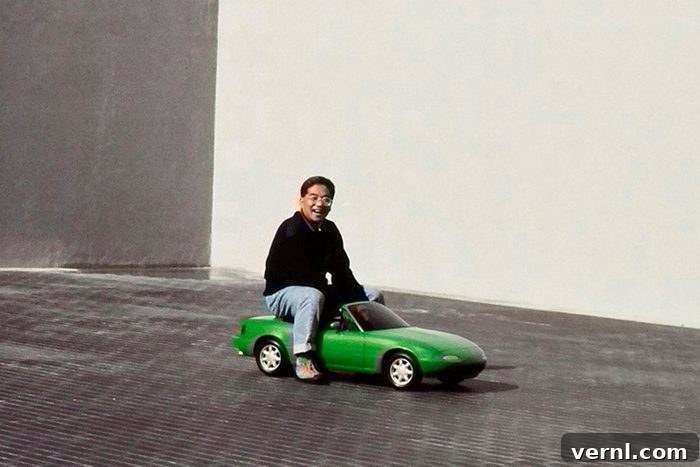
Tom Matano’s journey to becoming the visionary architect of the Miata was forged through a rich and diverse career, during which he meticulously honed his design skills at esteemed automotive giants such as BMW and General Motors. These invaluable experiences provided him with a unique and potent blend of European design sophistication, often characterized by precision engineering and driver focus, coupled with a deep understanding of American mass-market appeal and consumer preferences. When Matano arrived at Mazda’s burgeoning design studio in Irvine, California, in the late 1980s, he joined a talented team that was already poised to dramatically redefine the global sports car segment. The overarching objective was ambitious yet elegantly straightforward: to meticulously craft a lightweight, utterly fun-to-drive vehicle that brilliantly recaptured the quintessential essence of classic British roadsters – iconic cars like the MGB, Triumph Spitfire, and Lotus Elan – but crucially, without their notorious historical drawbacks of questionable reliability, often high maintenance demands, and frequently leak-prone, temperamental designs. Mazda’s mission, spearheaded by Matano, was to distil the unadulterated joy of open-top motoring into a modern, inherently dependable, and remarkably affordable package accessible to a broader audience.
The automotive market of the late 1980s, particularly in the United States, presented a curious and noticeable void. High-performance sports cars were increasingly becoming more complex, significantly more expensive, and often heavier, gradually drifting away from the fundamental purity and simplicity of earlier, more engaging designs. The concept of an accessible, lightweight, and genuinely driver-focused roadster seemed to have been largely forgotten or relegated to niche manufacturers. Mazda, with Tom Matano at the creative helm of their influential California studio, astutely recognized this vast, untapped potential. They envisioned a car that would explicitly prioritize driver engagement and tactile feedback over brute horsepower figures or excessive straight-line speed; a machine meticulously designed from the ground up to connect with its driver on an extraordinarily emotional and visceral level. This profound design philosophy would later be eloquently encapsulated by the revered Japanese concept of “Jinba Ittai,” which translates to “horse and rider as one” – a guiding principle that permeated every single aspect of the Miata’s conceptualization, engineering, and eventual development.
What ensued after Matano’s arrival was an intense and highly competitive period of internal creative brainstorming among various Mazda design teams situated across the globe. Each team was given the challenging task of conceptualizing the company’s next great sports car, encouraged to push conventional boundaries and explore diverse aesthetic and engineering possibilities. Ultimately, it was the California team, operating under Matano’s inspired leadership and in close collaboration with the Miata’s co-progenitor, Bob Hall (who initially pitched the audacious idea to Mazda’s R&D chief Kenichi Yamamoto way back in 1979), that submitted the winning proposal. Their collective vision coalesced into what would soon be famously unveiled as the Miata MX-5. The design was, from the very first glance, instantly captivating: characterized by sleek, uncluttered lines, perfectly compact dimensions, and an inherently balanced chassis that promised nimble handling. Crucially, it ingeniously packaged genuine rear-wheel-drive sports car thrills into an incredibly convenient, approachable, and remarkably affordable form factor. This innovative approach was precisely the refreshing antidote the evolving market desperately needed, and exactly what Mazda was looking for—a car that could be simultaneously exhilarating to drive and utterly reliable, standing in stark contrast to its often temperamental and high-maintenance British predecessors.
The public’s reception upon the Miata’s highly anticipated debut in 1989 was nothing short of ecstatic and overwhelmingly positive. Automotive journalists, who were often accustomed to evaluating increasingly sophisticated and prohibitively costly machines, were universally captivated by its refreshing simplicity, its undeniable purity, and its sheer, unadulterated driving pleasure. A particularly vivid review from Car and Driver magazine eloquently captured this widespread sentiment, expressing an almost uncontrollable enthusiasm: “There’s no use trying to hide our enthusiasm for this car,” the editor effused. “No way we can keep the envelope sealed until the end of this critique. You see, the Miata fairly glows with the automotive ideals that this magazine holds dear—exciting looks, fun to drive, sensible ergonomics, quality construction, fun to drive, refined mechanicals, affordable price, and—did we forget to mention?—fun to drive. We feel like cheering.” This glowing endorsement was not merely journalistic hyperbole; it genuinely reflected a widespread and profound recognition that Matano and his exceptionally talented team had tapped into something truly fundamental about the intrinsic joy of driving. The Miata delivered an unadulterated, tactile, and deeply engaging experience, conclusively proving that a car didn’t necessarily need hundreds of horsepower to be thrilling; it simply needed to be perfectly balanced, light on its feet, and inherently engaging to the driver.
Tom Matano’s Enduring Influence on Global Car Design Trends
The Mazda MX-5 Miata was far more than just a commercial success; it rapidly evolved into a cultural phenomenon that profoundly reshaped the entire automotive landscape. Its immediate and massive hit status, particularly evident in the United States, sent an unequivocal and powerful message to automakers worldwide: there existed an enormous, previously underserved appetite for entry-level sports cars among a broad and diverse demographic of drivers. Before the Miata’s arrival, the market for truly affordable, pure sports cars had largely dwindled, either being replaced by less engaging front-wheel-drive coupes or by increasingly expensive, high-performance machines that were out of reach for the average enthusiast. Matano, Bob Hall, and their ingenious team didn’t just design a revolutionary car; they effectively resurrected and brilliantly redefined an entire automotive segment, breathing vital new life into the timeless concept of accessible performance.
The Miata’s resounding triumph ignited a transformative trend that continues to influence the industry robustly to this very day. Its core philosophy – encompassing lightweight construction, impeccably balanced handling, classic rear-wheel-drive dynamics, and an unwavering emphasis on pure driver engagement over sheer raw power – swiftly became an industry benchmark. Suddenly, other discerning manufacturers recognized the undeniable viability and significant demand for such inherently driver-focused vehicles. Cars like the iconic Toyota GR86 (and its highly popular Subaru BRZ sibling), the sophisticated BMW Z3, and the prestigious Porsche Boxster all undeniably followed in the Miata’s meticulously paved tire tracks. These diverse vehicles, while perhaps targeting slightly different price points or performance tiers, share a common, fundamental DNA with Matano’s groundbreaking creation: they universally prioritize agility, responsive steering, and a direct, unadulterated connection between driver and road, thereby making truly exhilarating driving accessible to an even wider and more diverse audience. The Miata unequivocally proved that a car could be practical enough for comfortable daily use, reliable enough for worry-free ownership, and thrilling enough to satisfy even the most discerning genuine enthusiasts, all while remarkably remaining within the financial reach of the average consumer.
Matano’s profound influence extended well beyond simply inspiring rival models. He meticulously instilled in Mazda a powerful design philosophy that was inherently centered on human connection and emotional response, a philosophy that continued to define the brand’s distinct identity for many years to come. His groundbreaking work on the Miata eloquently emphasized the potent “less is more” principle, focusing intently on essential driving elements rather than introducing superfluous or overly complex features. This elegant, minimalist approach to sports car design was truly revolutionary and refreshing in an era often obsessively focused on increasing vehicle size, weight, and technological complexity. By demonstrating with resounding success that simplicity could indeed be a profound virtue and a key to widespread appeal, Matano boldly challenged conventional automotive wisdom and conclusively proved that purity of purpose could lead to unparalleled and enduring success. The Miata swiftly became an exemplary template for how to build a truly enjoyable, timeless, and universally appealing sports car, effectively serving as a blueprint for seamlessly combining engaging dynamic performance with practical everyday usability.
The Miata’s enduring impact is also profoundly evident in its pivotal role as a “halo car” – a model that dramatically elevates an entire brand’s image and perception. For Mazda, the Miata quickly became synonymous with exhilaration, unwavering reliability, and innovative, emotionally resonant design. It meticulously cultivated an extraordinarily loyal and passionate global fan base and powerfully demonstrated Mazda’s exceptional engineering prowess, unequivocally showcasing their remarkable ability to create vehicles that are both deeply emotionally resonant and flawlessly mechanically sound. Tom Matano, through his foundational and visionary work on the MX-5, therefore, didn’t just design a single, successful car; in many fundamental and far-reaching ways, he ignited an entire subgenre of accessible, driver-focused sports cars and profoundly influenced how manufacturers globally approach the creation of genuinely engaging and emotionally satisfying vehicles. His enduring vision remains a guiding light for aspiring designers and seasoned engineers alike, all striving to impeccably blend aesthetic appeal with an unforgettable and deeply rewarding driving experience.
A Timeless Bond: The Enduring Love for the MX-5 and its Creator
Following the spectacular global success and highly anticipated launch of the first-generation Miata, Tom Matano continued to serve as an indispensable driving creative force for Mazda for many subsequent years, holding various significant design leadership roles within the company. His profound influence was by no means confined to a single, iconic project; rather, he actively helped shape the aesthetic and functional direction of numerous Mazda vehicles, consistently championing the brand’s unwavering commitment to dynamic design and inherently engaging driving characteristics. Even after his formal retirement from Mazda, Matano never truly distanced himself from the vibrant automotive world, nor, crucially, from the car that rightfully became his most famous and cherished creation. He remained an incredibly active and beloved ambassador and an ardent fan of the Miata, embodying the very spirit of pure enthusiasm and passion he had helped instill in millions of drivers worldwide.
His continued visible presence and undeniable passion resonated deeply and authentically with the vast global Miata community. Fans would regularly and excitedly report sightings of Matano at major international car events, prestigious motorsport gatherings, and, perhaps most poignantly, at grassroots Miata enthusiast meet-ups across the globe. For countless owners, the opportunity to meet “MiataPapa” was akin to encountering a living legend, a direct, tangible connection to the very soul and genesis of their beloved car. He wasn’t merely a retired automotive designer; he was a genuinely fellow enthusiast, deeply and personally invested in the ongoing legacy and thriving community of his brainchild. This profound and genuine engagement fostered an extraordinary and unique bond between the car’s creator and its devoted community, reinforcing the powerful idea that the Miata was far more than just a car – it was a shared passion, a unifying symbol of pure, unadulterated driving pleasure and camaraderie.
Matano’s thoughtful and accessible digital footprint further cemented this deeply cherished connection. His distinctive Instagram handle, “@MiataPapa,” perfectly and affectionately encapsulated his intimate relationship with the car and its immense global fan base. Through this personal platform, he regularly posted captivating photos of his own meticulously maintained Miata collection, shared invaluable insights into design philosophies, and actively engaged with his myriad followers, offering a truly unique and personal glimpse into the brilliant mind of a master designer. This warm, personal touch made him incredibly accessible and universally beloved, transforming him from a significant figure of automotive history into a cherished and revered member of the extended global Miata family. He truly embodied the Miata’s intrinsic ethos: approachable, refreshingly unpretentious, and utterly charming.
The enduring love and widespread adoration for the MX-5 isn’t solely about its superb engineering or its delightful, nimble handling; it’s also profoundly about the unique spirit and vision instilled by creators like Tom Matano. His foundational vision of an affordable, undeniably reliable, and utterly fun sports car struck a resonant chord that continues to reverberate powerfully across multiple generations of drivers and enthusiasts. From exhilarating canyon carving adventures to spirited track days, from efficient daily commutes to memorable weekend road trips, the Miata consistently delivers an unfiltered, highly tactile, and deeply rewarding driving experience. Its inherent simplicity is, in fact, its greatest strength, offering a versatile canvas for personalization and a powerful catalyst for camaraderie among its diverse owners. So, if you are fortunate enough to own a Miata, or even if you simply appreciate the immense joy and accessibility it brings to the broader automotive world, consider taking it for a joyful drive this weekend. Let the wind playfully ruffle your hair, feel the nuanced road feedback through the perfectly weighted steering wheel, and remember the remarkable man who made it all wonderfully possible. It would be a most fitting and heartfelt tribute to Tsutomu “Tom” Matano, the original “MiataPapa,” whose enduring legacy ensures that pure driving joy will forever remain beautifully within reach for all.
Sources
- MotorTrend, “Designer Tom Matano, the Father of the Mazda Miata, Has Died” 2025
- Car and Driver, “Tested: 1990 Mazda MX-5 Miata Brings Pure Driving Joy” 2025
- Road and Track, “Tom Matano, Designer of the Original Mazda MX-5 Miata, Dies at 76” 2025
Related
- Do You Know What That Little Button on Your Seat Belt Is For?
- What Those Lines on Your Backup Camera Really Tell You
- Here’s What The Small Panel On Your Car’s Front Bumper Is For