
Mastering Underground Electrical Wiring: A Comprehensive Guide to Safe and Compliant Installation
Having dedicated a career as a master electrician and retired chief electrical inspector, I’ve overseen countless underground wiring projects. While most installations have been successful, providing reliable service for decades and filling me with pride, I’ve also witnessed firsthand the costly and dangerous consequences of improper practices. These experiences have reinforced the critical importance of adhering to established safety standards and best practices.
While common sense is an invaluable guide in any construction endeavor, installing underground electrical wiring demands a deeper understanding of specific regulations. The National Electrical Code (NEC) provides the essential framework, containing crucial, albeit sometimes less obvious, rules that guarantee not only the safety of the installation but also its long-term operational integrity and durability. Ignoring these guidelines can lead to severe hazards, including electrocution, fire, and premature system failure.
This comprehensive guide addresses frequently asked questions about underground wiring, drawing upon decades of practical experience and intimate knowledge of the NEC. Our goal is to equip you with the knowledge needed to ensure your underground electrical installations are safe, reliable, and compliant.
Understanding Common Underground Wiring Methods
The NEC is a comprehensive document that outlines nearly 50 distinct wiring methods, each designed for specific applications and environments. While many of these methods have descriptive names, they are often referred to by their acronyms within the electrical industry. Familiarity with these acronyms is incredibly useful, as they are ubiquitous in home improvement store advertising, on product labels, in technical literature, and often embossed directly onto conduits, cables, and wires.
For underground installations, certain methods are predominantly favored due to their durability and protection capabilities. The most common and approved underground wiring methods include:
- Rigid Metal Conduit (RMC): RMC is a heavy-duty, threaded steel conduit. It offers superior physical protection for conductors and is highly resistant to impact and corrosion, especially when properly galvanized or coated. Its robust nature makes it ideal for areas requiring maximum protection, such as under driveways or in commercial settings where heavy vehicle traffic is anticipated. RMC is a premium option, providing exceptional longevity.
- Rigid Polyvinyl Chloride Conduit (PVC): PVC conduit is a popular and cost-effective choice for underground wiring. Available in various schedules (thicknesses), PVC is lightweight, non-corrosive, and relatively easy to install. It provides excellent protection against moisture and many chemicals. For underground applications, heavy-duty Schedule 80 PVC is often preferred for exposed sections or areas subject to physical damage, while Schedule 40 is commonly used for direct burial in undisturbed earth.
- Underground Feeder and Branch-Circuit Cable (UF-B): UF-B cable is specifically designed for direct burial without the need for additional conduit in many applications. It consists of insulated conductors encased within a moisture-resistant, flame-retardant, and fungus-resistant thermoplastic jacket. Its robust construction allows it to withstand the rigors of underground environments. UF-B is a practical choice for supplying power to outdoor lighting, sheds, detached garages, and other auxiliary structures, provided the correct burial depth is maintained.
Understanding the strengths and limitations of each method is crucial for selecting the most appropriate solution for your specific project, balancing protection, cost, and ease of installation.
Decoding NEC Burial Depth Requirements
When discussing underground wiring, “burial depth” is a critical safety parameter defined by the NEC. It refers to the amount of cover – the vertical distance from the finished grade (the final surface level of the ground) to the very top of the buried wiring component (whether it’s a cable or the uppermost surface of a conduit). This distinction is vital for accurate installation.
The NEC mandates specific minimum cover requirements to protect underground wiring from various hazards, including inadvertent digging, excavation equipment, landscaping activities, and even natural phenomena like frost heave. These depths are not arbitrary; they are meticulously calculated to ensure adequate protection. For instance, when the NEC specifies a burial depth of six, 12, 18, or 24 inches, it’s essential to understand that this refers to the cover. Therefore, your trench will need to be slightly deeper than the specified cover to accommodate the physical dimensions of the cable or conduit itself. For example, if 18 inches of cover is required for a 1-inch diameter conduit, your trench must be at least 19 inches deep to ensure the conduit’s top surface is exactly 18 inches below grade.
The required burial depth varies significantly based on factors such as the type of wiring method used, the voltage of the circuit, and the specific environment (e.g., under a building, under a driveway, or in open ground). Always consult the latest edition of the NEC to determine the precise requirements for your specific application, as these depths are a cornerstone of safe underground electrical installations.
Options for Reducing Minimum Burial Depth
While the NEC sets minimum burial depths for safety, there are approved methods to reduce these requirements under specific conditions, primarily by enhancing the physical protection of the wiring. These methods can offer flexibility in challenging installation scenarios or when deeper excavation is impractical.
One primary method for reducing burial depth is by encasing the underground wiring in concrete. When conduits are surrounded by a concrete envelope, the NEC often allows for shallower burial. This concrete encasement must be at least two inches thick around the buried wiring, providing a robust protective layer against physical damage. This method is frequently used in high-traffic areas, under driveways, or where space constraints prevent deeper trenching. The concrete forms a formidable barrier, significantly increasing the wiring’s resilience to external forces.
Furthermore, the choice of conduit material itself can influence the minimum cover required. Different types of conduits offer varying degrees of inherent protection, which the NEC acknowledges:
- For example, Type UF cable typically requires a minimum of 24 inches of cover when directly buried in the earth. However, if that same UF cable is sleeved within a more robust conduit, such as Rigid Metal Conduit (RMC), its required cover can be dramatically reduced. In this scenario, the UF cable only needs to meet the minimum cover requirement for RMC, which is often as shallow as six inches in certain residential applications.
- Similarly, while standard Schedule 40 PVC might have a greater depth requirement in some contexts, the use of heavy-duty Schedule 80 PVC, particularly in areas susceptible to damage, can also provide a level of protection that may allow for more flexible burial depths, depending on specific NEC tables.
These options provide valuable flexibility but must be implemented strictly according to NEC guidelines, ensuring that any reduction in burial depth is compensated by adequate physical protection.
The Dangers of Using Electrical Metallic Tubing (EMT) Underground
A common misconception, often driven by the desire to save costs, is the suitability of Electrical Metallic Tubing (EMT) for underground installations. It is crucial to understand that EMT, frequently referred to as “thin-wall” conduit, is generally NOT approved for direct burial and must never come into direct contact with the earth. This is a critical safety and durability distinction.
Unless EMT is specifically and completely coated with an approved, factory-applied corrosion protection material designed for direct burial (which is rare and expensive for EMT), its standard construction is highly susceptible to corrosion. The thin steel wall of EMT is not designed to withstand the harsh, moist, and often chemically active environment of buried soil. Even seemingly minor applications of corrosion protection to the conduit and fittings by the installer would be an ineffective and wasteful effort, as it cannot match the rigorous factory treatment required for underground metal conduits like RMC or IMC.
Buried EMT will corrode and disintegrate rapidly, often within a short period, especially in areas with high moisture content or aggressive soil conditions. This disintegration creates an extremely serious safety hazard. As the EMT corrodes, it loses its structural integrity, exposing the electrical conductors inside to moisture, physical damage, and potential short circuits or ground faults. Such failures can lead to power outages, equipment damage, and, most critically, a significant risk of electrocution or fire. Therefore, resist any temptation to use EMT for underground applications; invest in approved methods like RMC, PVC, or UF-B cable to ensure the long-term safety and reliability of your electrical system.
Are Underground Electrical Conduits Watertight?
It’s a common, yet incorrect, assumption that the interior of underground conduits remains watertight and dry. In reality, the NEC classifies underground conduits as “wet locations.” This means that moisture, in the form of groundwater infiltration or condensation, is expected to be present within the conduit system. Therefore, all wires and cables installed in underground conduits MUST be specifically approved for use in wet locations (e.g., THWN, XHHW-2, or other designations indicating suitability for wet environments).
The presence of moisture necessitates specific installation practices to manage its effects:
- Sealing Conduit Ends: Where a conduit transitions between different temperature zones—for example, from the cool, stable underground environment to the warmer, fluctuating conditions inside a building or structure—the ends of the conduit must be effectively sealed. This sealing prevents the free flow of moist air, which can lead to significant condensation buildup within the conduit. Uncontrolled condensation can corrode conductors, degrade insulation, and lead to electrical faults.
- Sealing Conduit Body Fittings: Conduit body fittings, such as “L,” “T,” or “C” bodies, especially those with removable covers installed at service-entrance locations or similar points, must also be sealed. Furthermore, these fittings often require a small drain hole or weep hole. This allows any unwanted accumulated water or condensation to escape, preventing it from pooling and causing long-term damage or electrical issues.
- Recommended Sealing Material: For sealing conduits and conduit bodies, duct seal putty is an excellent choice. Its pliable nature allows for easy application and ensures a tight seal. Unlike some other sealants, duct seal putty never fully hardens, which means it can be readily removed if future access to the conduit is necessary for troubleshooting or modifications, providing both effectiveness and flexibility.
Properly managing moisture in underground conduits is paramount for preventing corrosion, ensuring insulation integrity, and maintaining the long-term safety and functionality of the electrical system.
Protecting Underground Wiring from Damage
The vulnerability of underground cables and wires to physical damage is a significant concern, both below and above grade. The NEC mandates robust protection measures to ensure the longevity and safety of these installations. Once underground cables and wires emerge from the earth, they must be protected by conduit. This protective conduit must extend to a point at least eight feet above the finished grade or to where the wiring enters the building, whichever is less. Crucially, this conduit must also extend a minimum of 18 inches below the finished grade, providing continuous protection through the critical soil transition zone.
For this essential physical protection, particularly in areas susceptible to impact or disturbance, the NEC specifies the use of heavy-duty Schedule 80 PVC conduit. This is a crucial distinction from the standard Schedule 40 PVC. Schedule 80 PVC has significantly thicker walls, making it far more resistant to crushing, impact, and penetration. This added robustness ensures it can better withstand common threats such as wayward lawnmowers, weed whip tools, shovels, and other landscaping or construction activities that could easily damage standard Schedule 40 PVC. While standard Schedule 40 PVC conduit is generally acceptable for the horizontal portions of a trench where it is completely surrounded by undisturbed earth, any section exposed or near the surface must utilize Schedule 80 for enhanced protection.
Furthermore, the NEC imposes strict rules regarding wiring under structures. Underground cables and wires are strictly prohibited from being installed directly beneath a building or structure unless they are housed within an approved conduit. This requirement prevents access issues for repairs and protects the wiring from structural loads and potential damage during construction or renovation. Adhering to these protection guidelines is paramount for safeguarding your underground electrical infrastructure from both common and severe threats.
Essential Precautions During Backfilling
The backfilling process, often overlooked, is a critical stage in underground wiring installation that significantly impacts the long-term integrity and safety of the system. Proper backfilling protects the wiring from immediate damage and ensures its continued performance.
Firstly, at any point where a conduit extends underground to protect a cable, the end of that conduit must be fitted with a bushing, terminal fitting, adapter, or a similar approved fitting. The critical characteristic of this fitting is that it must present a smooth, rounded surface to the cables and wires exiting the conduit. This prevents the sharp edges of the conduit from abrading or damaging the insulation of the conductors during installation, or over time due to expansion, contraction, or soil movement.
Secondly, the material used for backfill immediately surrounding the underground wiring is paramount. Dirt backfill that contains large rocks, sharp debris, construction waste, or other abrasive materials must absolutely not be placed directly over or around the wiring. Such materials can easily damage the cable jackets or conduit walls, compromising their integrity and leading to premature failure or dangerous electrical faults. To mitigate this risk, it is often necessary to install a protective layer of finely sifted sand, pea gravel, or other approved, granular, and non-abrasive material directly around the underground wiring before the native soil is returned. This protective bedding material cushions the wiring, distributing any localized pressure and shielding it from sharp objects.
Finally, underground conduits, cables, and wires can be subjected to significant forces from soil movement, such as ground settlement after initial installation or the powerful expansion and contraction caused by frost heave in colder climates. To prevent stress, strain, and potential damage to the wiring, specific measures must be implemented:
- Conduit Expansion or Slip Fittings: These fittings are designed to accommodate linear expansion and contraction of conduits, preventing them from buckling or pulling apart due to temperature fluctuations.
- Extra Slack in Cables and Wires: Providing a slight excess of cable or wire length within the trench, often by forming gentle “S” loops, allows the conductors to flex and move with the surrounding soil without being stretched taught. This slack acts as a buffer against tensile forces.
- “S” Loops in Cables or Wires: Similar to extra slack, intentional “S” shaped bends in direct-buried cables, particularly at transition points or where there might be differential soil movement, can effectively absorb movement and prevent excessive strain on the wiring connections or insulation.
By carefully addressing these backfilling and movement considerations, you can significantly enhance the resilience and longevity of your underground electrical system.
Warning Others: The Importance of Warning Ribbon Tape
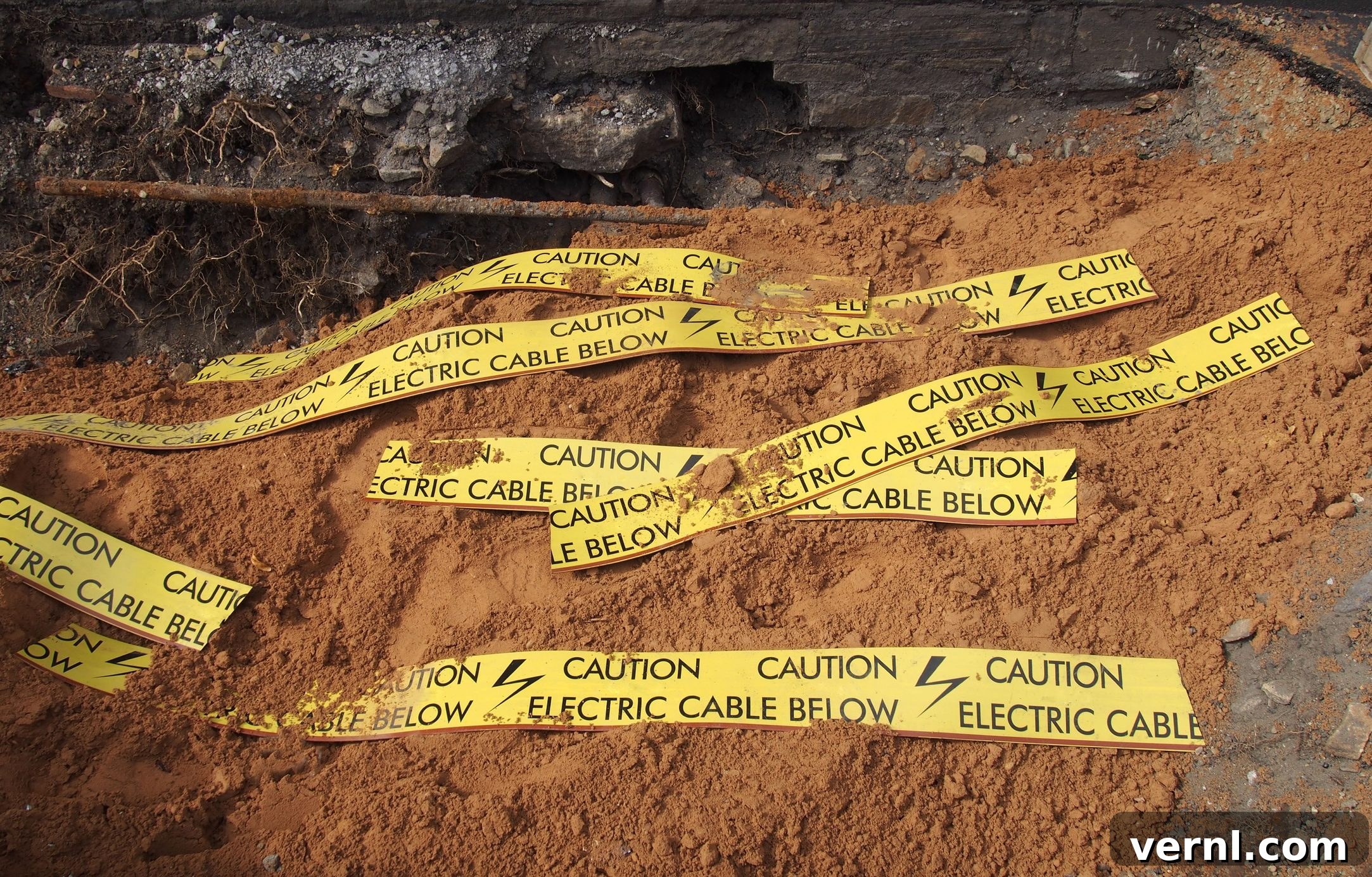
While the National Electrical Code (NEC) specifically mandates the installation of warning ribbon tape in trenches containing service wires – those critical lines extending from the electric meter at a utility pole or pedestal to the exterior of your home – its application should be considered a best practice for ALL underground wiring installations. This inexpensive material serves as invaluable “cheap insurance” against potentially catastrophic accidents.
Warning ribbon tape is typically a bright, non-degradable plastic tape, clearly marked with warnings like “CAUTION: BURIED ELECTRIC LINE BELOW.” Its purpose is to provide a visual and tactile warning to anyone excavating in the future, long before they encounter the actual electrical conductors. This early warning significantly reduces the risk of accidental strikes, which can lead to severe consequences:
- Potential Electrocution: Striking a live electrical cable can result in immediate and fatal electrocution for the individual operating excavation equipment or using hand tools.
- Arc-Flash Accidents: A shovel or digging tool hitting a live conductor can create an arc flash – a dangerous electrical explosion that releases intense heat, light, and pressure, causing severe burns, blindness, and other injuries.
- Equipment Damage: Beyond human harm, striking underground wiring can cause extensive damage to excavation equipment, utility infrastructure, and the electrical system itself, leading to costly repairs and service interruptions.
For the warning ribbon tape to be effective, it must be installed correctly. The NEC specifies that it should be placed in the trench at least 12 inches (approximately 30 cm) directly above the underground wiring. This placement ensures that an excavator will encounter the warning tape well before reaching the electrical cables or conduits, providing ample time to stop digging and identify the buried hazard. After the tape is laid, you can then proceed with the final backfilling of the trench.
Considering that a 300-foot roll of warning ribbon tape costs around $12, its minimal expense is a small price to pay for the significant protection it offers against dangerous and costly situations. It’s a simple, yet highly effective, layer of safety that no underground electrical project should omit.
Additional Crucial Considerations for Underground Wiring
Beyond the fundamental rules, several other important factors contribute to the safety, reliability, and longevity of underground electrical installations:
- Avoiding Direct-Buried Cable Splicing: Splicing direct-buried cables and wires should be avoided whenever possible. Every splice introduces a potential point of failure, especially in the harsh underground environment. If splicing is absolutely unavoidable, it must be performed using a method and means specifically approved for underground use. These approved methods often involve specialized waterproof connectors, heat-shrink tubing, or epoxy-filled splice kits designed to create a robust, moisture-impervious seal that can withstand the conditions of direct burial. Improper splices are a leading cause of underground electrical failures.
- Grounding of Metal Conduits: All underground metal conduits, such as RMC or IMC, are generally required to be effectively grounded. This grounding is achieved by connecting them to metal boxes, or by incorporating green or bare grounding wires within the conduit system. Proper grounding provides a safe path for fault currents in the event of an insulation failure, tripping circuit breakers and preventing dangerous voltage buildup on the metal conduit itself. This is a critical safety measure against electrocution.
- Exceptions for Short Metal Conduits: It’s important to note an exception: short lengths of metal conduits that serve solely to provide support or physical protection for cable assemblies, and are not part of the primary raceway system for wiring, are generally not required to be grounded. This often applies to short sections used at the point where a cable emerges from the ground to protect it from mechanical damage.
- Proximity of Conductors in the Same Trench: For optimal electrical circuit performance and safety, all underground cables and wires belonging to the same branch circuit must be placed in close proximity within the same trench. This practice minimizes inductive reactance and impedance imbalances, which can lead to voltage drops, inefficient power delivery, and nuisance tripping of overcurrent protection devices. Maintaining close proximity ensures that the magnetic fields generated by the current-carrying conductors cancel each other out, promoting proper circuit function and meeting NEC requirements for balanced electrical systems.
Planning and Permitting: Your First Steps
Before any ground is broken, thorough planning and obtaining the necessary permits are paramount. Research local building codes and the specific amendments your jurisdiction may have to the NEC. Contact your utility provider to locate existing underground utilities (gas, water, communication lines) to prevent accidental damage. A detailed plan, including a trench layout, wiring methods, and depths, will streamline the permit application process and guide your installation, ensuring it meets all local and national requirements. Failing to secure permits can result in fines, project delays, or even the forced removal and reinstallation of non-compliant work.
Safety First: Prioritizing Personal and Public Safety
Working with electricity, especially underground, carries inherent risks. Always prioritize safety. Disconnect power to circuits before starting work. Use appropriate personal protective equipment (PPE), including insulated gloves, safety glasses, and sturdy footwear. Never work alone. If you are unsure about any aspect of the installation, consult a qualified electrician or electrical inspector. The goal is not just a functioning electrical system, but one that is safe for both installation and future use by all. Regular inspections, both during and after installation, are vital to verify compliance and identify potential issues before they become hazards.