Rain runoff, persistent frost, and shifting soil are formidable adversaries to even the most robust driveways. While a properly installed concrete or asphalt driveway can reliably serve your property for many decades, no surface lasts indefinitely. Eventually, wear and tear will necessitate a decision regarding its future.
When the moment arrives for a driveway replacement, you can find comfort in knowing that this significant home improvement project often delivers a substantial return on investment. The cost of a new driveway is frequently recuperated, and sometimes even exceeded, through an increase in your property’s overall market value. Opting for a higher-quality material or incorporating attractive design upgrades can further amplify this return, transforming a basic necessity into a valuable asset. Furthermore, consider enhancing your property’s entrance with innovative driveway gate ideas to complement your new surface.
For existing concrete driveways, a range of aesthetic enhancements like multicolor staining, decorative stamping, and intricate engraving can revitalize its appearance and boost curb appeal. Your driveway is the very first feature visitors and potential buyers encounter when viewing your property, making it a critical element of its first impression. A meticulously finished driveway exudes quality and care, extending an inviting aesthetic from the street all the way to your front door. This significant boost in curb appeal is not just about aesthetics; it signals well-maintained property and attention to detail.
Even if you prioritize functionality and budget, choosing a durable, albeit less visually elaborate, material like asphalt over more premium options, a new driveway brings a dramatic improvement. Beyond the visual upgrade, a smooth, unblemished surface is vastly better for your vehicles. Gone are the days of navigating treacherous potholes, jarring bumps, and extensive cracking that can accelerate wear and tear on your car’s suspension and tires. Moreover, a sound driveway eliminates concerns about future rain undermining already compromised sections, providing peace of mind and long-term structural integrity.
The investment for a new driveway typically ranges from $4 to $30 per square foot (psf), a wide spectrum dictated by the specific materials chosen, the complexity of the design, and any additional features you opt to include. Understanding the variables involved is key to effective planning and budgeting.
Factors That Determine the Cost of Driveway Replacement
The considerable range in driveway replacement costs stems from numerous variables, each playing a significant role in the final invoice. To help you budget and make informed decisions, here are the most important factors to consider:
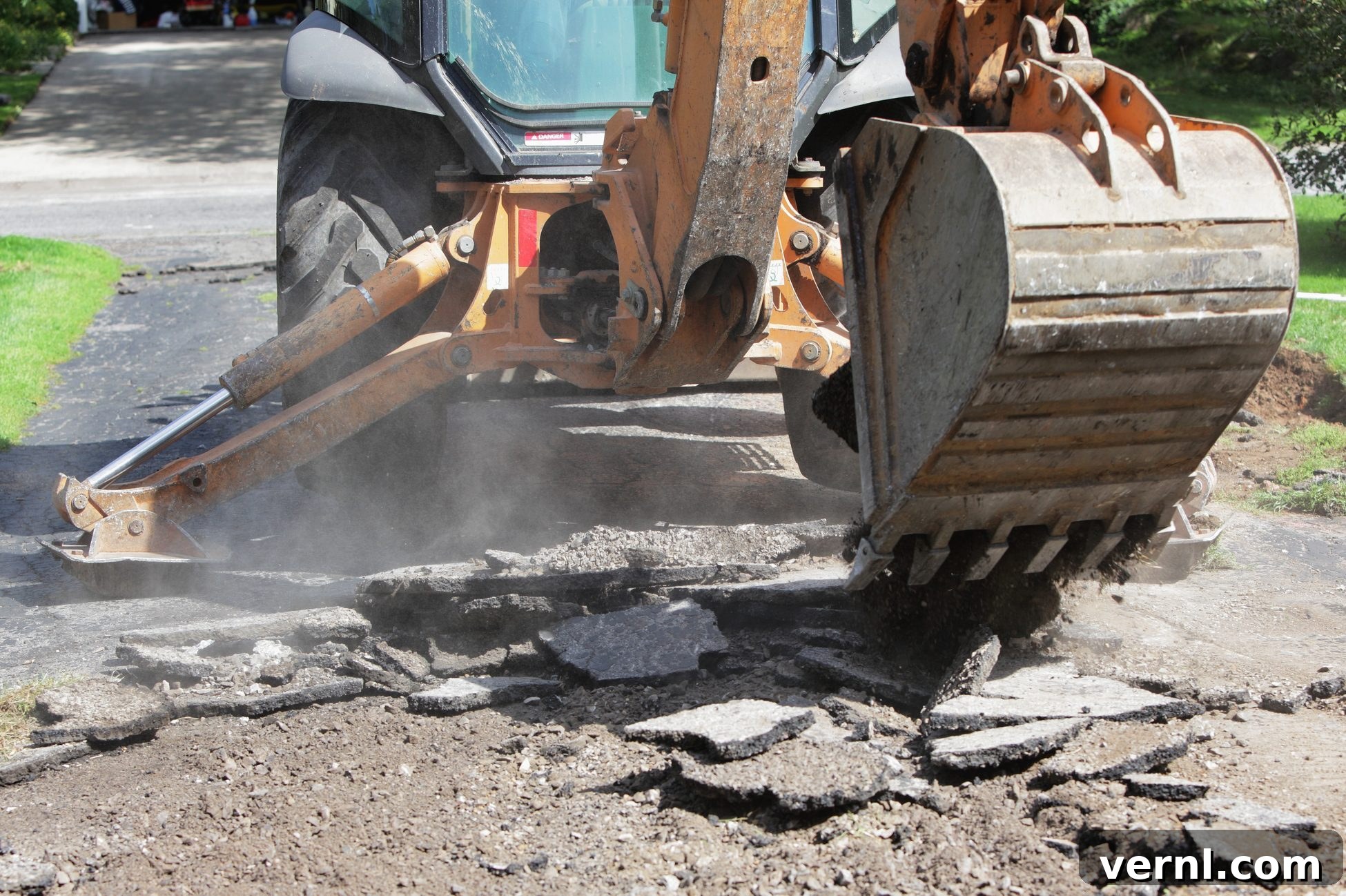
- Removing the Old Driveway: This initial step is often straightforward but critical. For existing concrete or asphalt surfaces, workers utilize heavy equipment to break up the material and then haul it away for disposal. If your property currently features a gravel driveway, the process involves scooping up all the gravel, which can then either be removed from the site or strategically redistributed elsewhere on your property for other landscaping purposes. The typical cost for old driveway removal ranges from $1 to $3 psf, but can vary based on material type and accessibility.
- Grading and Leveling the Base: A new driveway’s longevity and structural integrity depend heavily on a perfectly prepared sub-base. If the existing base has been compromised by erosion, settling, or frost heave, significant grading and leveling will be required. This involves preparing the soil, ensuring proper drainage slopes, and compacting the base material to create a stable, even foundation that can support the new surface without shifting or cracking prematurely. This step is non-negotiable for a durable installation.
- Choice of Materials: This is arguably the most influential factor in your total cost.
- Asphalt: Often the most budget-friendly paved option, asphalt typically costs $3 to $7 psf. It offers good flexibility in colder climates and a relatively quick installation process. However, it requires regular sealing and has a shorter lifespan than concrete.
- Concrete: A popular choice for its durability and versatility, concrete ranges from $4 to $8 psf. It offers excellent longevity and can be customized with various finishes, colors, and textures. While more expensive than asphalt, its extended lifespan often justifies the initial investment.
- Gravel: The most economical choice, gravel driveways can be installed for a fraction of the cost of paved options. However, they require more frequent maintenance, can be prone to rutting, and may cause dust.
- Rubber: A newer, eco-friendly option, rubber driveways are typically made from recycled tires. They offer excellent durability, slip resistance, and a unique aesthetic but come at a considerably higher price point.
- Exposed Aggregate: This concrete finish reveals decorative stones within the mix, offering a textured, high-end look. It is more expensive than standard concrete due to the specialized installation process.
- Pavers: The most premium option, pavers can cost as much as $30 psf installed. They offer unmatched aesthetic appeal, a wide array of design possibilities, and excellent durability. Individual pavers can also be replaced if damaged, extending the driveway’s life.
- Design Options and Enhancements: Basic driveways are functional, but many homeowners opt for upgrades to enhance curb appeal.
- Stamping and Staining Concrete: These techniques can mimic the appearance of brick, stone, or tile, significantly increasing the cost, particularly if multiple stain colors or complex patterns are involved.
- Borders and Edging: Decorative borders or edging materials can add a sophisticated touch and improve structural integrity.
- Integrated Heating Elements: For those in cold climates, embedding heating coils under the driveway can eliminate the need for snow removal, raising the cost substantially to between $21 and $28 psf due to materials and specialized installation.
- Lighting: Integrating LED lighting along the driveway edges can improve safety and ambiance.
- Driveway Size: The total square footage of your driveway directly correlates with the amount of material and labor required, making larger driveways inherently more expensive to replace. Economy of scale can sometimes offer slight savings on very large projects, but the overall cost will increase with size.
- Permits: Most driveway replacement projects, especially those involving changes to drainage or significant excavation, require permits from your local municipality. These permits ensure the work complies with local building codes and environmental regulations, typically costing between $100 and $200. Failing to obtain necessary permits can lead to fines or mandated re-dos.
- Labor: Labor often constitutes roughly half of the total project cost. This percentage can fluctuate significantly based on your geographical location, the complexity of the job, and the specific contractor you choose. Experienced crews command higher rates but often deliver superior results and efficiency.
- Site Accessibility: If your driveway is difficult for heavy equipment to access, or if there are obstacles like steep inclines or tight turns, labor costs may increase due to the extra time and effort required.
Driveway Replacement vs. Driveway Resurfacing: Making the Right Choice
A full driveway replacement is a significant investment, and it’s not always necessary. Understanding the difference between replacement and resurfacing can save you considerable time and money. The key factor in this decision is the condition of the driveway’s underlying base.
Driveway Resurfacing: If the base beneath your existing driveway remains solid and intact, resurfacing can be an excellent, cost-effective alternative. This process involves filling minor holes with a durable patching compound, sealing cracks with a specialized caulk, and then applying a fresh top layer. For asphalt driveways, this means applying a new layer of asphalt sealer or resurfacer. For concrete, a specialized concrete re-surfacer is applied to create a new, smooth surface. Professionally resurfacing typically costs between $2 and $5 psf, with many jobs averaging around $2.25 psf. This option is ideal for driveways with surface-level damage but no major structural issues.
Driveway Replacement: While resurfacing offers a quick fix, it’s not a panacea. A driveway that has surpassed 30 years in age or exhibits severe, widespread cracking is generally a more suitable candidate for complete replacement. Extensive cracks are often a tell-tale sign of underlying problems with the base, which could be caused by erosion, significant soil settling, or repetitive frost heaving. These issues compromise the structural integrity of the entire driveway, and the only effective way to address them comprehensively is by removing the old surface and rebuilding the base from scratch. Similarly, a wavy asphalt driveway strongly indicates severe base degradation that cannot be rectified by mere resurfacing; the waves are direct evidence that the foundation needs repair or replacement.
DIY vs. Hiring Professionals for Driveway Projects
When considering driveway projects, the “do-it-yourself” approach can be tempting for cost savings. However, the feasibility of DIY depends heavily on the scope and complexity of the task.
DIY Driveway Resurfacing: For minor resurfacing projects, taking the DIY route is generally manageable and can save you significant labor costs. The process typically involves a few key steps: thoroughly cleaning the driveway with a pressure washer to remove dirt and debris, meticulously patching any cracks and holes with appropriate compounds, and finally, spreading the resurfacing compound evenly across the surface using a long-handled squeegee. Most homeowners with a free afternoon and a willingness to follow instructions can successfully complete this project for a few hundred dollars in materials, achieving a refreshed appearance and extending the life of their driveway.
Professional Driveway Replacement: A complete driveway replacement, however, is an entirely different undertaking and is almost always best left to experienced professionals. This is not just about brute strength; it requires specialized knowledge, heavy machinery, and precise execution.
- Heavy Equipment: Professionals arrive equipped with machinery like excavators, jackhammers, and dump trucks, necessary for efficiently breaking up, removing, and disposing of the old driveway material.
- Base Preparation: The crucial step of proper base preparation, including accurate grading, leveling, and compaction to ensure adequate drainage and stability, demands expertise to prevent future issues like cracking or settling.
- Material Handling: Handling large quantities of concrete or asphalt for a pour is complex. Concrete, for instance, must be poured and finished quickly before it sets. This often requires an entire crew working in unison, making it a project that typically must be completed in a single day to ensure a seamless, uniform surface.
- Finishing Techniques: Achieving a smooth, durable, and aesthetically pleasing finish, especially with decorative concrete, requires skilled craftsmanship that DIYers typically lack.
- Safety and Efficiency: Professionals ensure the project is completed safely, efficiently, and to code, minimizing risks and maximizing the longevity of your new driveway.
While technical aspects like leveling the base and building forms are theoretically DIY-able, the sheer scale, time sensitivity, and specialized equipment involved in a large concrete or asphalt pour make it impractical and often dangerous for the average homeowner.
Questions To Ask Driveway Replacement Contractors
Before committing to any contractor for a significant home improvement project like a driveway replacement, it’s paramount to conduct thorough due diligence. Beyond the standard inquiries about licensing, bonding, insurance, and references (which are crucial for consumer protection and ensuring accountability), there are several specific questions pertinent to driveway projects that you should ask:
- What is the detailed, itemized cost of the project? The best way to plan your budget accurately and avoid unexpected expenses is to obtain a comprehensive, written quote that clearly itemizes all costs, including removal, materials, labor, and any potential extras. Be wary of vague estimates.
- How long will the project take from start to finish? You’ll need to make alternative arrangements for parking your vehicles, so having a clear timeline is essential for logistical planning. Also, inquire about potential delays due to weather or material availability and how those might affect the schedule.
- Do you have a dedicated crew for this type of work, or will it be a smaller team? Several experienced individuals working on the project generally helps guarantee a faster and more efficient completion than relying on just one or two workers, especially for large pours or complex installations.
- Who will be the primary point of contact and responsible for overseeing the work on-site? While you hire the contractor, they may delegate daily supervision to a crew leader or foreman. If so, request a meeting with this individual so you know exactly who will be managing the project day-to-day and can address any questions or concerns directly.
- Do you own your equipment, or will you rent it for this job? Contractors who own their heavy equipment often have more control over project timelines and can potentially offer more competitive pricing. If equipment needs to be rented, there’s a possibility of delays if it’s unavailable, impacting your project schedule.
- What type of warranty do you offer on both materials and labor? A reputable contractor should stand behind their work. Understand the duration and coverage of their warranty to protect your investment against premature failure or installation defects.
- Can you provide references for similar driveway projects you’ve completed recently? Speaking with past clients can offer invaluable insights into the contractor’s reliability, quality of work, adherence to timelines, and communication skills.
- What is your payment schedule? Understand the deposit requirements, progress payment milestones, and final payment terms. Be cautious of contractors demanding a large upfront payment.
- How will you handle site cleanup and debris disposal? Ensure that the contract specifies that the contractor is responsible for removing all construction debris and leaving your property tidy upon completion.
- What steps do you take to ensure proper drainage and prevent future water issues? Proper drainage is critical for driveway longevity. Ask about their plan for grading, sloping, and managing water runoff to protect your property.
By asking these comprehensive questions, you can ensure you’re hiring a qualified, reliable contractor who will deliver a high-quality, long-lasting driveway that enhances your property for years to come.