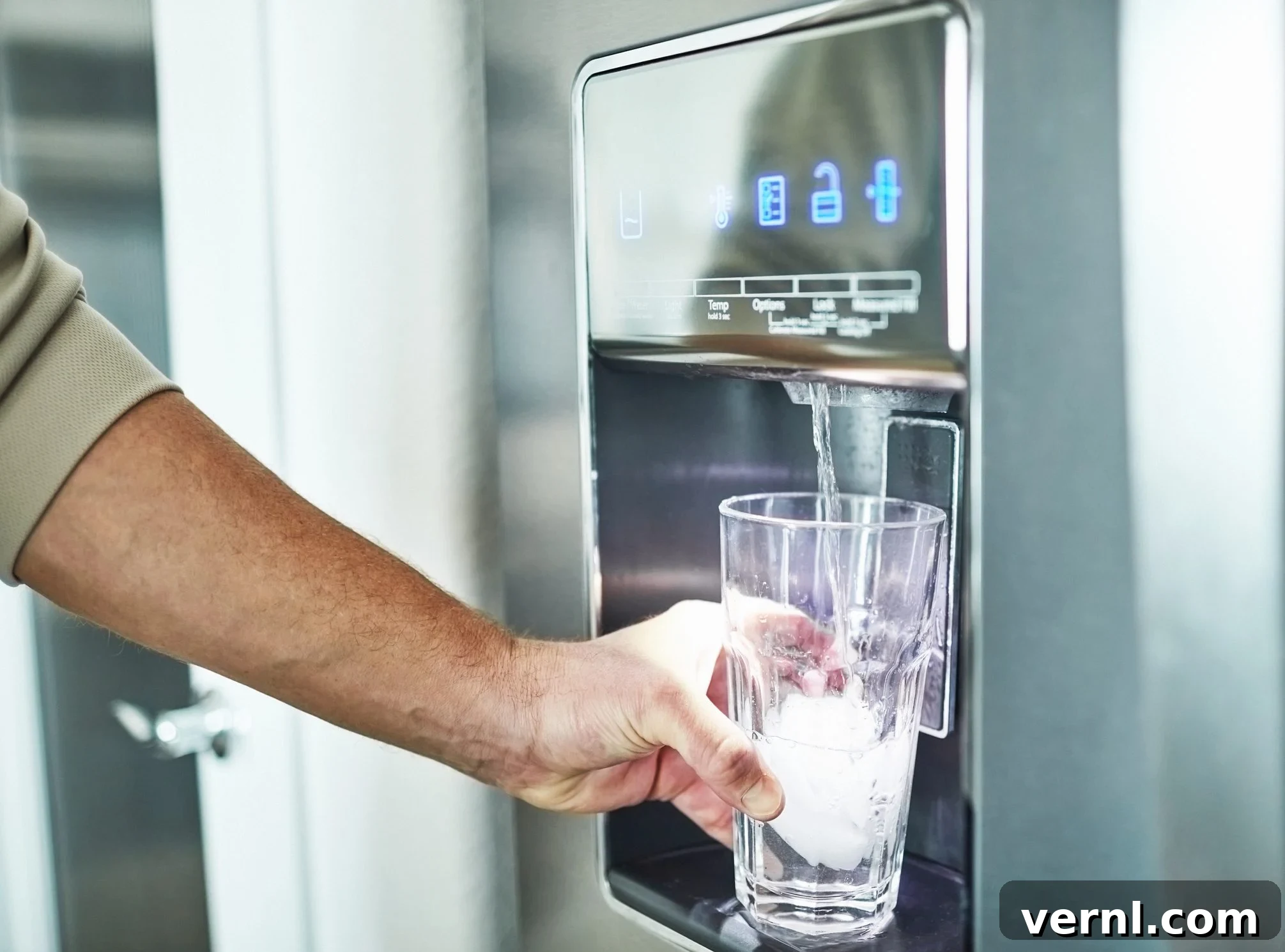
Understanding Your Refrigerator Water Dispenser: Why Isn’t My Fridge Water Ice-Cold?
Imagine this common scenario: You’ve just finished an exhilarating backyard game of kickball with the kids and their friends. Everyone’s parched, eagerly awaiting a refreshing glass of water from the refrigerator door dispenser. You hand out the glasses, but one of the kids pipes up, “My water’s warm!” Your heart sinks, thinking your trusty refrigerator’s water dispenser has finally given up the ghost. But what if we told you that a ‘warm’ glass of water isn’t necessarily a sign of a broken appliance?
According to Bob Tuck, a seasoned expert and franchise owner of Mr. Appliance of Port Charlotte, Naples, Lee County, and Asheville, North Carolina (a Neighborly company), your initial instinct might be mistaken. He reassures us that it’s probably not a malfunction. Instead, the temperature of the dispensed water is often a fundamental characteristic of the fridge’s internal design, rather than an issue with the dispenser mechanism itself. This insight is crucial for understanding why your filtered water might not always be bone-chillingly cold, and what you can realistically expect from your modern appliance, ultimately saving you from unnecessary worry or a service call.
The Evolution of Refrigerator Water Cooling: From Reservoirs to Tubing Systems
To truly grasp why your refrigerator water fluctuates in temperature, we need to delve into how these appliances are designed to cool water. Historically, many older refrigerators employed a simple reservoir system. This meant a dedicated, often large, tank, typically located at the bottom of the fridge near the crisper drawers. Water would sit in this reservoir for an extended period, allowing it to thoroughly chill and reach the same consistent temperature as the refrigerated compartment. This design was highly effective at producing consistently cold water, as a significant volume was kept at a stable, low temperature.
However, the landscape of refrigerator design has significantly evolved. Today, the vast majority of new fridges have moved away from bulky reservoirs. This shift is often driven by factors like space efficiency, cost reduction, and advancements in cooling technology. Instead, modern appliances utilize a sophisticated network of thin tubing that snakes its way through and around the interior of the appliance. Bob Tuck elaborates on this modern setup: “Most new fridges have a coiled-up section of tubing behind the crispers that’s zip-tied together and clamped to the back wall, and then it’s just a constant flow of water.” This continuous flow system, while innovative in many respects, introduces different dynamics concerning water temperature compared to its reservoir-based predecessors.
Why Is My Refrigerator Water Sometimes Warm, Sometimes Cold? Understanding Heat Transfer Dynamics
The key to understanding the variability in water temperature from your dispenser lies in the fundamental principle of heat transfer. When water flows through a narrow tubing system, rather than sitting stagnant in a large, consistently cold reservoir, it’s constantly exposed to its surroundings. “So what you have there is a transfer of heat through the tubing,” Tuck clarifies. This means that as water travels from your home’s main supply line, through various compartments and behind panels of the fridge, to the dispenser in the door, it inevitably picks up some heat from the warmer components and less insulated areas within the refrigerator cabinet.
This challenge is exacerbated because these newer designs often store “less water at the same temperature as the fridge” compared to the old reservoir systems. Unlike a large reservoir that acts as a substantial thermal mass, retaining cold for longer periods, the tubing system offers a much smaller volume of water directly exposed to the cooling elements at any given time. Once this small volume of pre-chilled water is dispensed, the next batch immediately flowing in from the ambient temperature supply line simply hasn’t had ample time to cool down to the desired icy temperature. This explains why your very first glass might be wonderfully cold, having had the most time to chill in the coils, but subsequent glasses can be noticeably warmer as fresh, unchilled water enters the system.
Bob Tuck highlights the prevalence of this design shift, noting that approximately 75 percent of his refrigerator service calls are related to temperature expectations from models utilizing these tubing systems rather than traditional storage reservoirs. He often performs a simple yet illuminating demonstration for his customers: measuring the temperature of their tap water versus the water dispensed from the fridge. In nearly every instance, the fridge water is indeed cooler by comparison, confirming that the cooling mechanism is functioning. However, it’s crucial to manage expectations, as it may not reach the arctic-cold degree some might anticipate based on older appliance experiences.
The Intricate Journey of Your Water: Why “Bone-Chilling Cold” is a Rarity
The specific path the water takes inside your refrigerator also plays a significant role in its final dispensed temperature. The tubing connected to your home’s main cold water source typically runs up the back of the fridge to the water filter, often positioned near the top or behind a specific panel. From the filter, the line then descends along the back of the appliance to the coiled-up tubing section, which, as Tuck mentioned, acts as a temporary, limited storage tank for cooling. Finally, from this coiled section, the water travels upwards again, through the refrigerator door, to the dispenser nozzle. This intricate and extended route, while necessary for filtration and convenient delivery, exposes the water to various temperature zones and influences within the appliance.
Consider the refrigerator door itself: it’s opened frequently throughout the day, allowing warmer ambient air from your kitchen to enter and raise the temperature within the door cavity. The door also houses electrical components, controls, and often has less consistent insulation compared to the main interior compartment. As the water tubing snakes its way through these fluctuating temperature zones, especially toward the dispenser located within the door, it’s highly susceptible to warming. This constant exposure to areas that aren’t maintained at the fridge’s absolute coldest temperatures effectively prevents the water from ever reaching a “bone-chilling cold” state, even if the coiled section provides some initial, substantial cooling.
Because the water is consistently flowing and has limited static chilling time in a large, dedicated reservoir, the dispensed water may never reach the super-cold temperatures many consumers remember from older models or associate with an ice-cold beverage. “Most people tolerate and accept it once they know it’s working properly,” Tuck observes. This acceptance often comes from a clear understanding that the appliance is functioning precisely as designed, despite not meeting an outdated or perhaps unrealistic expectation of water temperature. It’s a trade-off for the convenience and sleek design of modern refrigerators.
Optimizing Your Refrigerator Water Dispenser: Practical Tips for Colder Water
While your modern refrigerator’s water dispenser might not deliver arctic-cold water right out of the gate, there are several practical steps you can take to enhance its cooling performance and consistently get the most refreshing glass possible. These tips focus on maximizing the time water spends in the coldest parts of your fridge and minimizing undesirable heat transfer.
-
The “First Flush” Trick: Purging Warmer Water from the Lines
One of the most effective and widely practiced ways to ensure your drinking water is colder is to employ what Bob Tuck refers to as the “first flush” trick. This method acknowledges that the water sitting in the tubing closest to the dispenser, particularly within the door, will naturally be the warmest because it’s been exposed to ambient temperatures and less direct cooling. To counteract this, simply keep a small glass, perhaps four to six ounces, handy specifically for this purpose. When you’re ready for a truly cold drink, first dispense this small amount of water into the designated flush glass. This initial volume effectively purges the warmer water from the lines. After this quick flush, you can then fill your actual drinking glass with the subsequent water, which will have had more time to cool within the coiled tubing deeper inside the refrigerator’s colder compartments. Tuck notes that many of his satisfied customers successfully employ this simple method to consistently access the truly cooler water.
-
Maintain Optimal Refrigerator Fullness: Harnessing Thermal Mass
Believe it or not, the contents of your refrigerator play a significant role in its overall cooling efficiency and, consequently, the temperature of your dispensed water. A refrigerator that is too empty has to work considerably harder to maintain a consistent cool temperature, typically optimized between 34 and 38 degrees Fahrenheit (1 to 3 degrees Celsius) on newer models. The excessive empty space allows for quicker temperature fluctuations every time the door is opened, and there’s simply less thermal mass to absorb and retain the cold air. Conversely, an overcrowded fridge can restrict crucial airflow, preventing efficient and even cooling throughout the compartment.
The ideal scenario for consistent cooling, including that of your water lines, is a refrigerator that is full but not overcrowded. The items inside, particularly liquids like milk, juices, or even jugs of plain water, act as a thermal mass. They absorb the cold air and help maintain a stable internal temperature, even when the door is briefly opened. If your fridge often looks barren, a simple solution is to add a few jugs of water or other beverages. These additional items contribute significantly to the thermal mass, helping the compressor run more efficiently and ensuring a more consistently cold environment for your water tubing. This consistent cold environment directly translates to colder dispensed water over time, as the water has a better chance to reach a lower temperature before it’s dispensed.
-
Patience is a Virtue: Allowing Water to Re-Chill Between Fills
Given that modern refrigerators cool water “on demand” through a continuous flow system rather than relying on a large, pre-chilled reservoir, the rate at which you dispense water directly impacts its temperature. If you’ve just filled a large glass, a pitcher, or multiple glasses in quick succession, you’ve likely depleted the limited supply of adequately pre-chilled water residing in the coiled tubing. The water immediately following that initial rapid draw will be newly introduced from your home’s supply line and will not have had sufficient time to cool down within the refrigerator’s environment.
To ensure subsequent fills are as cold as possible, it’s wise to practice a bit of patience. Waiting at least 15 minutes, or even longer if you’ve dispensed a significant volume of water, between fill-ups allows the freshly introduced water to circulate through the coiled tubing and undergo the necessary heat exchange with the cold interior of the refrigerator. This waiting period is crucial for giving the system time to “recharge” its cold water supply. By allowing this re-chilling process to occur, you’ll significantly improve the chances of getting consistently cooler results, especially during periods of high demand like after an energetic outdoor game or during a family gathering.
Troubleshooting: When Your Refrigerator Water Is ALWAYS Warm
While some temperature variability is normal and expected with modern refrigerator designs, consistently warm water from your dispenser, regardless of the tips above, could indicate a more specific underlying issue that might require professional attention. The cause often depends significantly on the age and internal design of your refrigerator.
For Older Refrigerators: The Frozen or Cracked Reservoir Dilemma
If you own an older refrigerator model that still relies on a traditional water storage reservoir for cooling, consistently warm water can sometimes paradoxically signal a problem with freezing. In these systems, if the reservoir itself freezes solid, water cannot flow through it to be chilled or dispensed. The most concerning aspect is that as ice expands, a frozen reservoir can often lead to a cracked reservoir, which will inevitably result in leaks within your refrigerator and potentially significant damage to your floors or cabinetry.
A frozen or cracked reservoir almost always necessitates a service call from a qualified appliance technician. Bob Tuck warns that replacing a cracked reservoir can be quite costly, often starting at about $300, depending on the fridge model and labor rates. This is a complex repair that typically involves accessing internal components, disconnecting and reconnecting water lines, and dealing with potential water damage, making it unsuitable for most DIY enthusiasts. If you suspect your older fridge has a frozen or cracked reservoir, the best course of action is to unplug the unit, turn off the water supply to the refrigerator immediately, and contact a professional technician to prevent further damage and avoid potentially extensive and costly refrigerator repairs.
For Newer Refrigerators: Tubing Performance or Installation Anomalies
For newer refrigerators that utilize the continuous flow tubing system without a large, dedicated reservoir, consistently warm water is a less common occurrence, but still possible. Tuck identifies two primary, albeit rare, culprits:
-
Insufficient Cooling in the Tubing System Itself
One possibility for consistently warm water in a newer fridge is that the coiled tubes within the appliance simply aren’t providing adequate cooling for the water. This could stem from several factors. It might be a design flaw in a particular model where the tubing’s placement or length is suboptimal for achieving sufficient heat exchange with the cold air inside the fridge. Alternatively, it could be an issue with the refrigerator’s overall cooling efficiency, preventing the tubing from reaching its optimal chilling temperature. This could be due to a faulty compressor, a refrigerant leak, or poor insulation. While the dispensed water may still be cooler than room temperature, it might not meet even the modest cooling expectations for water coming from a refrigerated appliance. In such cases, a technician might evaluate the placement of the tubing, check the refrigerator’s refrigerant levels, or assess the general performance of the refrigeration unit to diagnose and rectify the problem.
-
The Extremely Rare Hot Water Connection
An extremely rare, almost unheard-of scenario, but one worth mentioning for the sake of completeness, is the accidental connection of the water dispenser to the hot water supply during installation. This is incredibly uncommon, as refrigerator water lines are almost universally routed to a cold water source in residential plumbing. However, if your fridge is truly dispensing hot water, this is an immediate and critical red flag that indicates a severe plumbing error. This requires immediate professional attention to correct the hazardous installation mistake. Fortunately, Bob Tuck reassures us, stating, “I have never in my career seen a fridge not getting some level of cooler water into the glass.” This expert testimony reinforces that even if your fridge water isn’t ice-cold, it’s almost certainly being cooled to some degree, making an actual hot water connection an extremely unlikely cause.
Setting Realistic Expectations for Your Refrigerator Water Dispenser
In conclusion, the modern refrigerator water dispenser is a marvel of convenience, offering filtered water on demand without the need to open the main refrigerator door. However, due to significant advancements and shifts in design, particularly the move from large, static reservoirs to dynamic, continuous flow tubing systems, the expectation of “bone-chilling cold” water needs to be realistically adjusted. Your fridge is likely working exactly as intended, efficiently cooling the water relative to your tap water temperature, but not necessarily to an icy degree that rivals a glass filled with ice cubes.
By understanding the underlying science behind the tubing system, implementing simple yet effective tips like the “first flush” technique, maintaining optimal fridge fullness for better thermal mass, and practicing patience between successive fills, you can significantly enhance the refreshing quality of your dispensed water. And, in the rare event of consistently warm water that doesn’t improve with these methods, knowing whether you have an older reservoir-based system or a newer tubing design will guide you toward the correct troubleshooting steps, minimizing frustration and potential repair costs. Remember, a cool glass of filtered water, delivered instantly, is still a significant convenience and a testament to modern appliance engineering, even if it doesn’t quite match the chill of an ice bath.
Embrace the design, follow the expert tips, and enjoy the unparalleled convenience of your refrigerator’s water dispenser, appreciating it for the efficient and functional system it is, rather than lamenting it for what it’s not. Your kids, and their friends, will thank you for the refreshed understanding!