
A modern toilet exists as something of a profound contradiction in the contemporary home. By the very nature of its primary function, it deals with waste, making it inherently far from a sanitary item in its raw state. Yet, through clever engineering and careful material selection, it is meticulously manufactured to be one of the easiest-to-clean and maintain fixtures in a home, a testament to design focused intently on hygiene and user convenience.
Beyond its paradoxical cleanliness, toilets are also remarkably durable structures. These essential bathroom fixtures are designed to withstand constant daily use and can often remain in continuous service for a century or even longer, a true testament to their robust construction and the longevity of their materials. However, this impressive longevity doesn’t mean they are indestructible. Anyone who has ever made the common mistake of over-tightening a toilet bolt during installation or repair knows the distinctive, sharp tink that signifies a cracked toilet base or tank, a stark reminder of their underlying fragility despite their general resilience.
Given these fascinating aspects—the intricate blend of essential function, engineered cleanliness, and surprising material science—it’s no surprise that many homeowners and curious individuals ponder the fundamental question: what exactly are toilets made of? To delve into this seemingly simple yet intricate query, we consulted with two prominent figures within the toilet industry: an expert from a leading manufacturing company and another from a pre-eminent testing and performance evaluation organization. Their combined insights provide a comprehensive understanding of the materials, processes, and consumer preferences behind this ubiquitous household item.
About Our Experts in Toilet Technology and Design
To ensure we provide the most accurate, current, and insightful information on toilet manufacturing and materials, we reached out to individuals with deep expertise in the field of toilet design, performance, and consumer preferences.
John Koeller, a distinguished engineer, has dedicated his career to the rigorous study of toilet performance and water use efficiency, a critical area in modern plumbing, since 1993. He is the co-founder of MaP (Maximum Performance), an independent organization that has conducted extensive testing on nearly 6,000 different toilet models from an impressive 192 brands since its inception in 2002. MaP is highly respected for its commitment to transparency and empowering consumers; it makes all of its comprehensive test results freely available to the public, offering invaluable data on toilet efficiency, flushing power, and overall performance.
Ryan Grotegut serves as the marketing manager for the toilet division at Kohler Co., one of the world’s most recognized and respected brands in kitchen and bath products. His role focuses on the strategic development of new toilet products, encompassing a wide spectrum of designs and technologies. This ranges from optimizing the enduring popularity of more traditional and accessible models like the Kohler Highline series to pioneering the cutting-edge innovation and luxurious features found in top-tier smart toilets such as the Numi 2.0, showcasing his deep understanding of both classic and future toilet trends and materials.
Key References and Industry Sources
Our research and insights are further informed by respected publications and expert analyses in the field of sanitary engineering and toilet innovation, providing a broader context to the discussion of materials and design:
Pipe Dreams: The Urgent Global Quest to Transform the Toilet, authored by Chelsea Wald (Simon & Schuster/Avid Reader Press, 2021). This highly acclaimed book offers a fascinating exploration into the history, engineering challenges, and future of toilet technology on a global scale, highlighting the critical role of material science, public health, and cultural factors in its evolution.
What Exactly Is a Modern Residential Toilet Made Of? Demystifying Porcelain and Vitreous China
When asked about the primary material composition of a modern residential toilet, the immediate answer for most people is confidently “porcelain.” While this isn’t entirely incorrect, it’s also not technically the full and most precise picture. The truth reveals an interesting and significant evolution in ceramic manufacturing and terminology that has shaped the toilets we use today.
Indeed, historical toilets from the elegant Victorian era were predominantly crafted from true porcelain. This material, known for its delicate beauty and translucence, was a marvel of its time. However, as the 20th century progressed, specifically by the 1920s, manufacturers began a significant shift in their production methods for sanitaryware. They started transitioning from pure, unglazed porcelain to a material known as vitreous china. This natural progression leads to the next crucial question for many consumers: what precisely is vitreous china, and how does it fundamentally differ from traditional porcelain?
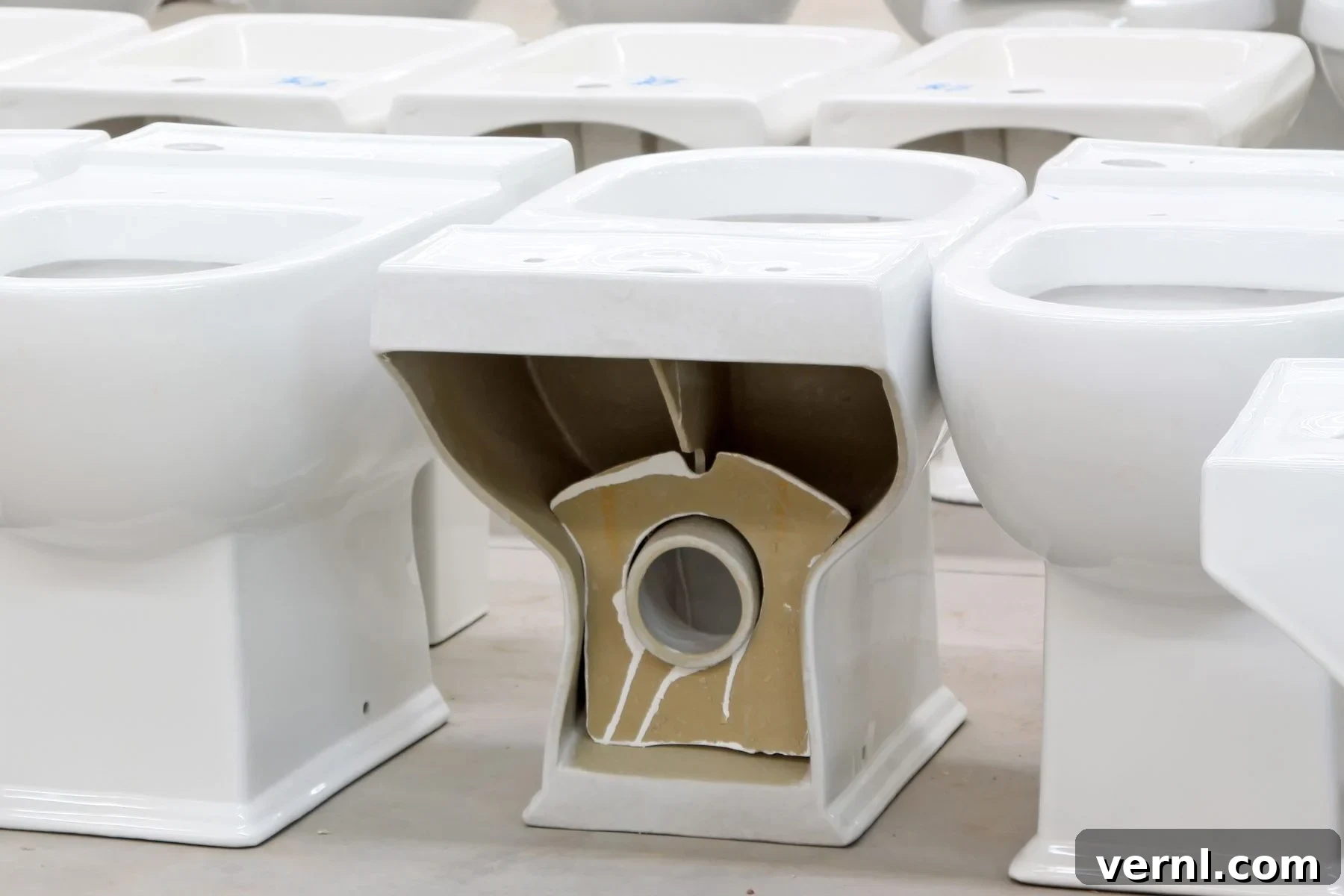
Without delving into excessively technical ceramic engineering jargon, vitreous china can best be understood as a specialized, glass-like coating applied to a porcelain base. The manufacturing process involves firing ceramic clay at extremely high temperatures to create a strong, durable, yet somewhat porous porcelain body. After this initial firing, this porcelain base is meticulously treated with a glaze. This glaze then undergoes a vitrification process, which essentially means it’s fired at even higher temperatures until it melts and becomes an extremely smooth, dense, and non-porous layer that chemically bonds with the underlying porcelain. This crucial treatment dramatically enhances the material’s durability, making it far more resistant to water absorption, staining, scratching, and bacterial growth compared to unglazed porcelain. Think of it this way: vitreous china is both the name of this highly functional, protective coating and the designation for the finished, glazed ceramic product. It’s much like how a simple slice of bread, once subjected to heat in a toaster, becomes “toast”—the transformation process and the desirable end product share the same common name, simplifying everyday parlance.
Today, the vast majority of residential toilets available on the market are constructed from this advanced material. Ryan Grotegut from Kohler Co., a leading industry expert, emphatically confirms this industry standard: “All Kohler toilet products are made from vitreous china.” This widespread adoption across major manufacturers underscores its proven efficacy, superior performance advantages, and widespread acceptance for household use.
Despite this important technical distinction, the term “porcelain” has become deeply ingrained in public consciousness and is still very often used interchangeably with “vitreous china” to describe toilet fixtures. This is partly due to historical precedent and partly due to the visual similarity of the finished product. For the sake of clarity and common understanding in this discussion, we will acknowledge the subtle but important technical difference while also using these terms somewhat interchangeably, reflecting how they are commonly understood and used by consumers.
Must Toilets Be Made of Porcelain or Vitreous China? Exploring Historical and Modern Alternatives
The short answer to whether toilets *must* be made of porcelain or vitreous china is a resounding no. While it remains the overwhelmingly predominant material for modern residential applications due to its superior properties, the long and varied history of sanitation—and even current specialized uses—showcases a wide array of materials employed for this essential fixture, each with its own advantages and disadvantages.
A Look Back: Pre-Ceramic and Early Toilet Designs
Before the widespread adoption and refinement of ceramic manufacturing techniques in the late 19th century (around the 1880s), the materials used for human waste disposal were far more rudimentary and often significantly less hygienic. Most early toilet-like structures, including privy seats and early forms of water closets, were primarily constructed from wood. These wooden facilities, while functional in a basic sense, were inherently porous, making them exceedingly difficult to clean thoroughly. This porosity led to rapid absorption of odors, persistent staining, and the inevitable harboring of bacteria, posing considerable public health challenges. Even further back in history, rudimentary latrines and waste systems in ancient civilizations often utilized carved stone. Stone offered a degree of durability but was still challenged by surface porosity, weight, and the complexities of shaping it for efficient waste removal and cleaning.
Modern Alternatives: Beyond Ceramic for Specialized Needs
In the age of advanced materials science and manufacturing, the possibilities for toilet construction are theoretically vast, though practical considerations such as hygiene, durability, cost, and user experience often dictate the ultimate choices. Theoretically, if one possessed the necessary technical skills and resources, there’s nothing to fundamentally prevent you from designing and building your own plastic toilet using advanced manufacturing techniques like a 3D printer. However, such a DIY approach, while conceptually intriguing, raises significant hygienic concerns. The layered structure inherent in many 3D-printed objects creates microscopic crevices and rough surfaces that are incredibly difficult, if not impossible, to sanitize effectively, making it a highly unhygienic and impractical choice for a fixture constantly exposed to waste and pathogens.
Perhaps your personal tastes lean towards the more opulent and extravagant? For those seeking a truly luxurious and unique statement piece in their bathroom, gold-plated toilets are a niche but available option. These typically feature a standard vitreous china toilet base that is meticulously coated with a layer of genuine gold. Such a fixture can range in price from $2,000 to $3,000, offering a dazzling aesthetic without compromising on the underlying ceramic’s practical benefits of hygiene and durability. However, finding a truly functional toilet made entirely of solid gold is an entirely different matter, bordering on artistic extravagance rather than practical plumbing.
Indeed, a singular functional solid gold toilet, aptly named “America,” was famously created by Italian artist Maurizio Cattelan. This unique piece was more of a functioning sculpture and conceptual art installation than a standard fixture, displayed for public interaction. Valued at an astonishing $5,000,000, it garnered global attention. I say ‘was’ because, in a truly audacious act of theft, it was stolen from Blenheim Palace in 2019. It’s widely speculated, and sadly probable, that the toilet was quickly melted down for its precious metal content, rather than kept intact as an art piece. (One can only hope that particular gold didn’t somehow find its way into anyone’s dental fillings!)
Beyond these extreme examples, other materials serve critical practical purposes in specific, non-residential environments. It’s quite common to encounter outhouses, particularly in rural or recreational settings, that still feature basic wooden toilets, echoing historical designs due to their simplicity and low cost. In demanding institutional environments like prisons, or in transport applications such as airplanes, trains, and even some marine vessels, toilets are almost exclusively constructed from highly durable stainless steel. This material choice is driven by its extreme durability, resistance to vandalism and heavy impacts, ease of cleaning, and non-porous surface, which is ideal for high-traffic, demanding, and often harsh environments. Similarly, portable toilets, ubiquitous at large events, construction sites, and outdoor gatherings, are typically fabricated from robust, lightweight plastic. Plastic is chosen here for its cost-effectiveness, ease of manufacturing, portability, and relative ease of maintenance, making it suitable for temporary and mobile sanitation solutions.
Yet, despite the existence of these diverse alternatives across history and specialized applications, in the primary realm of residential toilets, vitreous china continues to reign supreme. It consistently embodies the ideal balance of hygiene, exceptional durability, pleasing aesthetics, and cost-effectiveness that homeowners seek for their daily sanitation needs.
Why Vitreous China Reigns Supreme: Unpacking the Unmatched Advantages for Residential Toilets
The widespread dominance of vitreous china in residential toilet manufacturing isn’t arbitrary; it’s a direct result of a compelling combination of critical performance characteristics. These include its superior water resistance, impressive durability and inherent strength, and a strong positive public perception. Let’s explore each of these factors in detail, revealing why this material is the undisputed leader in home sanitation fixtures.
1. Exceptional Water Resistance: The Foundation of Hygiene
-
For any material constantly exposed to water, especially in a fixture designed to handle human waste, outstanding water resistance is absolutely essential for both functionality and hygiene. Vitreous china excels dramatically in this regard. Ryan Grotegut from Kohler Co. emphasizes this key attribute: “Vitreous china has incredible resistance to water absorption.” This characteristic is paramount for preventing a host of undesirable issues that would plague other materials.
-
Unlike many other materials, vitreous china’s thoroughly non-porous and glassy surface means it does not absorb water over time, nor does it allow liquids to penetrate its structure. This is critically important because water absorption within the material itself would inevitably create a breeding ground for harmful bacteria and mold, lead to unpleasant and persistent odors, cause deep-seated staining that is impossible to remove, and eventually compromise the structural integrity and longevity of the fixture. Even seemingly robust materials like certain types of plastics, over prolonged periods of continuous exposure, can exhibit some degree of microscopic water absorption, which, as Grotegut points out, “is the last thing anyone wants to happen inside a toilet bowl.” The impermeable nature of vitreous china ensures a consistently hygienic, easy-to-clean, and odor-free surface, which is a non-negotiable requirement for a modern toilet.
2. Durability and Strength: Built to Last (Within Engineered Limits)
-
Beyond its crucial water resistance, robust durability and inherent strength are equally important for a product that undergoes frequent daily use and must comfortably support varying weights over many years. It is certainly true that well-made porcelain toilets can last for decades, even centuries, a testament to the fundamental strength and resilience of fired ceramic. The vitrified material offers excellent resistance to scratches from cleaning implements, withstands exposure to common household chemical cleaners (within reason), and can tolerate moderate impacts, making it exceptionally suitable for the demands of daily household use. Its rigid, unyielding structure ensures vital stability, prevents flexing, and maintains the integrity of the flushing mechanism over time.
-
However, it’s also true that no material is entirely infallible or indestructible. As mentioned earlier, ceramic, while incredibly hard, possesses a degree of brittleness. The distinctive “tink” sound of a cracked toilet base, often resulting from an over-tightened bolt or an accidental heavy impact, highlights this specific vulnerability. Materials like stainless steel, for instance, offer superior impact resistance and are virtually unbreakable under normal conditions, making them ideal for high-vandalism or industrial environments. Yet, stainless steel has its own drawbacks in residential settings, such as increased noise during flushing, a colder tactile sensation, potential for dents if abused, and a more industrial aesthetic that doesn’t appeal to all homeowners. Vitreous china strikes an excellent balance, offering ample strength and durability for typical home use while maintaining its other desirable characteristics.
3. Public Perception and Aesthetic Preference: The “Feel” of Cleanliness and Quality
-
Perhaps one of the most powerful, albeit subjective, factors driving the enduring preference for vitreous china in residential toilets is deeply rooted in public perception and aesthetic preference. For many homeowners, the smooth, glossy, pristine white (or colored) surface and the substantial, solid feel of ceramic simply “feels” cleaner, inherently more hygienic, and undoubtedly sturdier than alternative materials. There’s an inherent and strong association of ceramic with traditional, high-quality bathroom fixtures, cleanliness, a sense of permanence, and overall perceived value.
-
This powerful psychological preference can often override purely functional or cost-saving considerations that manufacturers might explore. John Koeller, through his extensive industry experience, has observed this phenomenon firsthand in the manufacturing sector. He recounts instances where toilet manufacturers attempted to offer more budget-friendly toilets by incorporating plastic components, particularly for less visible areas like the tank lids or internal tank structures. Despite the undeniable potential for significant cost savings in production and perhaps even reduced overall weight for shipping, these plastic-enhanced models consistently struggled in the consumer market. Sales figures never seemed to support this shift away from full ceramic construction. For Koeller, the message gleaned from consumer behavior is unequivocally clear: “Americans prefer vitreous china.” This strong, ingrained consumer preference for the familiar look, premium feel, and perceived quality of ceramic ensures its continued dominance in the residential market, even when technically viable, cheaper alternatives exist.
Beyond Material: The Critical Role of Hydraulic Design in Performance
You may notice that we haven’t included flushing “performance” as a direct, inherent attribute of the vitreous china material itself on this list of advantages. This is a crucial distinction and a point that John Koeller consistently emphasizes. According to Koeller and two decades of rigorous MaP testing, while the material (vitreous china) provides the durable, hygienic vessel for the toilet, the actual effectiveness of a toilet’s flush is primarily determined by its sophisticated hydraulic design. This encompasses the intricate engineering of the bowl’s interior shape, the precise diameter and curvature of the trapway (the S-shaped pipe that carries waste away), and the sophisticated way water moves from the tank into the bowl during a flush cycle. These highly specific design elements, rather than the raw material alone, are what truly differentiate a high-performing, efficient toilet from a sub-par one in terms of waste removal, bowl cleaning, and water conservation.
The Manufacturing Process: How Toilets Are Coated with Vitreous China
The terminology surrounding “porcelain” and “vitreous china” in the context of toilets can sometimes be a source of confusion, largely because the base material and the final finished product share similar, often interchangeable, names. Understanding the precise manufacturing process helps to clarify this relationship and the critical role each step plays.
From Raw Clay to Durable Ceramic: The Journey of a Toilet
Essentially, the journey of a toilet begins with a specialized blend of ceramic clays. These raw materials, typically consisting of various types of clay, feldspar (a fluxing agent), and silica (a glass-forming component), are carefully mixed with water to form a uniform slip, which is a thick, liquid clay mixture resembling a slurry. This slip is then meticulously poured into intricate multi-part plaster molds that define the precise shape of the toilet bowl, tank, and base. After the casting process, the porous plaster molds slowly absorb water from the slip, causing the clay form to stiffen and shrink slightly. Once sufficiently firm, the semi-solid clay pieces are carefully removed from the molds and undergo an initial, controlled drying phase, often in specialized drying rooms or tunnels. This crucial step removes excess moisture and minimizes the risk of cracking or warping during subsequent high-temperature processes.
The dried ceramic forms are then subjected to their first intense firing in a large industrial kiln, a process known as bisque firing. During this stage, the toilet components are heated to incredibly high temperatures, typically ranging from 1800-2000°F (approximately 980-1100°C). This immense heat causes chemical and physical changes within the clay, transforming the raw material into a hard, rigid, yet still somewhat porous material that is technically referred to as bisque-fired porcelain. This “greenware” or bisque-fired porcelain, while strong, still possesses a degree of inherent porosity, making it susceptible to water absorption, staining, and bacterial growth if left untreated for its intended purpose.
Applying the Essential Vitreous China Glaze
It is after this initial bisque firing that the crucial step of applying the vitreous china coating takes place. The bisque-fired porcelain toilet components are meticulously treated with a specialized liquid glaze. This glaze is essentially a finely ground mixture of glass-forming minerals (like silica), fluxes, and stabilizers suspended in water. It is carefully applied to the entire surface of the toilet, both inside and out, using automated spraying systems or by dipping, ensuring an even and complete coating across every functional and visible surface.
Following the precise glaze application, the toilet undergoes a second, and often even hotter, firing in the kiln, a critical stage known as glaze firing (temperatures often exceeding 2200°F or 1200°C). During this period of intense heat, the applied glaze melts, flows smoothly, and then vitrifies. This vitrification process causes the glaze to transform into an incredibly smooth, non-porous, and durable glass-like layer that chemically bonds irrevocably with the underlying porcelain body. This fused, glassy layer is what we specifically refer to as vitreous china. It is this final, impermeable, and highly durable coating that gives the toilet its signature brilliant shine, makes it exceptionally smooth to the touch, and provides its superior resistance to water penetration, stubborn stains, unpleasant odors, and the proliferation of bacteria. Without this essential vitreous china glaze, the underlying porcelain body would not be nearly as hygienic, durable, or easy to clean for its intended purpose as a modern sanitary fixture.
Thus, when people commonly refer to a “porcelain toilet,” they are almost always referring to a toilet that has undergone this complete, sophisticated manufacturing process. The result is a product where the strong porcelain body is expertly finished with a resilient vitreous china glaze. The finished material itself, with its exceptional combined properties, is then universally known as vitreous china, making the terms effectively synonymous in everyday usage and commercial parlance, much like how a carefully toasted slice of bread is simply and widely called “toast.”