The Ultimate Guide to Insulating Your Shed: Enhancing Functionality and Comfort
Even a generously sized property can quickly feel cramped if you lack adequate storage solutions. This common challenge often leads homeowners to invest in an outdoor shed. Several years ago, I tackled this very issue by constructing a 10- by 12-ft. shed complete with a practical loft. While my initial intention was to fill its bays with insulation, life, as it often does, intervened, and the task was never completed. Interestingly, this oversight has had minimal impact on its utility. What’s more, our shed evolved beyond its initial purpose of mere storage.
Instead of housing seldom-used items, our shed transformed into a vibrant workshop and a cozy additional living space. Living in California’s mild climate, the uninsulated structure rarely feels too cold in winter, provided a heater is running. This personal experience highlights a crucial takeaway: insulating a shed isn’t always a mandatory step. The decision to add insulation hinges on a blend of factors, including your local climate, the specific type of shed you own, and perhaps most importantly, how you intend to use it. It’s also worth noting that sheds often develop unforeseen purposes long after their construction, making foresight and flexibility key considerations.
Before you commit to the time and expense of insulating your shed, take a moment to weigh the following critical factors. This comprehensive guide will help you determine if insulation is a worthwhile investment for your particular needs, transforming your shed from a simple storage unit into a versatile and comfortable extension of your home.
Factors to Consider Before Insulating a Shed
1. Climate: Battling the Elements
Your geographical location and its prevailing weather patterns are arguably the most significant determinants when considering shed insulation. If you reside in an area characterized by cold, damp winters or scorching, humid summers, an insulated shed will offer far greater versatility and protection. Insulation acts as a thermal barrier, keeping the interior warm and dry during colder months and significantly cooler when temperatures soar. This climate control not only enhances comfort for anyone using the shed but also provides a safer, more stable environment for garden equipment, power tools, sensitive materials, and valuable items you choose to store there.
Cold Climates and Winter Protection
In regions where winters are genuinely cold, insulating your shed is a highly recommended, if not essential, step. The ideal time to install insulation is during the initial construction phase, as it’s considerably easier and more efficient than retrofitting it later. A climate-controlled space offers numerous benefits: it will significantly lower heating bills if you opt to warm the shed, and perhaps more critically, it protects electrical wiring, fixtures, and any sensitive equipment from the damaging effects of extreme cold. Freezing temperatures can cause plastics to become brittle, liquids to expand and burst containers, and electronics to malfunction. Furthermore, if your shed hosts a water supply, insulation is vital to prevent pipes from freezing and bursting, saving you from costly repairs.
Wet and Humid Climates: A Fight Against Moisture
Beyond just temperature, insulation plays a crucial role in moisture control, especially in wet or humid climates. While often overlooked, uncontrolled moisture can be incredibly destructive. For instance, if you plan to store gasoline-powered equipment such as lawnmowers, snowblowers, or leaf blowers, insulation can help mitigate condensation. Condensation occurs when warm, moist air meets cooler surfaces, leading to water droplets forming on metal parts. This moisture accelerates rust on metallic components and can even contaminate gasoline, potentially leading to engine problems. However, insulation isn’t an absolute necessity if you’re meticulous with maintenance. Diligently emptying gas tanks or adding fuel stabilizers, and regularly conditioning your hand tools (like shovels, saw blades, and rakes) with protective oils, can go a long way in preventing corrosion in an uninsulated storage shed. Ultimately, the most critical factor in a wet climate, with or without insulation, is ensuring your shed is thoroughly sealed against rain and external moisture intrusion, ensuring a dry interior.
Hot Climates and Summer Comfort
While often associated with cold weather, insulation is equally beneficial in hot climates. A properly insulated shed will significantly reduce heat gain during scorching summer months, making it much cooler and more comfortable inside. This is particularly important if you use the shed as a workshop, office, or simply a refuge from the sun. Insulation helps reduce the load on any air conditioning unit you might install, leading to energy savings, and prevents stored items from overheating, which can damage sensitive materials, paints, and chemicals. By keeping the interior temperature stable, insulation protects your belongings and makes the space more enjoyable to use year-round.
2. What Will Be Stored There? Protecting Your Assets
The nature of the items you intend to store within your shed is a paramount consideration for insulation. Certain materials are far more susceptible to damage from temperature fluctuations, humidity, and condensation than others. If your shed is destined to house valuable or delicate items, insulation transitions from an option to a near-essential requirement.
Sensitive Items and Environmental Damage
Consider items such as wood furniture, important documents, textiles, electronics, photographs, or musical instruments. Without insulation to regulate temperature and humidity, wood furniture will quickly absorb and release moisture, leading to warping, cracking, and structural instability. Metal items, from tools to antique pieces, will tarnish, pit, and rust at an accelerated rate. Documents, books, and photographs are prime candidates for becoming soggy, developing mildew, and eventually turning moldy and unusable. If these possessions hold significant value, either monetary or sentimental, they unequivocally belong in an insulated space that can be more effectively kept dry and stable, shielding them from environmental degradation.
Pest Control: A Separate but Related Concern
While insulation is crucial for environmental control, it’s important to clarify its role in pest management. Rodents, insects, and other pests are a legitimate concern for any outdoor structure. However, fiberglass insulation alone does not deter them. In fact, if left exposed and uncovered, fiberglass batts can inadvertently invite mice, rats, cockroaches, and other critters to establish nests within their fibrous material. You might find yourself with a larger pest problem than if you had left the bays uninsulated. To effectively combat an infestation, especially with fiberglass, it’s imperative to cover the insulation with a protective layer, such as drywall, plywood, or OSB. This creates a physical barrier that makes it significantly harder for pests to burrow and nest, while also providing a finished, more aesthetically pleasing interior.
3. How the Shed Will Be Used: Enhancing Functionality and Comfort
The intended and potential future uses of your shed significantly influence the decision to insulate. A shed is no longer just a utilitarian box for garden tools; it can be an extension of your home, a sanctuary, or a productivity hub.
Workshops and Hobby Spaces
For those planning to transform their shed into a dedicated workshop, an art studio, a home office, or a personal gym, insulation becomes a game-changer. Beyond temperature regulation, insulation provides a notable degree of soundproofing. This is a considerable bonus, creating a quieter interior by blocking out neighborhood noise – a true blessing for focused work or relaxation. Conversely, if your workshop involves noisy power tools, an insulated shed acts as a buffer, containing the sound and preventing those activities from bothering your neighbors. This mutual benefit fosters better community relations and a more enjoyable environment for everyone, making your shed a more versatile and less disruptive workspace.
Additional Living Space and Versatility
If your shed is envisioned as an overflow guest room, a “man cave” or “she shed,” a reading nook, or even a meditation space, insulation is indispensable. Comfort is paramount in these scenarios. Insulation ensures the space remains usable and pleasant throughout the year, regardless of external temperatures. It creates a more consistent indoor environment, allowing for heating or cooling without excessive energy loss, and making the space genuinely feel like an integrated part of your living area rather than just a detached outbuilding. This expanded functionality truly unlocks the full potential of your shed.
Soundproofing Benefits Beyond the Workshop
The sound-dampening qualities of insulation extend beyond just workshops. If your shed is located near a busy road, a noisy neighbor, or simply an area with frequent ambient sounds, insulation can significantly improve the interior tranquility. This makes the space more conducive to activities requiring concentration or quiet, such as studying, writing, or simply unwinding, offering a peaceful retreat from the hustle and bustle.
How to Insulate a Shed: Methods and Materials
Once you’ve determined that insulating your shed is the right choice, the next step is selecting the appropriate method and materials. The most efficient and effective approach often depends on your shed’s existing construction and your budget, along with the desired R-value (a measure of thermal resistance).
1. Fiberglass Batts: The Common and Cost-Effective Choice
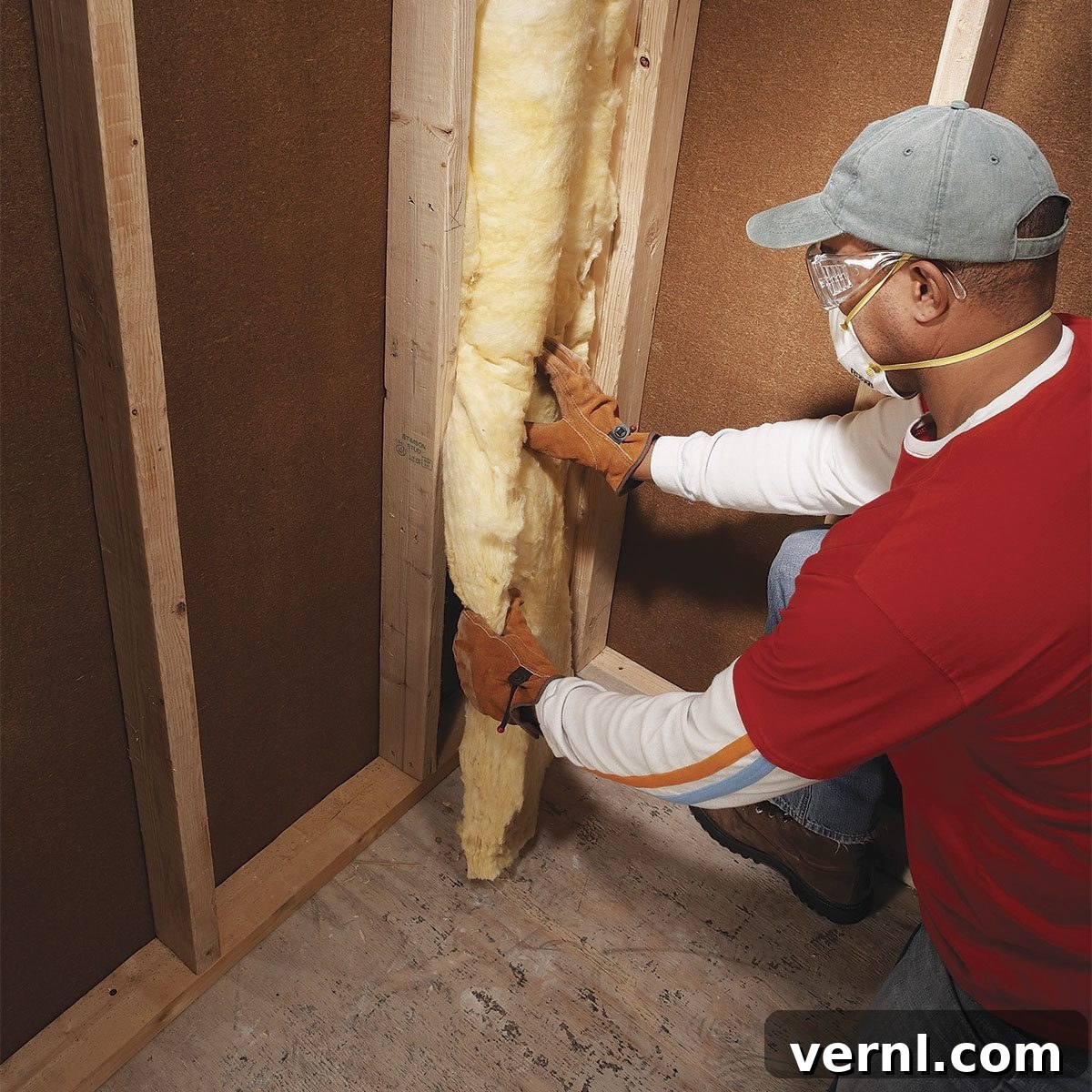
For sheds constructed with standard 2×4 framing, Kraft paper-faced fiberglass batts are often the easiest and most economical insulation method. These batts are specifically sized to fit snugly within standard framing spacing (typically 16 or 24 inches on center). Installation is relatively straightforward: you simply place the batts between the studs, joists, or rafters and staple the paper facing to the edges of the framing. The paper facing acts as a vapor barrier, which is crucial for preventing moisture migration into the wall cavity, especially in colder climates where warm, moist indoor air can condense on cold surfaces.
Pros and Cons of Fiberglass Batts:
- Pros: Relatively inexpensive, widely available at most hardware stores, easy to cut and install for DIYers, and provides good thermal performance for its cost (typically R-3 to R-4 per inch).
- Cons: Can be itchy and irritating to the skin, eyes, and lungs, requiring protective gear (gloves, mask, long sleeves) during installation. As mentioned, it can attract rodents if left uncovered, as it provides an ideal nesting material. It’s also susceptible to moisture damage if it gets wet, which can significantly reduce its effectiveness and promote mold growth.
2. Rigid Foam Sheets: A Robust and Pest-Resistant Alternative
If your shed, like many, is situated in an area prone to pests (such as a forest setting), or if you’re seeking superior moisture resistance and a higher R-value per inch, rigid foam sheets are an excellent alternative. These sheets, typically made from expanded polystyrene (EPS), extruded polystyrene (XPS), or polyisocyanurate (polyiso), are easy to cut with a utility knife to precisely fit inside the framing bays. They can be secured to the walls, ceiling, or floor with construction adhesive, specific foam-compatible fasteners, or by being friction-fit. Rigid foam boards do not offer raw material for nests, making them a less appealing habitat for rodents and insects, providing an added layer of protection for your shed’s contents.
Versatility for Non-Standard Framing:
Rigid foam sheets are particularly versatile for sheds with non-standard framing. Many store-bought models, for example, might use 2x3s instead of the more common 2x4s, making fiberglass batts difficult to fit without cutting and custom sizing. Foam sheets can be easily customized to these dimensions. It’s important to note, however, that some prefab steel or plastic sheds present unique challenges and may not be easily insulated with conventional methods due to their construction, often lacking internal framing for support.
Addressing Gaps and Seams:
Even for steel or plastic prefab sheds, rigid sheets can be a viable option, though you might encounter difficulties covering the inevitable gaps along the seams where walls and roof panels are bolted together. For a more permanent solution, especially if you intend for your shed to be a long-term addition to your property, these gaps can be sealed effectively with expanding spray foam insulation. While the aesthetic finish might not be perfectly smooth, the functional benefits are substantial: the shed will be significantly warmer in winter and cooler in summer. This is because the insulation, combined with a good air seal, deflects the radiant heat that would otherwise penetrate through the walls and roof, drastically improving the shed’s thermal performance and making it a more comfortable space.
Pros and Cons of Rigid Foam Sheets:
- Pros: Excellent R-value per inch (typically R-4 to R-7 per inch), resistant to moisture, does not provide nesting material for pests, adds structural rigidity, relatively easy to cut and install for DIYers.
- Cons: Generally more expensive than fiberglass batts, requires careful sealing of seams and gaps for optimal performance, can be less forgiving if not cut precisely, and some types require a thermal barrier (like drywall) for fire safety.
3. Spray Foam Insulation: High Performance for a Tight Seal
For the ultimate in thermal performance and air sealing, spray foam insulation is an exceptional choice. Available in both open-cell and closed-cell formulations, spray foam expands upon application, filling every nook, cranny, and crevice to create an incredibly tight, seamless thermal envelope. Closed-cell foam, in particular, offers a very high R-value per inch and acts as an excellent vapor barrier, making it ideal for extreme conditions or high-performance sheds.
Pros and Cons of Spray Foam:
- Pros: Superior air sealing, excellent R-value (closed-cell up to R-7 per inch), moisture resistance (closed-cell), adds structural integrity, resistant to pests and allergens. It effectively eliminates drafts and provides superior sound dampening.
- Cons: Highest cost among insulation options, requires specialized equipment and expertise for professional application, DIY kits can be tricky to apply evenly and safely, requires proper ventilation and personal protective equipment during application, and can be difficult to remove once applied.
Insulating the Floor, Walls, and Ceiling
To achieve comprehensive thermal control, it’s essential to insulate all six sides of your shed: the four walls, the ceiling/roof, and the floor. Each area presents specific considerations:
- Walls: This is the most common area for insulation. Ensure the material fits snugly between studs without compressing it, as compression reduces R-value. Covering with an interior finish like plywood or drywall will protect the insulation and create a finished look.
- Ceiling/Roof: Critical for preventing heat loss in winter and heat gain in summer, as heat rises and radiant heat from the sun is intense. Insulation can be installed between rafters or trusses. Proper ventilation in the attic space (if applicable) is vital to prevent moisture buildup and ensure the longevity of your roof structure.
- Floor: Often overlooked, insulating the floor can make a significant difference in comfort and energy efficiency, especially if the shed is built on piers or skids, allowing cold air to circulate underneath. Rigid foam boards are often ideal for floor insulation, installed between joists or beneath a subfloor, protected from moisture and pests.
Vapor Barriers: A Crucial Component
Regardless of the insulation type you choose, incorporating a vapor barrier is a critical step, especially in climates with significant temperature differences between inside and outside. A vapor barrier (typically a sheet of 6-mil polyethylene plastic) is installed on the “warm in winter” side of the insulation. Its purpose is to prevent moisture-laden air from migrating through the wall assembly, condensing within the insulation, and leading to mold, mildew, reduced insulation effectiveness, and structural rot. For Kraft-faced fiberglass batts, the paper facing often serves as the vapor barrier; otherwise, a separate sheet must be carefully installed, overlapping seams and sealing around penetrations.
Preparing Your Shed for Insulation
Before you even unroll your first batt or cut your first foam board, ensure your shed is properly prepared. This groundwork is essential for maximizing the effectiveness and longevity of your insulation, and skipping these steps can severely undermine your efforts.
- Seal Air Leaks: Thoroughly inspect your shed for any cracks, gaps, or holes in the walls, floor, or around windows and doors. Use high-quality caulk, expanding foam sealant, or weatherstripping to seal these openings. An unsealed shed will allow drafts and moisture to bypass your insulation, severely compromising its performance and negating much of your insulation’s benefit.
- Address Moisture Issues: Ensure your shed is completely dry and free from any existing leaks or water damage. Repair any roof leaks, seal gaps around windows, and ensure proper drainage around the shed’s foundation to direct water away. Insulation installed in a damp environment will quickly become compromised and can lead to mold and rot, creating unhealthy conditions and damaging your shed’s structure.
- Ventilation: While insulation reduces air exchange, proper ventilation is still crucial, especially if the shed will be used for activities that generate moisture or fumes, or if it will house gasoline-powered equipment. Consider installing soffit and ridge vents for passive airflow, or a small exhaust fan for active ventilation. However, ensure ventilation doesn’t counteract your insulation efforts by creating uncontrolled air leaks that allow conditioned air to escape.
- Pest Proofing: Beyond the insulation itself, take proactive steps to pest-proof your shed. Seal all entry points with sturdy materials, consider hardware cloth over vents and other openings larger than a quarter inch, and ensure a tight fit around doors and windows to deny access to rodents and insects.
DIY vs. Professional Installation
For many homeowners, insulating a shed is a manageable DIY project, especially when using fiberglass batts or rigid foam boards. These methods are relatively straightforward and require common tools. If you have basic carpentry skills and are comfortable with the safety precautions, you can often achieve excellent results. However, if your shed has complex framing, if you opt for advanced materials like spray foam insulation (which requires specialized equipment and expertise), or if you simply prefer to ensure a flawless installation without the hassle, hiring a professional insulator might be a wise investment. Professionals have the expertise, equipment, and experience to achieve optimal results, which can be particularly beneficial for maximizing energy efficiency, ensuring proper vapor barrier installation, and guaranteeing the longevity of your insulation system.
The Value of a Well-Insulated Shed
Ultimately, the decision to insulate your shed is an investment in its versatility, longevity, and your comfort. While my own shed experience demonstrated that insulation isn’t always strictly necessary in a moderate climate for a multipurpose space, the benefits it offers in harsher environments or for specific uses are undeniable. A well-insulated shed transcends its basic function, transforming a simple outbuilding into a truly functional extension of your home – a comfortable workshop, a secure storage facility for valuables, a quiet retreat, or even a cozy auxiliary living space.
By carefully considering your climate, intended use, and the items you plan to store, along with the various insulation methods available, you can make an informed decision that will significantly enhance the utility, value, and year-round enjoyment of your shed for many years to come. Don’t underestimate the power of a little insulation to turn a basic structure into a truly comfortable and high-performing space that meets all your evolving needs.