Understanding Your Car’s Check Engine Light: A Comprehensive Guide
The check engine light (CEL) is arguably the most misunderstood and anxiety-inducing warning indicator on your vehicle’s dashboard. When this little light illuminates, many drivers are instantly filled with dread, uncertainty, and often, the misguided hope that it will simply disappear on its own. However, ignoring the CEL is a critical mistake. This crucial warning means your vehicle’s Engine Control Unit (ECU) – the sophisticated computer brain of your car – has detected a problem that is either currently affecting or has the potential to affect your vehicle’s emission control system. What might seem like a minor issue, if left unaddressed, can rapidly escalate into significantly more complex and costly repairs. This guide will demystify the check engine light, explaining what it signifies, why it activates, and what proactive steps you should take to ensure your vehicle’s health and your peace of mind.
What Is the Check Engine Light (and Its Symbol)?
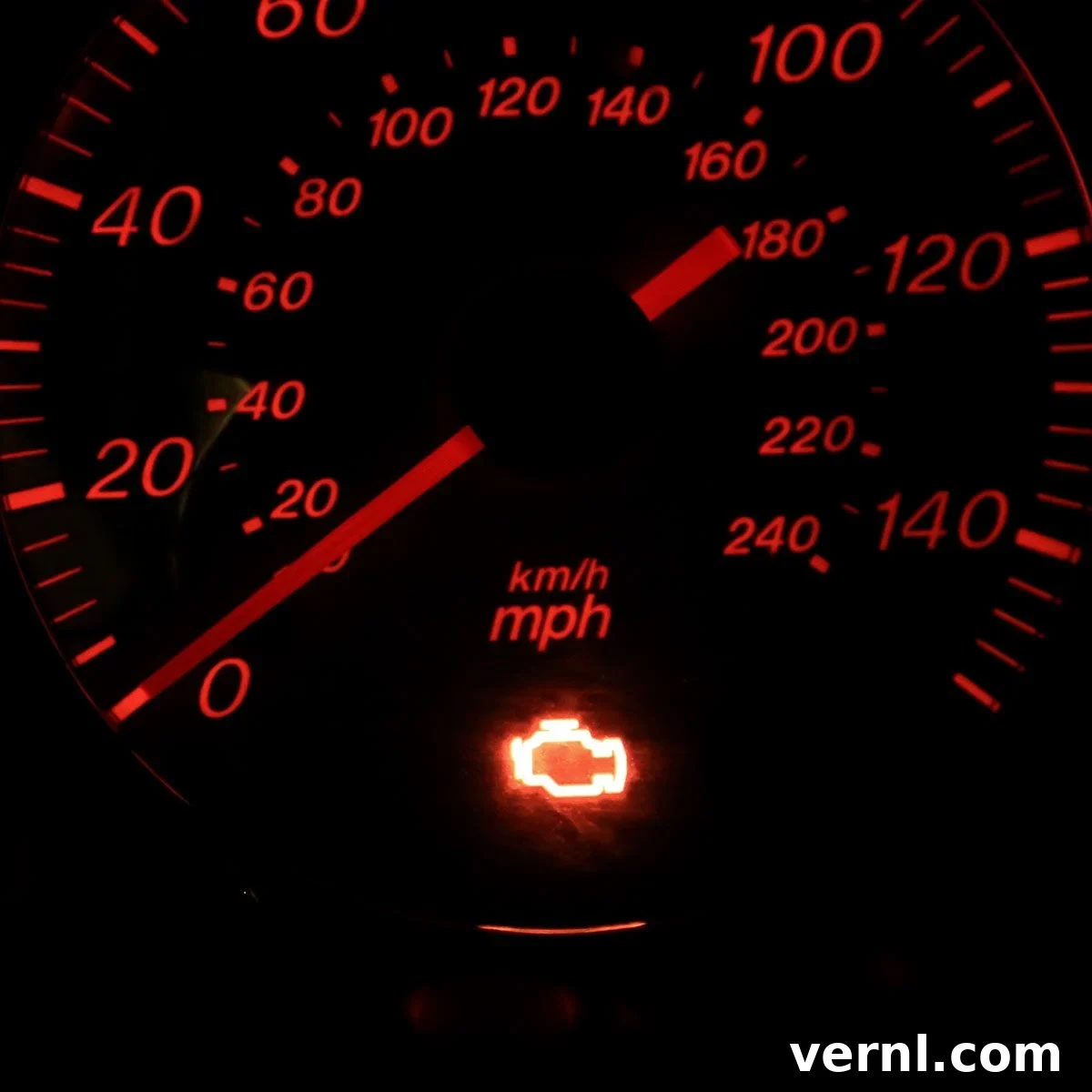
Universally recognized as the International Check Engine Symbol, the CEL manifests as a distinctive engine-shaped warning indicator on your instrument cluster. While its shape remains consistent across most vehicles, its color can vary, typically appearing in yellow, amber, or orange. Beyond the iconic engine graphic, you might also see accompanying text labels such as “Check Engine,” “Service Engine Soon,” “Check Powertrain,” or simply “Check.” In some minimalist designs, the light might appear without any label, or just the label without the engine graphic, though the engine icon is most common. Regardless of its specific appearance, its message is always the same: your car’s computer has identified an issue.
The Brain Behind the Light: Understanding the ECU and Sensors
To truly grasp why the check engine light illuminates, it’s essential to understand the intricate network of systems it monitors. At the heart of this system is the Engine Control Unit (ECU), a powerful computer that constantly monitors and regulates nearly every aspect of your engine’s performance. It receives data from dozens of sensors strategically placed throughout your vehicle. These sensors act as the ECU’s eyes and ears, providing real-time information on critical parameters such as:
- Oxygen Levels: Measured by O2 sensors in the exhaust.
- Airflow: Measured by the Mass Air Flow (MAF) sensor entering the engine.
- Engine Temperature: Monitored by coolant temperature sensors.
- Engine Speed and Position: Tracked by crankshaft and camshaft position sensors.
- Throttle Position: Detected by the throttle position sensor.
- Fuel Pressure: Monitored to ensure proper fuel delivery.
The ECU uses this vast amount of data to make precise, instantaneous adjustments to fuel delivery, spark timing, and even automatic transmission shifting. This constant fine-tuning ensures optimal fuel economy, peak performance, and minimal emissions. When any of these sensors transmit data that falls outside the ECU’s predefined operating parameters, or if a sensor itself fails, the ECU registers an anomaly. This discrepancy is the trigger for the check engine light.
Why Does the Check Engine Light Turn On? A Deeper Dive
The fundamental reason for the CEL’s illumination is that one or more engine sensors are sending abnormal or implausible data to the ECU. This doesn’t necessarily mean the sensor itself is faulty; it could be accurately reporting a problem with a mechanical component it’s monitoring. For instance, an O2 sensor might be working perfectly, but it’s reporting incorrect oxygen levels because the catalytic converter is failing, or there’s an exhaust leak. The problem could be a failed or failing mechanical component (like a failing spark plug causing a misfire) or the sensor providing the suspicious data could itself be malfunctioning.
Crucially, when the CEL turns on, the ECU doesn’t just illuminate the light; it also stores a specific “Diagnostic Trouble Code” (DTC) in its memory. These alphanumeric codes, standardized across all OBD-II (On-Board Diagnostics, second generation) compliant vehicles (generally 1996 and newer), act as clues, pointing technicians toward the specific system or component where the fault was detected. While the CEL being on often means there’s an issue with the emissions control system, it can indicate a wide array of problems, from trivial to severe.
If your CEL comes on but you notice no immediate drivability problems – no strange noises, no loss of power, no smoke – you can usually continue driving your vehicle for a short period. However, it is paramount to have your vehicle checked out by a qualified mechanic or diagnose the problem yourself using a scan tool as soon as possible. Delaying diagnosis can transform an inexpensive fix into a costly repair or, worse, lead to further damage.
The Urgency of a Flashing Check Engine Light
While a steady check engine light warrants prompt attention, a flashing check engine light is an entirely different matter and signals a critical situation. A flashing CEL indicates a severe drivetrain problem that is actively causing, or has the potential to cause, irreversible damage to vital and expensive components such as the engine itself, the catalytic converter, or the transmission. This usually means a severe engine misfire is occurring, allowing unburned fuel to enter the exhaust system, which can quickly overheat and destroy the catalytic converter. Continuous driving with a flashing CEL is highly inadvisable and will almost certainly lead to extensive damage.
If your check engine light begins to flash, you should stop driving the car immediately and safely pull over to the side of the road as soon as possible. Turn off the engine. In some instances, the computer may engage a protective measure known as “Limp Home Mode” (also known as “fail-safe mode” or “limp mode”). This mode intentionally reduces engine power, limits engine RPMs, and alters transmission shifting patterns to protect the drivetrain from further damage caused by missing or out-of-parameter data. While Limp Home Mode might allow you to cautiously drive a very short distance to a nearby repair shop or home, it is always safer to call for a tow service to prevent exacerbating the damage. Do not attempt to continue your journey if the light is flashing.
Common Culprits: Detailed Causes of a Check Engine Light
Here are some of the most frequent and common reasons your check engine light might illuminate, ranging from simple fixes to more complex issues:
-
Loose, Damaged, or Missing Gas Cap
This is often the simplest and least expensive cause of a CEL. Your gas cap is not just for keeping fuel in; it’s an integral component of your vehicle’s Evaporative Emission Control (EVAP) system. This system is designed to prevent fuel vapors from escaping into the atmosphere. A loose, damaged, or missing gas cap can cause a pressure leak within the fuel system, which the ECU interprets as an emission system fault. The seals on gas caps can also wear out over time. Try retightening the cap until it clicks. If the light persists after a few drive cycles, consider replacing it, especially if it’s several years old.
-
Failed or Failing Oxygen (O2) Sensors
Oxygen sensors are critical input sensors that measure the amount of unburned oxygen in your exhaust gases. This data is vital for the ECU to accurately adjust the air-fuel mixture for optimal combustion and lower emissions. O2 sensors can fail due to age, contaminants (such as bad fuel, raw unburned fuel, oil silicates, or coolant) entering the exhaust, or even physical damage. A failing O2 sensor can lead to a rich or lean fuel mixture, resulting in decreased fuel economy, increased emissions, poor engine performance, and potentially damage to the catalytic converter.
-
Spark Plugs, Spark Plug Wires, or Ignition Coil Issues
These components are essential for igniting the air-fuel mixture in your engine’s cylinders. Problems with any of them can lead to engine misfires, which are a common cause of a flashing CEL. Worn, incorrect, or cracked spark plugs; worn, damaged, or shorted spark plug wires; or an open, shorted, or damaged ignition coil(s) can result in incomplete combustion. When fuel doesn’t burn completely, raw, unburned fuel exits the combustion chamber and enters the exhaust system. This raw fuel can rapidly overheat and severely damage the oxygen sensors and, most critically, the expensive catalytic converter.
-
Catalytic Converter Failure
The catalytic converter is a vital emissions control device that converts harmful pollutants in exhaust gases into less toxic substances. It’s usually located in the exhaust system between the engine and the muffler. Catalytic converter failure is often not the initial problem but rather the expensive consequence of other underlying issues, such as prolonged engine misfires (leading to raw fuel entering the exhaust), excessive oil consumption, or antifreeze entering the exhaust system. A bad catalytic converter can cause the CEL to come on, but it can also result in noticeable drivability issues, including a significant lack of power, poor acceleration, reduced fuel efficiency, and sometimes a strong sulfur or “rotten egg” smell from the exhaust. Replacing a catalytic converter is typically one of the most expensive repairs.
-
Mass Air Flow (MAF) Sensor Failure
The MAF sensor measures the amount and density of air flowing into the engine. This data is crucial for the ECU to calculate the correct amount of fuel to inject for optimal combustion. A contaminated or failed MAF sensor cannot accurately measure incoming air, sending incorrect data to the ECU and triggering the CEL. Contamination often occurs from dirty air filters. Symptoms of a faulty MAF sensor can include a rough idle, stalling, poor acceleration, a “rich” (too much fuel) or “lean” (not enough fuel) condition, or possibly even a no-start condition. Sometimes, cleaning a lightly contaminated MAF sensor with a specialized MAF cleaner can resolve the issue, but often replacement is necessary.
-
Vacuum Leaks
Modern engines rely on a precisely controlled vacuum system for various functions, including brake boost, PCV (Positive Crankcase Ventilation), and EVAP (Evaporative Emission Control). A vacuum leak occurs when air enters the engine system from an unintended source, bypassing the MAF sensor. This “unmetered” air throws off the air-fuel mixture, causing the engine to run lean. Common sources of vacuum leaks include cracked or deteriorated hoses, loose connections, or failing intake manifold gaskets. Symptoms can include a rough idle, engine surging, a whistling sound, or a general reduction in engine performance.
-
EGR Valve Issues (Exhaust Gas Recirculation)
The EGR valve plays a critical role in reducing nitrogen oxide (NOx) emissions by recirculating a small portion of exhaust gases back into the engine’s combustion chambers. This process lowers combustion temperatures, thereby reducing NOx formation. Over time, the EGR valve can become clogged with carbon deposits, preventing it from opening or closing properly. A stuck-open or stuck-closed EGR valve will trigger the CEL and can lead to symptoms like rough idle, engine hesitation, increased emissions, or even engine knocking.
-
Aftermarket Accessories
While seemingly harmless, poorly installed aftermarket accessories such as alarms, light kits, or sound systems can wreak havoc with your vehicle’s sensitive computer systems. Modern cars are highly integrated and very particular about their electrical systems. Incorrect wiring, splicing into critical emission control system wires, or excessive current draw can confuse the ECU. This can lead to the CEL triggering by either causing voltage fluctuations, draining the battery, or interfering with essential sensor signals. It’s crucial to have aftermarket components professionally installed to avoid such issues.
Diagnosing the Problem: Your Next Steps
When the check engine light illuminates, your primary goal is to identify the underlying cause. The first and most crucial step is to retrieve the Diagnostic Trouble Codes (DTCs) stored by the ECU. These codes provide a specific starting point for diagnosis.
You have a couple of options for reading these codes:
- Professional Service: The most reliable method is to take your vehicle to a reputable mechanic or dealership. They have advanced diagnostic tools and the expertise to not only read the codes but also interpret them correctly and perform further diagnostics to pinpoint the exact issue.
- DIY with an OBD-II Scanner: You can purchase an OBD-II code reader or scan tool. These devices plug into your vehicle’s diagnostic port, usually located under the dashboard on the driver’s side. Once plugged in, the scanner will display the trouble codes. You can then search for these codes online (e.g., “P0420 meaning”) to get an initial understanding of the potential problem. Remember that a code points to a system, not necessarily a specific part. For example, a “P0420 – Catalytic Converter Efficiency Below Threshold” code indicates a catalytic converter issue, but the root cause might be an upstream O2 sensor or prolonged misfires, not the converter itself.
Can You Reset/Turn Off the Check Engine Light Yourself?
Sometimes, the CEL will go off by itself if the problem was intermittent or resolved (e.g., after tightening a loose gas cap). However, this doesn’t mean there isn’t a problem, and the code will likely remain stored in the ECU’s history. To avoid potentially expensive future repairs, it’s always best to have the trouble codes read even if the light extinguishes on its own.
Once a problem has been fixed, a scan tool typically has the ability to “clear” the code(s), turning off the CEL. Be warned, however, that simply clearing a code without addressing the underlying issue is a temporary fix at best. The light will inevitably return once the ECU redetects the fault. While there are sometimes procedures that may clear trouble codes and reset the CEL without a dedicated scan tool (such as disconnecting the battery for a short period), this is generally something best left to the pros. Disconnecting the battery can reset other vehicle systems, erase learned engine parameters, and sometimes even lock your radio, requiring a code to reactivate.
For any persistent or, more importantly, flashing check engine light, professional diagnosis is highly recommended. Automotive systems are increasingly complex, and a proper diagnosis can save you significant time, money, and potential damage down the line.
Conclusion: Don’t Ignore the Warning
The check engine light is not merely an inconvenience; it’s your vehicle’s way of communicating a critical message. Understanding its significance, recognizing the difference between a steady and a flashing light, and taking prompt, informed action can save you from costly repairs, maintain your vehicle’s performance, ensure its longevity, and protect the environment. Never ignore the CEL. By paying attention to this vital dashboard indicator and addressing potential issues proactively, you can keep your vehicle running smoothly and safely on the road for years to come.