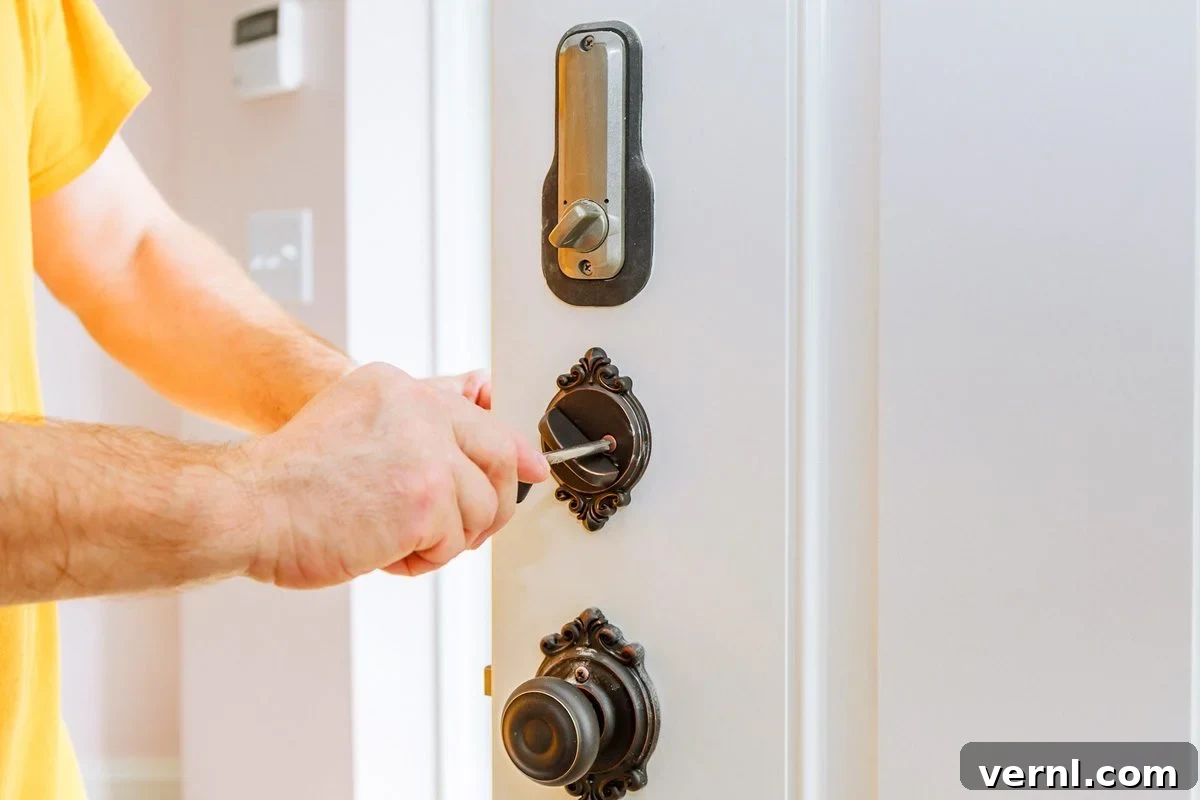
Deadbolt vs. Door Knob Lock: Fortifying Your Home’s First Line of Defense
Ensuring the security of your home is not just a preference; it’s a necessity. The stark reality of home intrusions highlights the importance of robust security measures. According to data from the FBI Crime Data Explorer, a staggering almost 300,000 residences in the United States were burglarized over a two-year period from 2023 to 2024. More broadly, the total value of stolen goods across the U.S. during this time soared past $2 trillion, underscoring the significant financial and emotional toll property crime can take.
These figures serve as a powerful reminder that proactive steps are crucial for safeguarding your peace of mind, your valuables, and the safety of your loved ones. As you delve into enhancing your home’s defenses, one of the most fundamental decisions you’ll face is choosing the right locking mechanism for your doors. This often leads to a crucial comparison: the security provided by a deadbolt versus a standard door knob lock. To help you navigate this vital choice, we’ve gathered insights from a panel of seasoned professionals, including a locksmith, a home repair specialist, a door manufacturer, and two dedicated home security experts.
Our experts will guide you through the intricacies of each lock type, helping you determine whether you need the combined strength of both, or if one alone suffices, and if so, which option offers the superior protection you seek. By the end of this comprehensive guide, you’ll be equipped with the knowledge to make an informed decision and significantly bolster your home’s security posture.
Understanding Door Knob Locks and Deadbolts: What Are They?
Before we dive into the comparison, it’s essential to understand the fundamental characteristics and functions of both door knob locks and deadbolts. While both serve as locking mechanisms, their design, operation, and security levels vary significantly.
The Standard Door Knob Lock: Convenience Meets Basic Security
Virtually every swinging door in a home features a doorknob, but not all doorknobs incorporate a locking mechanism. Those that do are commonly referred to as locksets. These are the typical locks you’ll find on entry doors, as well as many interior doors like those leading to bedrooms or bathrooms. A lockset can be operated via a traditional key, a digital keypad, or in more modern systems, wirelessly through smart home controls. When locked, the knob or handle is designed to either prevent turning or to disengage from the internal latching mechanism, thereby securing the door.
The core of a door knob lock’s security lies in its latch. This latch is typically a half-inch to three-quarter-inch barrel that is spring-loaded and beveled on one side. When you close the door, the beveled edge allows the latch to retract automatically as it makes contact with the door frame, then springs forward into a pre-drilled hole in the jamb. This hole is usually reinforced by a metal strike plate. While convenient, this spring-loaded design is also its primary vulnerability. A common break-in technique, known as “jimmying,” involves forcing the spring-loaded barrel back into the door using a thin, flat object like a credit card or a pry tool, allowing the door to open without a key. This inherent design flaw makes standard door knob locks relatively easy to bypass for a determined intruder.
The Robust Deadbolt: Unyielding Strength for Maximum Protection
A deadbolt, in contrast, is a distinct locking mechanism engineered for superior security. It may be installed as a standalone unit above or below a door knob lock, or sometimes integrated within a more complex lockset. The defining feature of a deadbolt is its solid, rectangular barrel bolt, which extends an inch or more deep into the door jamb. Unlike the spring-loaded latch of a doorknob lock, a deadbolt’s bolt is not beveled and does not retract automatically. It requires manual operation—either by turning a key, inputting a code on a keypad, or using a mobile app for smart deadbolts—to extend or retract the bolt.
This design makes a deadbolt significantly more resistant to forced entry. Because the bolt is not spring-loaded, it cannot be “jimmyed” back with a thin tool. Its greater length and solid construction mean it withstands greater force, making it highly effective against kick-ins and prying attempts. On the exterior, operation typically involves a key or keypad, while on the interior, there’s usually a thumb-turn lever or a keypad for quick manual egress. Modern deadbolts can also feature advanced security measures like pick-resistant cylinders and reinforced strike plates, further enhancing their protective capabilities.
Key Differences Between Deadbolts and Door Knob Locks
Understanding the core differences is crucial for making an informed decision about your home security. Here’s a breakdown of the distinct characteristics:
- Locking Mechanism: A door knob lock uses a spring-loaded, beveled latch that retracts upon contact with the door frame and can often be forced back. A deadbolt employs a solid, non-spring-loaded bolt that must be manually extended into the door frame, making it resistant to prying and forcing.
- Security Level: Deadbolts offer a significantly higher level of security compared to door knob locks. The spring-loaded nature of doorknob latches makes them vulnerable to common bypass methods.
- Installation: Door knob locks are typically straightforward to install, often fitting into pre-drilled holes. Deadbolts, especially those installed separately, may require additional drilling for the bolt mechanism and strike plate, sometimes benefiting from professional installation.
- Primary Function: Door knob locks are primarily designed for convenience and basic privacy/security, suitable for interior doors and as a secondary lock on exterior doors. Deadbolts are engineered specifically for robust security against forced entry, serving as the primary deterrent for exterior doors.
- Resistance to Attack: Deadbolts are highly resistant to jimmying, kicking, and drilling, particularly when paired with reinforced strike plates and door frames. Door knob locks offer minimal resistance to these methods.
Do I Really Need Both a Deadbolt and a Door Knob Lock?
The question of whether to install both a deadbolt and a door knob lock on your entry doors is a common one, and the answer often depends on several factors, including the material of your door, your personal security concerns, and convenience. While some argue that one robust lock might suffice, many experts advocate for a layered security approach.
According to locksmith Bryan Runk, the material of your door plays a significant role. He suggests that if your door is made from a sturdy material like solid wood or steel, you might be able to get by with just one high-quality locking mechanism. However, for doors constructed from lightweight materials, Runk strongly recommends a combination of a deadbolt and a keyed handle or knob. This combination provides a crucial layer of security that a lighter door might otherwise lack.
Security expert Jeff Ketelaars further emphasizes this point: “Ultimately, having both sets of locks along with security cameras and an integrated security system is best for anyone looking to defend their home.” This perspective highlights that a multi-faceted approach, where locks work in conjunction with other security technologies, offers the most comprehensive protection against potential threats. Two distinct locking mechanisms present a greater challenge to intruders, buying valuable time and often deterring them entirely.
However, it’s equally important to weigh this enhanced security against practical considerations like convenience and emergency safety. Having to manipulate two separate locks can be a minor inconvenience in your daily routine, especially when your hands are full with groceries or children. Door manufacturer Myles Robinson also points out a critical safety concern: in an emergency, such as a fire, having to unlock two mechanisms could slow down your exit from the house, potentially putting lives at risk. This balance between maximum security and practical usability is key to choosing the right system for your home.
Deadbolt vs. Door Knob Lock: Which Offers Superior Security?
On the question of which lock offers superior security, there is an unequivocal consensus among security professionals: the deadbolt. Our panel of experts unanimously agrees with home repair pro Rick Berres, who states, “In terms of security, you really want the deadbolt, particularly if we’re talking about doors leading outside. They’re sturdier and hold better in case of a forced entry attempt or a break-in attempt.”
The reasons for the deadbolt’s superior security are rooted in its design. Unlike the spring-loaded latch of a door knob lock, a deadbolt’s solid, non-spring-loaded bolt extends deep into the door frame, making it far more resistant to various forms of attack:
- Resistance to Jimmying: Because the deadbolt lacks a beveled, spring-loaded latch, it cannot be easily pushed back into the door using a credit card or similar tool.
- Resistance to Kick-Ins: The longer throw of a deadbolt’s bolt (typically 1 inch or more) provides a much stronger anchor within the door frame compared to the shorter latch of a door knob lock. This makes it significantly harder to kick the door open without destroying the door frame itself.
- Resistance to Prying: The solid bolt and often reinforced strike plate of a deadbolt stand up much better to attempts to pry the door open from the frame.
- Resistance to Picking (for high-quality deadbolts): While no lock is entirely pick-proof, many high-security deadbolts incorporate features like complex pinning or anti-drill plates that make them much harder to pick or drill through than standard door knob locks.
For any exterior door that serves as an entry point to your home, a deadbolt is not merely an upgrade; it’s a fundamental requirement for effective protection against intruders.
Pros and Cons of Having Both a Deadbolt and a Door Knob Lock
When considering the comprehensive security of your home, combining a deadbolt with a door knob lock offers a multifaceted approach. Security advisor Laura Finson sees significant advantages to this dual-lock system. “None at all,” she replied when asked about drawbacks. “In fact, pairing a doorknob lock with a deadbolt adds an extra layer of security, without complicating your daily routine.”
Pros of Dual Lock Systems
- Enhanced Security Layer: A deadbolt and a door knob lock together create a formidable barrier. If an intruder manages to bypass one lock, they still have another to contend with, significantly increasing the time and effort required for a break-in. This layered defense is often enough to deter opportunistic burglars.
- Increased Deterrence: As Finson notes, “Burglars often look for easy wins, and a home without a visible deadbolt looks like one. A strong, secure deadbolt makes them think twice.” The visible presence of two locks signals a higher level of security, making your home a less appealing target.
- Redundancy: In the rare event that one lock mechanism fails or is compromised, the other still provides a measure of security, preventing a complete security breach.
- Flexibility: The door knob lock can be used for quick, casual locking when you’re just stepping out for a moment, while the deadbolt provides robust security for longer absences or nighttime.
Cons of Dual Lock Systems
- Inconvenience: As discussed, unlocking two separate mechanisms can be cumbersome, especially when carrying items or trying to enter quickly. This is particularly true if you need two different keys.
- Emergency Egress Concerns: In an emergency situation like a fire, having to unlock two mechanisms can delay exit, which could be critical for safety.
- Increased Cost: Purchasing and potentially installing two quality locks will naturally be more expensive than just one.
- Overkill for Interior Doors: As home repair pro Rick Berres points out, for most interior doors, “you’re going to get annoyed having both when it’s really not necessary.” The added security isn’t typically justified for internal rooms unless they guard highly valuable items or sensitive areas.
- Managing Multiple Keys: While a common drawback, this can often be mitigated by having both locks “keyed alike,” meaning a single key can operate both mechanisms.
Pros and Cons of Only Having a Deadbolt
For those prioritizing ultimate security without the perceived hassle of a dual system, opting for only a deadbolt can be a viable choice, particularly on sturdy doors. As Jeff Ketelaars wisely states, “It’s a balance of security and convenience.”
Pros of Only a Deadbolt
- Simplicity and Ease of Management: A single lock system means fewer keys to manage and a simpler entry/exit routine. This is especially beneficial if you’re prone to losing keys or prefer a minimalist approach. If you are going to have just one lock on an exterior door, it should unequivocally be a deadbolt.
- Strong Visual Deterrent: A visible, robust deadbolt signals to potential intruders that your home is well-protected, often causing them to seek an easier target.
- Adequate Security (with a Sturdy Door): For doors made of solid wood, metal, or composite materials, a high-quality deadbolt alone can provide a formidable level of security against most common break-in attempts. It offers superior resistance to forced entry compared to any door knob lock.
- Cost-Effective Security: Investing in one premium deadbolt can be a more focused and effective use of your security budget than two lesser-quality locks.
Cons of Only a Deadbolt
- Single Point of Failure: Relying on just one lock, even a strong deadbolt, means that if that single mechanism is compromised (e.g., through advanced lock picking or a brute-force attack), your home’s security is entirely breached. “A single lock can be a single point of failure,” cautions Laura Finson, “especially to a determined intruder.”
- No Secondary Mechanism: Unlike a dual system, there’s no backup lock to provide an additional layer of resistance or redundancy if the primary lock is defeated.
- Potential Overkill for Interior Doors: While essential for exterior doors, a deadbolt on an interior door is generally excessive unless that door leads to a secure area housing valuables or sensitive information. For typical bedroom or bathroom doors, a simple privacy lock is usually sufficient.
- Less Convenient for Casual Use: If the deadbolt is key-operated on both sides (double-cylinder), it might be less convenient for quick exits, although most residential deadbolts feature a thumb-turn on the interior.
Pros and Cons of Only Having a Door Knob Lock
While commonly found on almost all doors, relying solely on a door knob lock for exterior security is generally not recommended by security experts. However, there are scenarios where they are appropriate, primarily for interior use.
Pros of Only a Door Knob Lock
- Cost-Effective: Door knob locksets are generally less expensive to purchase and install than deadbolts, making them a budget-friendly option.
- Simple Installation: They are typically easy for a DIY enthusiast to install, often fitting into standard pre-drilled holes in most doors.
- Convenience and Ease of Use: Many door knob locks auto-latch when the door closes, offering quick and effortless securing. They are simple to operate for everyday use.
- Suitable for Interior Privacy: For bedrooms, bathrooms, or other interior rooms where privacy is the primary concern rather than high security against forced entry, a door knob lock is perfectly adequate.
Cons of Only a Door Knob Lock
- Low Security: This is the most significant drawback. Door knob locks are inherently less secure due to their spring-loaded, beveled latch. They are highly susceptible to “jimmying” with a credit card or similar tool.
- Vulnerable to Forced Entry: They offer minimal resistance to kick-ins, prying attempts, or even simple drilling techniques, making them a weak point in your home’s defense.
- False Sense of Security: Relying solely on a door knob lock for an exterior door can provide a false sense of security, potentially leaving your home vulnerable to even casual intruders.
- Not Recommended for Exterior Entry Points: Due to their inherent weaknesses, door knob locks should never be the sole locking mechanism on any exterior door. They should, at best, serve as a secondary lock when paired with a robust deadbolt.
Factors to Consider When Choosing Your Door Security
Selecting the right door locking mechanisms is a critical decision that should be tailored to your specific needs and circumstances. Consider the following factors:
- Door Material and Strength: A solid wood or steel door can support robust locks better than a hollow-core or lightweight composite door. The strength of the door and its frame directly impacts the effectiveness of any lock.
- Location of the Door: Exterior doors absolutely require maximum security (deadbolts). Interior doors primarily need privacy and basic security (door knob locks suffice).
- Your Budget: High-quality locks come at a price. Balance your desired security level with what you are willing to invest. Remember, a single high-quality deadbolt can be more effective than two cheap locks.
- Convenience and Lifestyle: Consider how often you enter and exit, and whether fumbling with multiple keys or complex operations fits your daily routine. Emergency egress is also a crucial safety consideration.
- Aesthetics: Locks are also part of your home’s visual appeal. Choose finishes and styles that complement your door and home decor.
- Smart Home Integration: If you’re building a smart home, consider smart deadbolts or locksets that can be controlled remotely, offer keyless entry, or integrate with other security systems.
- Insurance Requirements: Some homeowner insurance policies may offer discounts for certain security features, or even require specific lock types to validate coverage against theft.
- Personal Risk Assessment: Evaluate your neighborhood’s crime rate, the value of your possessions, and your personal comfort level with security. Are you a high-target home, or do you just want basic deterrence?
Installation and Maintenance Tips for Optimal Security
Even the best locks won’t provide adequate security if they are improperly installed or poorly maintained. Here are some tips:
- Professional Installation: For deadbolts on exterior doors, especially if additional drilling is required, consider hiring a professional locksmith. Proper alignment of the bolt with the strike plate is crucial for maximum security.
- Reinforce the Strike Plate: For exterior doors, always use a heavy-duty, reinforced strike plate with long screws (3 inches or more) that penetrate into the wall studs of the door frame. This significantly increases resistance to kick-ins.
- Strong Door Frame: A deadbolt is only as strong as the door frame it secures into. Ensure your door frame is solid and in good condition.
- Regular Lubrication: Apply a dry lubricant (like graphite powder) to the lock cylinders periodically to keep them functioning smoothly and prevent wear and tear.
- Check for Wear and Tear: Inspect your locks regularly for any signs of damage, looseness, or corrosion. A worn-out lock is a vulnerable lock.
- Key Management: Be mindful of who has copies of your keys. Consider rekeying locks if keys are lost or if you move into a new home.
Conclusion: A Layered Approach for Uncompromised Home Security
In the ongoing battle against home intrusion, the choice between a deadbolt and a door knob lock is more than just a preference—it’s a critical decision that directly impacts your home’s resilience. While door knob locks offer convenience for interior doors and a basic secondary layer for exterior ones, it is the deadbolt that stands as the undisputed champion of robust security, providing unparalleled resistance to forced entry.
Ultimately, the consensus among our experts points towards a layered approach for optimal home security. For any exterior door, the combination of a high-quality deadbolt and a door knob lock, ideally keyed alike for convenience, offers the strongest deterrent and defense. This dual-lock system, integrated with other security measures such as surveillance cameras and alarm systems, creates a formidable barrier that protects your property and, more importantly, provides invaluable peace of mind for you and your family.
Take the time to assess your specific security needs, evaluate your door types, and invest wisely in quality locking mechanisms. Your home is your sanctuary; ensure it’s protected with the best possible defenses.
About the Experts
- Jeff Ketelaars is a seasoned security expert with over 35 years in the industry. He co-founded Security Guards Only, a networking platform for security professionals to connect and stay informed on industry developments.
- Laura Finson is the Director of Product and Strategy at Brinks Home Security.
- Rick Berres has been in the home construction and remodeling business for 18 years. He is the owner of Honey-Doers based in Lakeville, MN
- Myles Robinson is the founder and owner of UK Composite Doors. He has extensive experience in home maintenance, remodeling, DIY and improvements.
- Bryan Runk has been in the locksmithing business for over 10 years. He is the owner of Bryman’s Locksmith in Dublin, Ohio.
Sources
- FBI Crime Data Explorer: Expanded Property Reported in the United States; (2025)
Related Articles:
- How To Strategically Place Your Security Cameras for Maximum Safety
- The Legal Dos and Don’ts of DIY Home Security Systems
- Why a No-Subscription Home Security System Might Be Perfect for You