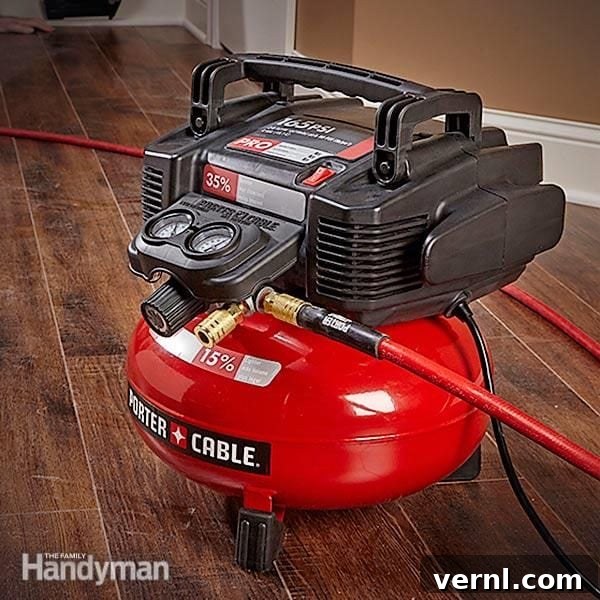
Stepping into the market for a small air compressor can feel like entering a technical labyrinth. Manufacturers often plaster their products with an array of specifications and acronyms that can be overwhelming for even experienced DIY enthusiasts. However, understanding these terms is crucial to making an informed decision. This comprehensive guide aims to demystify the technical jargon, highlight which specifications truly matter, and ultimately help you select the ideal portable air compressor that perfectly aligns with your project needs.
It’s important to set realistic expectations from the outset: small air compressors are designed for specific tasks. They excel at powering lighter-duty tools such as brad nailers, finish nailers, staplers, and for various inflation tasks. However, if your projects frequently involve air-hungry power tools like heavy-duty pneumatic impact wrenches, orbital sanders, or professional paint sprayers, a much larger, stationary compressor will be a more suitable and efficient investment. This guide focuses specifically on helping you find the perfect companion for your more manageable, yet equally important, DIY and workshop tasks.
CFM Is the Cornerstone: Understanding Air Delivery for Your Small Compressor
When evaluating a small air compressor, the most critical specification you’ll encounter is CFM, which stands for “cubic feet per minute.” This number directly quantifies how quickly the compressor can supply air to your pneumatic tools. In simple terms, CFM is the heartbeat of your air compressor; it dictates its performance capacity. If your tool demands air faster than the compressor can deliver it, you’ll inevitably experience frustrating interruptions, forcing you to pause your work and wait for the compressor’s tank to refill.
Manufacturers adhere to a consistent testing standard, rating their compressors’ CFM at 90 pounds per square inch (psi). This 90 psi benchmark is significant because it represents an average operating pressure for many common pneumatic tools, particularly nail guns. This standardization ensures that when you compare CFM ratings across different brands and models, you are indeed comparing “apples to apples,” allowing for a fair and accurate assessment of their true air delivery capabilities. For most general-purpose DIY tasks involving nailers or small impact wrenches, a CFM rating of 2-4 at 90 psi is a good starting point, but always check the specific CFM requirement of your most demanding tool to avoid performance bottlenecks. Prioritizing CFM will ensure a smoother, more efficient workflow for all your pneumatic applications.
Tank Size: More Than Just a Number
While CFM tells you how fast air is produced, the tank size of your small air compressor indicates how much air it can store. Most portable units typically feature tanks ranging from 1 to 6 gallons. A larger tank serves as a bigger reservoir, allowing you to use more air before the internal pressure drops to a point where the motor is triggered to restart and replenish the supply. For tasks that require short, intermittent bursts of air, a larger tank can be incredibly beneficial, potentially allowing you to complete a series of operations without interruption.
Consider framing a small wall or inflating multiple tires; a larger tank might provide enough stored air to finish the job without the motor cycling on and off excessively. This can be especially advantageous in situations where noise is a concern or when working in areas without readily available power. However, it’s crucial to understand a fundamental principle: a generously sized tank is never a substitute for adequate CFM. If your application demands a high, continuous volume of air, even the largest tank will eventually deplete, and if the CFM output isn’t sufficient to keep up with the demand, you’ll still experience frustrating pauses. The tank merely delays the inevitable motor kick-on; it doesn’t increase the compressor’s fundamental air production rate. Therefore, assess your typical usage: if you frequently perform short-burst tasks, a larger tank is a bonus. If continuous air flow is paramount, CFM remains your primary consideration.
PSI: Often Overstated for DIY, But Has Its Place
PSI, or “pounds per square inch,” measures the maximum pressure an air compressor can generate. For the vast majority of DIY projects and typical home workshop tools, most modern small air compressors provide more than sufficient pressure. Tools like nail guns, staplers, and even tire inflators generally operate well within a common pressure range, making a compressor’s maximum PSI rating less of a critical factor in your purchasing decision than CFM. In essence, you’ll likely have enough pressure for nearly any task a small compressor is designed for.
However, a higher maximum PSI rating does offer a distinct advantage related to air storage. A tank capable of holding air at a higher pressure can effectively store more usable air volume than a lower-PSI tank of the same physical size. For example, a 2-gallon tank rated at 150 psi can hold roughly the same amount of compressed air as a 3-gallon tank rated at 100 psi. This translates to greater efficiency in a more compact package, allowing a smaller, lighter compressor to perform like a larger unit in terms of available air before the motor needs to cycle. So, while you might not directly need 150 psi for your tools, a higher max PSI can contribute to a more compact yet capable portable air compressor, making it an appealing feature for those prioritizing portability and space-saving design without sacrificing usable air capacity.
Taming the Roar: Understanding Compressor Noise Levels
One of the most common complaints about air compressors, especially smaller models, is their noise level. The decibel (dB) scale, which measures sound intensity, isn’t linear like many scales you might be familiar with; it’s logarithmic. This means that seemingly small increases in decibels represent significant jumps in perceived loudness. For instance, an increase of just 10 dB doubles the perceived level of noise. A machine rated at 70 dB is twice as loud as one rated at 60 dB. Extending this further, an 80-dB machine is four times as loud as a 60-dB unit. This logarithmic nature highlights why even a modest reduction in decibel rating can dramatically improve the user experience and make a quiet air compressor far more pleasant to operate, especially in residential areas or enclosed workshops.
Many modern manufacturers are now focusing on producing “low noise” or “ultra-quiet” small air compressors, with ratings often dropping into the 60-70 dB range, or even lower for some premium models. For context, a normal conversation is around 60 dB, while a lawnmower is typically 90 dB. Investing in a quieter model can significantly reduce operator fatigue, allow for conversations nearby, and prevent disturbances to neighbors. Always check the dB rating before purchasing, as operating a loud compressor for extended periods can be tiresome and even damaging to hearing without proper protection.
Portability: Beyond Just the Weight
When selecting a portable air compressor, weight is undeniably a crucial factor, but it’s far from the only determinant of true portability. The physical shape and overall design of the unit play an equally significant role in how easy it is to transport and maneuver. A compressor designed with a slim, compact profile is generally the easiest to carry, allowing you to navigate tight spaces, store it conveniently, and transport it to various job sites with minimal effort. These units often feature well-placed handles that provide a balanced grip.
Conversely, wide or awkwardly shaped compressors, even if relatively lightweight, can be cumbersome and difficult to handle, making them a hassle to load into a vehicle or carry up stairs. Consider the ergonomics of the design: are there comfortable carrying handles? Is the weight distributed evenly? Does it have a low center of gravity to prevent tipping? Some larger small compressors even incorporate wheels for easier rolling, though this is less common for the very smallest units. In our evaluations, we pay close attention not just to the listed weight, but also to the overall footprint and handling characteristics, identifying those that genuinely offer effortless transport versus those that become an awkward burden. True portability encompasses both lightness and intelligent design, ensuring your compressor is always ready to go wherever your project takes you.
Powering Nailers: Specific CFM for Specific Tasks
If your primary need for a small air compressor is to power pneumatic nailers, it’s essential to match the compressor’s output with the tool’s demand. Different types of nailers have varying air requirements. For example, a framing nailer, which drives larger nails into dense materials, demands a considerably higher air volume than a smaller finish nailer or brad nailer. If you intend to use a framing nailer and work at a moderate, consistent pace, your compressor will ideally need a sustained CFM rating of approximately 2.0 CFM or higher at 90 psi to keep up with the tool’s demand.
Compressors with lower CFM ratings will certainly drive framing nails, but you’ll experience frequent pauses. You might drive a few nails, then have to wait for the compressor to cycle and replenish its tank before you can continue. This can significantly slow down your project and lead to frustration. For finish nailers, brad nailers, and staplers, which have much lower CFM requirements, most small compressors will provide ample, uninterrupted power. Always consult your nailer’s specifications to determine its precise CFM needs and ensure your chosen compressor can meet or exceed them, guaranteeing smooth and efficient operation for all your nailing tasks.
Oil-Free Technology: The New Standard for Convenience
The vast majority of small air compressors sold today are “oil-less” models. This technological shift has brought a significant convenience factor to users: gone are the days of needing to regularly check, change, or top off oil levels. This eliminates a common maintenance task, making these compressors far more user-friendly and essentially “maintenance-free” in that regard. An oil-less design also means there’s no risk of oil leaks, which helps keep your workspace cleaner and prevents oil from contaminating the air output, a crucial factor for certain painting or delicate tasks.
Historically, oil-lubricated compressors were known for their longer lifespan and quieter operation due to less friction in the pump. While it’s true that the internal components of an oil-less compressor may, in theory, experience wear slightly faster than their oil-lubricated counterparts, this is rarely a significant concern for the typical DIY user. With normal, intermittent use for home projects, an oil-less small air compressor will provide many years of reliable service. The benefits of reduced maintenance, cleaner operation, and typically lighter weight far outweigh any potential longevity trade-off for the average homeowner or hobbyist. The convenience of an oil-free system has made it the prevailing standard for portable and small-scale air compressors.
Disregard Horsepower: Focus on What Matters
When assessing the true power and capability of a small air compressor, it’s a common misconception to focus on the horsepower (HP) rating of its motor. While horsepower indicates the motor’s mechanical output, it is not an accurate or reliable measure of the compressor’s air delivery capacity. A higher horsepower rating doesn’t automatically translate to more usable air for your tools. This is because various factors, including the pump’s efficiency, design, and internal components, play a much larger role in converting mechanical power into compressed air.
To gain the most accurate and practical understanding of how much airpower a small air compressor can actually deliver to your pneumatic tools, always look at the CFM (cubic feet per minute) rating. As discussed earlier, CFM directly tells you the volume of air the compressor can supply at a given pressure (typically 90 psi). This metric directly relates to the performance of your air tools and determines whether the compressor can keep up with their demands. Therefore, disregard horsepower as a primary indicator; for air compressors, CFM is the indisputable metric that truly signifies its working capacity and efficiency.
Protective Shrouding: Guarding Against Wear and Tear
One of the primary advantages of a small air compressor is its inherent portability, allowing you to easily transport it to various locations – from your workshop to a job site, or even around the house for different tasks. However, this very benefit also presents a potential downside: a portable unit is naturally more susceptible to bumps, scrapes, and accidental impacts. While the robust metal air tank is usually quite durable and capable of withstanding minor abuse, the compressor’s more delicate components are vulnerable.
Gauges, pressure regulators, air outlets, and control knobs are particularly exposed and can be easily damaged if not adequately protected. This is where protective shrouding comes into play. Well-designed shrouding, often made from durable plastic or metal, encases these sensitive parts, offering a crucial layer of defense against accidental drops, impacts from falling tools, or general rough handling during transport. Look for a small air compressor where the vital components are recessed or shielded by a robust outer shell. This thoughtful design feature significantly enhances the compressor’s durability and longevity, ensuring that it remains functional and reliable even after encountering the inevitable knocks and jolts that come with frequent relocation and use in diverse environments. A protected compressor is a long-lasting compressor.
Essential Features to Consider for the Best Small Air Compressor Experience
Beyond the core performance metrics, several thoughtful features can significantly enhance the usability, convenience, and longevity of your small air compressor. Paying attention to these details can make a considerable difference in your overall experience and the value you derive from your investment.
- Ball Valve Drain for Easy Maintenance: Water condensation is an unavoidable byproduct of air compression. This moisture collects in the tank and, if not regularly drained, can lead to internal rusting, premature tank deterioration, and even dangerous pinhole leaks. Manufacturers universally recommend daily draining. While all tanks have drains, there are two primary types. The older “drain cock” or petcock style is often small, stiff, and awkward to operate, sometimes requiring pliers for stubborn valves. We strongly prefer a “ball valve drain.” This design operates much like a simple faucet, requiring just a quarter turn to open and close, making the essential task of draining your tank quick, effortless, and much more likely to be performed regularly. This simple feature is key to extending the life of your compressor.
- Integrated Cord Wrap for Tidy Storage: A power cord, when left untamed, can be a tangled mess, a tripping hazard, and a nuisance during transport. Many well-designed portable air compressors incorporate a convenient cord wrap system. This can be as simple as hooks on the unit or a dedicated channel that allows you to neatly coil and secure the power cord when not in use. This seemingly small feature contributes significantly to the compressor’s overall portability and ease of storage, keeping your workspace organized and preventing damage to the cord.
- Dual Outlets for Enhanced Versatility: Most small air compressors are equipped with a single air outlet for connecting an air hose. While perfectly adequate for individual use, some models offer the added benefit of two independent air outlets. This feature is incredibly practical, allowing you to connect two different pneumatic tools simultaneously or enable two users to work from the same compressor. Imagine having both a brad nailer and a stapler hooked up, ready to go, without needing to swap hoses, or tackling a project with a friend. Dual outlets significantly enhance efficiency and versatility, making shared tasks or multi-tool projects much smoother.
- Value-Adding Kits and Accessories: For buyers seeking maximum value, consider small air compressors that come bundled with essential accessories or as part of a kit. Many manufacturers offer packages that include a starter air hose, a set of inflation nozzles (for tires, sports equipment, air mattresses), a blow gun, or a tire gauge. These accessories, if purchased separately, can add up quickly. Some of the most attractive bundles even include a specific pneumatic nail gun (like a brad or finish nailer) and a hose, often sold under a unique model number. These kits are an excellent way to get started with air tools, offering significant savings and ensuring you have everything you need right out of the box for common tasks. Always check the contents of these kits to ensure they meet your specific needs.
By carefully evaluating these specifications and features, you’ll be well-equipped to choose a small air compressor that not only meets your immediate needs but also provides reliable, efficient service for years to come. Happy DIYing!