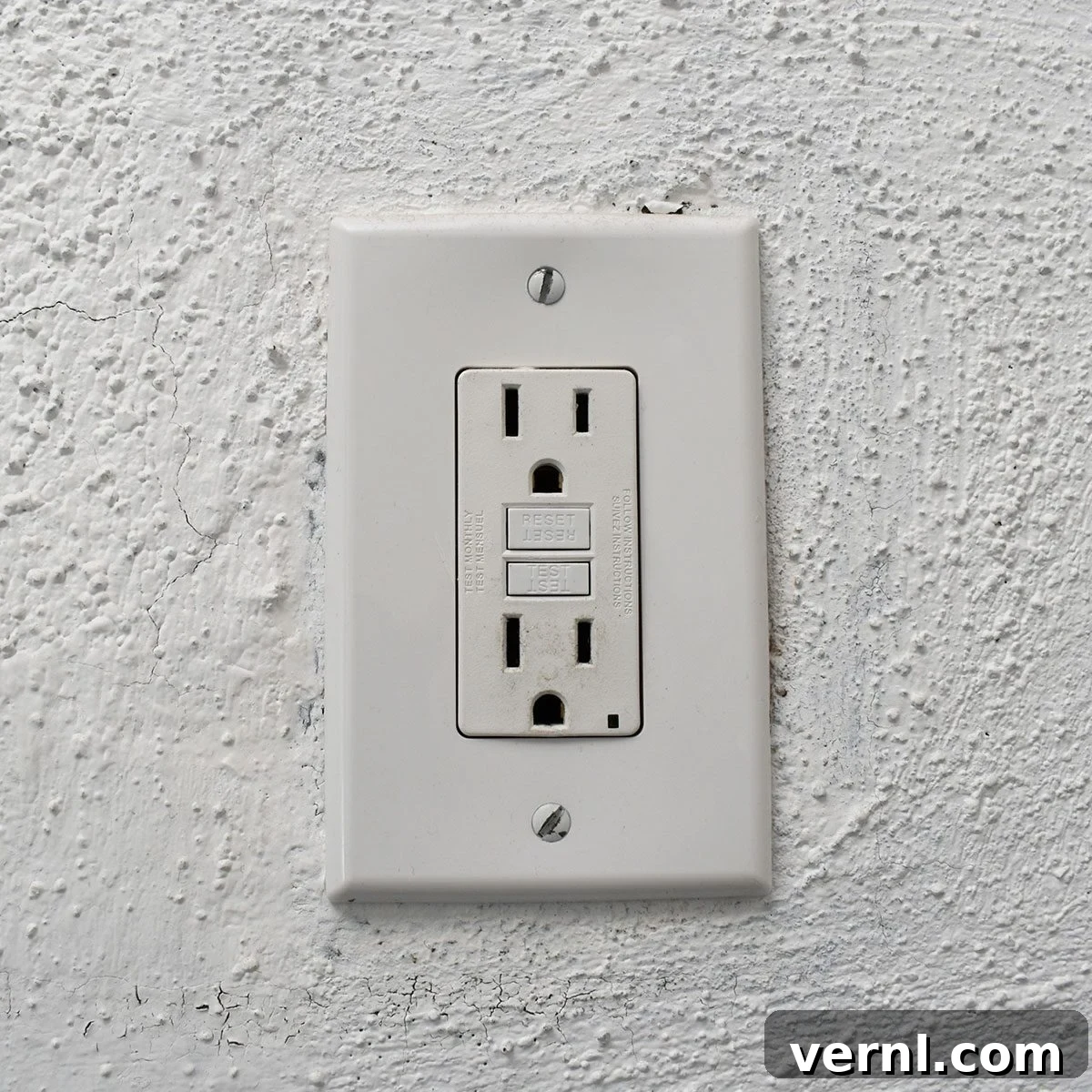
Ensuring the electrical safety of your home is paramount, and understanding common safety devices is a critical step. If you’ve ever explored DIY home improvement projects or visited hardware stores, you’ve likely come across discussions about GFCI vs. AFCI outlets. These vital electrical safety mechanisms, technically referred to as “receptacles” or “circuit breakers,” are designed to protect you and your property from dangerous electrical hazards.
Many homes today are equipped with these devices, providing a layer of protection against unforeseen electrical events. But what exactly are they? How do they function to keep your family safe? And, if your home currently lacks these safeguards, do you need to prioritize their installation?
From personal experience, I’ve seen firsthand the critical role these devices play. An incident during my electrical apprenticeship, where a severe electric shock knocked me down, could have been entirely prevented by a GFCI. Later, I dedicated significant time to installing AFCI protection in numerous college dormitories, only to realize my own home was unprotected. That was a situation I remedied without delay, and you can certainly enhance your home’s safety too.
Dive into this comprehensive guide to discover everything you need to know about AFCI vs. GFCI outlets, empowering you to make informed decisions about your home’s electrical safety.What is a GFCI Outlet?
A Ground Fault Circuit Interrupter (GFCI) outlet, or receptacle, serves as a crucial guardian against electric shock. Its primary function involves continuously monitoring the flow of electrical current through the circuit it protects. The brilliance of a GFCI lies in its sensitivity: it constantly compares the current flowing out on the “hot” wire with the current returning on the “neutral” wire. In a properly functioning circuit, these currents should be precisely balanced.
If the GFCI detects even a minute discrepancy—typically a difference of just 4 to 6 milliamperes (mA)—between the outgoing and incoming current, it immediately identifies this as a “ground fault.” This imbalance suggests that some current is diverting from its intended path, potentially flowing through an unintended conductor, such as a person. In response, the GFCI acts almost instantaneously, de-energizing the circuit in fractions of a second (often as quickly as 1/40th of a second), thereby preventing severe injury or electrocution.
To grasp the significance of 4 to 6 milliamperes, consider this: an electrical current of 10 mA can cause a person to lose voluntary muscle control, making it impossible to let go of an electrified object. At approximately 100 mA, the risk of death becomes substantial, depending on various factors like an individual’s age, weight, and the duration of exposure. The rapid response of a GFCI is therefore critical in mitigating these life-threatening risks.
What Does GFCI Stand For?
GFCI is an acronym for Ground Fault Circuit Interrupter. It’s important to note that GFCI protection can be incorporated into your electrical system in two main forms: as GFCI receptacles (outlets) or as GFCI circuit breakers installed in your electrical panel. Regardless of their form, these devices must always be installed in a readily accessible location, ensuring you can easily reach and reset them if they trip.
What is a Ground Fault?
A ground fault is a specific type of short circuit that occurs when an energized “hot” wire unintentionally makes contact with a grounded component of an electrical system or appliance. This could be anything that’s not designed to carry current, such as the metal casing of an electrical box, the outer shell of an appliance like a toaster or washing machine, or even the ground itself. When this happens, electricity takes an unintended path to the ground.
The danger arises if you happen to be touching the now-electrified object. In such a scenario, your body could become the path for the electrical current to reach the ground, leading to a severe electric shock. A GFCI is specifically designed to detect this dangerous diversion of current and quickly cut off power, preventing the current from flowing through you and potentially saving your life.
Are GFCIs Required?
Absolutely. Due to their life-saving capabilities, GFCIs are classified as essential safety devices. The National Electrical Code (NEC) rigorously mandates their installation in specific areas and on particular circuits within new construction and whenever circuits are modified or extended. These requirements are put in place to protect individuals in environments where the risk of ground faults is elevated, primarily due to the presence of water or damp conditions. Common locations where GFCIs are required include:
- Bathrooms: All receptacles serving bathroom counter areas.
- Kitchens: Receptacles serving kitchen countertops, dishwashers, and often other appliances.
- Sinks: Any receptacle installed within 6 feet of the outside edge of a sink.
- Outdoors: All exterior receptacles, which are exposed to weather and potential moisture.
- Basements and Crawl Spaces: All receptacles in unfinished basements and crawl spaces.
- Garages and Outbuildings: All receptacles in garages, attached accessory buildings, and often detached garages.
- Laundry Areas: Receptacles in laundry rooms.
- Damp and Wet Locations: Other areas prone to moisture, such as boathouses, pool areas, and specific appliances like sump pumps.
It is always crucial to consult with your local jurisdiction or a qualified electrician, as local codes can sometimes supersede or add to the national NEC requirements, ensuring full compliance and maximum safety.
Do GFCI Outlets Go Bad?
Yes, like any electrical device, GFCI outlets can degrade and fail over time. Therefore, it is highly recommended to test them monthly to ensure they are functioning correctly. Many homeowners, unfortunately, overlook this vital safety check. Recognizing this, the NEC began requiring GFCIs to incorporate an internal self-test function since 2015. This feature automatically checks the GFCI’s internal components at regular intervals. When a self-testing GFCI reaches the end of its useful lifespan or detects an internal fault, it will automatically shut off power to the device and typically indicate this status with a visible light on its face.
Despite the convenience of self-testing GFCIs, performing a manual test each month remains a critical practice. A manual test actively checks the mechanical tripping mechanism, confirming that the device can physically interrupt power when needed. This dual approach ensures comprehensive protection.
How to Wire a GFCI Outlet
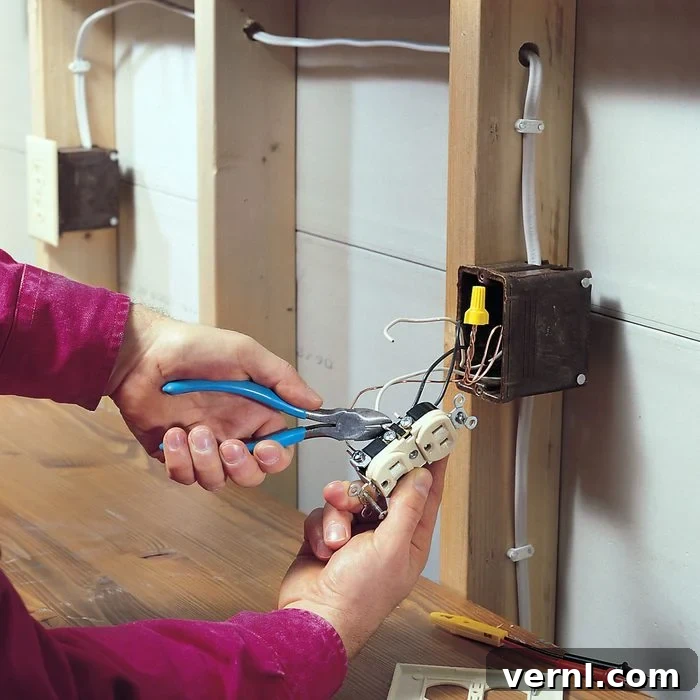
Safety First: Before attempting any electrical work, always turn off the power to the circuit at your main electrical panel. Verify the power is off using a voltage tester.
A GFCI receptacle has two distinct sets of terminals: “Line” and “Load.” These will be clearly labeled on the back of the device. New GFCIs often come with a piece of yellow tape covering the “Load” connections, indicating they should only be used under specific circumstances. The “Line” terminals are where the incoming power from your electrical panel connects, providing power directly to the GFCI outlet itself. The “Load” terminals are used to extend GFCI protection to other standard receptacles or devices located “downstream” on the same circuit.
To wire a single GFCI receptacle that only protects itself, you will use only the “Line” terminals. Connect the hot (usually black) wire from the circuit to the brass “Line” screw terminal, and the neutral (usually white) wire to the silver “Line” screw terminal. If you intend to protect other receptacles downstream from this GFCI, carefully remove the yellow tape covering the “Load” terminals. Then, connect the wires leading to the next receptacle on the circuit to the corresponding “Load” side screws (hot to brass, neutral to silver).
Crucially, always ensure the receptacle and circuit are properly grounded. Connect the bare copper or green insulated ground wire from the circuit to the green ground screw terminal on the GFCI. Proper grounding is a fundamental safety measure in all electrical installations.
How to Reset and Test a GFCI Outlet
Every GFCI receptacle is equipped with two distinct buttons: “Test” and “Reset.” These buttons are essential for both verifying the device’s functionality and restoring power after it has tripped.
To perform a manual test of your GFCI, simply press the “Test” button. You should hear an audible click, and the power to the outlet (and any downstream outlets it protects) will be interrupted. This indicates that the GFCI’s internal contacts have opened, confirming that the device is operational and capable of tripping. To restore power, press the “Reset” button. You’ll hear another click, and power should return.
If your GFCI trips unexpectedly, typically due to a detected ground fault, you can restore power by pushing the “Reset” button. Occasional trips are normal and indicate the GFCI is doing its job. However, if a GFCI trips frequently without an apparent cause, it could signal an underlying electrical issue in the circuit or the device itself. In such cases, it’s prudent to have the circuit inspected by a licensed electrician to diagnose and rectify the problem.
Another convenient method for testing GFCIs is to use a dedicated GFCI receptacle tester. This specialized tool plugs directly into the outlet. When you press the test button on the tester, it simulates a ground fault. The GFCI should trip, and the power indicator on the tester will go off. After the test, remove the tester and press the GFCI’s “Reset” button to restore power.
What is an AFCI Outlet?
An Arc Fault Circuit Interrupter (AFCI) receptacle, commonly known as an AFCI outlet, provides a different yet equally vital layer of protection for your home: it specifically guards against electrical fires. AFCIs achieve this by constantly monitoring the electrical circuit for specific signatures of dangerous electrical arcs. Unlike GFCIs, which detect current leakage to the ground, AFCIs are engineered to distinguish between normal, brief arcs that occur during routine electrical operations (such as flipping a light switch or plugging in an appliance) and abnormal, hazardous arcs caused by damaged wiring, loose connections, or compromised electrical components.
When an AFCI detects the characteristic pattern of a dangerous arc fault, it rapidly de-energizes the circuit. This swift action prevents the arc from generating excessive heat, which could ignite nearby combustible materials like insulation, curtains, or wooden structures, thereby significantly reducing the risk of electrical fires.
What Does AFCI Stand For?
AFCI stands for Arc-Fault Circuit Interrupter. Similar to GFCI protection, AFCI functionality can be incorporated into your electrical system either through AFCI receptacles (outlets) or through AFCI circuit breakers installed in your main electrical panel. Regardless of the form factor, AFCI devices, like GFCIs, must be installed in an easily accessible location to facilitate convenient testing and resetting.
What is an Arc Fault?
An arc fault is an unintended and potentially dangerous electrical discharge, essentially a miniature lightning bolt that occurs within an electrical circuit. These faults typically arise when electricity “jumps” through an air gap between damaged sections of a single conductor (a series arc fault) or between two different conductors (a parallel arc fault). Common culprits behind arc faults include:
- Damaged or frayed electrical wires (e.g., from furniture pinching cords, nails piercing wires).
- Loose or improperly made electrical connections at outlets, switches, or junction boxes.
- Overheated or stressed electrical cords.
- Faulty appliances or extension cords.
When an arc fault occurs, it generates intense heat and often sparks, which can easily ignite surrounding combustible materials such as insulation, wood framing, carpets, or curtains. Because these faults often occur within walls or behind furniture, they can go unnoticed until a fire has already started. AFCI technology is designed to detect these subtle but highly dangerous electrical phenomena before they escalate into a full-blown blaze, making them indispensable fire prevention tools.
Are AFCIs Required?
Yes, the National Electrical Code (NEC) has steadily expanded the requirements for AFCI protection, making it mandatory for nearly every living area in newly constructed homes. The intent is to provide widespread protection against electrical fires, which often originate in these frequently occupied spaces. Areas now commonly requiring AFCI protection include:
- Bedrooms
- Living rooms
- Dining rooms
- Family rooms
- Kitchens (often in conjunction with GFCIs, leading to dual-function breakers/outlets)
- Laundry rooms
- Hallways
- Closets
- Dormitories
Generally, the only common areas in residential settings that might not require AFCI protection are bathrooms and garages, where GFCI requirements take precedence due to the presence of water. However, it is always imperative to verify the specific code requirements with your local authority or a licensed electrician, as local jurisdictions may have unique stipulations or recent updates to the NEC adoption cycle.
Do AFCI Outlets Go Bad?
Similar to GFCIs, AFCI outlets are electrical devices that can degrade or fail over time. Therefore, it is essential to test them monthly to ensure their continued functionality and reliability. Regular testing helps confirm that the arc-fault detection mechanism and the tripping function are working correctly, providing ongoing protection against electrical fires.
How to Wire an AFCI Outlet
Safety Warning: Always ensure the power to the circuit is turned off at the main electrical panel before performing any wiring. Use a non-contact voltage tester to confirm the circuit is de-energized.
Wiring an AFCI receptacle follows a procedure very similar to that of a GFCI outlet. The AFCI also features clearly marked “Line” and “Load” terminals. The incoming power wires from your circuit breaker panel (the “hot” wire, typically black, and the “neutral” wire, typically white) connect to the “Line” side terminals of the AFCI receptacle. Specifically, the hot wire goes to the brass “Line” screw, and the neutral wire goes to the silver “Line” screw.
If you intend for the AFCI receptacle to provide arc-fault protection to subsequent standard receptacles further down the circuit, you will utilize the “Load” side terminals. The wires leading to the next receptacle in the series will connect to the “Load” side screws (hot to brass, neutral to silver). If the AFCI is only protecting itself, the “Load” terminals should remain unused.
As with all electrical installations, proper grounding is non-negotiable for safety. Ensure the bare copper or green insulated ground wire from the circuit is securely connected to the green ground screw terminal on the AFCI receptacle.
How to Reset and Test an AFCI Outlet
To verify the proper operation of an AFCI receptacle, locate the “Test” button on its face. Pressing this button should simulate an arc fault, causing the AFCI to trip and interrupt power to the outlet and any downstream receptacles it protects. You will typically hear an audible click as the device trips. To restore power, simply press the “Reset” button. This action will close the internal contacts, and power should be restored to the circuit.
For added convenience and diagnostic capabilities, you can also purchase a specialized AFCI receptacle tester. Many of these testers are designed to test both AFCI and GFCI receptacles, making them versatile tools for maintaining your home’s electrical safety. These testers plug into the outlet and, upon activation, simulate the specific fault conditions that the AFCI is designed to detect, confirming its responsiveness.
What’s the Difference Between GFCI and AFCI Outlets?
While both AFCI and GFCI protection devices are critical for electrical safety and share the common function of monitoring circuits to shut off power upon detecting a problem, they are designed to protect against distinct types of electrical hazards. Understanding their specific roles is key to appreciating their combined importance.
- GFCI (Ground Fault Circuit Interrupter) Protection: Primarily engineered to protect people from severe electric shock and electrocution. It detects ground faults, which occur when current leaks from a circuit to an unintended path (often a person or a grounded object), indicating a potential shock hazard. GFCIs are crucial in wet or damp locations where the risk of current flowing through water (and then through a person) is high.
- AFCI (Arc-Fault Circuit Interrupter) Protection: Specifically designed to protect your home from electrical fires. It continuously monitors for dangerous arc faults, which are high-temperature electrical discharges caused by damaged wires, loose connections, or faulty equipment. These arcs can generate enough heat and sparks to ignite nearby combustible materials, leading to devastating fires. AFCIs detect these specific electrical signatures before ignition can occur.
In essence, GFCIs protect lives by preventing shocks, while AFCIs protect property and lives by preventing fires. They are complementary safety devices, each addressing a unique and serious electrical risk.
GFCI vs. AFCI Outlets: Which Is Right For Me?
Determining whether to install GFCI or AFCI protection, or both, in your home largely depends on the age of your property, your local electrical codes, and your desire to enhance safety. In new construction projects, the usage of AFCI vs. GFCI outlets (or breakers) will be explicitly dictated by the latest edition of the National Electrical Code (NEC) as adopted by your state and local municipality. The NEC is updated every three years, frequently adding new locations and circuits that require specific types of protection to reflect evolving safety standards and technologies. Since states and cities adopt these codes at varying intervals, specific requirements can differ based on your geographical location.
For older homes, you are generally not mandated to retrofit your existing electrical system with new fault protection unless you undertake significant electrical renovations, such as updating your wiring, adding new circuits, or extensively remodeling an area. However, choosing to proactively upgrade your home’s electrical safety is a highly recommended and relatively straightforward process. Adding AFCI and GFCI protection can be as simple as swapping out an existing standard receptacle for a protective one on a circuit, or replacing a standard circuit breaker with a GFCI or AFCI breaker in your electrical panel.
The benefits of retrofitting these important safety devices in an older home are substantial, greatly reducing the risks of both electric shock and electrical fires. To ensure proper installation and compliance, it’s advisable to consult the latest NEC guidelines or, better yet, enlist the expertise of a licensed electrician. An electrician can assess your home’s current wiring, identify areas most in need of protection, and ensure that AFCI and GFCI devices are installed correctly and in readily accessible locations for optimal safety and functionality.
FAQs
How Can You Tell if an Outlet is GFCI vs. AFCI?
Distinguishing between GFCI and AFCI receptacles can sometimes be tricky at a glance, as both often feature “Test” and “Reset” buttons on their face. The most reliable way to identify them is to look for explicit labeling. Both types of devices will have “GFCI” or “AFCI” clearly printed on the front of the receptacle itself. If you see a standard (non-button) receptacle, it might still be protected by a GFCI or AFCI device located upstream in the circuit or by a GFCI/AFCI circuit breaker in the electrical panel. In such cases, a small sticker might be placed on the standard receptacle indicating “GFCI Protected” or “AFCI Protected” to signify that it receives protection from another device. These stickers are typically provided with AFCI and GFCI receptacles or breakers for this very purpose.
Are GFCIs or AFCIs Surge Protectors?
No, neither GFCIs nor AFCIs function as surge protectors. Their roles in electrical safety are entirely different. Surge protectors are designed to suppress and divert excessive voltage spikes, such as those caused by lightning strikes or power utility fluctuations, preventing them from damaging sensitive electronic equipment. Surge protectors have a specified maximum number of joules (a unit of energy) they can absorb before their protective capacity is exhausted, at which point they need to be replaced. In contrast, AFCIs and GFCIs have no specified limits of protection in terms of energy absorption; their function is to detect specific electrical faults and instantly interrupt the circuit, irrespective of the energy level of a surge.
Do GFCIs or AFCIs Prevent Fires?
This is a crucial distinction. AFCIs (Arc-Fault Circuit Interrupters) are specifically engineered and mandated to prevent electrical fires by detecting dangerous arc faults that can ignite combustible materials. GFCIs (Ground Fault Circuit Interrupters), on the other hand, are designed to protect people from severe electric shock and electrocution by detecting ground faults. While preventing electric shock can indirectly prevent scenarios that might lead to a fire (e.g., a person dropping an energized appliance into water causing sparks), their primary purpose is life safety from shock, not fire prevention from arc faults.
Can I Use a GFCI or AFCI Breaker Instead of an Outlet?
Yes, absolutely. The National Electrical Code (NEC) mandates AFCI and GFCI protection, not specifically AFCI or GFCI receptacles. Therefore, using GFCI or AFCI circuit breakers in your main electrical panel is a highly effective and often convenient way to achieve the required protection. When you install a GFCI or AFCI breaker, the entire circuit that it controls receives the respective protection, meaning all standard receptacles, lighting fixtures, and appliances on that circuit are protected from the panel outward. This can be a more efficient solution, especially for protecting multiple outlets on a single circuit or for areas where replacing individual receptacles might be impractical. Dual-function circuit breakers, which combine both GFCI and AFCI protection, are also available and are commonly required in modern kitchens and laundry rooms to provide comprehensive safety from both shock and fire hazards.