
In the evolving world of home design and plumbing, the bathroom faucet has undergone a remarkable transformation. From rudimentary spigots affixed directly to walls in plumbing’s infancy, we’ve moved through various iterations, with deck-mounted faucets becoming the prevailing standard for decades. These traditional faucets, mounted directly onto the sink or countertop, have long dominated the market due to their relatively straightforward installation and widespread availability. However, a growing trend is witnessing a resurgence in the popularity of wall-mount bathroom faucets, challenging the conventional wisdom that once relegated them to niche designs. Adam Horwitz, an expert from leading faucet manufacturer Speakman, observes that while deck-mounted options still constitute the vast majority of sales, the sophisticated aesthetic and functional benefits of wall-mount faucets are increasingly captivating homeowners and designers alike, marking a shift in modern bathroom aspirations.
Despite their undeniable elegance and clean lines, wall-mounted faucets have historically been less common due to perceived installation complexities and higher costs. Simone Bumpus, a distinguished design specialist at Kitchens by Good Guys in Scottsdale, Arizona, highlights that the intricate nature of their installation—which necessitates concealed supply pipes behind the wall—often deters homeowners. Integrating a wall-mount faucet into an existing bathroom typically involves extensive renovation, including cutting into the wall to reroute plumbing and subsequently repairing the drywall, a process that can be both time-consuming and expensive. This intricate process often means that homeowners only consider wall-mounted options during major remodels or new construction projects.
Yet, the appeal of wall-mount faucets is undeniable, especially in space-conscious designs. Michael Clarke, the visionary founder of the Pulled App, points to a significant driving factor behind their burgeoning popularity: the invaluable counter space they liberate. In modern homes, especially in small bathrooms or powder rooms where every inch counts, maximizing usable surface area is paramount. A wall-mounted faucet elegantly floats above the sink, leaving the countertop completely clear, offering an uncluttered aesthetic and practical benefits. For those who can accommodate the initial investment in installation, the unparalleled space-saving advantages and distinctive visual appeal might just provide compelling reasons to embrace a wall-mount bathroom faucet for their next bathroom project.
What Is a Wall-Mount Bathroom Faucet?
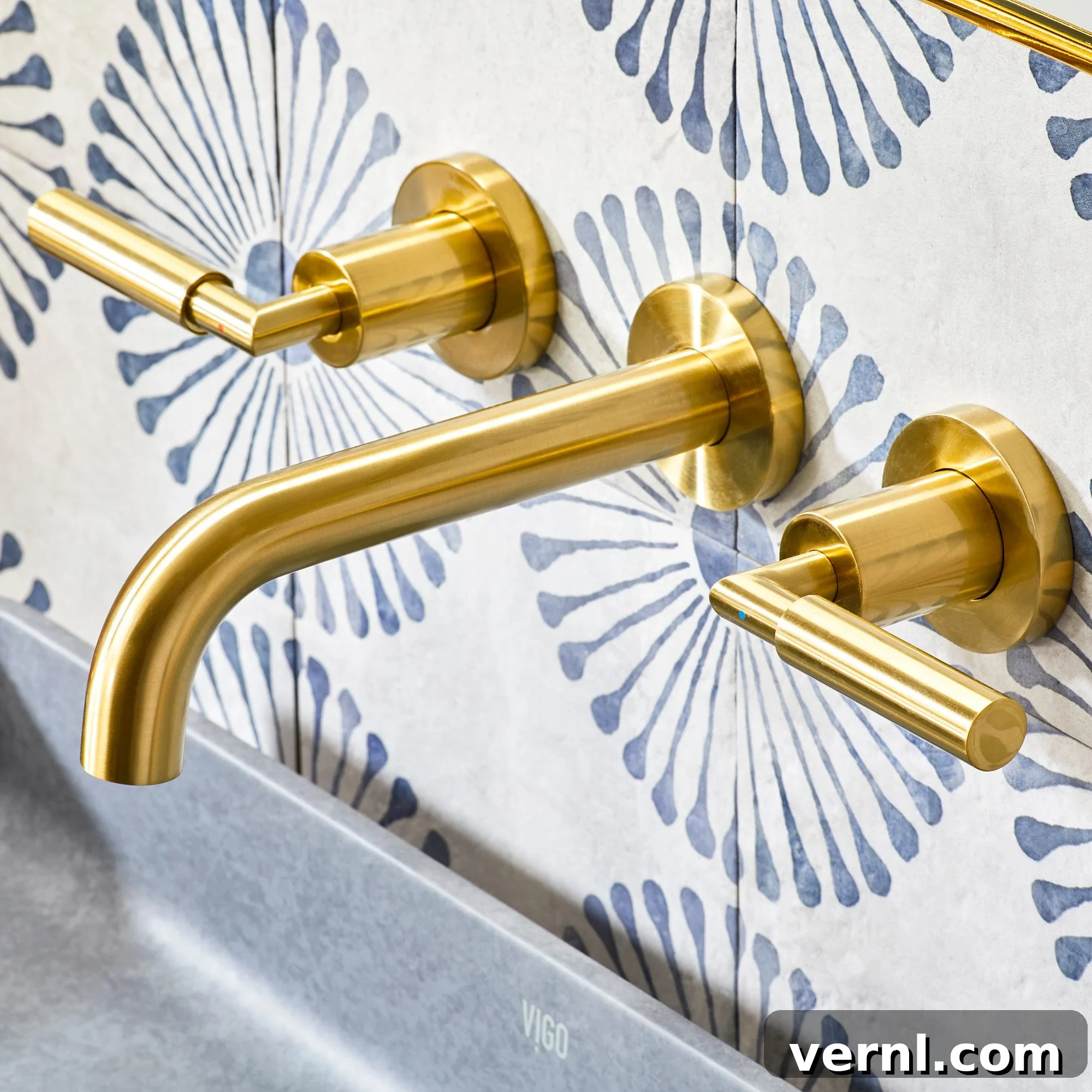
The concept behind a wall-mount bathroom faucet is elegantly simple: it is a faucet designed to be mounted directly onto the wall, rather than on the sink or countertop. While its fundamental function of delivering water remains identical to any other faucet, the critical distinction lies in its internal mechanics. Unlike deck-mounted versions where supply pipes are typically exposed beneath the sink cabinet, a wall-mount faucet’s entire plumbing system, including the hot and cold water lines and the mixing valve, is concealed behind the wall surface. This seemingly minor difference carries significant implications, demanding meticulous planning and precise execution before and during installation.
One of the immediate benefits of this design is the elimination of the need for faucet holes on the sink or countertop itself. This opens up new possibilities for sink and countertop materials and designs, allowing for sleeker, more minimalist aesthetics. However, attempting to retrofit an existing bathroom with a deck-mounted faucet to a wall-mount system can be complex and expensive. Such a conversion often necessitates replacing the existing sink or countertop, particularly if they have pre-drilled faucet holes that would become unsightly or redundant with a wall-mounted unit. This makes wall-mount faucets an ideal choice for new construction or comprehensive bathroom renovations where design elements can be planned from the ground up.
Another crucial consideration for wall-mount faucets is determining the appropriate faucet height and projection. This step requires careful foresight, as the faucet is typically installed before the sink is in place. Without the sink as a direct reference, installers must meticulously measure and plan the exact placement to ensure optimal functionality and aesthetics. General guidelines suggest positioning the spout three to four inches above the rim of the sink and projecting about seven inches from the wall. This specific placement ensures adequate clearance for comfortable handwashing, minimizes splashing, and maintains the elegant, floating look that defines wall-mounted fixtures. When paired with vessel or undermount sinks, a wall-mount bathroom faucet becomes an ideal complement, extending gracefully from the wall, leaving the sink basin and surrounding countertop entirely free of hardware, thus enhancing both visual appeal and ease of cleaning.
Wall-Mounted Bathroom Faucet Pros and Cons
Choosing a bathroom faucet involves balancing aesthetics, functionality, and practical considerations. Wall-mounted faucets, while offering distinct advantages, also come with their own set of challenges that potential buyers should be aware of. Understanding these pros and cons is essential for making an informed decision that aligns with your design vision and budget.
Pros
Simone Bumpus views wall-mount faucets as particularly suited for bathrooms embracing contemporary or minimalist designs, where their clean lines and understated presence truly shine. Yet, their benefits extend beyond mere aesthetics, offering utilitarian features that can enhance even more traditional bathroom settings.
- Unparalleled Space Saver: This is arguably one of the most significant advantages, especially in compact bathrooms. By mounting the faucet on the wall, it frees up valuable countertop real estate that would otherwise be occupied by a deck-mounted fixture. This allows the sink to be positioned closer to the wall, potentially enabling the installation of a more compact vanity. In small bathrooms, this subtle gain in space can make a substantial difference, making the room feel larger, more open, and less cluttered. It’s a smart solution for maximizing functionality in constrained environments.
- Distinctive Design Feature: Wall-mount faucets are inherently a design statement. They exude a sleek, modern sophistication that can elevate the entire aesthetic of a bathroom. Available in a wide array of materials like solid brass for durability, stainless steel for a contemporary gleam, or with popular matte-black finishes, they offer versatility to complement various interior styles. When paired with a stylish backsplash, these faucets can create a dramatic focal point. Furthermore, for those aiming for a more antique or industrial motif, widespread wall-mount models with elegantly exposed pipes can beautifully integrate, adding character and historical charm while retaining modern functionality.
- Enhanced Utilitarian Benefits: As Michael Clarke astutely points out, the absence of a faucet base on the countertop significantly simplifies cleaning the sink area. There are fewer nooks and crannies for water, soap scum, or toothpaste to accumulate, making routine maintenance far easier and promoting better hygiene. This clean design is particularly advantageous for vessel sinks, which sit atop the counter. Traditional high-arc deck-mount faucets designed for vessel sinks can sometimes appear cumbersome or disproportionately large. Wall-mount faucets provide an elegant, streamlined solution, extending directly over the vessel sink without cluttering its base, offering superior aesthetics and functionality.
Cons
While the allure of wall-mount faucets is strong, their primary drawback—the complexity of installation—is a substantial consideration. Adam Horwitz from Speakman suggests that homeowners should typically reserve these faucets for periods of significant bathroom renovation or entirely new construction, when the walls are open and plumbing modifications are most feasible.
- Installation Limitations and Challenges: The inherent design of wall-mount faucets means they cannot be installed everywhere. For instance, mounting a faucet on a wall directly behind a window is impractical due to plumbing restrictions and potential interference with the window frame. Moreover, installing these faucets on an exterior wall, especially in colder climates, presents an additional challenge. The concealed supply pipes require sufficient insulation within the wall cavity to prevent the pipes from freezing in winter, which may necessitate extra wall depth or specialized insulation techniques, adding to the complexity and cost.
- Difficult and Costly to Replace or Repair: The initial difficulty of installation is mirrored, if not amplified, when it comes to replacing or repairing a wall-mount faucet. Should a leak develop, or if you decide to update your bathroom design later, removing an existing wall-mount faucet typically involves the same disruptive process as installing one: opening up the wall, accessing the plumbing, and then patching and repairing the wall surface. This can be a labor-intensive and expensive undertaking, far more involved than simply unscrewing a deck-mounted faucet from above the counter.
- Critical and Precise Measurements Required: Unlike their deck-mounted counterparts, where slight variations in hole drilling are less critical, the positioning of a wall-mount faucet demands absolute precision. The height and projection must be meticulously calculated and executed. Setting the faucet too low will result in insufficient clearance, making it awkward or impossible to use the sink comfortably. Conversely, mounting it too high can lead to excessive splashing, with water constantly escaping the sink basin during use. This requires careful consideration of the sink’s depth, the user’s height, and the faucet’s spout reach to achieve the perfect balance between aesthetics and practical functionality. Any error in measurement or installation can lead to long-term frustration and potentially costly rectifications.
How to Install a Wall-Mount Faucet
Installing a wall-mount faucet is a more involved process than a standard deck-mount faucet due to the need to integrate plumbing within the wall. It requires careful planning and execution, often best left to experienced DIYers or professional plumbers. Here’s a detailed guide to the steps involved.
Tools and Materials
Before you begin, gather all necessary tools and materials to ensure a smooth installation process. Having everything at hand will prevent interruptions and make the job more efficient.
- 1/2-inch copper or PEX pipe: Choose based on your existing plumbing and preference. Copper is durable but requires soldering, while PEX is flexible and uses crimp fittings.
- Soldering supplies (for copper pipe): Including solder, flux, a torch, and a wire brush for cleaning pipes.
- Crimping tool and barbed fittings (for PEX pipe): Essential for creating secure, leak-proof connections.
- Two shutoff valves: One for hot water and one for cold, allowing for easy water cutoff to the faucet without affecting the entire house.
- 2×4 blocking crossmember: Used to provide a stable, secure mounting surface for the faucet’s valve body within the wall.
- Measuring tape: For precise measurements of pipe lengths, faucet placement, and blocking.
- Torpedo level: Crucial for ensuring the blocking crossmember and faucet valve body are perfectly level.
- Drill: For securing the blocking and pipe straps.
- Screws: To attach the blocking crossmember to studs and the valve body to the blocking.
- Pipe straps: To secure the water supply pipes to the wall framing, preventing movement and noise.
- Drywall saw and repair materials (if retrofitting): For cutting into existing walls and patching them up afterward.
Steps
- Run the Water Supply Pipes. This is the foundational step. If you’re replacing an existing faucet, you’ll need to extend the stubouts from the old faucet’s location to the new, higher position of the wall-mount faucet. For new installations or major remodels, you’ll tap into the nearest existing hot and cold water supply lines, typically teeing off from main lines. For copper pipes, connections are made using soldering, which requires heating the pipes and fittings with a torch and applying solder. If you’re using PEX piping, connections are made with barbed fittings and a crimping tool, which creates a strong, watertight seal. Always ensure all connections are clean and secure to prevent future leaks.
- Install Shut-Off Valves. Before connecting to the faucet’s valve body, it’s critical to install a dedicated shut-off valve for both the hot and cold supply lines. These valves allow you to turn off the water to the faucet independently, which is invaluable for future maintenance or repairs without having to shut off the main water supply to your entire home. Position these valves in an easily accessible location. Some plumbers prefer to place them behind a removable access panel in an adjacent room or within the vanity cabinet, if space allows, ensuring they are hidden but reachable.
- Install the Blocking Crossmember. The wall-mount faucet’s valve body requires a robust mounting surface. Modify your wall framing by installing a horizontal 2×4 blocking crossmember at the precise height where your faucet will be located. Use your measuring tape to determine the correct height, taking into account the sink height and desired spout clearance. Level the crossmember meticulously with a torpedo level and secure it firmly to the vertical wall studs on either side using screws. Refer to your specific faucet’s installation instructions to determine the exact depth behind the finished wall surface the crossmember needs to be, as this varies by manufacturer and faucet model. This blocking provides the necessary stability for the heavy faucet.
- Mount the Valve Body. Once the blocking is in place, attach the faucet’s valve body directly to the crossmember. Use screws appropriate for securing metal to wood. Again, employ your torpedo level to ensure the valve body is perfectly level both horizontally and vertically. This step is critical for the proper alignment of the faucet trim and spout. Carefully measure the distance that the pipe stub outs from the valve body protrude beyond the plane of the finished wall. Double-check this measurement against the manufacturer’s requirements, as incorrect protrusion can prevent the trim from fitting flush or properly.
- Connect the Water and Test for Leaks. With the valve body securely mounted, complete the installation of your water lines, connecting them directly to the valve body. Ensure all connections are tightened appropriately for their respective pipe types (soldered for copper, crimped for PEX). Secure the water supply pipes to the adjacent wall framing using pipe straps to prevent movement and vibration, which can cause noise or stress on the connections. Before closing up the wall, turn on the main water supply and carefully inspect all connections for any signs of leaks. Address any leaks immediately by tightening or re-doing the faulty connection. This pre-drywall leak check is crucial, as fixing a leak after the wall is finished is far more difficult and damaging.
- Finish the Wall and Install the Faucet Trim. After successfully testing for leaks and ensuring all plumbing is sound, you can proceed with finishing the wall. This involves installing drywall, taping, mudding, sanding, and finally painting or tiling the wall surface. Once the wall is completely finished and dry, install the decorative faucet trim (handles, spout, and escutcheons) according to the specific instructions provided by your faucet manufacturer. These final steps bring the functional plumbing into a beautiful, finished aesthetic.
Following these steps meticulously will help ensure a successful and leak-free installation of your wall-mount bathroom faucet, providing a stylish and functional addition to your bathroom for years to come.
About the Experts
Insights from industry leaders are invaluable when considering complex design and installation choices. We appreciate the expertise shared by:
- Simone Bumpus is a distinguished design specialist at Kitchens by Good Guys, located in Scottsdale, Arizona. Her extensive experience in kitchen and bathroom design provides a practical perspective on integrating modern fixtures into various home styles.
- Michael Clarke is the innovative founder of the Pulled App. His focus on smart home solutions and design trends offers a forward-thinking view on the practical advantages of wall-mounted fixtures in contemporary living spaces.
These professionals offer a blend of design sensibility and practical understanding, helping homeowners navigate the choices involved in creating functional and beautiful bathrooms.