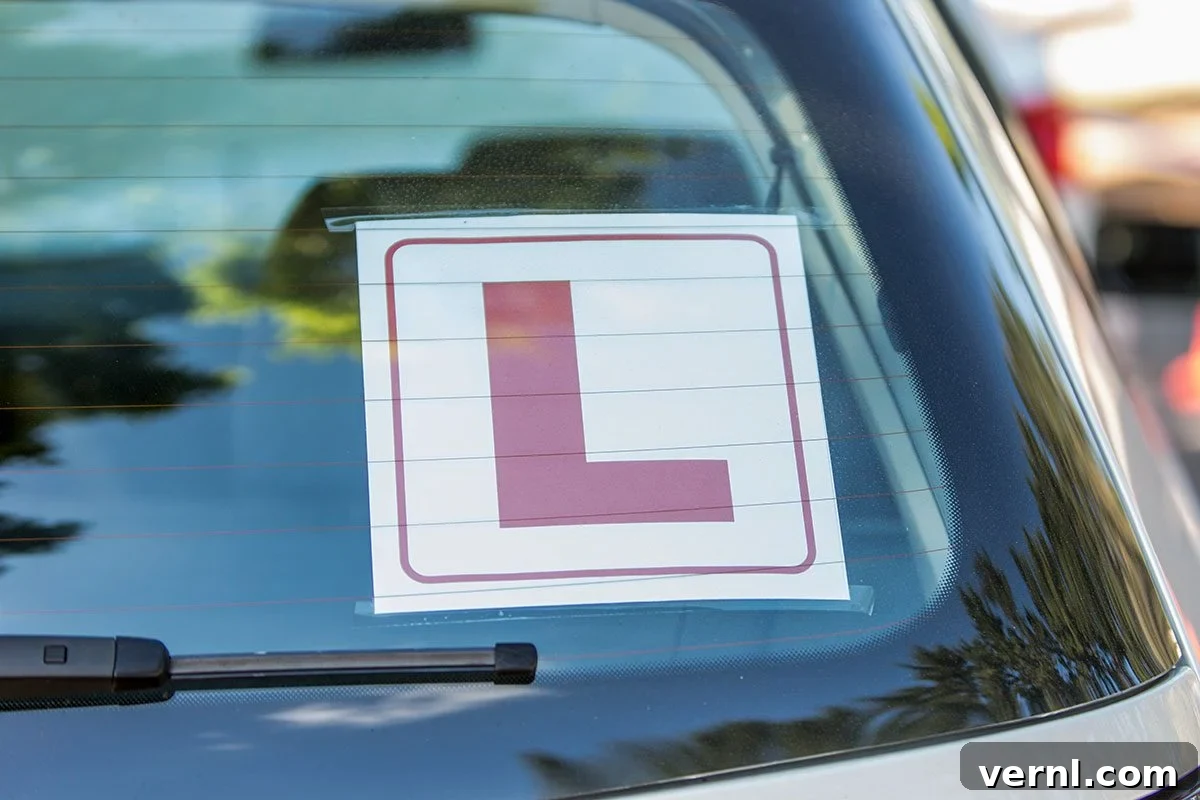
Learning to drive is undoubtedly one of life’s most pivotal milestones, a rite of passage that ushers in a new era of independence and responsibility. It’s a journey often marked by an exhilarating mix of newfound freedom and the occasional flutter of nerves. The open road beckons with promises of self-sufficiency, commuting convenience, and the sheer joy of spontaneous road trips. Yet, before any aspiring motorist can confidently navigate traffic solo, there’s a crucial phase of learning and development. During this period, most countries employ a clear, universally understood signal to other road users: a visible indicator that the driver behind the wheel is still honing their skills. This indispensable sign, often steeped in tradition and vital for road safety, is commonly known as the L plate.
The Indispensable L Plate: A Mark of the Learner Driver
An “L plate,” short for “learner plate,” serves as a universally recognized symbol indicating that a vehicle is being operated by a driver who is currently undergoing instruction. Typically, this visual cue takes the form of a prominent square or rectangular sign, sticker, or magnetic plate. Its design is intentionally simple yet highly effective: a bold, often red or black, capital letter “L” emblazoned against a white background. This stark contrast ensures maximum visibility, making it difficult for other motorists to overlook. The fundamental purpose of the L plate is to communicate a vital message: “Please exercise patience and understanding; I am new to driving.” It’s a silent plea for consideration, reminding everyone on the road that the person at the helm is navigating unfamiliar territory, making crucial decisions, and building fundamental driving habits.
Beyond its primary function as a warning sign, the L plate plays a psychological role in road safety. It encourages other drivers to maintain a greater following distance, approach with caution, and be more forgiving of potential hesitation or minor errors. For the learner driver themselves, displaying an L plate can reduce the pressure of feeling they must drive perfectly, allowing them to focus on the task of learning rather than worrying excessively about the judgments of others. It’s a critical component of the graduated driver licensing systems in many nations, facilitating a safer, more structured environment for new drivers to develop their competency and confidence before fully integrating into the flow of traffic.
Global Adoption: Where Learner Plates Pave the Way
The practice of requiring learner plates is widespread, though the specifics can vary significantly from one country, or even region, to another. These variations often encompass the plate’s design, the duration of its display, and the precise regulations governing its use.
The **United Kingdom** stands as perhaps the most iconic example of L plate usage. Here, learner drivers are legally obligated to display an L plate on both the front and rear of their vehicle at all times when driving. This requirement extends until they successfully pass their practical driving test. Post-test, many new drivers in the UK opt to display a “P” plate (for “Probationary” or “Passed”), though this is voluntary, signalling to others that they are still relatively inexperienced, even if fully licensed.
**Australia** also widely adopts the L plate system, but with state-specific nuances. While the familiar red “L” on a white background is common, some states might use yellow and black versions. Furthermore, Australia employs a multi-stage graduated licensing system that typically transitions from L plates (learners) to P1 plates (provisional first year) and then P2 plates (provisional second year) before achieving a full license. Each stage comes with its own set of restrictions, such as passenger limits, speed limits, and even vehicle type restrictions, all designed to gradually expose new drivers to increasing levels of responsibility.

In **New Zealand**, learner drivers are not only required to prominently display L plates but must also be accompanied by a supervisor who holds a full, valid driver’s license and has done so for at least two years. This dual requirement underscores a commitment to supervised practice, ensuring that learners benefit from experienced guidance during their initial driving hours.
**India** similarly mandates the display of L plates for all learner drivers. Given the diverse and often challenging traffic conditions in Indian cities, these plates are particularly crucial for alerting other motorists to the presence of an inexperienced driver, promoting a greater degree of caution and anticipation.
**Ireland** operates a system closely mirroring that of the UK. L plates are compulsory for learner drivers. Once a driver passes their test, they then transition to displaying “N” plates (for “novice”) for a period of two years. This “novice” phase acknowledges that passing a test is just the beginning; true driving proficiency and hazard perception continue to develop significantly in the immediate years following licensure.
Contrastingly, the system differs significantly in the **United States** and **Canada**. Here, learners are typically identified not by a physical plate on their car but by the specific type of license they hold, such as a “learner’s permit” or “instruction permit.” These permits carry various restrictions, including the mandatory presence of a fully licensed driver, limitations on driving hours (e.g., no night driving), and often, passenger restrictions. While not legally mandated, some learner drivers or driving schools in these countries may still choose to display a “Student Driver” sticker. This voluntary action reflects a universal understanding that communicating one’s learning status can elicit greater patience and understanding from fellow motorists, regardless of specific legal requirements.
Who Benefits From and Uses Learner Plates?
The L plate is not a universal free pass for all drivers; its usage is strictly regulated to ensure its integrity and effectiveness in identifying legitimate learners. Typically, only individuals holding the appropriate provisional or learner’s permit are legally permitted to display them. The primary users fall into specific categories, each with distinct responsibilities:
Aspiring Drivers on a Learner’s Permit
This is the most common and intended group. These individuals have typically passed an initial written or theory test and are now actively engaged in the practical aspect of learning to drive. Whether undergoing formal driving lessons with a certified instructor or practicing with a supervising driver, the L plate clearly signals their status. For these new drivers, the L plate provides a degree of psychological comfort, allowing them to focus on mastering fundamental skills like steering, braking, gear changes, and spatial awareness without the added pressure of experienced drivers expecting perfection.
Professional Driving Instructors
Driving instructors play a critical role in educating new drivers, and their vehicles are often specifically adapted for this purpose. Many instructor cars feature permanently affixed L plates or distinct roof signs that explicitly state “Driving School” or “Learner Driver.” These vehicles are usually equipped with dual controls (a second set of pedals for the instructor) and additional mirrors, further emphasizing the professional learning environment. The visible L plate on an instructor’s car is a clear indication that the vehicle may be moving slower, making sudden stops, or performing maneuvers that require extra caution from surrounding traffic.
Parents or Guardians Supervising Practice Drives
In many regions, learner drivers are required or encouraged to gain practical experience outside of formal lessons, often under the supervision of a parent, guardian, or other experienced driver. When conducting these practice sessions, it is legally mandatory to display L plates. This ensures that other road users are aware that an inexperienced driver is at the wheel, even if the supervising driver is fully licensed and capable. This period of supervised practice is invaluable for consolidating skills learned in lessons and applying them in diverse real-world driving scenarios, making the L plate a crucial tool for both safety and legal compliance during these sessions.
Navigating the Road: Specific Traffic Rules for New Drivers
While learner drivers are expected to adhere to all standard traffic laws—speed limits, traffic signals, road signs, and right-of-way rules—they often face an additional layer of restrictions. These supplementary rules are not punitive; rather, they are thoughtfully designed to facilitate a gradual and safe transition into full driving privileges. The specifics of these graduated driver licensing (GDL) systems can vary significantly by jurisdiction, but several common themes emerge globally.
Mandatory Supervision Requirements
One of the most fundamental restrictions is the requirement for supervision. Learner drivers are almost always required to be accompanied by a fully licensed driver who meets specific criteria, such as holding a full license for a minimum number of years (e.g., 2 or 3 years) and often being above a certain age (e.g., 21 or 25). This supervisor is expected to be vigilant, provide immediate feedback, and intervene if necessary, acting as an additional layer of safety and guidance.
Restrictions on Vehicle Type and Conditions
In some contexts, learner drivers might face limitations on the types of vehicles they can operate. More commonly, there are rules regarding the vehicle’s condition. For instance, in the UK, learner drivers are generally not permitted on motorways unless they are with an approved driving instructor in a dual-control vehicle. This restriction acknowledges the higher speeds and complex multi-lane maneuvers involved on motorways, which are often too challenging for novice drivers.
Zero-Tolerance Alcohol Policies
Virtually all jurisdictions impose zero-tolerance alcohol policies for learner drivers. This means that a learner driver must have absolutely no alcohol in their system while driving, a much stricter standard than for fully licensed drivers. This stringent rule underscores the critical importance of unimpaired judgment and quick reaction times when learning to drive, minimizing risks associated with even minimal alcohol consumption.
Limitations on Driving Hours and Passengers
Many GDL systems include restrictions on when learner drivers can be on the road. Night driving, for instance, is frequently restricted or entirely prohibited for learners due to reduced visibility and the increased prevalence of impaired drivers. Similarly, passenger restrictions are common, particularly for teenage learners, to reduce distractions and the potential for peer pressure, allowing them to focus solely on the demanding task of driving.
Reduced Speed Limits
While learners are expected to follow posted speed limits, some regions may impose slightly reduced maximum speed limits specifically for L-plate drivers, or they may be encouraged to drive at a pace that feels comfortable and safe within the general limits, without feeling pressured to keep up with faster traffic. This allows them to build confidence and refine their control without the added stress of high-speed environments.
Collectively, these additional rules serve a singular, paramount purpose: to enable new drivers to acquire experience incrementally and safely. Driving is a complex activity demanding simultaneous multitasking, swift decision-making, acute situational awareness, and emotional regulation. These structured rules provide learner drivers with the necessary “breathing room” to internalize these fundamentals, process information effectively, and develop sound judgment without being overwhelmed by the full spectrum of driving challenges prematurely.
The Consequences of Neglecting L Plate Display
Ignoring the legal requirement to display an L plate when you are a learner driver is not a trivial oversight; it constitutes a serious traffic offense in many countries and carries significant repercussions. While L plates are not mandatory in the U.S. and Canada, for nations where they are, non-compliance can lead to a cascade of penalties that can severely impede a learner’s progress towards obtaining a full license.
Legal and Financial Penalties
The most immediate consequence is typically a fine, which can vary widely depending on the jurisdiction and the severity of the infraction. Beyond monetary penalties, drivers may incur penalty points on their provisional license, which can delay their ability to take a driving test or even lead to an increase in future insurance premiums. In more severe or repeated cases, a learner’s permit could be suspended or entirely revoked, forcing the individual to restart the entire licensing process, including re-taking written tests and waiting periods. This setback can be incredibly frustrating and costly, both in terms of time and money.
Insurance Implications
Driving without a legally required L plate could also invalidate your car insurance policy. Insurance providers base their premiums and coverage on accurate assessments of risk. If a learner driver is involved in an accident while not displaying a mandatory L plate, the insurance company might argue that the terms of the policy were breached, potentially refusing to cover damages or injuries. This could leave the learner, or their supervising driver, personally liable for substantial costs.
Compromised Road Safety and Public Perception
Beyond the legal ramifications, failing to display an L plate creates a significant safety hazard. The L plate serves as a crucial heads-up to other motorists, prompting them to exercise additional caution and patience. Without this visual cue, other drivers will assume the person behind the wheel is fully licensed and experienced, expecting them to react and perform like any other seasoned driver. This misunderstanding can lead to dangerous situations, including tailgating, aggressive overtaking, or general impatience, which can escalate the stress for the learner and increase the risk of accidents. From an ethical standpoint, transparency about one’s level of driving experience contributes to overall road safety and fosters a culture of mutual respect among road users. Therefore, displaying an L plate is not just about legal compliance; it’s about responsible driving and contributing to a safer environment for everyone on the road.
Additional Driving Insights
- Do You Know What That Little Button on Your Seat Belt Is For?
- What Those Lines on Your Backup Camera Really Tell You
- Here’s What The Small Panel On Your Car’s Front Bumper Is For