
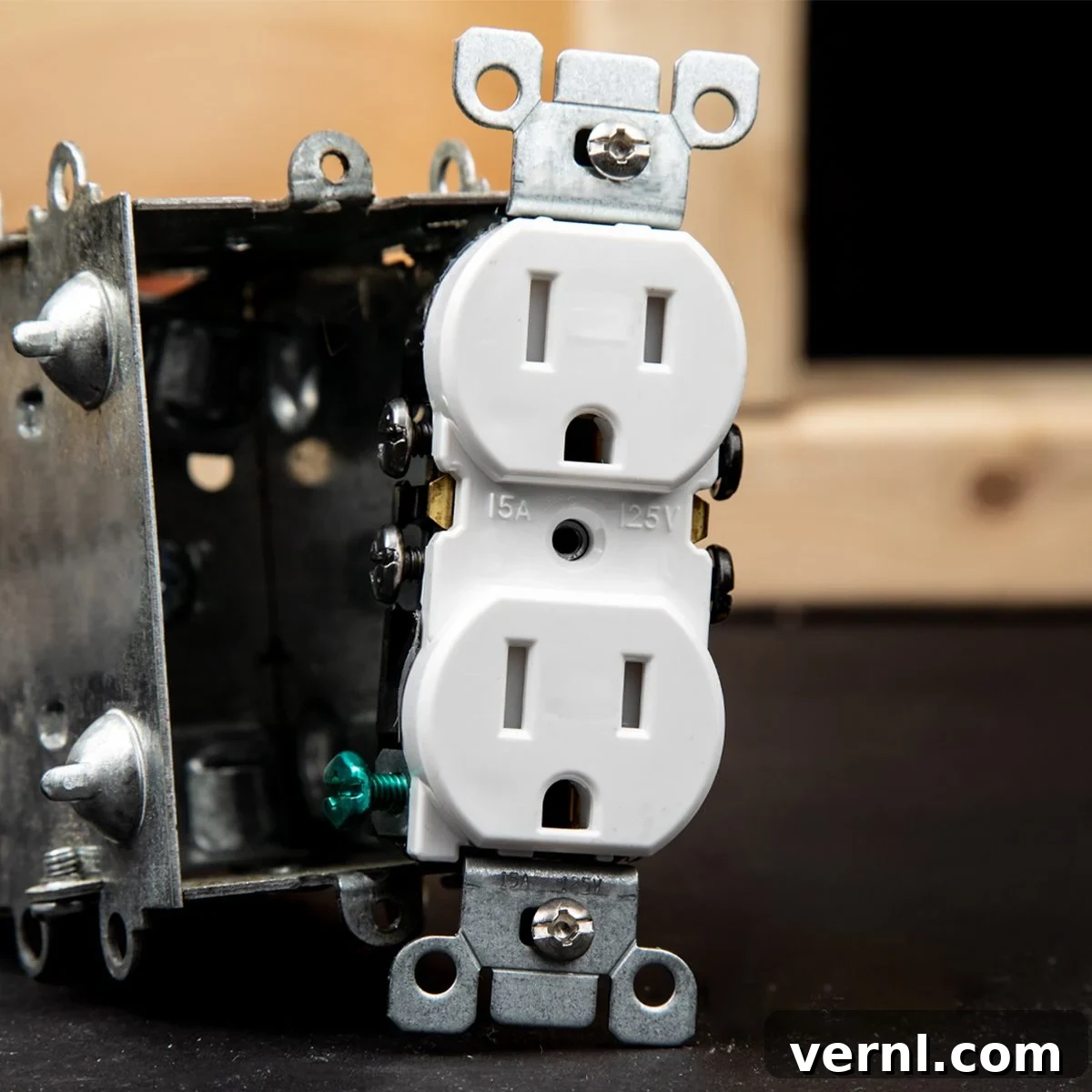
Demystifying 15-Amp vs. 20-Amp Outlets: Your Essential Guide to Home Electrical Safety
Embarking on my electrical apprenticeship was a profound learning experience, revealing the intricate world behind wall plates and wires. Before then, my electrical knowledge was limited to swapping light fixtures and installing basic appliances. The technical specifics of amps, voltage, and circuit design often left me puzzled. As a homeowner, you might find yourself in a similar position, facing a bewildering array of choices when tackling electrical repairs or planning upgrades.
A common point of confusion for many DIY enthusiasts and new homeowners alike is understanding the crucial differences between 15-amp and 20-amp outlets, also known as receptacles. Both types are readily available at any home improvement store, leading to the vital question: “Which one do I need, and where should it go?”
This comprehensive guide aims to shed light on these distinctions. We’ll start by clarifying essential electrical terminology, then delve into the practical differences between these two common receptacle types, outlining their appropriate applications. Remember, your safety is always the top priority, and there’s absolutely no shame in seeking expert advice from a licensed electrician (like myself!) when in doubt. Understanding these fundamentals will empower you to make safer, more informed decisions for your home’s electrical system.
Outlet vs. Receptacle: Clarifying the Terminology
Before we dive into the specific amperage ratings, it’s essential to clear up some commonly misused terms. When most people refer to an “outlet,” they’re usually thinking about the device on the wall where they plug in their electronics, appliances, or tools. However, in the world of electrical work, the device you interact with is technically known as a receptacle.
While receptacles are indeed installed at an outlet, understanding this subtle but significant distinction is key to grasping broader electrical concepts:
- Outlet: Think of an outlet as a designated *location* on an electrical circuit where electricity is made available to supply equipment. It’s a point where you can draw power, not the physical device itself. For example, a ceiling light fixture location is an outlet, even though you don’t plug anything into it.
- Receptacle: This is the actual *device* installed at an outlet. It’s designed to receive a plug from an electrical cord, establishing a connection to the circuit. This is what you typically see on your walls or power strips.
- Receptacle Outlet: This term clarifies an outlet where one or more receptacles are installed. In common parlance, when people say “outlet,” they almost always mean a “receptacle outlet.”
This distinction, though seemingly minor, is crucial for adhering to the National Electrical Code (NEC) and correctly identifying components during electrical planning or troubleshooting.
What Exactly Is an Amp (Ampere)?
Amperes, often shortened to “amps,” are fundamental units used to measure electrical current. In simple terms, current is the organized flow of electrons through an electrical circuit. It’s this continuous flow that powers everything from your smallest electronic devices to your home’s major appliances and lighting systems. Amps quantify the *rate* at which these electrons move through a conductor, like a wire.
To better visualize this, consider the common analogy of water flowing through a garden hose. If you turn on the faucet, water begins to flow. The more you open the faucet, the stronger and faster the flow of water. We could measure the volume of water passing a specific point in the hose per second.
Now, substitute the water in the hose with electricity in a wire, and you’re essentially describing an amp. A higher amperage means a greater flow of electrons, capable of delivering more power to operate devices. The amperage requirements of tools, appliances, lights, and any other electrical device are critical in determining many aspects of your electrical system. This includes the appropriate size of your circuit breakers (which protect against overcurrent), the gauge of electrical wiring needed, and even the type of extension cord you should purchase. Understanding amps is paramount for ensuring that your electrical system can safely meet the demands of your devices without overheating or tripping breakers.
Receptacle Rating vs. Branch Circuit Rating: Understanding Electrical Capacity
Another vital concept to grasp before selecting a receptacle is the difference between the branch circuit rating and the receptacle rating. These terms describe different aspects of electrical capacity and are governed by specific requirements set forth by the National Electrical Code (NEC). Simply matching a receptacle’s rating to a circuit’s rating isn’t always sufficient; there are nuances that ensure safety and proper functionality.
Let’s define these key terms:
- Branch Circuit: These are the electrical pathways that “branch” out from your home’s main electrical panel. Each branch circuit is dedicated to powering a specific area or group of devices within your home, such as a set of lights, a group of receptacles, or a major appliance.
- Branch Circuit Rating: This describes the maximum amount of electrical current that can be safely carried on a particular circuit. This rating is primarily determined by the circuit’s overcurrent protection device – typically a circuit breaker (or fuse) – which is designed to trip and cut off power if the current exceeds a safe limit. For instance, a circuit protected by a 15-amp breaker is a 15-amp branch circuit.
- Receptacle Rating: This specifies the maximum amperage that the receptacle itself is designed to handle safely. Plugging a device that draws more current than the receptacle’s rating can lead to overheating, damage to the receptacle, and potential fire hazards.
It’s important to recognize that while our homes commonly feature 15-amp and 20-amp branch circuits (and larger ones for specific, high-demand appliances like electric ranges or HVAC units), the rating of a receptacle and the rating of the circuit it’s installed on do not always have a one-to-one correspondence. The NEC provides specific guidelines for when these ratings must match and when there’s flexibility. We will explore these detailed requirements in the sections below.
Key Differences Between a 15-Amp Receptacle and a 20-Amp Receptacle
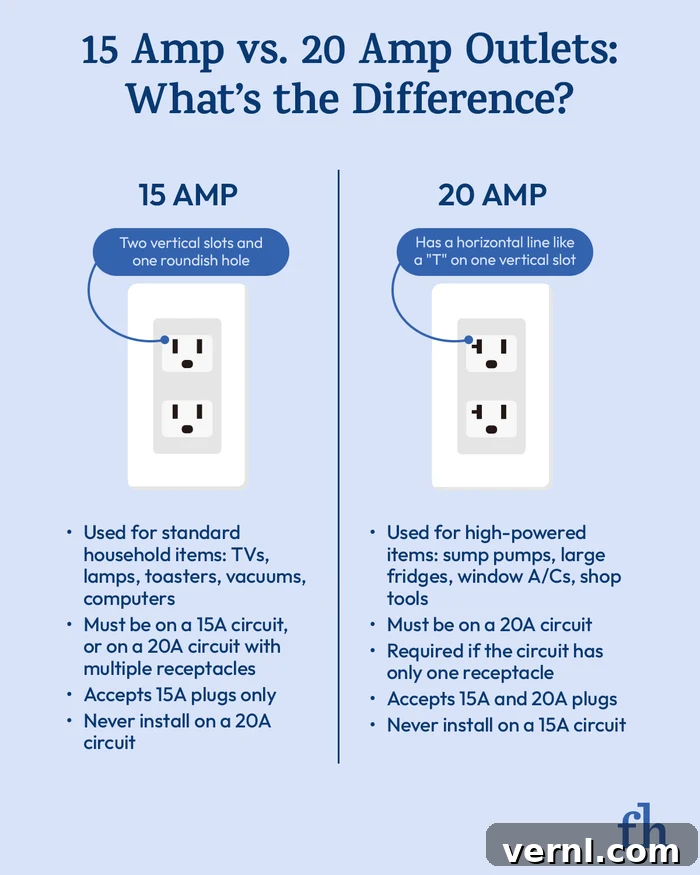
The most immediate and noticeable distinction between a 15-amp receptacle and a 20-amp receptacle is their physical appearance. These differences are not merely cosmetic; they are crucial safety features designed to prevent improper connections and potential electrical hazards.
A standard 15-amp receptacle, which you encounter daily in homes, offices, and public spaces, features two vertical slots and a single U-shaped or rounded grounding hole beneath them. This configuration is often described as resembling a surprised or neutral “face.” This design, known as a NEMA 5-15R (R for receptacle), is compatible with most household appliance plugs.
In contrast, a 20-amp receptacle presents a slightly different “face.” While it also has two slots and a grounding hole, one of its vertical slots has an additional horizontal leg, making it look like a sideways “T” or sometimes described as a “winking face.” This unique shape is technically a NEMA 5-20R. This horizontal slot is the key differentiator.
Why these distinct shapes? As with many deliberate design choices within the electrical industry, it’s fundamentally a matter of safety. Plugs designed for 20-amp devices, known as NEMA 5-20P (P for plug), have one standard vertical blade and one blade with a horizontal orientation. This specialized plug can fit into a 20-amp receptacle (NEMA 5-20R) because of its “T”-shaped slot, which accommodates both the vertical and horizontal blades. Crucially, this 20-amp plug *cannot* fit into a standard 15-amp receptacle (NEMA 5-15R), which lacks the horizontal slot.
This ingenious design prevents individuals from plugging a high-power appliance – one that draws more than 15 amps – into a circuit or receptacle that is not rated to safely handle that much current. Attempting to do so could overload the circuit, trip the breaker, or worse, lead to overheating, wire damage, and a significant risk of electrical fire. The physical lockout mechanism is a primary safeguard built into the system to protect both your equipment and your home.
When You Need a 15-Amp Receptacle: Everyday Power Needs
Consider the myriad devices you use on a daily basis: computers, televisions, lamps, vacuum cleaners, blenders, coffee makers, toasters, refrigerators, and many portable power tools. What do their plugs look like? Almost without exception (barring older two-prong, ungrounded plugs), they are three-prong plugs featuring two vertical blades and a round grounding pin. The vast majority of standard household appliances are designed to draw less than 15 amps, often significantly less, making them perfectly compatible with 15-amp rated circuits and receptacles.
The choice of receptacle, however, depends directly on the branch circuit’s rating and the number of receptacles on that circuit. Here’s a breakdown of when a 15-amp receptacle is required or permitted:
- On a 15-Amp Branch Circuit: If your circuit is protected by a 15-amp circuit breaker, the National Electrical Code (NEC) mandates that you *must* use 15-amp rated receptacles. This is a strict requirement for safety. Fifteen-amp circuits are typically wired with 14-gauge electrical conductors (wires), which are designed to safely carry a maximum of 15 amps. Attempting to draw more than 15 amps on such a circuit will overload the wires, causing the circuit breaker to trip as a protective measure. More dangerously, if the breaker were to fail, the wires could overheat, posing a severe fire risk.
- Multiple Receptacles on a 20-Amp Branch Circuit: This is where it can get a bit counter-intuitive for some. If you have a 20-amp branch circuit (protected by a 20-amp breaker, typically wired with 12-gauge wire), you are permitted to install 15-amp receptacles, but *only* if there are multiple receptacles on that same circuit. This is a very common scenario in homes, particularly in kitchens, bathrooms, and living areas, where you find duplex (two-plug) or quad (four-plug) receptacle setups. The reasoning behind this NEC allowance is practical: it’s highly unlikely that you would simultaneously plug in and operate multiple high-amperage devices on every single receptacle of a multi-outlet circuit, pushing the total load beyond 20 amps. The cumulative load is expected to remain within the circuit’s 20-amp capacity. This flexibility allows for the use of readily available 15-amp plugs for common appliances on robust 20-amp circuits.
- Single Receptacle on a Dedicated 20-Amp Circuit: This is a crucial exception. If you have a single receptacle installed on a dedicated 20-amp circuit – meaning the circuit is specifically designed to power only one plug and one piece of equipment – then the NEC requires you to use a 20-amp rated receptacle. Dedicated circuits with a single receptacle are typically reserved for critical appliances or those with significant power demands where consistent, uninterrupted operation is essential. Examples include sump pumps (where failure could lead to flooding), large standalone freezers or refrigerators, or certain workshop equipment. In these cases, the circuit and the receptacle must be matched to ensure the appliance receives adequate power and operates safely without inadvertently using a lower-rated receptacle.
When You Need a 20-Amp Receptacle: Heavy-Duty Applications
As you survey your home, you’ll likely notice that “winking-face” or T-slot receptacles (NEMA 5-20R) are far less common than their 15-amp counterparts. Similarly, if you examine the plugs on most of your household appliances, you’ll rarely find one with a horizontal blade.
This rarity is simply because appliances and tools that genuinely draw close to or exceed 15 amps, thus requiring a dedicated 20-amp receptacle and circuit, are not typical for everyday residential use. However, for certain specialized applications and high-demand equipment, a 20-amp setup becomes essential for safety and optimal performance.
Here are common scenarios and devices that typically necessitate a 20-amp receptacle:
- Large Appliances on Dedicated Circuits: As mentioned earlier, high-power appliances like window air conditioning units (especially larger models), built-in microwaves, large capacity refrigerators or freezers, and sometimes washing machines or dishwashers (depending on their power draw) often require a dedicated 20-amp circuit and thus a 20-amp receptacle if it’s the sole point of connection. These appliances draw substantial current and demand a robust power supply.
- Workshop and Garage Tools: Many heavy-duty power tools found in workshops or garages, such as table saws, miter saws, air compressors, arc welders, and some industrial-grade vacuum cleaners, can easily exceed a 15-amp draw. For these tools, a 20-amp receptacle provides the necessary power and safety margin.
- Commercial Kitchen Appliances: In a commercial setting, many kitchen appliances, even portable ones, are designed for continuous, heavy use and require 20-amp receptacles. While this guide focuses on residential applications, understanding this difference highlights the power demands.
- Outdoor Power Needs: Some outdoor applications, particularly for heating elements or heavy-duty landscaping tools, might also warrant 20-amp circuits and receptacles, especially in areas like outdoor kitchens or workshops.
It’s worth noting that occasionally, builders or electricians might install 20-amp receptacles even when a 15-amp one would suffice. This is typically done because 20-amp receptacles are often perceived as more robust and, importantly, they can accept *both* 15-amp (NEMA 5-15P) and 20-amp (NEMA 5-20P) plugs. While this is technically permissible and doesn’t pose a direct safety risk *if* the receptacle is on a 20-amp circuit, it is often a needlessly more expensive option compared to a standard 15-amp receptacle if the extra capacity isn’t genuinely needed.
However, under no circumstances should you ever install a 20-amp receptacle on a 15-amp circuit. This is a direct violation of the National Electrical Code and creates an extremely dangerous situation. Doing so would allow you to plug in a 20-amp device, which could then draw excessive current through undersized 15-amp wiring, leading to severe overheating, potential wire degradation, and a high risk of electrical fire. Always ensure that the circuit’s overcurrent protection (breaker) and wiring gauge are appropriately matched to the receptacle and the anticipated load.
Prioritizing Electrical Safety and Professional Expertise
Understanding the distinctions between 15-amp and 20-amp receptacles is more than just technical knowledge; it’s a fundamental aspect of ensuring electrical safety in your home. Incorrectly installed or mismatched electrical components can lead to serious hazards, including overloaded circuits, tripped breakers, damaged appliances, electrical shocks, and even devastating electrical fires. The National Electrical Code (NEC) exists precisely to provide a standardized framework for safe electrical installations, and adhering to its guidelines is not optional – it’s crucial for protecting your property and loved ones.
While this guide provides valuable information for homeowners, it’s vital to recognize the limits of DIY electrical work. Electrical systems are complex, and even seemingly simple tasks can have dangerous consequences if not executed correctly. Whenever you are uncertain about the appropriate receptacle to use, the capacity of an existing circuit, or if you plan to undertake any significant electrical modifications or installations, the safest and most responsible course of action is always to consult with or hire a licensed and qualified electrician. Professionals possess the specialized training, tools, and in-depth knowledge of local codes to ensure that all work is performed safely and up to standard.
Investing in professional electrical services not only safeguards your home but also provides peace of mind, knowing that your electrical system is reliable and compliant. Whether you’re upgrading an old outlet, installing a new appliance, or simply troubleshooting an electrical issue, remember that safety should always be your paramount concern. Don’t hesitate to lean on expert help to keep your home powered securely and efficiently.