

Every dedicated DIY enthusiast understands the importance of a well-stocked toolbox. While professional-grade tools often come with a hefty price tag, most home projects don’t demand the most expensive, feature-packed option on the market. Instead, the smart approach is to find reliable tools that get the job done efficiently and at a reasonable cost, especially for items you might not use every single day. This philosophy guides many in their tool-buying decisions, ensuring functionality without breaking the bank.
In the quest for such a tool, I put the RS290G random orbit sander from Ryobi through its paces. This particular model perfectly aligns with the category of a basic, affordable tool, making it an attractive option for anyone looking to equip their workshop without overspending. My primary goal was to thoroughly assess its capabilities and determine if this budget-friendly sander truly “gets the job done” for typical DIY woodworking and home improvement tasks.
Understanding the Ryobi RS290G Random Orbit Sander: A DIY Essential
For those new to the world of woodworking or simply looking for an effective sanding solution, it’s crucial to understand what a random orbit sander is and how it functions. Unlike a standard orbital sander (which only vibrates in small circles) or a belt sander (which uses a continuous abrasive belt for aggressive material removal), a random orbit sander employs a unique dual-motion mechanism. Its sanding disc not only spins but also travels in a random elliptical orbit. This innovative design is key to its effectiveness, as it prevents the abrasive from following the same path twice, significantly reducing the likelihood of swirl marks or noticeable scratches on your workpiece.
This dual action allows the random orbit sander to smooth workpieces efficiently by progressively working through different grits of sandpaper, from coarse to fine. Each successive grit is designed to remove the microscopic scratches left by the previous one, leading to an incredibly smooth surface that’s perfectly prepped for staining, painting, or varnishing. For DIYers who occasionally need to tackle furniture refinishing, cabinet building, or general wood preparation, the Ryobi RS290G offers a practical and accessible solution without the steep investment often associated with specialized power tools.
Why Choose a Random Orbit Sander?
The versatility of a random orbit sander makes it a staple in any DIY toolkit. It excels at a variety of tasks, including:
- Fine Finishing: Achieving a professional-grade smooth surface on wood before applying a finish.
- Paint and Varnish Removal: Stripping old finishes from furniture or other wooden items.
- General Surface Preparation: Smoothing rough lumber, preparing surfaces for glue-ups, or removing minor imperfections.
- Edge Blending: Softening sharp edges on woodworking projects.
If you’re an occasional woodworker or simply need a reliable sander that won’t cost a fortune, the Ryobi RS290G is indeed a compelling choice. From the moment you pick it up, its comfortable grip and seemingly robust construction inspire confidence, making it an easy-to-use tool for both beginners and experienced hobbyists.
Comprehensive Testing: Evaluating the Ryobi RS290G’s Performance
To provide a thorough and honest assessment, my testing of the Ryobi RS290G focused on real-world applications relevant to the average DIYer. Random orbit sanders are primarily used to prepare wood for finishing, so I subjected this sander to various hardwoods, including oak and maple, as well as plywood with hardwood veneer. These materials present different challenges in sanding, from the open grain of oak to the denser structure of maple, allowing for a comprehensive evaluation of the sander’s capabilities.
The testing process involved working through different grits of sandpaper, typically starting with 80-grit for initial material removal and progressing through 120-grit, 180-grit, and finally 220-grit. At each stage, I meticulously inspected the workpiece to ensure the sander effectively removed the scratches left by the previous, coarser grit. This step-by-step approach is crucial for achieving a truly smooth, blemish-free surface, and a good random orbit sander should facilitate this process without leaving its own imperfections.
Focus on Handling and User Experience
Beyond just sanding effectiveness, a critical aspect of any handheld power tool is its ease of handling and user comfort. Anyone who has spent significant time sanding knows that some random orbit sanders can feel like they have “a mind of their own,” pulling your hand and arm in various directions during use. This can lead to user fatigue, reduced control, and even compromise the quality of the finish. My preference is for a sander to have a “floating” feel, allowing me to easily guide it across the surface rather than being forced to counteract its erratic movements. When a sander pulls or feels unwieldy, there’s a natural tendency to apply more pressure, which often results in deeper scratches, uneven sanding, or even gouges in the material. The Ryobi RS290G was carefully evaluated on this characteristic, assessing its vibration levels and how well it allowed for precise, controlled movements.
Ryobi RS290G Performance Review: A Strong Contender for DIY
The Ryobi RS290G is, in my opinion, purposefully designed as a well-made, basic tool offered at an affordable price point, specifically targeting the occasional user or DIY enthusiast. From this perspective, it truly excels, making it a purchase you’re unlikely to regret. My experience with the sander from the moment of unboxing reinforced this impression.
Initial Impressions and Ergonomics
Upon opening the box, the sander presented a well-thought-out design. The build quality, while not indicative of a professional-grade tool, certainly felt robust enough for regular DIY tasks. The grip is comfortable and fits well in the hand, an important factor for maintaining control and reducing fatigue during longer sanding sessions. Operating the RS290G is straightforward: simply attach the 5-inch hook-and-loop sanding disc – a standard and widely available size – and press the power button. There are no complicated settings or adjustments, which contributes to its user-friendly appeal.
Sanding Effectiveness and Control
In use, the Ryobi RS290G performed admirably. As with any random orbit sander, regardless of price, there’s a brief learning curve to discover its “sweet spot” – that specific balance of pressure and movement where it glides smoothly and effectively across the workpiece without pulling or bogging down. Once I found this sweet spot, operation was consistently smooth and highly effective. It efficiently removed material and, when used with proper grit progression, delivered a smooth finish suitable for various wood projects. The random orbit action effectively minimized swirl marks, producing results that many DIYers would be proud of.
Analyzing the Limitations: Corded Design and Fixed Speed
While the Ryobi RS290G offers excellent value and performance for its target audience, it does come with a couple of limitations. However, it’s important to consider these in the context of its price point and intended use.
1. Corded Operation: A Practical Consideration
The first limitation, and perhaps the most noticeable, is that the RS290G is a corded tool. In an age where cordless power tools are increasingly popular for their portability and convenience, a corded sander might seem like a drawback. However, this is only maybe a limitation depending on your specific needs. Cordless tools invariably come with a higher price tag due to battery technology, and they also require managing battery charge times. For most DIYers, who typically work in a workshop or garage with readily available power outlets, a corded sander like the RS290G poses no significant inconvenience. In fact, a corded tool offers consistent, uninterrupted power, meaning you never have to worry about battery life running out in the middle of a project. This reliability can be a major advantage for extended sanding tasks.
2. Lack of Variable Speed: Is It a Deal-Breaker?
The second limitation is the absence of variable speed control. The Ryobi RS290G operates at a single, fixed speed. Having used random orbit sanders for many years, I can genuinely count on one hand the number of times I’ve truly needed to adjust the speed. Variable speed can be beneficial for very delicate sanding tasks, working with heat-sensitive materials (like certain plastics or finishes), or for aggressive stock removal where a lower speed might be desired to prevent burning the wood. In those specific, often niche, situations, I was glad to have the option. However, for the vast majority of common woodworking and DIY projects – smoothing wood, preparing for finish, removing paint – a single, optimized speed is perfectly adequate. For the occasional user, the lack of variable speed is simply not a deal-breaker and helps keep the tool’s cost down without sacrificing essential functionality.
Dust Collection: An Important, Often Overlooked Feature
While not explicitly highlighted in the original content, effective dust collection is a crucial aspect of any sander, contributing to a cleaner workspace and healthier breathing environment. The Ryobi RS290G typically comes with a dust bag attachment. While integrated dust bags are convenient, they are often less efficient than connecting the sander to a shop vacuum. For optimal dust management, I recommend using a shop vac attachment if available for this model, or regularly emptying the dust bag. Good dust extraction not only keeps your work area tidy but also improves the sanding performance by preventing sawdust from clogging the sandpaper, thereby extending its life.
Final Verdict: The Ryobi RS290G is a Recommended Budget Sander
The truth is, random orbit sanders have been on the market long enough for manufacturers to refine their designs and figure out all the basic performance needs for efficient sanding. At its price point, typically around $60, the Ryobi RS290G stands out as an exceptional value. It delivers consistent performance, comfortable handling, and reliable results that meet or exceed expectations for its category. It’s not a professional-grade tool built for daily, heavy-duty industrial use, but it doesn’t pretend to be. For its intended audience – the DIYer, the hobbyist, the occasional woodworker – it’s an outstanding choice.
Why You Should Add the Ryobi RS290G to Your Toolkit
If you’re currently in the market for an affordable random orbit sander, the Ryobi RS290G is a purchase you can make with confidence. Whether you need an introductory tool to get started with woodworking, a reliable occasional-use sander for various home projects, or simply an “extra” sander to supplement your existing collection, you truly can’t go wrong with this model. Its blend of affordability, user-friendliness, and effective performance makes it a highly recommended choice for anyone looking to achieve smooth, professional-looking finishes without a significant investment.
Where to Buy the Ryobi RS290G
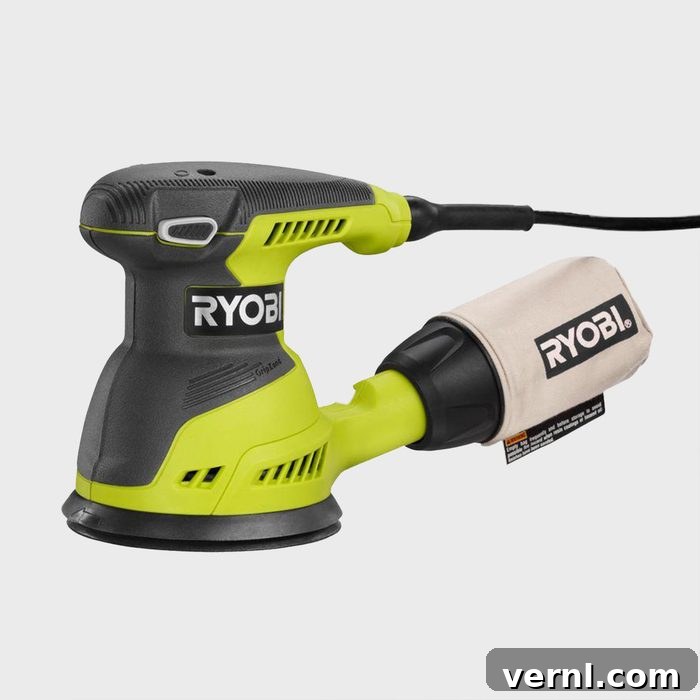
Ryobi products are exclusively available through The Home Depot. You can find the Ryobi RS290G 2.6 Amp Corded 5-inch Random Orbital Sander both in-store at your local Home Depot location and conveniently online via their website. Their widespread availability ensures you can easily acquire this reliable tool whenever your next project calls for it.