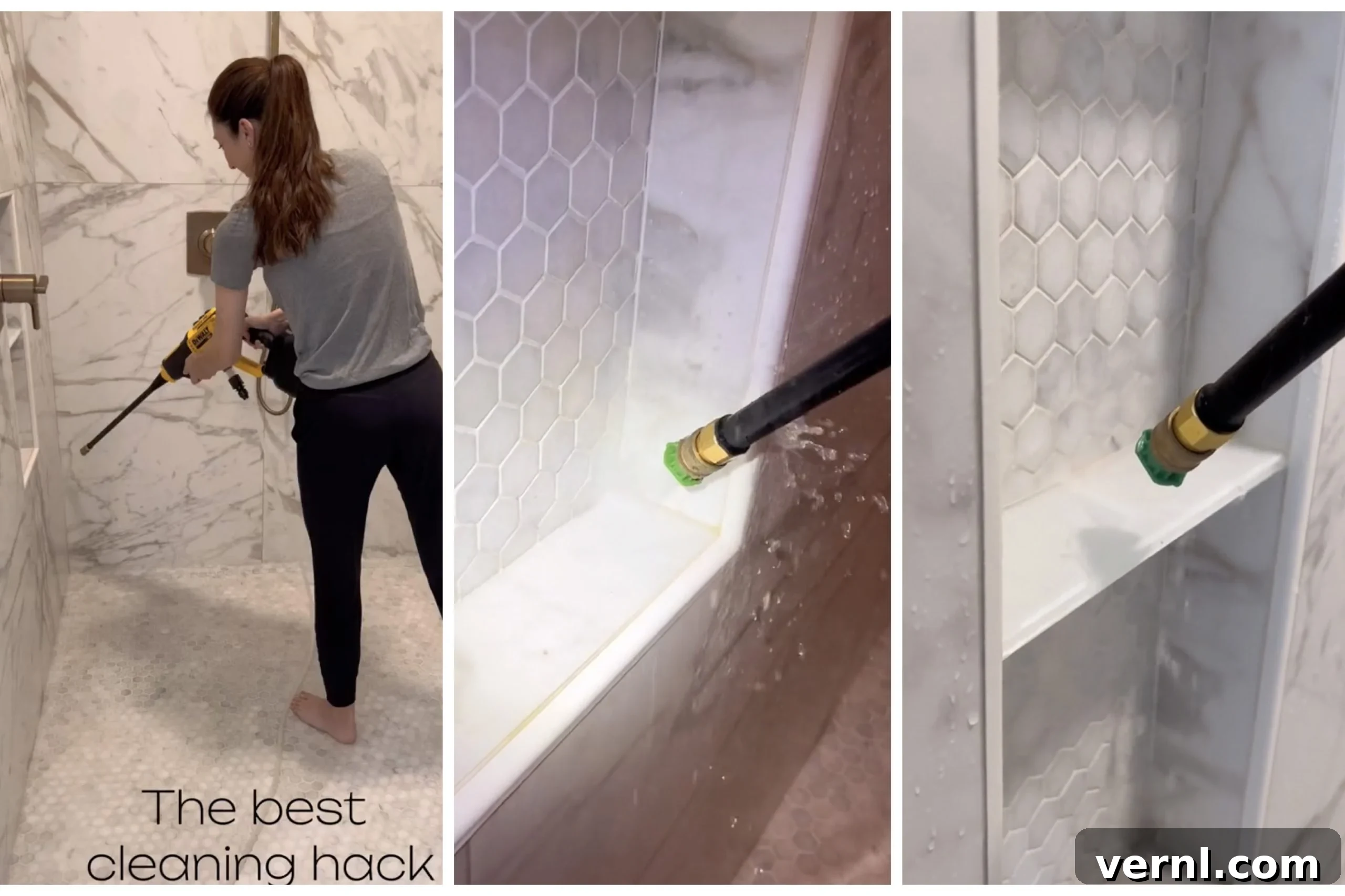
Shower tiles are notorious magnets for a wide array of unsightly and unhygienic messes. From the stubborn, creeping black mold that infiltrates grout lines to the chalky, whitish-gray mineral deposits left by hard water, and the sticky accumulation of soap scum and shampoo residue, maintaining a pristine shower can feel like a constant battle. This relentless grime not only diminishes the aesthetic appeal of your bathroom but also creates an environment ripe for bacterial growth and potential health concerns.
For years, battling these persistent problems has involved endless scrubbing, harsh chemicals, and specialized brushes, often leading to frustratingly mediocre results and sore arms. However, a revolutionary cleaning hack has recently captured the attention of homeowners and cleaning enthusiasts alike, promising to transform the arduous task of shower cleaning into a swift and satisfying chore. The idea? Employing a pressure washer right in your bathroom.
This innovative concept gained significant traction thanks to social media platforms, particularly TikTok. Influencers like @amberzimm have demonstrated the astonishing effectiveness of this method, showcasing before-and-after transformations that are nothing short of miraculous. The virality of these cleaning hacks underscores a universal desire for more efficient and less labor-intensive ways to maintain a clean home.
@amberzimm I’m far from your go-to cleaning or organizing girl, so if I’m sharing it, know it’s legit & going to make your life easier. You NEED a cordless pressure washer. Make sure you get one with enough pressure-Linked mine in my LTK. The best time saving cleaning hack. I was starting to regret white tile & grout, but design choice is good now that I use this cleaning method. #cleantok #cleaninghack #tileshower #hack #cleaningtiktok #timesaver #gamechanger #momhack #homedesign ♬ original sound – Amber
Naturally, such an unconventional approach raises questions and demands scrutiny. To assess the viability and safety of this method, we consulted with industry experts. Art Dann, a seasoned general contractor with extensive experience in tiling, reacted with keen interest: “I want to try that in the bathroom at home!” His enthusiasm suggests the idea holds genuine appeal even for professionals.
Further investigation involved two professional cleaning specialists. Matthew Morris, the founder of Go Cleaners London, echoed Dann’s positive sentiment, viewing the concept as potentially revolutionary. However, Toby Schultz, founder and CEO of Maid2Match, expressed a more cautious stance. His advice was direct and to the point: “Pressure wash at your own risk.” This warning highlights the critical need for understanding the potential dangers alongside the benefits.
The collective feedback indicates that while this innovative cleaning technique holds immense promise for tackling stubborn shower grime, it comes with important caveats. The key to success and safety lies in understanding the mechanics, choosing the right equipment, and exercising meticulous care. This guide aims to equip you with all the knowledge needed to decide if pressure washing your shower is the right solution for your home.
How Pressure Washing Transforms Your Shower Cleaning Routine
The operational principle behind using a pressure washer for shower cleaning is remarkably straightforward yet incredibly effective. It leverages a high-pressure stream of water to dislodge and remove various forms of accumulated grime that manual scrubbing often struggles with. This powerful jet of water physically blasts away contaminants, leaving surfaces sparkling clean.
Specifically, a pressure washer excels at eradicating common shower nuisances:
- Stubborn Soap Scum: The sticky, difficult-to-remove layer left by soap and body wash residues is no match for concentrated water pressure.
- Embedded Mold and Mildew: Particularly effective in dislodging mold spores and growth from the porous surfaces of grout lines, where they often take deep root.
- Unsightly Hard Water Stains: Mineral deposits, often appearing as whitish or grayish films, are effectively lifted and rinsed away by the sheer force of the water.
One of the initial practical considerations is connecting your pressure washer to a water source. For many cordless models, a garden hose can be easily routed through a bathroom window, offering convenience and sufficient water flow. Alternatively, for those who prefer an indoor connection, you can attach the pressure washer to your sink faucet. This typically involves temporarily replacing the aerator on your faucet with a specialized hose adapter. Ensure the adapter creates a secure, leak-proof connection to prevent water spills in the bathroom.
If you’re accustomed to using a pressure washer outdoors, you’ll understand the importance of maintaining a safe and effective distance from the surface you’re washing. This principle applies equally, if not more so, indoors. Starting too close can cause damage, while being too far away will diminish cleaning effectiveness. There’s an initial “learning curve” involved in finding that sweet spot – a distance close enough to obliterate stains but far enough to protect your shower’s delicate components. Begin spraying from a greater distance and gradually move closer until you observe the grime lifting efficiently. Once you’ve mastered the optimal distance, use steady, overlapping strokes to ensure uniform cleaning across all shower walls and the floor, guaranteeing a thorough and streak-free finish.
Is It Safe to Bring a Pressure Washer into Your Home Bathroom?
The primary concern when bringing any powerful outdoor tool indoors is safety. With pressure washers, this concern is amplified, making careful selection and usage paramount. The most crucial safety rule is absolute: Never use a gas-powered pressure washer indoors. Beyond the obvious and severe danger posed by carbon monoxide exhaust fumes, which can be lethal in an enclosed space, gas-powered units generate extremely high pressures, typically ranging from 2,800 pounds per square inch (psi) and upwards. This immense force is far too powerful for the delicate surfaces and fixtures found in a typical bathroom and could cause catastrophic damage.
The pressure washer seen in the popular TikTok video is a cordless electric model, and these are generally the only type recommended for indoor use. Cordless models are designed to generate relatively lower pressures, typically around 600 psi. This lower pressure range is generally considered safe for all components of your shower, including the tile, grout, faucet, and shower head, provided they are in good condition. Their portability and lack of a power cord also minimize electrical hazards in a wet environment.
If you find that a cordless model isn’t providing sufficient cleaning power for particularly stubborn stains, you might consider a corded electric model. However, exercise extreme caution. Opt for models that generate no more than approximately 1,700 psi. While this level of pressure can be safe for shower walls and floors, it still carries a significant risk. Under no circumstances should you directly spray the faucet, shower head, or any other plumbing fixtures with a corded pressure washer at this pressure. The intense force could easily damage their finish, internal components, or even dislodge them, leading to costly repairs.
Another critical consideration is overspray control. Indoors, managing where the high-pressure water goes is much more challenging than outdoors. Prepare your bathroom thoroughly before you begin: remove all items you don’t want to get wet, such as towels, bathmats, toiletries, and decorative items. Consider covering anything susceptible to moisture damage with plastic sheeting. If your bathroom floor is made of materials like laminate, engineered wood, or certain types of tile that can be damaged by excessive moisture, think twice before power washing. Prolonged exposure to high-pressure water can cause warping, swelling, or water infiltration, leading to structural issues or mold growth beneath the flooring. Always ensure proper ventilation by opening windows and using exhaust fans to help dry out the space quickly and prevent mold growth from the increased humidity.
Can a Pressure Washer Damage Your Shower? The Risks to Consider
While the prospect of a sparkling clean shower with minimal effort is appealing, it’s imperative to acknowledge that a pressure washer, when used improperly, can indeed inflict significant damage. The potential for harm to tiles and, especially, grout, was a primary concern raised by every expert interviewed. Therefore, the cardinal rule for this cleaning technique is this: Only use a pressure washer on shower tile and grout that are in excellent, structurally sound condition.
Pre-Cleaning Inspection is Crucial
“It’s hard to verify whether the tiles are structurally sound enough to withstand the high pressure,” cautions Matthew Morris. This highlights the absolute necessity of a thorough pre-cleaning inspection. Before even thinking about plugging in your pressure washer, meticulously examine every tile and grout line in your shower. Look for:
- Cracks: Even hairline cracks in tiles can expand rapidly under pressure, leading to breakage.
- Loose or Chipped Tiles: Any tile that is not firmly adhered can be dislodged, or its edges chipped away.
- Compromised Grout: Look for missing grout, crumbling sections, or areas where the grout appears thin or cracked. Grout acts as a protective barrier and structural support; if it’s weakened, high-pressure water can erode it further or penetrate behind tiles, leading to water damage and mold growth within the wall structure.
Art Dann specifically mentioned hesitation if grout lines are wider than about half an inch, explaining that wider lines, by their nature, are more prone to chipping and degradation under pressure. They present a larger surface area for the water’s force to impact and are often less dense than narrower lines.
Understanding Nozzle Selection: A Critical Safety Factor
The type of nozzle you attach to your pressure washer dictates the spray pattern and the concentration of force, making nozzle selection a critical safety factor. Using the wrong nozzle is a direct path to damaging your shower.
- Green Nozzle (25 degrees): This is generally the safest and most recommended nozzle for shower cleaning. It provides a wide, fan-shaped spray pattern of 25 degrees, distributing the water’s force over a larger area, making it ideal for general cleaning and minimizing the risk of damage.
- Yellow Nozzle (15 degrees): If you’re using a cordless pressure washer and find the green nozzle isn’t quite powerful enough for stubborn grime, the yellow (15-degree) nozzle can offer increased cleaning power by concentrating the spray slightly more. Use it with caution, starting from a greater distance and observing its effect carefully.
- Red Nozzle (0 degrees): ABSOLUTELY NEVER USE THE RED (0-DEGREE) NOZZLE with any pressure washer for indoor cleaning. This nozzle produces a highly concentrated, pinpoint stream of water, which is incredibly powerful. Such a focused spray will almost certainly damage or chip tiles, blast away grout, and can even etch surfaces, causing irreversible harm. Its use is reserved for very specific, heavy-duty outdoor applications on extremely durable materials.
Material-Specific Caveats
Toby Schultz provided two more critical warnings regarding specific shower materials:
- Glazed Ceramic or Porcelain Tiles: “Pressure washing is inadvisable for glazed ceramic or porcelain tiles since it could ruin the finish.” The high-pressure water can be abrasive enough to strip away the delicate glaze, leading to a dull, scratched, or etched appearance that permanently compromises the tile’s protective layer and aesthetic. For these tiles, stick to gentler cleaning methods.
- Natural Stone Tiles (e.g., Marble, Travertine, Granite): While not explicitly mentioned in the original text, it’s crucial to add that natural stone tiles are highly porous and sensitive. Pressure washing can force water deep into their pores, causing internal damage, discoloration, or accelerating erosion. They also often require specific, pH-neutral cleaners, which high-pressure water alone won’t address. Avoid pressure washing natural stone entirely.
- Shower Doors: “You should also not use a pressure washer to clean shower doors as you risk shattering the glass.” The tempered glass used in shower doors is strong but not indestructible. A concentrated stream of high-pressure water can create stress points or impact it at an angle that leads to shattering, posing a serious safety hazard.
- Shower Light Fixtures: Similar to shower doors and plumbing fixtures, never spray light fixtures directly. Water ingress can cause electrical shorts, damage the fixture, or create a dangerous situation.
The Balanced Verdict: Is Pressure Washing Your Shower a Good Idea?
After weighing the expert opinions, practical considerations, and safety precautions, a clear verdict emerges regarding the use of a pressure washer for shower cleaning. This innovative method, championed by viral cleaning hacks, indeed offers a powerful and efficient solution for tackling stubborn grime, but its successful and safe application hinges entirely on adherence to specific conditions and careful execution.
The danger involved in this cleaning method is minimal if you meet two primary criteria: you use a low-pressure, cordless pressure washer, and your shower tile and grout are in excellent, structurally sound condition. Under these specific conditions, pressure washing is a brilliant idea. It can dramatically cut down cleaning time, reduce the physical effort required, and achieve a level of cleanliness that traditional scrubbing often cannot match. For homeowners battling relentless mold, mildew, and hard water stains on well-maintained shower surfaces, a cordless pressure washer can truly be a game-changer, restoring the pristine appearance of their bathroom with remarkable efficiency.
However, the risk factor significantly increases when you deviate from these optimal conditions. Opting for a higher-pressure corded pressure washer, even if below the maximum recommended PSI for walls, demands heightened vigilance and awareness of potential damage to fixtures and surrounding areas. The risk crosses the threshold into the danger zone if you use the wrong nozzle – particularly the highly concentrated red (0-degree) nozzle – or if your shower tile and grout are in poor, compromised condition. Ignoring signs of chipped, loose, or cracked tiles, or degraded grout, means you are effectively setting up your shower for further, potentially irreversible, damage.
In cases where your shower exhibits any signs of weakness, such as chipped or loose tiles, missing grout, or cracks in either the tiles or grout lines, you are unequivocally better off sticking to traditional methods. Scrubbing by hand, using appropriate cleaning agents, and focusing on gentle yet effective techniques will prevent exacerbating existing damage and incurring costly repairs. A damaged shower structure can lead to water infiltration, which is a far more serious and expensive problem to fix than surface grime.
In conclusion, a pressure washer can be an invaluable tool for maintaining a spotless shower, offering a powerful, time-saving alternative to strenuous manual labor. But like any powerful tool, it demands respect, knowledge, and caution. Perform a thorough inspection, select the right equipment, choose the correct nozzle, protect surrounding areas, and always prioritize the integrity of your shower’s surfaces. When used judiciously, you can unlock the full potential of pressure washing and enjoy a brilliantly clean shower with remarkable ease.