
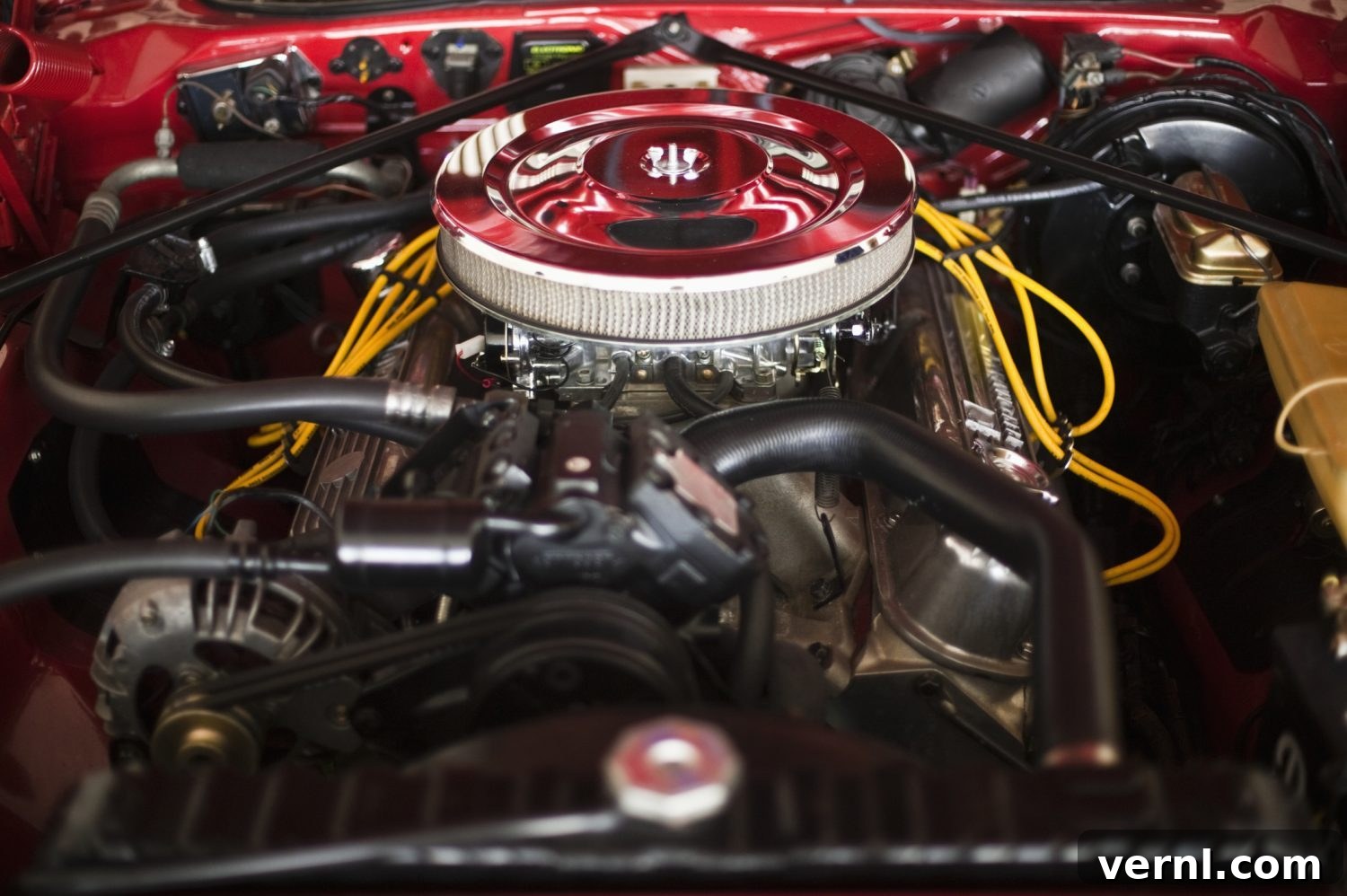
In 1962, the iconic American band The Beach Boys released their hit song “409” on the album “Surfin’ Safari.” This catchy tune wasn’t just another beach anthem; it was a vibrant ode to American muscle car culture, celebrating the power and allure of a specific automobile engine: the mighty Chevrolet big-block V-8. Lyrics like “She’s real fine, my 409” and “Giddy up, giddy up, giddy up 409” immediately etched the number 409 into the minds of car enthusiasts and music lovers alike. While perhaps not their most complex musical masterpiece, the song undeniably captured the spirit of an era defined by roaring engines and open roads.
However, if “409” were to be released in today’s automotive landscape, its title might need a significant revision. The number 409 in the song refers to the engine’s displacement, a measurement of its total internal volume, expressed in cubic inches. In contemporary automotive engineering and global markets, engine displacement is more commonly measured in cubic centimeters (cc) or liters (L). Consequently, the legendary 409 cubic inches would translate to approximately 6,700 cubic centimeters, potentially leading to a less poetic, though more modern, title of “6,700.” This shift highlights a broader evolution in how we measure and perceive engine size and performance.
While I may not share the same level of profound automotive enthusiasm as the lyrical author of that Beach Boys’ classic, I’ve certainly spent my fair share of time under the hood. I recall, for instance, once replacing the engine in my Datsun B-210. That humble vehicle featured an engine with a displacement of only 1,400 cubic centimeters. Its compact size made it remarkably easier to handle and maneuver compared to the colossal Chevrolet V-8. Naturally, this smaller displacement meant it possessed considerably less raw power than a V-8, but it offered a significant advantage in terms of fuel efficiency. The pursuit of gas economy is precisely why engines with large displacements are predominantly found today in heavy-duty trucks, high-performance sports cars, and turbocharged luxury vehicles, rather than in the average family sedan.
What Does CC Mean in an Engine? Demystifying Engine Displacement
When discussing engine specifications, the term “CC” frequently arises, often leading to a slight divergence in interpretation. Some mechanics and enthusiasts understand CC as an abbreviation for “cubic centimeters,” while others refer to it as “cubic capacity.” Regardless of the exact interpretation, both terms convey the same fundamental concept: CC is a standard measure of engine displacement, which is essentially a volume measurement. It’s crucial to clarify that this volume isn’t equivalent to the amount of water an engine would displace if you were to submerge it. Instead, engine displacement refers to the combined total volume of all the engine’s cylinders, specifically the volume swept by the pistons within those cylinders.
To understand engine displacement more deeply, visualize the internal workings of a combustion engine. Within each cylinder, a piston moves rapidly back and forth in a precisely fitted bore. This motion is driven by the controlled explosions resulting from the combustion of fuel and air. Each time a piston moves from its lowest point (Bottom Dead Center or BDC) to its highest point (Top Dead Center or TDC), it “sweeps” or displaces a certain volume of air and fuel mixture. The total engine displacement is calculated by summing the volumes swept by all the pistons in all cylinders. This metric provides a clear indication of the engine’s potential to intake air and fuel during each combustion cycle, directly influencing its power output capability.
Conversely, if you know an engine’s total displacement and the number of cylinders it possesses, you can easily calculate the individual volume of each piston bore. Let’s revisit our historical example: the Chevrolet V-8 409. This engine is designed with eight cylinders, typically arranged in a V-formation within the engine block. Given its total displacement of 409 cubic inches, each individual cylinder has a volume of just over 51 cubic inches. Translating these figures into the metric system, the total displacement becomes approximately 6,700 cubic centimeters (cc), which means each cylinder contributes about 837.5 cc to the overall volume. To put this into perspective, just two cylinders from the legendary 409 V-8 engine possess a larger capacity than the entire engine of my Datsun B-210, illustrating the sheer scale difference in engine design.
How Many CC Is Equal to One Horsepower? Exploring the Power Equation
It’s a common misconception that there’s a direct, linear correlation between an engine’s cubic capacity (CC or cubic inches) and its horsepower (hp). While it’s generally true that an engine with a larger displacement often has the potential to develop more power, there isn’t a fixed conversion rate of “X CC equals Y horsepower.” The relationship is far more nuanced. Larger engines are inherently capable of generating more torque, which is the rotational force the pistons apply to spin the crankshaft. This torque is a crucial component of power, but it’s not the sole determinant.
Engine performance, as quantified by horsepower, is a more intricate quantity that depends not only on the torque produced but also on the speed at which the engine operates, measured in revolutions per minute (rpm). A powerful engine delivers high torque at high RPMs. Therefore, a larger engine might produce significant torque, but if it can’t sustain high RPMs efficiently, its peak horsepower might be limited. Modern engine design, including turbocharging, supercharging, direct injection, and advanced valve timing, plays a pivotal role in extracting maximum power from a given displacement.
Consider a compelling modern example: Chevrolet, in collaboration with Cadillac, developed a turbocharged version of its V-8 engine. This particular iteration, with a displacement of 6,162 cc, was actually slightly smaller in volume than the classic 409. Yet, as reported by Andrew Wendler in Car and Driver magazine, this turbocharged V-8 was capable of developing a staggering peak output of 755 hp. This figure is nearly double the power output of the original 409. This stark comparison unequivocally demonstrates that “bigger” in terms of displacement doesn’t automatically translate to “more powerful.” Technology and design play a much larger role in maximizing power output.
Many interconnected factors contribute to and significantly affect an engine’s overall performance. These include, but are not limited to:
- Engine Design: This encompasses critical elements such as the number of cylinders, their orientation (e.g., inline, V-formation, flat), cylinder bore and stroke dimensions, and the sophistication of the valvetrain (e.g., DOHC, SOHC).
- Engine Materials: The choice of materials impacts weight, heat dissipation, and structural integrity. High-performance engines often utilize lightweight, yet incredibly strong, alloys to reduce inertia and improve efficiency.
- Fuel Type and Delivery System: The octane rating of the fuel and the precision of the fuel injection system (e.g., direct injection, port injection) directly influence combustion efficiency and resistance to knocking.
- Combustion Ratio (Compression Ratio): This ratio of the volume of the cylinder with the piston at BDC to the volume with the piston at TDC is critical. A higher compression ratio generally leads to greater thermal efficiency and power, but also requires higher octane fuel.
- Forced Induction (Turbocharging/Supercharging): These systems compress air before it enters the engine, allowing more oxygen and fuel to be burned, thus significantly boosting power output from a smaller displacement.
- Vehicle Load and Aerodynamics: The total weight of the vehicle, including any cargo or passengers, and its aerodynamic resistance have a substantial impact on how the engine’s power translates into actual vehicle performance and speed.
Is a Higher CC Engine Better? Balancing Power, Efficiency, and Purpose
The question of whether a higher CC engine is inherently “better” is complex and entirely dependent on your specific needs and priorities. There’s no one-size-fits-all answer, as engine size must be matched to the vehicle’s intended purpose and the driver’s expectations.
If your primary requirement is a robust vehicle, such as a truck or a tractor, designed to haul heavy loads or perform demanding tasks, then a larger displacement engine is generally preferable. These engines excel at producing significant torque at lower RPMs, providing the necessary pulling power to move substantial weight with greater ease. The sheer volume of fuel and air they can process translates directly into the raw grunt needed for utility and heavy lifting.
However, if your goal is a fast, agile vehicle focused on rapid acceleration and high top speeds, the number of revolutions per minute (RPM) the engine can achieve becomes a more critical factor. While large engines can produce high horsepower, smaller, high-revving engines often excel in delivering spirited performance, especially in lighter vehicles. Modern engineering advancements, such as lightweight components, sophisticated valve timing, and efficient turbochargers, allow smaller displacement engines to generate impressive horsepower figures, often surpassing larger naturally aspirated counterparts while maintaining better fuel efficiency. Additionally, fuel economy is a paramount consideration for many drivers. Large displacement engines inherently consume more fuel than smaller ones, making them a less economical choice for daily commuting or for environmentally conscious drivers.
What Is More Important: CC or HP? Defining Your Automotive Priorities
When evaluating a vehicle’s performance capabilities, both engine cubic capacity (CC) and horsepower (HP) are important metrics, but they provide different insights. Horsepower is ultimately the figure that determines how quickly a car will accelerate from a standstill and what its maximum speed will be. It is a direct product of the engine’s torque and its rotational speed. The fundamental equation that ties these concepts together is hp = torque X rpm/5252 (when torque is in lb-ft and RPM is in revolutions per minute, yielding HP).
Engine cubic capacity (CC) plays an integral role in this equation because, as discussed, larger engines typically have the potential to develop more torque. This increased torque contributes directly to the horsepower output. However, it’s crucial to remember that CC is just one piece of the puzzle. Numerous other factors, including engine design, forced induction, fuel delivery, and material science, also govern an engine’s ultimate performance as measured by horsepower. Therefore, if your primary concern is exhilarating performance, quick acceleration, and high top speeds, you will predominantly be interested in the horsepower figure an engine produces.
Conversely, if fuel economy is your top priority, especially for everyday driving or long commutes, you will typically want to seek out a car equipped with a smaller capacity engine. Smaller engines, by their very nature, burn less fuel, leading to better gas mileage and reduced running costs. While they might offer less raw power than their larger counterparts, advancements in engine technology mean that many smaller engines today deliver a perfectly adequate, and often surprisingly peppy, driving experience without sacrificing efficiency. Ultimately, the “more important” metric depends on whether your driving priorities lean towards raw performance or economical operation.
Does CC Apply to EV Engines? A New Paradigm of Power
The advent of electric vehicles (EVs) introduces a fundamentally different approach to propulsion, and with it, a new set of metrics for discussing power. The power developed by an electric vehicle’s motor, which can be measured in kilowatts (kW) or horsepower (HP), is still a product of torque and rotational speed – a concept that remains consistent with internal combustion engines (ICEs). Electric motors generate instantaneous torque, which is one of their key advantages, contributing to the quick acceleration characteristic of many EVs. The “size” of an EV’s electric motor certainly matters, as a larger motor can inherently produce more torque and horsepower.
However, the concept of “engine displacement” (CC) simply doesn’t apply to electric vehicles. EVs operate without pistons, cylinders, combustion chambers, or the need to displace a volume of air and fuel. Their power generation relies on electromagnetic forces rather than internal explosions. Consequently, EV manufacturers do not measure motor size in terms of cubic centimeters. Instead, they often quote power in terms of brake horsepower (BHP) or kilowatts (kW) for the motor itself. While paying attention to the motor’s individual BHP can be useful when shopping for an EV, the total horsepower of the entire powertrain (especially in multi-motor setups) is a far more significant and holistic number for understanding the vehicle’s overall performance potential.
Beyond the motor’s power output, another crucial factor for EVs is the voltage and capacity of their battery pack. The battery provides the electrical energy that powers the motor, and its characteristics directly influence not only the motor’s performance but also the vehicle’s range and charging speed. A high-voltage battery system, for instance, can deliver more power to the motors more efficiently. Therefore, when evaluating an EV, while the horsepower figure remains important for performance, equally, if not more, critical are the battery’s specifications and the vehicle’s overall energy management system. The automotive world is clearly transitioning, and with it, our vocabulary for power and efficiency is evolving to match these exciting new technologies.